2007 PONTIAC TORRENT brake
[x] Cancel search: brakePage 180 of 490
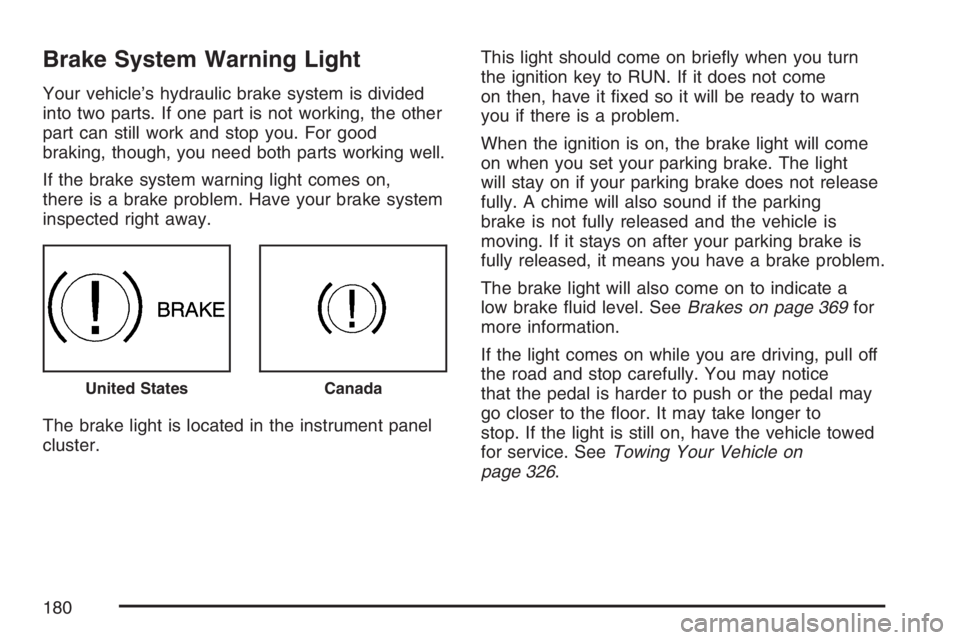
Brake System Warning Light
Your vehicle’s hydraulic brake system is divided
into two parts. If one part is not working, the other
part can still work and stop you. For good
braking, though, you need both parts working well.
If the brake system warning light comes on,
there is a brake problem. Have your brake system
inspected right away.
The brake light is located in the instrument panel
cluster.This light should come on briey when you turn
the ignition key to RUN. If it does not come
on then, have it xed so it will be ready to warn
you if there is a problem.
When the ignition is on, the brake light will come
on when you set your parking brake. The light
will stay on if your parking brake does not release
fully. A chime will also sound if the parking
brake is not fully released and the vehicle is
moving. If it stays on after your parking brake is
fully released, it means you have a brake problem.
The brake light will also come on to indicate a
low brake uid level. SeeBrakes on page 369for
more information.
If the light comes on while you are driving, pull off
the road and stop carefully. You may notice
that the pedal is harder to push or the pedal may
go closer to the oor. It may take longer to
stop. If the light is still on, have the vehicle towed
for service. SeeTowing Your Vehicle on
page 326.
United StatesCanada
180
Page 181 of 490

{CAUTION:
Your brake system may not be working
properly if the brake system warning light
is on. Driving with the brake system
warning light on can lead to an accident.
If the light is still on after you have pulled
off the road and stopped carefully, have
the vehicle towed for service.
Anti-Lock Brake System
Warning Light
With the Anti-Lock
Brake System (ABS),
the light will come
on when your engine is
started and stay on
for several seconds.
This is normal.If the ABS warning light comes on and stays on,
there may be a problem with the anti-lock
portion of the brake system. If the brake system
warning light is not on, you still have brakes,
but you do not have anti-lock brakes. SeeBrake
System Warning Light on page 180for more
information.
If the light stays on, turn the ignition to LOCK. If the
light comes on when you are driving, stop as soon
as possible and turn the ignition off. Then start the
engine again to reset the system. If the light still
stays on, or comes on again while you are driving,
your vehicle needs service. If the regular brake
system warning light is not on, you still have brakes,
but you do not have anti-lock brakes. If the regular
brake system warning light is also on, you do not
have anti-lock brakes and there is a problem with
your regular brakes. SeeBrake System Warning
Light on page 180for more information.
The ABS warning light should come on briey
when you turn the ignition key to RUN. If the light
does not come on then, have it xed so it will
be ready to warn you if there is a problem.
181
Page 206 of 490

SERVICE ALL WHEEL DRIVE
If your vehicle has the All-Wheel Drive (AWD)
system, this message displays along with
the service all-wheel drive light if a problem occurs
with this system. SeeService All-Wheel Drive
Light on page 191. If this message appears, stop
as soon as possible and turn off the vehicle.
Restart the vehicle and check for the message on
the DIC display. If the message is still displayed
or appears again when you begin driving, the AWD
system needs service. See your dealer.
SERVICE BATTERY CHARGING
SYSTEM
This message displays when there is a problem
with the generator and battery charging systems.
Driving with this problem could drain the
vehicle’s battery. Turn off all unnecessary
accessories. Stop and turn off the vehicle as soon
as it is safe to do so. Have the electrical system
checked by your dealer immediately.
Connecting a battery charger to your vehicle while
the ignition is in any position other than LOCK
may cause this message to appear. If you need to
charge your vehicle, make sure that the key is
in LOCK or out of the ignition during charging.
SERVICE BRAKE SYSTEM
This message displays and a chime sounds when
the brake uid level is low. The brake system
warning light also appears on the instrument panel
cluster when this message appears on the DIC.
SeeBrake System Warning Light on page 180.
Have the brake system serviced by your dealer as
soon as possible.
SERVICE POWER STEERING
On some vehicles, this message displays when a
problem is detected with the power steering
system. When this message is displayed, you may
notice that the effort required to steer the vehicle
increases or feels heavier, but you will still be able
to steer the vehicle. Have your vehicle serviced
by your dealer immediately.
206
Page 289 of 490
Your Driving, the Road, and Your
Vehicle..................................................... 290
Defensive Driving...................................... 290
Drunken Driving........................................ 291
Control of a Vehicle.................................. 294
Braking...................................................... 294
Anti-Lock Brake System (ABS).................. 295
Braking in Emergencies............................. 297
Traction Control System (TCS).................. 297
StabiliTrak
®System................................... 298
All-Wheel Drive (AWD) System.................. 299
Steering.................................................... 300
Off-Road Recovery.................................... 303
Passing..................................................... 303
Loss of Control.......................................... 305
Driving at Night......................................... 306Driving in Rain and on Wet Roads............ 308
City Driving............................................... 311
Freeway Driving........................................ 312
Before Leaving on a Long Trip.................. 313
Highway Hypnosis..................................... 314
Hill and Mountain Roads........................... 314
Winter Driving........................................... 316
If Your Vehicle is Stuck in Sand, Mud,
Ice, or Snow.......................................... 320
Rocking Your Vehicle to Get It Out........... 321
Loading Your Vehicle................................ 321
Towing........................................................ 326
Towing Your Vehicle ................................. 326
Recreational Vehicle Towing...................... 326
Towing a Trailer........................................ 328
Section 4 Driving Your Vehicle
289
Page 294 of 490
Control of a Vehicle
You have three systems that make your vehicle go
where you want it to go. They are the brakes, the
steering, and the accelerator. All three systems
have to do their work at the places where the tires
meet the road.
Sometimes, as when you are driving on snow or
ice, it is easy to ask more of those control systems
than the tires and road can provide. That means
you can lose control of your vehicle. SeeTraction
Control System (TCS) on page 297.
Adding non-GM accessories can affect your
vehicle’s performance. SeeAccessories and
Modications on page 339.
Braking
SeeBrake System Warning Light on page 180.
Braking action involves perception time and
reaction time.
First, you have to decide to push on the brake
pedal. That is perception time. Then you have to
bring up your foot and do it. That is reaction time.
Average reaction time is about three-fourths of a
second. But that is only an average. It might be less
with one driver and as long as two or three seconds
or more with another. Age, physical condition,
alertness, coordination, and eyesight all play a part.
So do alcohol, drugs, and frustration. But even in
three-fourths of a second, a vehicle moving at
60 mph (100 km/h) travels 66 feet (20 m). That
could be a lot of distance in an emergency, so
keeping enough space between your vehicle and
others is important.
And, of course, actual stopping distances vary
greatly with the surface of the road, whether it is
pavement or gravel; the condition of the road,
whether it is wet, dry, or icy; tire tread; the
condition of the brakes; the weight of the vehicle;
and the amount of brake force applied.
294
Page 295 of 490

Avoid needless heavy braking. Some people drive
in spurts — heavy acceleration followed by
heavy braking — rather than keeping pace with
traffic. This is a mistake. The brakes may not have
time to cool between hard stops. The brakes
will wear out much faster if you do a lot of heavy
braking. If you keep pace with the traffic and
allow realistic following distances, you will
eliminate a lot of unnecessary braking. That means
better braking and longer brake life.
If your vehicle’s engine ever stops while you are
driving, brake normally but do not pump the
brakes. If you do, the pedal may get harder to
push down. If the engine stops, you will still have
some power brake assist. But you will use it
when you brake. Once the power assist is used
up, it may take longer to stop and the brake pedal
will be harder to push.
Adding non-GM accessories can affect your
vehicle’s performance. SeeAccessories and
Modications on page 339.Anti-Lock Brake System (ABS)
Your vehicle has the Anti-Lock Brake System
(ABS), an advanced electronic braking system
that will help prevent a braking skid.
When you start your engine and begin to drive
away, ABS will check itself. You may hear a
momentary motor or clicking noise while this test
is going on, and you may even notice that
your brake pedal moves a little. This is normal.
If there is a problem
with ABS, this warning
light will stay on.
SeeAnti-Lock Brake
System Warning
Light on page 181.
295
Page 296 of 490
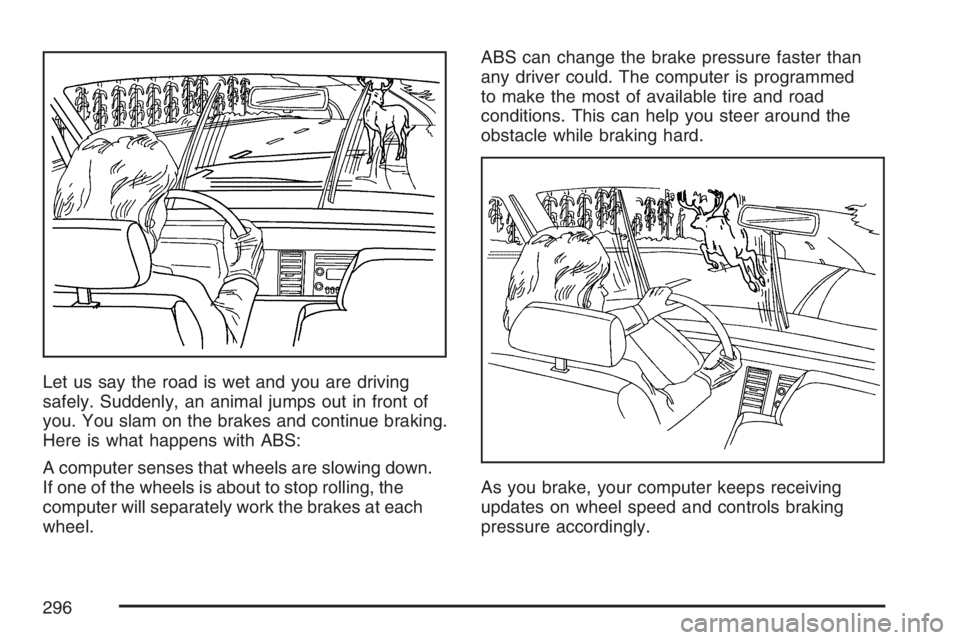
Let us say the road is wet and you are driving
safely. Suddenly, an animal jumps out in front of
you. You slam on the brakes and continue braking.
Here is what happens with ABS:
A computer senses that wheels are slowing down.
If one of the wheels is about to stop rolling, the
computer will separately work the brakes at each
wheel.ABS can change the brake pressure faster than
any driver could. The computer is programmed
to make the most of available tire and road
conditions. This can help you steer around the
obstacle while braking hard.
As you brake, your computer keeps receiving
updates on wheel speed and controls braking
pressure accordingly.
296
Page 297 of 490
Remember: ABS does not change the time you
need to get your foot up to the brake pedal
or always decrease stopping distance. If you get
too close to the vehicle in front of you, you will not
have time to apply your brakes if that vehicle
suddenly slows or stops. Always leave enough
room up ahead to stop, even though you
have ABS.
Using ABS
Do not pump the brakes. Just hold the brake pedal
down rmly and let anti-lock work for you. You may
hear the anti-lock pump or motor operate, and feel
the brake pedal pulsate, but this is normal.
Braking in Emergencies
With ABS, you can steer and brake at the same
time. In many emergencies, steering can help you
more than even the very best braking.
Traction Control System (TCS)
Your vehicle has a traction control system that
limits wheel spin. This is especially useful in
slippery road conditions. The system operates only
if it senses that one or more of the wheels are
spinning or beginning to lose traction. When this
happens, the system works the brakes and
reduces engine power to limit wheel spin.
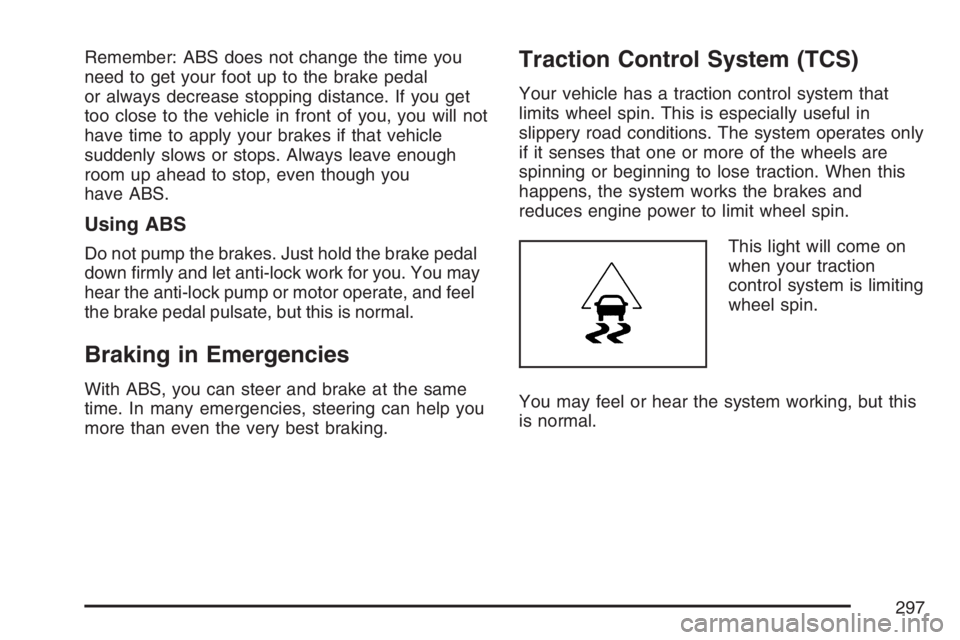
This light will come on
when your traction
control system is limiting
wheel spin.
You may feel or hear the system working, but this
is normal.
297