Page 90 of 490

Restraint System Check
Checking the Restraint Systems
Now and then, make sure the safety belt reminder
light and all your belts, buckles, latch plates,
retractors and anchorages are working properly.
Look for any other loose or damaged safety
belt system parts. If you see anything that might
keep a safety belt system from doing its job, have
it repaired. SeeCare of Safety Belts on page 424
for more information.
Torn or frayed safety belts may not protect you in
a crash. They can rip apart under impact forces.
If a belt is torn or frayed, get a new one right away.
Also look for any opened or broken airbag
covers, and have them repaired or replaced. The
airbag system does not need regular maintenance.Notice:If you damage the covering for the
driver’s or the right front passenger’s airbag, or
the side impact airbag covering (if equipped) on
the ceiling near the side windows, the airbag
may not work properly. You may have to replace
the airbag module in the steering wheel, both
the airbag module and the instrument panel for
the right front passenger’s airbag, or side
impact airbag module and ceiling covering for
roof-mounted side impact airbags (if equipped.)
Do not open or break the airbag coverings.
90
Page 93 of 490

Keys.............................................................. 95
Remote Keyless Entry (RKE) System.......... 96
Remote Keyless Entry (RKE) System
Operation................................................. 97
Doors and Locks........................................ 104
Door Locks................................................ 104
Power Door Locks..................................... 105
Delayed Locking........................................ 105
Programmable Automatic Door Locks........ 105
Rear Door Security Locks......................... 106
Lockout Protection..................................... 106
Liftgate...................................................... 107
Windows...................................................... 109
Power Windows........................................ 110
Sun Visors................................................ 110
Theft-Deterrent Systems............................. 111
Content Theft-Deterrent............................. 111
PASS-Key
®III+......................................... 112
PASS-Key®III+ Operation......................... 113Starting and Operating Your Vehicle......... 114
New Vehicle Break-In................................ 114
Ignition Positions....................................... 115
Retained Accessory Power (RAP)............. 116
Starting the Engine.................................... 116
Engine Coolant Heater.............................. 118
Automatic Transaxle Operation.................. 119
Parking Brake........................................... 122
Shifting Into Park (P) ................................. 123
Shifting Out of Park (P)............................. 125
Parking Over Things That Burn................. 126
Engine Exhaust......................................... 127
Running the Engine While Parked............. 128
Mirrors......................................................... 129
Manual Rearview Mirror............................. 129
Manual Rearview Mirror with OnStar
®....... 129
Automatic Dimming Rearview Mirror with
OnStar
®and Compass........................... 129
Automatic Dimming Rearview Mirror with
Compass............................................... 131
Outside Power Mirrors............................... 132
Outside Convex Mirrors............................. 133
Section 2 Features and Controls
93
Page 95 of 490
Keys
{CAUTION:
Leaving children in a vehicle with the
ignition key is dangerous for many
reasons. They could operate the power
windows or other controls or even make
the vehicle move. The children or others
could be badly injured or even killed.
Do not leave the keys in a vehicle with
children.
95
Page 101 of 490

Remote Vehicle Start
Your vehicle may have the remote start feature.
This feature allows you to start the engine
from outside the vehicle. See “REMOTE START”
underDIC Vehicle Personalization on page 210
for instructions on how to enable and disable this
feature.
During a remote start, the climate control system
will turn on at the fan, temperature, and mode
settings the vehicle was set to when the vehicle
was last turned off and will also turn on the
rear window defogger.
Laws in some local communities may restrict the
use of remote starters. For example, some
laws may require a person using remote start to
have the vehicle in view when doing so. Check
local regulations for any requirements on remote
starting of vehicles.
/(Remote Vehicle Start):Press and release
the lock button and then press and hold the remote
vehicle start button to start the vehicle.
Your RKE transmitter, with the remote start button,
provides an increased range of operation.
However, the range may be less while the vehicle
is running. As a result, you may need to be
closer to your vehicle to turn it off, than you were
to turn it on.
If your vehicle is low on fuel, do not use the remote
start feature. The vehicle may run out of fuel.
To start the engine using the remote start feature,
do the following:
1. Aim the RKE transmitter, that has a remote
vehicle start button, at the vehicle.
2. Press and release the transmitter’s lock
button, then immediately press and hold
the remote vehicle start button until the
vehicle’s turn signal lamps ash, or for at
least four seconds, if the vehicle’s lights are
not visible. The vehicle’s doors will be locked.
Pressing the remote start button again after the
vehicle has started will turn off the ignition.
101
Page 107 of 490

Liftgate
{CAUTION:
It can be dangerous to drive with the
liftgate or liftglass open because carbon
monoxide (CO) gas can come into your
vehicle. You cannot see or smell CO.
It can cause unconsciousness and even
death. If you must drive with the liftgate
open or if electrical wiring or other cable
connections must pass through the seal
between the body and the liftgate or
liftglass:
Make sure all other windows are shut.
Turn the fan on your climate control
system to its highest speed and select
the control setting that will force
outside air into your vehicle. See
“Climate Control System” in the Index.
If you have air outlets on or under the
instrument panel, open them all the
way. SeeEngine Exhaust on page 127.To unlock the liftgate, press the unlock button on
the Remote Keyless Entry (RKE) transmitter
twice or use the power door lock switch.
To lock the liftgate, press the lock button on the
RKE transmitter or use the power door lock switch.
The liftgate does not have a key lock cylinder.
To open the liftgate, pull up on the handle located
in the center of the liftgate.
When closing the liftgate, use the molded handles
to pull the liftgate down. Push the liftgate closed
until it latches.
107
Page 109 of 490
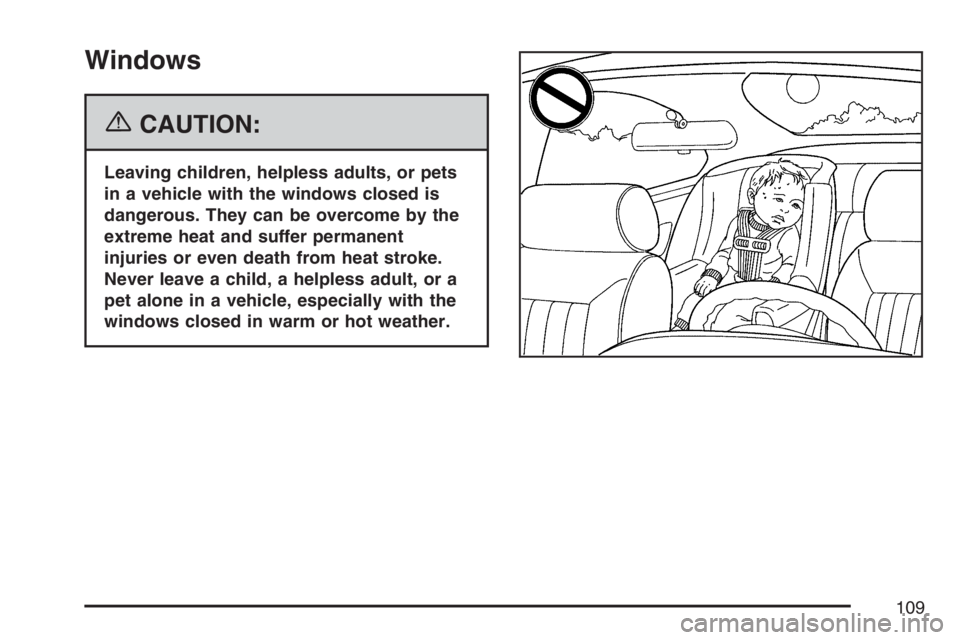
Windows
{CAUTION:
Leaving children, helpless adults, or pets
in a vehicle with the windows closed is
dangerous. They can be overcome by the
extreme heat and suffer permanent
injuries or even death from heat stroke.
Never leave a child, a helpless adult, or a
pet alone in a vehicle, especially with the
windows closed in warm or hot weather.
109
Page 110 of 490
Power Windows
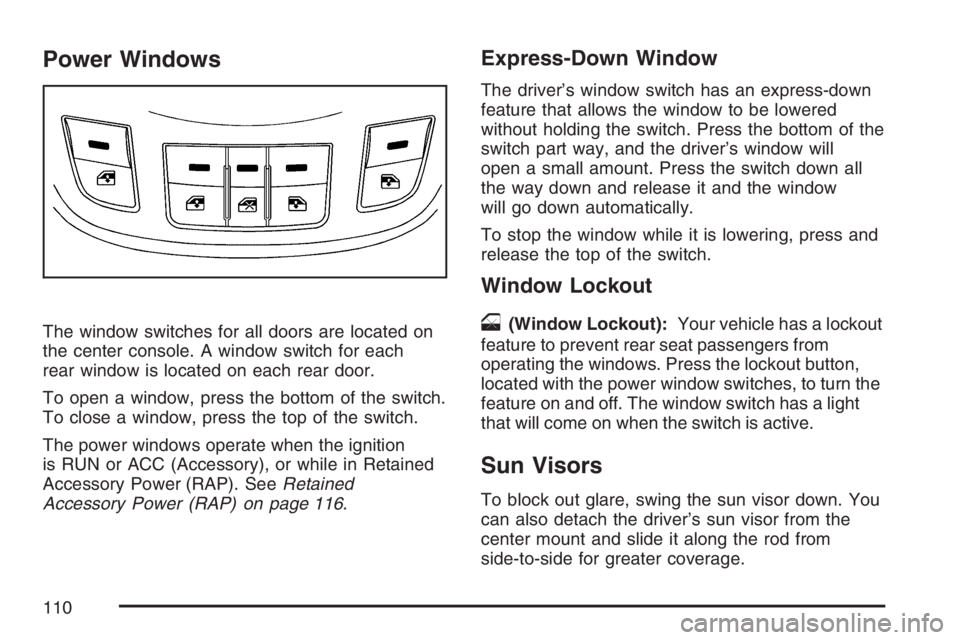
The window switches for all doors are located on
the center console. A window switch for each
rear window is located on each rear door.
To open a window, press the bottom of the switch.
To close a window, press the top of the switch.
The power windows operate when the ignition
is RUN or ACC (Accessory), or while in Retained
Accessory Power (RAP). SeeRetained
Accessory Power (RAP) on page 116.
Express-Down Window
The driver’s window switch has an express-down
feature that allows the window to be lowered
without holding the switch. Press the bottom of the
switch part way, and the driver’s window will
open a small amount. Press the switch down all
the way down and release it and the window
will go down automatically.
To stop the window while it is lowering, press and
release the top of the switch.
Window Lockout
o
(Window Lockout):Your vehicle has a lockout
feature to prevent rear seat passengers from
operating the windows. Press the lockout button,
located with the power window switches, to turn the
feature on and off. The window switch has a light
that will come on when the switch is active.
Sun Visors
To block out glare, swing the sun visor down. You
can also detach the driver’s sun visor from the
center mount and slide it along the rod from
side-to-side for greater coverage.
110
Page 116 of 490

Key In the Ignition
Never leave your vehicle with the keys inside, as it
is an easy target for joy riders or thieves. If you
leave the key in the ignition and park your vehicle,
a chime will sound, when you open the driver’s
door. Always remember to remove your key from
the ignition and take it with you. This will lock
your ignition and transaxle. Also, always remember
to lock the doors.
The battery could be drained if you leave the key
in the ignition while your vehicle is parked.
You may not be able to start your vehicle after it
has been parked for an extended period of time.
Retained Accessory Power (RAP)
Your vehicle has a Retained Accessory
Power (RAP) feature which will allow the radio,
power windows and sunroof to continue to work up
to 10 minutes after the ignition is turned off or
the driver’s door is opened.
All these features will work when the ignition key
is in RUN or ACC.
Starting the Engine
Place the transaxle in the proper gear.
Automatic Transaxle
Move your shift lever to PARK (P) or
NEUTRAL (N). Your engine will not start in
any other position — this is a safety feature.
To restart when you are already moving,
use NEUTRAL (N) only.
Notice:Shifting into PARK (P) with the vehicle
moving could damage the transaxle. Shift into
PARK (P) only when your vehicle is stopped.
Manual Transaxle
The shift lever should be in the neutral position
and the parking brake engaged. Hold the
clutch pedal to the oor and start the engine. Your
vehicle will not start if the clutch pedal is not all
the way down. That is a safety feature.
Starting Procedure
1. With your foot off the accelerator pedal, turn
the ignition key to START. When the engine
starts, let go of the key. The idle speed will go
down as your engine gets warm. Do not
race the engine immediately after starting it.
Operate the engine and transaxle gently
to allow the oil to warm up and lubricate all
moving parts.
116