Page 163 of 490

Electric Power Management
The vehicle has Electric Power Management (EPM)
that estimates the battery’s temperature and state
of charge. It then adjusts the voltage for best
performance and extended life of the battery.
When the battery’s state of charge is low, the
voltage is raised slightly to quickly put the charge
back in. When the state of charge is high, the
voltage is lowered slightly to prevent overcharging.
If the vehicle has a voltmeter gage or voltage
display on the Driver Information Center (DIC), you
may see the voltage move up or down. This is
normal. If there is a problem, an alert will be
displayed.
The battery can be discharged at idle if the
electrical loads are very high. This is true for all
vehicles. This is because the generator (alternator)
may not be spinning fast enough at idle to
produce all the power that is needed for very high
electrical loads.A high electrical load occurs when several of the
following loads are on: headlamps, high beams,
fog lamps, rear window defogger, climate
control fan at high speed, heated seats, engine
cooling fans, trailer loads, and loads plugged into
accessory power outlets.
EPM works to prevent excessive discharge of the
battery. It does this by balancing the generator’s
output and the vehicle’s electrical needs. It
can increase engine idle speed to generate more
power, whenever needed. It can temporarily
reduce the power demands of some accessories.
Normally, these actions occur in steps or levels,
without being noticeable. In rare cases at the
highest levels of corrective action, this action may
be noticeable to the driver. If so, a Driver
Information Center (DIC) message might be
displayed, such as Battery Saver Active or Service
Battery Charging System. If this message is
displayed, it is recommended that the driver
reduce the electrical loads as much as possible.
SeeDIC Warnings and Messages on page 200.
163
Page 172 of 490

Warning Lights, Gages, and
Indicators
This part describes the warning lights and gages
that may be on your vehicle. The pictures will
help you locate them.
Warning lights and gages can signal that something
is wrong before it becomes serious enough to
cause an expensive repair or replacement. Paying
attention to your warning lights and gages could
also save you or others from injury.
Warning lights come on when there may be or
is a problem with one of your vehicle’s functions.
As you will see in the details on the following
pages, some warning lights come on briey when
you start the engine just to let you know they
are working. If you are familiar with this section,
you should not be alarmed when this happens.Gages can indicate when there may be or is a
problem with one of your vehicle’s functions. Often
gages and warning lights work together to let you
know when there is a problem with your vehicle.
When one of the warning lights comes on and
stays on when you are driving, or when one of the
gages shows there may be a problem, check
the section that tells you what to do about
it. Please follow this manual’s advice. Waiting to
do repairs can be costly and even dangerous.
So please get to know your warning lights
and gages. They are a big help.
172
Page 179 of 490

If the word OFF or the off symbol is lit on the
airbag status indicator, it means that the
passenger sensing system has turned off the right
front passenger’s frontal airbag. SeePassenger
Sensing System on page 82for more on this,
including important safety information.
If, after several seconds, all status indicator lights
remain on, or if there are no lights at all, there
may be a problem with the lights or the passenger
sensing system. See your dealer for service.
{CAUTION:
If the off indicator and the airbag
readiness light ever come on together, it
means that something may be wrong with
the airbag system. If this ever happens,
have the vehicle serviced promptly,
because an adult-size person sitting in the
right front passenger seat may not have
the protection of the frontal airbag. See
Airbag Readiness Light on page 176.
Battery Warning Light
The battery warning light
will come on briey as a
check, when you turn on
the ignition. Then it
should go out when the
engine is started.
If the light does not come on when you start your
vehicle, have your vehicle serviced right away.
This condition may indicate your battery warning
light is not functioning properly. If this light
comes on while you are driving, be sure to turn off
accessories such as the radio and climate
control system. Have your vehicle serviced right
away. The SERVICE BATTERY CHARGING
SYSTEM message may also appear in the Driver
Information Center. SeeDIC Warnings and
Messages on page 200for more information.
179
Page 180 of 490
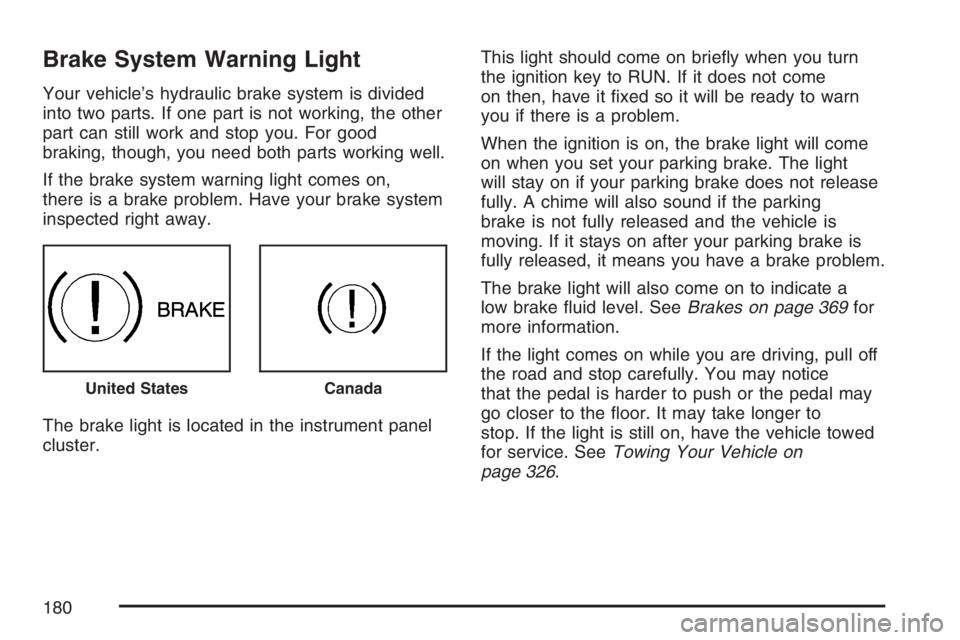
Brake System Warning Light
Your vehicle’s hydraulic brake system is divided
into two parts. If one part is not working, the other
part can still work and stop you. For good
braking, though, you need both parts working well.
If the brake system warning light comes on,
there is a brake problem. Have your brake system
inspected right away.
The brake light is located in the instrument panel
cluster.This light should come on briey when you turn
the ignition key to RUN. If it does not come
on then, have it xed so it will be ready to warn
you if there is a problem.
When the ignition is on, the brake light will come
on when you set your parking brake. The light
will stay on if your parking brake does not release
fully. A chime will also sound if the parking
brake is not fully released and the vehicle is
moving. If it stays on after your parking brake is
fully released, it means you have a brake problem.
The brake light will also come on to indicate a
low brake uid level. SeeBrakes on page 369for
more information.
If the light comes on while you are driving, pull off
the road and stop carefully. You may notice
that the pedal is harder to push or the pedal may
go closer to the oor. It may take longer to
stop. If the light is still on, have the vehicle towed
for service. SeeTowing Your Vehicle on
page 326.
United StatesCanada
180
Page 181 of 490

{CAUTION:
Your brake system may not be working
properly if the brake system warning light
is on. Driving with the brake system
warning light on can lead to an accident.
If the light is still on after you have pulled
off the road and stopped carefully, have
the vehicle towed for service.
Anti-Lock Brake System
Warning Light
With the Anti-Lock
Brake System (ABS),
the light will come
on when your engine is
started and stay on
for several seconds.
This is normal.If the ABS warning light comes on and stays on,
there may be a problem with the anti-lock
portion of the brake system. If the brake system
warning light is not on, you still have brakes,
but you do not have anti-lock brakes. SeeBrake
System Warning Light on page 180for more
information.
If the light stays on, turn the ignition to LOCK. If the
light comes on when you are driving, stop as soon
as possible and turn the ignition off. Then start the
engine again to reset the system. If the light still
stays on, or comes on again while you are driving,
your vehicle needs service. If the regular brake
system warning light is not on, you still have brakes,
but you do not have anti-lock brakes. If the regular
brake system warning light is also on, you do not
have anti-lock brakes and there is a problem with
your regular brakes. SeeBrake System Warning
Light on page 180for more information.
The ABS warning light should come on briey
when you turn the ignition key to RUN. If the light
does not come on then, have it xed so it will
be ready to warn you if there is a problem.
181
Page 182 of 490

Traction Control System (TCS)
Warning Light
Your vehicle has a
Traction Control
System (TCS) and
StabiliTrak
®warning
light.
This light will come on when the TCS is limiting
wheel spin or when the StabiliTrak
®system
is active. You may feel or hear the system working,
but this is normal.
If the TCS warning light comes on and stays on
for an extended period of time when the system is
turned on, your vehicle needs service. See
Traction Control System (TCS) on page 297and
StabiliTrak
®System on page 298for more
information.
Engine Coolant Temperature
Warning Light
The engine coolant
temperature warning
light will come on when
the engine has
overheated.
If this happens you should pull over and turn off
the engine as soon as possible. SeeEngine
Overheating on page 360for more information.
Notice:Driving with the engine coolant
temperature warning light on could cause your
vehicle to overheat. SeeEngine Overheating
on page 360. Your vehicle could be damaged,
and it might not be covered by your warranty.
Never drive with the engine coolant
temperature warning light on.
This light will also come on when starting your
vehicle. If it does not, have your vehicle serviced.
182
Page 183 of 490

Engine Coolant Temperature Gage
This gage measures the
temperature of the
vehicle’s engine.
If the indicator needle moves towards the shaded
in thermostat, the engine is too hot. The engine
coolant temperature warning light will turn on. See
Engine Coolant Temperature Warning Light on
page 182for more information.
If you have been operating your vehicle under
normal driving conditions, and the engine coolant
temperature warning light comes on, you
should pull off the road, stop your vehicle and turn
off the engine as soon as possible.
Tire Pressure Light
This light will come on
briey when you turn
the ignition to RUN.
This light will also come on when one or more of
your tires are signicantly underinated.
A CHECK TIRE PRESSURE DIC message will
accompany the light.
Stop and check your tires as soon as it is safe to do
so. If underinated, inate to the proper pressure.
SeeTires on page 386for more information.
This light will ash for 60 seconds and then turn
on solid if a problem is detected with the Tire
Pressure Monitor system.
SeeTire Pressure Monitor System on page 395
for more information.
183
Page 191 of 490
Service All-Wheel Drive Light
This light is located in
the center of your
instrument panel cluster.
This light and the SERVICE ALL WHEEL DRIVE
message in the Driver Information Center (DIC) will
come on and stay on to indicate that there may be a
problem with the drive system and service is
required. SeeAll-Wheel Drive (AWD) System on
page 299andDIC Warnings and Messages on
page 200for more information.
All-Wheel Drive Disabled Light
This light will come on
when the rear drive
system is overheating.
An ALL WHEEL DRIVE OFF message will appear
in the Driver Information Center (DIC) too. This
light will turn off when the rear drive system cools
down. If this light stays on for a while, you
need to reset the light. To reset the light, turn the
ignition off and then back on again. If the light
stays on, see your dealer right away.
SeeAll-Wheel Drive on page 378andDIC
Warnings and Messages on page 200for more
information.
191
