2007 PONTIAC TORRENT mirror
[x] Cancel search: mirrorPage 143 of 490
Convenience Net
Your vehicle may have a rear compartment net to
prevent items from rolling under the rear seat.
There may also be four convenience net tie-downs.
Two tie-downs are located on the side trim just
behind the rear seat and the other two are located
on the oor at the rear of the cargo area.
Sunroof
If the vehicle is equipped with a sunroof, the
controls to operate it are located on the headliner
above the rearview mirror. The ignition must
be in RUN or ACC, or Retained Accessory
Power (RAP) must be active, to operate the
sunroof. SeeRetained Accessory Power (RAP) on
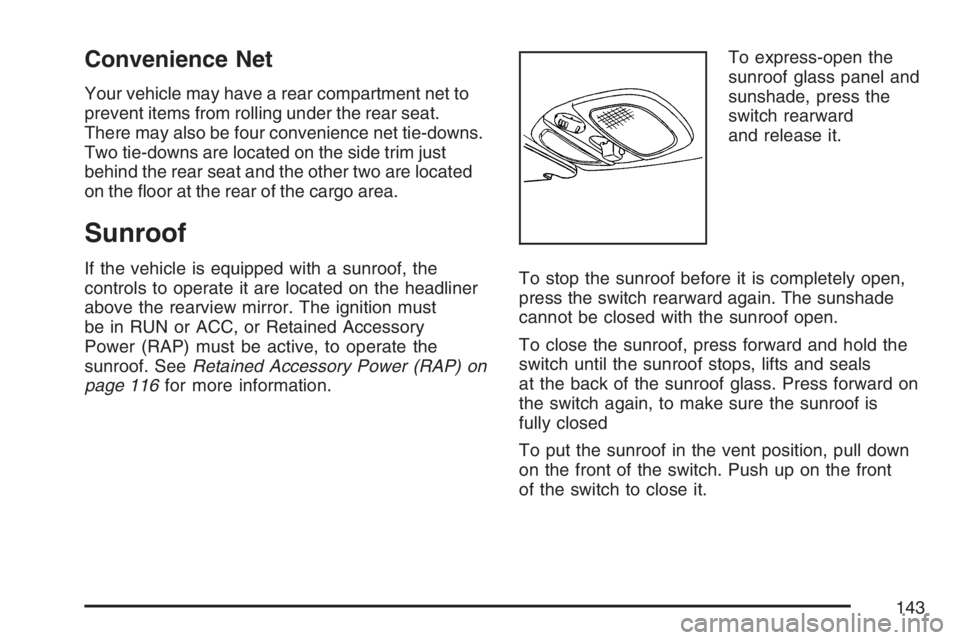
page 116for more information.To express-open the
sunroof glass panel and
sunshade, press the
switch rearward
and release it.
To stop the sunroof before it is completely open,
press the switch rearward again. The sunshade
cannot be closed with the sunroof open.
To close the sunroof, press forward and hold the
switch until the sunroof stops, lifts and seals
at the back of the sunroof glass. Press forward on
the switch again, to make sure the sunroof is
fully closed
To put the sunroof in the vent position, pull down
on the front of the switch. Push up on the front
of the switch to close it.
143
Page 149 of 490

The main components of your instrument panel are the following:
A. Air Outlets. SeeOutlet Adjustment on page 170.
B. Turn Signal/Multifunction Lever. SeeTurn
Signal/Multifunction Lever on page 151.
C. Instrument Panel Cluster. SeeInstrument Panel
Cluster on page 173.
D. Windshield Wiper/Washer Lever. See
Windshield Wipers on page 153.
E. Driver Information Center Controls. SeeDIC
Operation and Displays on page 195.
F. Hazard Warning Flashers. SeeHazard Warning
Flashers on page 150.
G. Passenger Airbag Status Indicator. See
Passenger Airbag Status Indicator on page 177.
H. Rear Window Wiper/Washer Buttons. See
Rear Window Wiper/Washer on page 155. Fog
Lamps Button. SeeFog Lamps on page 161.
I. Power Mirror Control. SeeOutside Power
Mirrors on page 132.
J. Instrument Panel Brightness Control. See
Instrument Panel Brightness on page 161.K. Cruise Controls. SeeCruise Control on
page 155.
L. Tilt Wheel. SeeTilt Wheel on page 151.
M. Horn. SeeHorn on page 150.
N. Audio Steering Wheel Controls. SeeAudio
Steering Wheel Controls on page 285.
O. Audio System. SeeAudio System(s) on
page 218.
P. Shift Lever. SeeShifting Into Park (P) on
page 123.
Q. Traction Control System (TCS) Button. See
Traction Control System (TCS) on page 297.
R. Power Window Switches. SeePower Windows
on page 110.
S. Climate Control System. SeeClimate Control
System on page 166. Heated Seat Buttons
(If Equipped). SeeHeated Seats on page 11.
T. Glove Box. SeeGlove Box on page 137.
149
Page 162 of 490

Dome Lamp
The dome lamp switch has three positions.
9(Off):The lamp will not come on as long as
the switch is in this position.
AUTO (Automatic):The lamp will come on when a
door is opened. SeeEntry Lighting on page 162.
R(On):The lamp will stay on as long as the
switch is in this position.
Entry Lighting
If the dome lamp is in the AUTO position, the
dome lamp and the cargo lamp inside your vehicle
will come on when any door is opened. In
addition, the light will come on when the remote
keyless entry unlock button is pressed. It will
stay on for 20 seconds or until a door is opened.
After the door is opened the light will remain
on and stay on for 20 seconds after the doors are
closed, or until you put the key in the ignition
and turn the key to RUN.
Map Lamps
Your vehicle may have lamps located on the
headliner above the rearview mirror. Push on the
lens in the lamp to turn them on and off.
Cargo Lamp
The cargo lamp is located over the rear
compartment, and is controlled by the dome lamp.
SeeDome Lamp on page 162.
162
Page 304 of 490
Watch for traffic signs, pavement markings,
and lines. If you can see a sign up ahead
that might indicate a turn or an intersection,
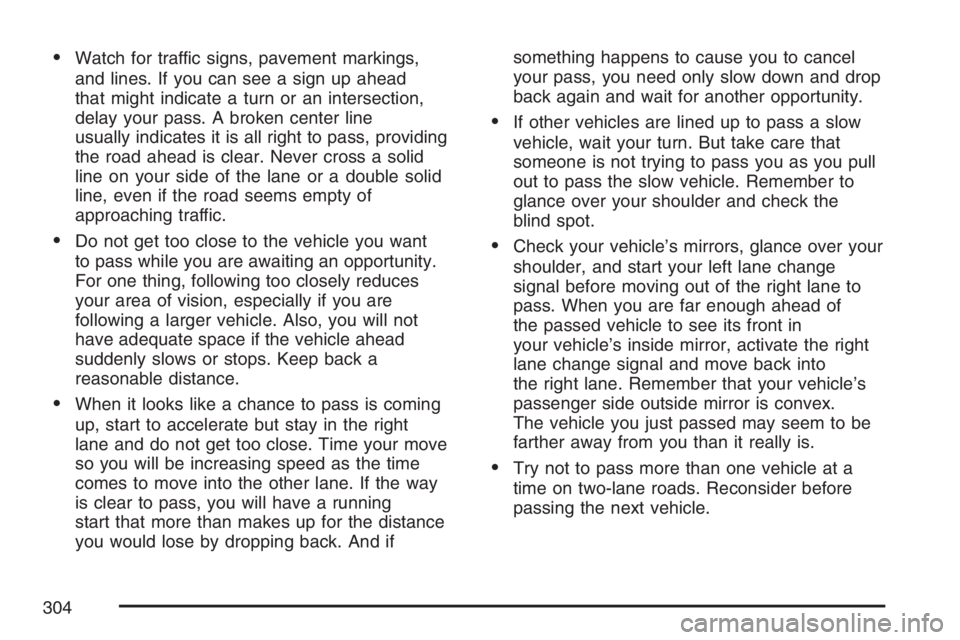
delay your pass. A broken center line
usually indicates it is all right to pass, providing
the road ahead is clear. Never cross a solid
line on your side of the lane or a double solid
line, even if the road seems empty of
approaching traffic.
Do not get too close to the vehicle you want
to pass while you are awaiting an opportunity.
For one thing, following too closely reduces
your area of vision, especially if you are
following a larger vehicle. Also, you will not
have adequate space if the vehicle ahead
suddenly slows or stops. Keep back a
reasonable distance.
When it looks like a chance to pass is coming
up, start to accelerate but stay in the right
lane and do not get too close. Time your move
so you will be increasing speed as the time
comes to move into the other lane. If the way
is clear to pass, you will have a running
start that more than makes up for the distance
you would lose by dropping back. And ifsomething happens to cause you to cancel
your pass, you need only slow down and drop
back again and wait for another opportunity.
If other vehicles are lined up to pass a slow
vehicle, wait your turn. But take care that
someone is not trying to pass you as you pull
out to pass the slow vehicle. Remember to
glance over your shoulder and check the
blind spot.
Check your vehicle’s mirrors, glance over your
shoulder, and start your left lane change
signal before moving out of the right lane to
pass. When you are far enough ahead of
the passed vehicle to see its front in
your vehicle’s inside mirror, activate the right
lane change signal and move back into
the right lane. Remember that your vehicle’s
passenger side outside mirror is convex.
The vehicle you just passed may seem to be
farther away from you than it really is.
Try not to pass more than one vehicle at a
time on two-lane roads. Reconsider before
passing the next vehicle.
304
Page 306 of 490
Of course, traction is reduced when water, snow,
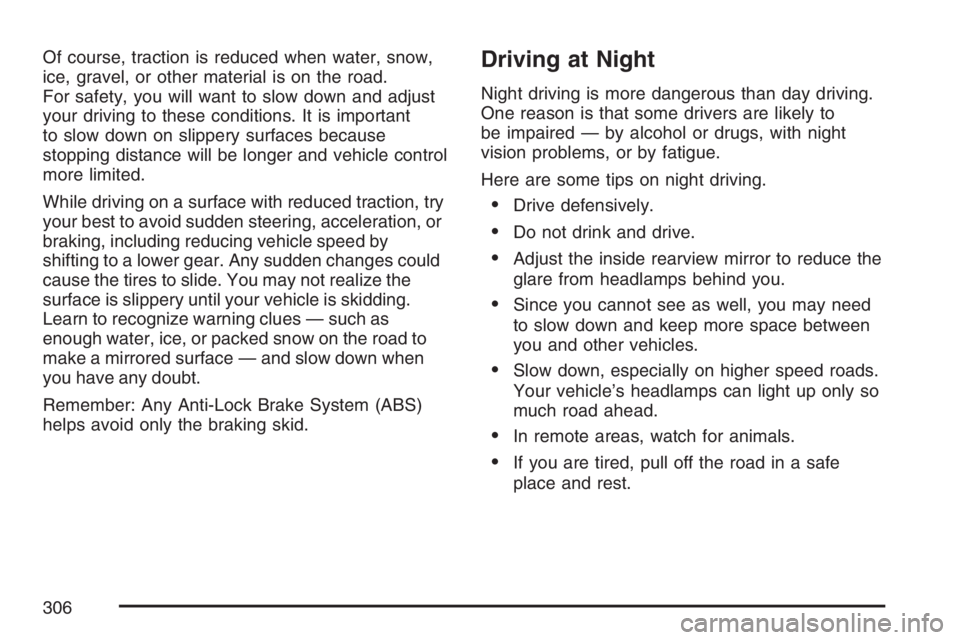
ice, gravel, or other material is on the road.
For safety, you will want to slow down and adjust
your driving to these conditions. It is important
to slow down on slippery surfaces because
stopping distance will be longer and vehicle control
more limited.
While driving on a surface with reduced traction, try
your best to avoid sudden steering, acceleration, or
braking, including reducing vehicle speed by
shifting to a lower gear. Any sudden changes could
cause the tires to slide. You may not realize the
surface is slippery until your vehicle is skidding.
Learn to recognize warning clues — such as
enough water, ice, or packed snow on the road to
make a mirrored surface — and slow down when
you have any doubt.
Remember: Any Anti-Lock Brake System (ABS)
helps avoid only the braking skid.Driving at Night
Night driving is more dangerous than day driving.
One reason is that some drivers are likely to
be impaired — by alcohol or drugs, with night
vision problems, or by fatigue.
Here are some tips on night driving.
Drive defensively.
Do not drink and drive.
Adjust the inside rearview mirror to reduce the
glare from headlamps behind you.
Since you cannot see as well, you may need
to slow down and keep more space between
you and other vehicles.
Slow down, especially on higher speed roads.
Your vehicle’s headlamps can light up only so
much road ahead.
In remote areas, watch for animals.
If you are tired, pull off the road in a safe
place and rest.
306
Page 312 of 490
Freeway Driving
Mile for mile, freeways — also called thruways,
parkways, expressways, turnpikes, or
superhighways — are the safest of all roads.
But they have their own special rules.The most important advice on freeway driving
is: Keep up with traffic and keep to the right. Drive
at the same speed most of the other drivers are
driving. Too-fast or too-slow driving breaks a
smooth traffic ow. Treat the left lane on a freeway
as a passing lane.
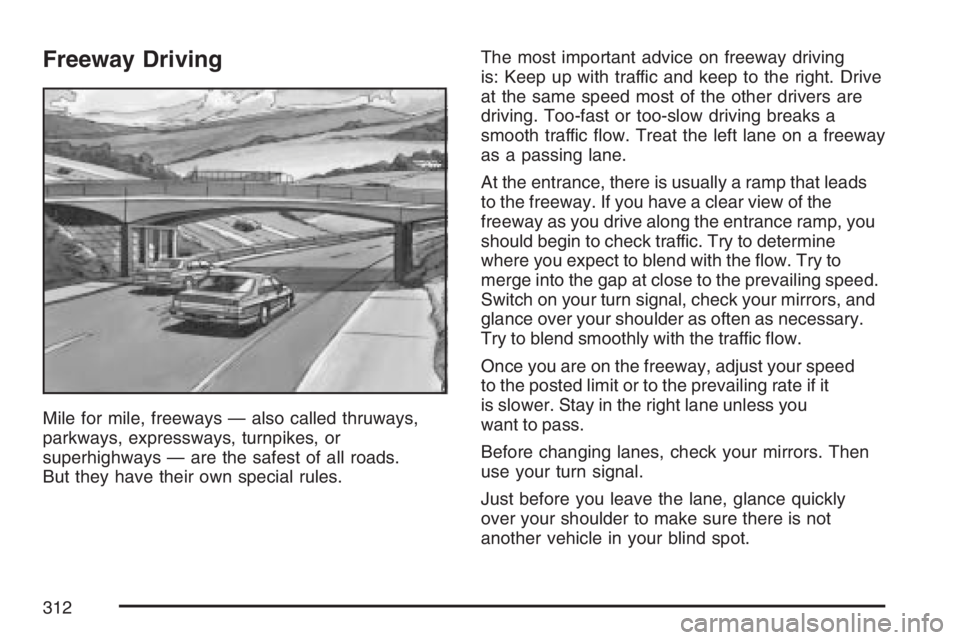
At the entrance, there is usually a ramp that leads
to the freeway. If you have a clear view of the
freeway as you drive along the entrance ramp, you
should begin to check traffic. Try to determine
where you expect to blend with the ow. Try to
merge into the gap at close to the prevailing speed.
Switch on your turn signal, check your mirrors, and
glance over your shoulder as often as necessary.
Try to blend smoothly with the traffic ow.
Once you are on the freeway, adjust your speed
to the posted limit or to the prevailing rate if it
is slower. Stay in the right lane unless you
want to pass.
Before changing lanes, check your mirrors. Then
use your turn signal.
Just before you leave the lane, glance quickly
over your shoulder to make sure there is not
another vehicle in your blind spot.
312
Page 314 of 490
Highway Hypnosis
Is there actually such a condition as highway
hypnosis? Or is it just plain falling asleep at the
wheel? Call it highway hypnosis, lack of
awareness, or whatever.
There is something about an easy stretch of road
with the same scenery, along with the hum of the
tires on the road, the drone of the engine, and the
rush of the wind against the vehicle that can make
you sleepy. Do not let it happen to you! If it does,
your vehicle can leave the road in less than a
second, and you could crash and be injured.
What can you do about highway hypnosis?
First, be aware that it can happen.
Then here are some tips:
Make sure your vehicle is well ventilated, with
a comfortably cool interior.
Keep your eyes moving. Scan the road ahead
and to the sides. Check your mirrors and your
instruments frequently.
If you get sleepy, pull off the road into a rest,
service, or parking area and take a nap, get
some exercise, or both. For safety, treat
drowsiness on the highway as an emergency.
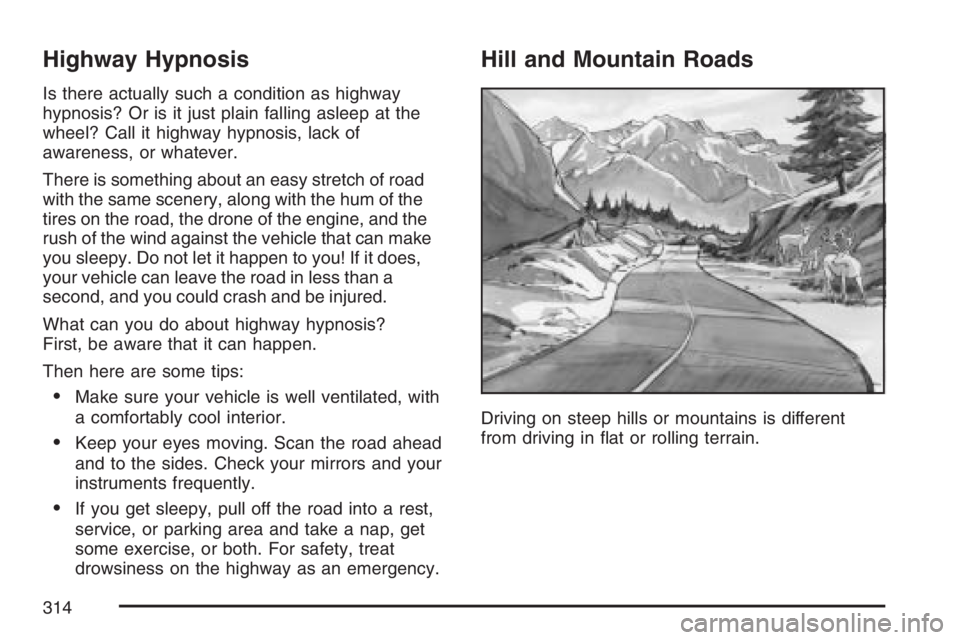
Hill and Mountain Roads
Driving on steep hills or mountains is different
from driving in at or rolling terrain.
314
Page 333 of 490

Before you start, check all trailer hitch parts and
attachments, safety chains, electrical connector,
lamps, tires and mirror adjustment. If the trailer has
electric brakes, start your vehicle and trailer
moving and then apply the trailer brake controller
by hand to be sure the brakes are working.
This lets you check your electrical connection at
the same time.
During your trip, check occasionally to be sure
that the load is secure, and that the lamps and any
trailer brakes are still working.
Following Distance
Stay at least twice as far behind the vehicle ahead
as you would when driving your vehicle without
a trailer. This can help you avoid situations
that require heavy braking and sudden turns.
Passing
You will need more passing distance up ahead
when you are towing a trailer. And, because
you are a good deal longer, you will need to go
much farther beyond the passed vehicle
before you can return to your lane.
Backing Up
Hold the bottom of the steering wheel with one
hand. Then, to move the trailer to the left,
just move that hand to the left. To move the trailer
to the right, move your hand to the right. Always
back up slowly and, if possible, have someone
guide you.
Making Turns
Notice:Making very sharp turns while
trailering could cause the trailer to come in
contact with the vehicle. Your vehicle could be
damaged. Avoid making very sharp turns
while trailering.
When you are turning with a trailer, make wider
turns than normal. Do this so your trailer will
not strike soft shoulders, curbs, road signs, trees
or other objects. Avoid jerky or sudden
maneuvers. Signal well in advance.
333