Page 372 of 490

Battery
Your vehicle has a maintenance free battery.
When it is time for a new battery, get one that has
the replacement number shown on the original
battery’s label. We recommend an ACDelco
®
replacement battery.
For battery replacement, see your dealer or the
service manual. To purchase a service manual,
seeService and Owner PublicationsinService
Publications Ordering Information on page 474.
Warning:Battery posts, terminals, and related
accessories contain lead and lead compounds,
chemicals known to the State of California
to cause cancer and reproductive harm. Wash
hands after handling.
Vehicle Storage
If you are not going to drive your vehicle for
25 days or more, remove the black, negative (-)
cable from the battery. This will help keep
your battery from running down.
{CAUTION:
Batteries have acid that can burn you and
gas that can explode. You can be badly
hurt if you are not careful. SeeJump
Starting on page 373for tips on working
around a battery without getting hurt.
You must close all doors and the liftgate before
reconnecting the battery. After reconnecting
the battery, you must press the unlock button on
the remote keyless entry transmitter. Failure
to follow this procedure may result in a sounding
alarm. Pressing unlock on the remote keyless
entry transmitter would stop the sounding alarm.
372
Page 374 of 490
Notice:If you leave your radio or other
accessories on during the jump starting
procedure, they could be damaged. The repairs
would not be covered by your warranty.
Always turn off your radio and other
accessories when jump starting your vehicle.
3. Turn off the ignition on both vehicles. Unplug
unnecessary accessories plugged into the
cigarette lighter or the accessory power outlet.
Turn off the radio and all lamps that are not
needed. This will avoid sparks and help save
both batteries. And it could save your radio!
4. Open the hoods and locate the positive (+)
and negative (−) terminal locations on each
vehicle.
You will not need to access your battery for
jump starting. Your vehicle has a remote
positive (+) and a remote negative (−) jump
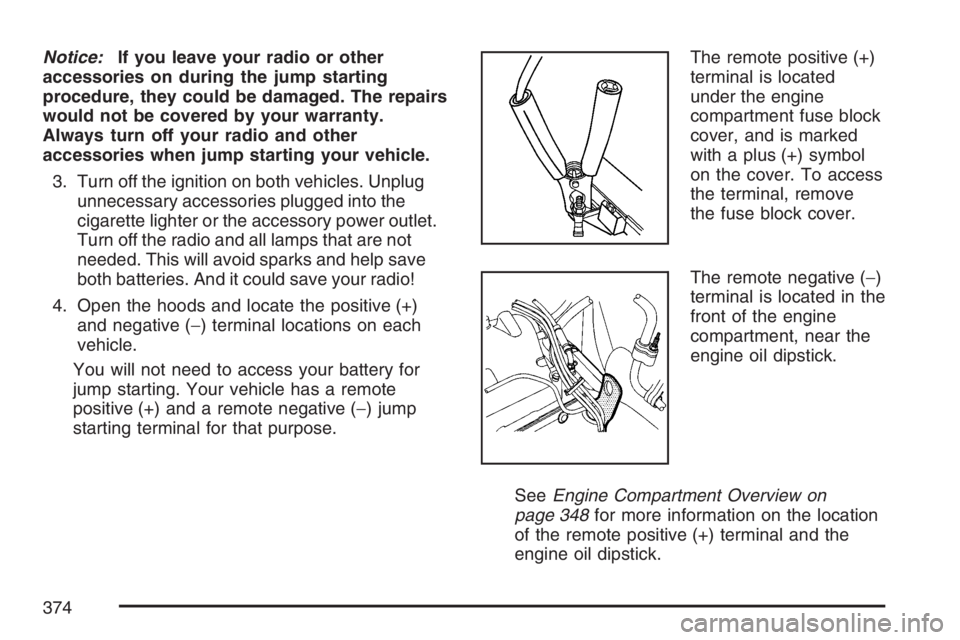
starting terminal for that purpose.The remote positive (+)
terminal is located
under the engine
compartment fuse block
cover, and is marked
with a plus (+) symbol
on the cover. To access
the terminal, remove
the fuse block cover.
The remote negative (−)
terminal is located in the
front of the engine
compartment, near the
engine oil dipstick.
SeeEngine Compartment Overview on
page 348for more information on the location
of the remote positive (+) terminal and the
engine oil dipstick.
374
Page 377 of 490
9. Connect the other end of the negative (−) cable
at least 18 inches (45 cm) away from the dead
battery, but not near engine parts that move.
The electrical connection is just as good there,
and the chance of sparks getting back to the
battery is much less.
Your vehicle has a remote negative (−)
terminal for this purpose.
10. Now start the vehicle with the good battery
and run the engine for a while.
11. Press the unlock button on the remote
keyless entry transmitter to disarm your
content theft-deterrent system.
12. Try to start the vehicle that had the dead
battery. If it will not start after a few tries, it
probably needs service.Notice:If the jumper cables are connected or
removed in the wrong order, electrical shorting
may occur and damage the vehicle. The repairs
would not be covered by your warranty. Always
connect and remove the jumper cables in the
correct order, making sure that the cables do
not touch each other or other metal.
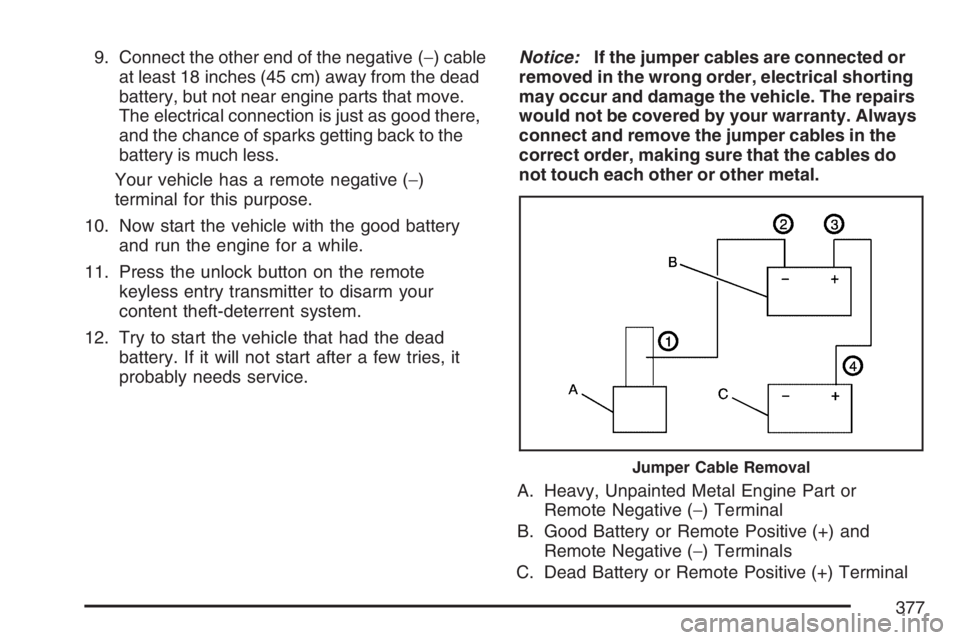
A. Heavy, Unpainted Metal Engine Part or
Remote Negative (−) Terminal
B. Good Battery or Remote Positive (+) and
Remote Negative (−) Terminals
C. Dead Battery or Remote Positive (+) Terminal
Jumper Cable Removal
377
Page 378 of 490
To disconnect the jumper cables from both
vehicles, do the following:
1. Disconnect the black negative (−) cable from
the vehicle that had the dead battery.
2. Disconnect the black negative (−) cable from
the vehicle with the good battery.
3. Disconnect the red positive (+) cable from the
vehicle with the good battery.
4. Disconnect the red positive (+) cable from the
other vehicle.
5. Return the fuse block cover to its original
position.All-Wheel Drive
If you have an all-wheel-drive vehicle, be sure to
perform the lubricant checks described in this
section. However, there are two additional systems
that need lubrication.
Transfer Case (Power Transfer Unit)
When to Check Lubricant
Refer to the Maintenance Schedule to determine
how often to check the lubricant. SeeScheduled
Maintenance on page 440.
378
Page 381 of 490
Headlamps, Front Turn Signal,
Sidemarker, and Parking Lamps
To replace one of these bulbs, do the following:
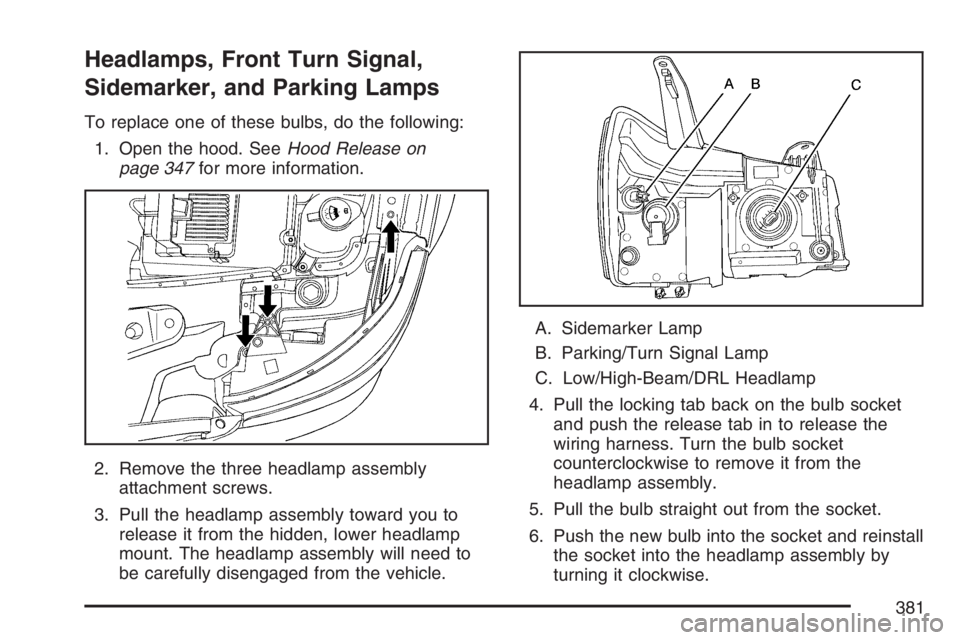
1. Open the hood. SeeHood Release on
page 347for more information.
2. Remove the three headlamp assembly
attachment screws.
3. Pull the headlamp assembly toward you to
release it from the hidden, lower headlamp
mount. The headlamp assembly will need to
be carefully disengaged from the vehicle.A. Sidemarker Lamp
B. Parking/Turn Signal Lamp
C. Low/High-Beam/DRL Headlamp
4. Pull the locking tab back on the bulb socket
and push the release tab in to release the
wiring harness. Turn the bulb socket
counterclockwise to remove it from the
headlamp assembly.
5. Pull the bulb straight out from the socket.
6. Push the new bulb into the socket and reinstall
the socket into the headlamp assembly by
turning it clockwise.
381
Page 383 of 490
5. Turn the bulb socket counterclockwise to
disconnect it from the taillamp assembly.
6. Pull the bulb out of the bulb socket.
7. Push the new bulb into the bulb socket.
8. Insert the bulb socket into the taillamp
assembly and turn it clockwise to secure.
9. Reverse Steps 1 through 3 to reinstall the
taillamp assembly. When reinstalling the
screws, do not overtighten.
License Plate Lamp
To replace one of these bulbs, do the following:
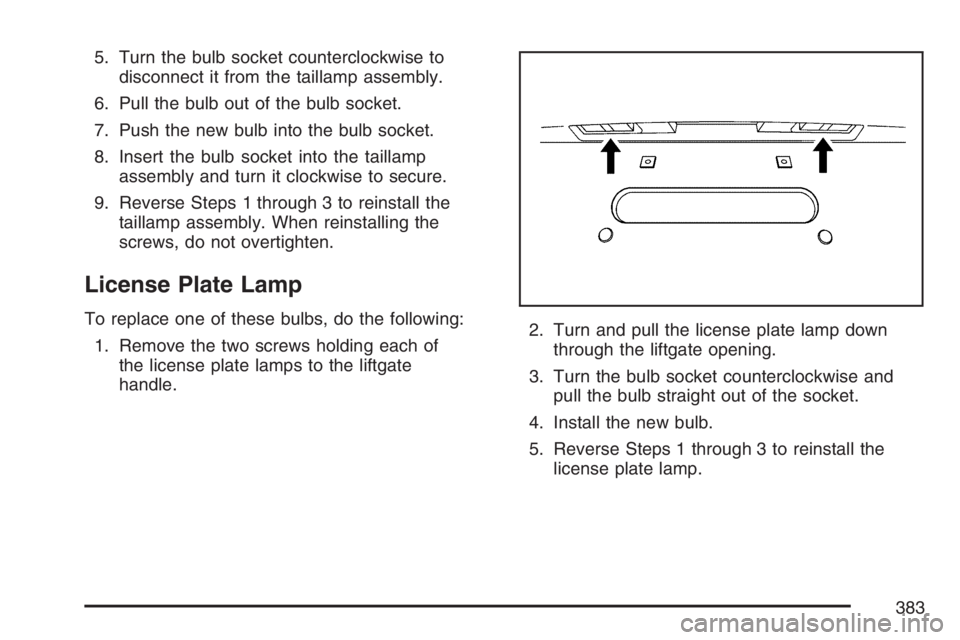
1. Remove the two screws holding each of
the license plate lamps to the liftgate
handle.2. Turn and pull the license plate lamp down
through the liftgate opening.
3. Turn the bulb socket counterclockwise and
pull the bulb straight out of the socket.
4. Install the new bulb.
5. Reverse Steps 1 through 3 to reinstall the
license plate lamp.
383
Page 398 of 490

The TPMS matching process is outlined below:
1. Set the parking brake.
2. Turn the ignition switch to RUN with the
engine off.
3. Using the DIC, press the vehicle information
button until the TIRE LOCATIONS PRESS
V
TO LEARN message displays.
4. Press the set/reset button to allow the system
to learn the tire positions. The horn will sound
twice to indicate the receiver is ready, and
the TIRE LEARNING ACTIVE message
displays. The TPMS system is ready for the
sensor matching process to begin.
5. Start with the driver side front tire.
6. Remove the valve cap from the tire’s valve
stem. Activate the TPMS sensor by increasing
or decreasing the tire’s air pressure for
ve seconds, or until a horn chirp sounds.The horn chirp, which may take up to
30 seconds to sound, conrms that the sensor
identication code has been matched to the
tire/wheel position. To decrease the tire’s
air-pressure use the pointed end of the valve
cap, a pencil-style air pressure gage, or a key.
7. Proceed to the passenger side front tire, and
repeat the procedure in Step 6.
8. Proceed to the passenger side rear tire, and
repeat the procedure in Step 6.
9. Proceed to the driver side rear tire, and
repeat the procedure in Step 6.
10. After hearing the conrming horn chirp for the
driver side rear tire, the tire learning process
ends. Turn the ignition switch to LOCK.
11. Set all four tires to the recommended air
pressure level as indicated on the tire and
loading information label.
12. Put the valve caps back on the valve stems.
398
Page 403 of 490

Different Size Tires and Wheels
If you add wheels or tires that are a different size
than your original equipment wheels and tires,
this may affect the way your vehicle performs,
including its braking, ride and handling
characteristics, stability, and resistance to rollover.
Additionally, if your vehicle has electronic
systems such as, anti-lock brakes, traction control,
and electronic stability control, the performance
of these systems can be affected.
{CAUTION:
If you add different sized wheels, your
vehicle may not provide an acceptable
level of performance and safety if tires not
recommended for those wheels are
selected. You may increase the chance
that you will crash and suffer serious
injury. Only use GM specic wheel and
tire systems developed for your vehicle,
and have them properly installed by a GM
certied technician.SeeBuying New Tires on page 401and
Accessories and Modications on page 339for
additional information.
Uniform Tire Quality Grading
Quality grades can be found where applicable on
the tire sidewall between tread shoulder and
maximum section width. For example:
Treadwear 200 Traction AA Temperature A
The following information relates to the system
developed by the United States National Highway
Traffic Safety Administration (NHTSA), which
grades tires by treadwear, traction, and
temperature performance. This applies only to
vehicles sold in the United States. The grades are
molded on the sidewalls of most passenger car
tires. The Uniform Tire Quality Grading (UTQG)
system does not apply to deep tread, winter-type
snow tires, space-saver, or temporary use
spare tires, tires with nominal rim diameters of
10 to 12 inches (25 to 30 cm), or to some
limited-production tires.
403