Page 287 of 486

You will need a well-charged battery to restart the
vehicle, and possibly for signaling later on with
your headlamps. Let the heater run for a while.
Then, shut the engine off and close the window
almost all the way to preserve the heat. Start
the engine again and repeat this only when you
feel really uncomfortable from the cold. But do it as
little as possible. Preserve the fuel as long as
you can. To help keep warm, you can get out of
the vehicle and do some fairly vigorous exercises
every half hour or so until help comes.
If Your Vehicle is Stuck in Sand,
Mud, Ice, or Snow
In order to free your vehicle when it is stuck, you
will need to spin the wheels, but you do not
want to spin your wheels too fast. The method
known as rocking can help you get out when you
are stuck, but you must use caution.
If your vehicle has a traction system, the traction
system can often help to free a stuck vehicle.
SeeTraction Control System (TCS) on page 262,
Enhanced Traction System (ETS) on page 263,
orStabiliTrak
®System on page 265.Ifthestuck condition is too severe for the traction
system to free the vehicle, turn the traction system
off and use the rocking method.
{CAUTION:
If you let your vehicle’s tires spin at high
speed, they can explode, and you or others
could be injured. And, the transaxle or
other parts of the vehicle can overheat.
That could cause an engine compartment
re or other damage. When you are stuck,
spin the wheels as little as possible. Do not
spin the wheels above 35 mph (55 km/h) as
shown on the speedometer.
Notice:Spinning the wheels can destroy parts
of your vehicle as well as the tires. If you
spin the wheels too fast while shifting
the transaxle back and forth, you can destroy
the transaxle. SeeRocking Your Vehicle to
Get It Out on page 288.
For information about using tire chains on your
vehicle, seeTire Chains on page 389.
287
Page 295 of 486
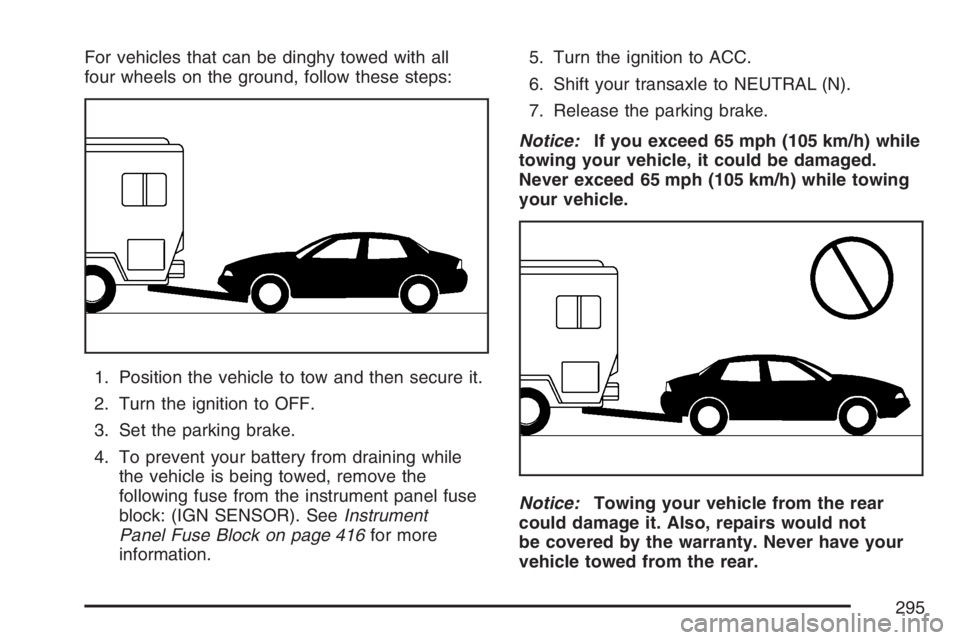
For vehicles that can be dinghy towed with all
four wheels on the ground, follow these steps:
1. Position the vehicle to tow and then secure it.
2. Turn the ignition to OFF.
3. Set the parking brake.
4. To prevent your battery from draining while
the vehicle is being towed, remove the
following fuse from the instrument panel fuse
block: (IGN SENSOR). SeeInstrument
Panel Fuse Block on page 416for more
information.5. Turn the ignition to ACC.
6. Shift your transaxle to NEUTRAL (N).
7. Release the parking brake.
Notice:If you exceed 65 mph (105 km/h) while
towing your vehicle, it could be damaged.
Never exceed 65 mph (105 km/h) while towing
your vehicle.
Notice:Towing your vehicle from the rear
could damage it. Also, repairs would not
be covered by the warranty. Never have your
vehicle towed from the rear.
295
Page 305 of 486

Service........................................................ 308
Accessories and Modications................... 308
California Proposition 65 Warning.............. 309
Doing Your Own Service Work.................. 309
Adding Equipment to the Outside of
Your Vehicle.......................................... 310
Fuel............................................................. 310
Gasoline Octane........................................ 310
Gasoline Specications.............................. 310
California Fuel........................................... 311
Additives................................................... 311
Fuels in Foreign Countries........................ 312
Filling the Tank......................................... 313
Filling a Portable Fuel Container............... 315
Checking Things Under
the Hood.................................................. 316
Hood Release........................................... 317
Engine Compartment Overview.................. 318
Engine Oil................................................. 325
Engine Oil Life System.............................. 328
Engine Air Cleaner/Filter............................ 330
Automatic Transaxle Fluid
(2.4L L4 and 3.5L V6 Engines).............. 332Automatic Transaxle Fluid
(3.6L Engine)......................................... 332
Automatic Transaxle Fluid
(3.9L V6 Engine).................................... 335
Manual Transaxle Fluid............................. 338
Hydraulic Clutch........................................ 338
Engine Coolant.......................................... 339
Pressure Cap............................................ 342
Engine Overheating................................... 342
Overheated Engine Protection
Operating Mode..................................... 344
Cooling System......................................... 345
Power Steering Fluid ................................. 349
Windshield Washer Fluid........................... 350
Brakes...................................................... 352
Battery...................................................... 355
Jump Starting............................................ 356
Bulb Replacement....................................... 361
Halogen Bulbs........................................... 361
Headlamps, Front Turn Signal,
Sidemarker, and Parking Lamps............. 362
Center High-Mounted
Stoplamp (CHMSL) (Sedan)................... 363
Section 5 Service and Appearance Care
305
Page 319 of 486
A. Engine Air Cleaner/Filter. SeeEngine Air
Cleaner/Filter on page 330.
B. Engine Oil Fill Cap. See “When to Add Engine
Oil” underEngine Oil on page 325.
C. Engine Oil Dipstick. See “Checking Engine Oil”
underEngine Oil on page 325.
D. Engine Coolant Surge Tank. SeeEngine
Coolant on page 339.
E. Pressure Cap. SeePressure Cap on page 342.F. Brake Master Cylinder Reservoir. See “Brake
Fluid” underBrakes on page 352.
G. Battery. SeeBattery on page 355.
H. Windshield Washer Fluid Reservoir. See
“Adding Washer Fluid” underWindshield
Washer Fluid on page 350.
I. Engine Compartment Fuse Block. SeeEngine
Compartment Fuse Block on page 418.
319
Page 321 of 486
A. Engine Air Cleaner/Filter. SeeEngine Air
Cleaner/Filter on page 330.
B. Power Steering Fluid Reservoir. SeePower
Steering Fluid on page 349.
C. Engine Oil Fill Cap. See “When to Add Engine
Oil” underEngine Oil on page 325.
D. Engine Oil Dipstick. See “Checking Engine Oil”
underEngine Oil on page 325.
E. Engine Coolant Surge Tank. SeeEngine
Coolant on page 339.F. Pressure Cap. SeePressure Cap on page 342.
G. Brake Master Cylinder Reservoir. See “Brake
Fluid” underBrakes on page 352.
H. Battery. SeeBattery on page 355.
I. Engine Compartment Fuse Block. SeeEngine
Compartment Fuse Block on page 418.
J. Windshield Washer Fluid Reservoir. See
“Adding Washer Fluid” underWindshield
Washer Fluid on page 350.
321
Page 323 of 486

A. Engine Air Cleaner/Filter. SeeEngine Air
Cleaner/Filter on page 330.
B. Power Steering Fluid Reservoir. SeePower
Steering Fluid on page 349.
C. Engine Oil Fill Cap. See “When to Add Engine
Oil” underEngine Oil on page 325.
D. Engine Oil Dipstick. See “Checking Engine Oil”
underEngine Oil on page 325.
E. Electric Engine Cooling Fans. SeeCooling
System on page 345.
F. Engine Coolant Surge Tank. SeeEngine
Coolant on page 339.
G. Pressure Cap. SeePressure Cap on page 342.H. Brake Master Cylinder Reservoir. See “Brake
Fluid” underBrakes on page 352.
I. Automatic Transaxle Fluid Dipstick (Out of
View). See “Checking the Fluid Level” under
Automatic Transaxle Fluid (2.4L L4 and 3.5L V6
Engines) on page 332orAutomatic Transaxle
Fluid (3.6L Engine) on page 332orAutomatic
Transaxle Fluid (3.9L V6 Engine) on page 335.
J. Battery. SeeBattery on page 355.
K. Underhood Fuse Block. SeeEngine
Compartment Fuse Block on page 418.
L. Windshield Washer Fluid Reservoir. See
“Adding Washer Fluid” underWindshield
Washer Fluid on page 350.
323
Page 325 of 486

A. Engine Air Cleaner/Filter. SeeEngine Air
Cleaner/Filter on page 330.
B. Engine Coolant Bleed Valve.
C. Power Steering Fluid. SeePower Steering
Fluid on page 349.
D. Automatic Transaxle Fluid Dipstick (Out of
View). See “Checking the Fluid Level” under
Automatic Transaxle Fluid (2.4L L4 and 3.5L V6
Engines) on page 332orAutomatic Transaxle
Fluid (3.6L Engine) on page 332orAutomatic
Transaxle Fluid (3.9L V6 Engine) on page 335.
E. Engine Oil Fill Cap. See “When to Add
Engine Oil” underEngine Oil on page 325.
F. Engine Oil Dipstick. See “Checking Engine Oil”
underEngine Oil on page 325.
G. Engine Coolant Surge Tank. SeeEngine
Coolant on page 339.
H. Pressure Cap. SeePressure Cap on page 342.
I. Brake Master Cylinder Reservoir. See “Brake
Fluid” underBrakes on page 352.
J. Battery. SeeBattery on page 355.K. Windshield Washer Fluid Reservoir. See
“Adding Washer Fluid” underWindshield
Washer Fluid on page 350.
L. Engine Compartment Fuse Block. SeeEngine
Compartment Fuse Block on page 418.
Engine Oil
Checking Engine Oil
It is a good idea to check the engine oil every time
you get fuel. In order to get an accurate reading,
the oil must be warm and the vehicle must be
on level ground.
The engine oil dipstick handle is a yellow loop.
SeeEngine Compartment Overview on page 318
for the location of the engine oil dipstick.
1. Turn off the engine and give the oil several
minutes to drain back into the oil pan. If you
do not do this, the oil dipstick might not
show the actual level.
2. Pull out the dipstick and clean it with a paper
towel or cloth, then push it back in all the
way. Remove it again, keeping the tip down,
and check the level.
325
Page 355 of 486

Replacing Brake System Parts
The braking system on a vehicle is complex. Its
many parts have to be of top quality and work well
together if the vehicle is to have really good
braking. Your vehicle was designed and tested with
top-quality GM brake parts. When you replace parts
of your braking system — for example, when your
brake linings wear down and you need new ones
put in — be sure you get new approved GM
replacement parts. If you do not, your brakes may
no longer work properly. For example, if someone
puts in brake linings that are wrong for your vehicle,
the balance between your front and rear brakes can
change — for the worse. The braking performance
you have come to expect can change in many other
ways if someone puts in the wrong replacement
brake parts.
Battery
Your vehicle has a maintenance free battery. When
it is time for a new battery, get one that has the
replacement number shown on the original battery’s
label. We recommend an ACDelco
®replacement
battery. SeeEngine Compartment Overview on
page 318for battery location.
Warning:Battery posts, terminals, and related
accessories contain lead and lead compounds,
chemicals known to the State of California
to cause cancer and reproductive harm. Wash
hands after handling.
355