Page 1 of 428

Seats and Restraint Systems
........................ 7
Front Seats
.............................................. 8
Rear Seats
............................................. 15
Safety Belts
............................................ 16
Child Restraints
...................................... 39
Airbag System
........................................ 64
Restraint System Check
......................... 80
Features and Controls
................................. 83
Keys
....................................................... 85
Doors and Locks
.................................... 94
Windows
............................................... 100
Theft-Deterrent Systems
....................... 102
Starting and Operating Your Vehicle
..... 106
Mirrors
.................................................. 125
OnStar
®System
................................... 127
Storage Areas
...................................... 131
Sunroof
................................................ 132Instrument Panel
........................................ 133
Instrument Panel Overview
................... 136
Climate Controls
................................... 152
Warning Lights, Gages, and Indicators
.... 157
Driver Information Center (DIC)
............ 174
Audio System(s)
................................... 185
Driving Your Vehicle
.................................. 217
Your Driving, the Road, and
Your Vehicle
..................................... 218
Towing
................................................. 254
Service and Appearance Care
................... 265
Service
................................................. 268
Fuel
...................................................... 270
Checking Things Under the Hood
......... 276
Headlamp Aiming
................................. 309
Bulb Replacement
................................ 312
Windshield Wiper Blade Replacement
.... 319
2007 Pontiac G5 Owner ManualM
1
Page 8 of 428
Front Seats
Manual Seats
{CAUTION:
You can lose control of the vehicle if
you try to adjust a manual driver’s seat
while the vehicle is moving. The sudden
movement could startle and confuse you,
or make you push a pedal when you do
not want to. Adjust the driver’s seat only
when the vehicle is not moving.Lift the bar located under the front of the seat to
unlock it. Slide the seat to where you want it
and release the bar. Try to move the seat with
your body to be sure the seat is locked in place.
8
Page 10 of 428

Heated Seats
Your vehicle may have heated front seats. The
switches are located on the instrument panel
above the climate control system.
Press the side of the
switch with the double
indicator lights to turn on
the heated seat at the
highest setting.
Both indicator lights will be lit to indicate that the
setting is on high. Press the side of the switch with
the single indicator light to go to the low setting.
The indicator light will be lit to indicate that
the setting is on low. Return the switch to the
center to turn off the heated seat.
If your vehicle has been turned off, the last heated
seat setting will be retained when the vehicle is
started again.
Reclining Seatbacks
{CAUTION:
You can lose control of the vehicle if
you try to adjust a manual driver’s seat
while the vehicle is moving. The sudden
movement could startle and confuse you,
or make you push a pedal when you do
not want to. Adjust the driver’s seat only
when the vehicle is not moving.
{CAUTION:
If the seatback is not locked, it could
move forward in a sudden stop or crash.
That could cause injury to the person
sitting there. Always push and pull on
the seatback to be sure it is locked.
Driver’s Switch Shown,
Passenger’s Switch
Similar
10
Page 22 of 428
How to Wear Safety Belts Properly
This part is only for people of adult size.
Be aware that there are special things to know
about safety belts and children. And there
are different rules for smaller children and babies.
If a child will be riding in your vehicle, see
Older Children on page 39orInfants and Young
Children on page 42. Follow those rules for
everyone’s protection.
First, you will want to know which restraint
systems your vehicle has.
We will start with the driver position.
Driver Position
Lap-Shoulder Belt
The driver has a lap-shoulder belt. Here is how
to wear it properly.
1. Close and lock the door.
2. Adjust the seat so you can sit up straight.
To see how, see “Seats” in the Index.3. Pick up the latch plate and pull the belt across
you. Do not let it get twisted.
The lap-shoulder belt may lock if you pull the
belt across you very quickly. If this happens,
let the belt go back slightly to unlock it.
Then pull the belt across you more slowly.
22
Page 31 of 428

Safety Belt Use During Pregnancy
Safety belts work for everyone, including pregnant
women. Like all occupants, they are more likely
to be seriously injured if they do not wear
safety belts.
A pregnant woman should wear a lap-shoulder
belt, and the lap portion should be worn as low as
possible, below the rounding, throughout the
pregnancy.The best way to protect the fetus is to protect the
mother. When a safety belt is worn properly, it
is more likely that the fetus will not be hurt
in a crash. For pregnant women, as for anyone,
the key to making safety belts effective is wearing
them properly.
Right Front Passenger Position
To learn how to wear the right front passenger’s
safety belt properly, seeDriver Position on page 22.
The right front passenger’s safety belt works the
same way as the driver’s safety belt — except
for one thing. If you ever pull the shoulder portion
of the belt out all the way, you will engage the
child restraint locking feature which may turn off
the passenger’s frontal airbag. If this happens, just
let the belt go back all the way and start again.
31
Page 33 of 428
2. Push the latch plate into the buckle until it
clicks.
Pull up on the latch plate to make sure it is
secure.
When the shoulder belt is pulled out all the
way, it will lock. If it does, let it go back all the
way and start again.
If the belt is not long enough, seeSafety Belt
Extender on page 38.
Make sure the release button on the buckle is
positioned so you would be able to unbuckle
the safety belt quickly if you ever had to.
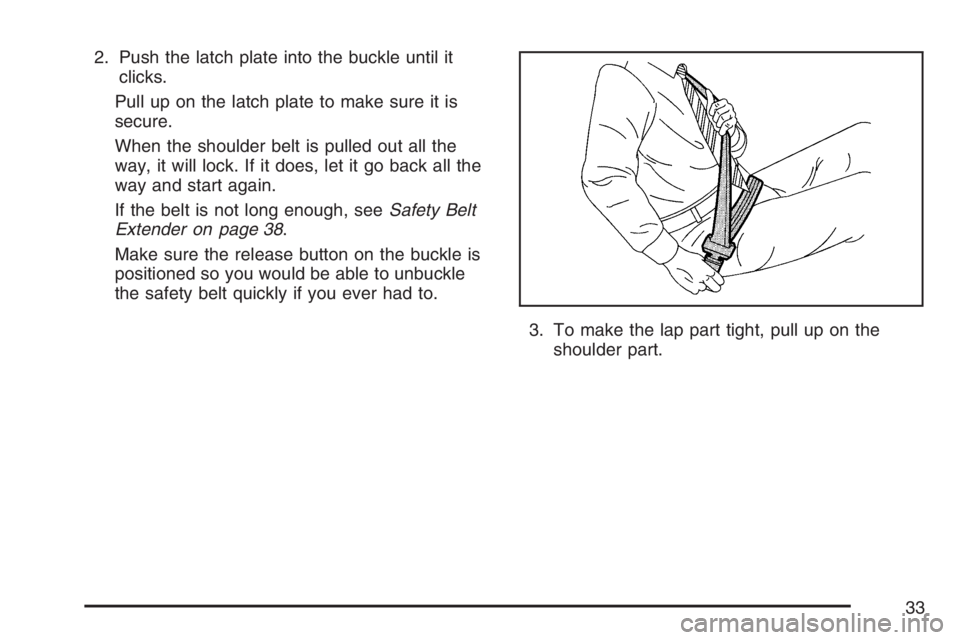
3. To make the lap part tight, pull up on the
shoulder part.
33
Page 61 of 428

CAUTION: (Continued)
If you need to secure a forward-facing
child restraint in the right front seat,
always move the front passenger seat
as far back as it will go. It is better to
secure the child restraint in a rear seat.
If you need to secure a forward-facing child
restraint in the right front seat position, move the
seat as far back as it will go before securing the
forward-facing child restraint. SeeManual Seats
on page 8.
If your child restraint has the LATCH system, see
Lower Anchors and Tethers for Children (LATCH)
on page 51.
There is no top tether anchor at the right front
seating position. Do not secure a child restraint in
this position if a national or local law requires that
the top tether be anchored or if the instructions that
come with the child restraint say that the top tether
must be anchored. SeeLower Anchors and Tethers
for Children (LATCH) on page 51if your child
restraint has a top tether.You will be using the lap-shoulder belt to secure
the child restraint in this position. Be sure to follow
the instructions that came with the child restraint.
Secure the child in the child restraint when and as
the instructions say.
1. Your vehicle has a right front passenger’s
frontal airbag. SeePassenger Sensing
System on page 73. We recommend that
rear-facing child restraints be secured in a rear
seat, even if the airbag is off. If your child
restraint is forward-facing, move the seat as
far back as it will go before securing the
child restraint in this seat. SeeManual Seats
on page 8.
When the passenger sensing system has
turned off the right front passenger’s frontal
airbag, the off indicator in the passenger airbag
status indicator should light and stay lit
when you turn the ignition to RUN or START.
SeePassenger Airbag Status Indicator
on page 162.
61
Page 63 of 428

6. To tighten the belt, push down on the child
restraint, pull the shoulder portion of the belt
to tighten the lap portion of the belt, and
feed the shoulder belt back into the retractor.
If you are using a forward-facing child
restraint, you may nd it helpful to use your
knee to push down on the child restraint
as you tighten the belt. You should not be able
to pull more of the belt from the retractor
once the lock has been set.
7. Push and pull the child restraint in different
directions to be sure it is secure.8. If your vehicle has a passenger sensing
system and the airbag is off, the off indicator
on the instrument panel will be lit and stay
lit when the key is turned to RUN or START.
If a child restraint has been installed and the on
indicator is lit, turn the vehicle off. Remove
the child restraint from the vehicle and reinstall
the child restraint.
If, after reinstalling the child restraint and restarting
the vehicle, the on indicator is still lit, check to
make sure that the vehicle’s seatback is not
pressing the child restraint into the seat cushion.
If this happens, slightly recline the vehicle’s
seatback and adjust the seat cushion if possible.
Also make sure the child restraint is not trapped
under the vehicle head restraint. If this happens,
adjust the head restraint.
If the on indicator is still lit, secure the child in
the child restraint in a rear seat position in
the vehicle and check with your dealer.
To remove the child restraint, just unbuckle the
vehicle’s safety belt and let it go back all the way.
The safety belt will move freely again and be
ready to work for an adult or larger child
passenger.
63