Page 86 of 142
ATC-86
TROUBLE DIAGNOSIS
Revision: 2006 November2007 350Z
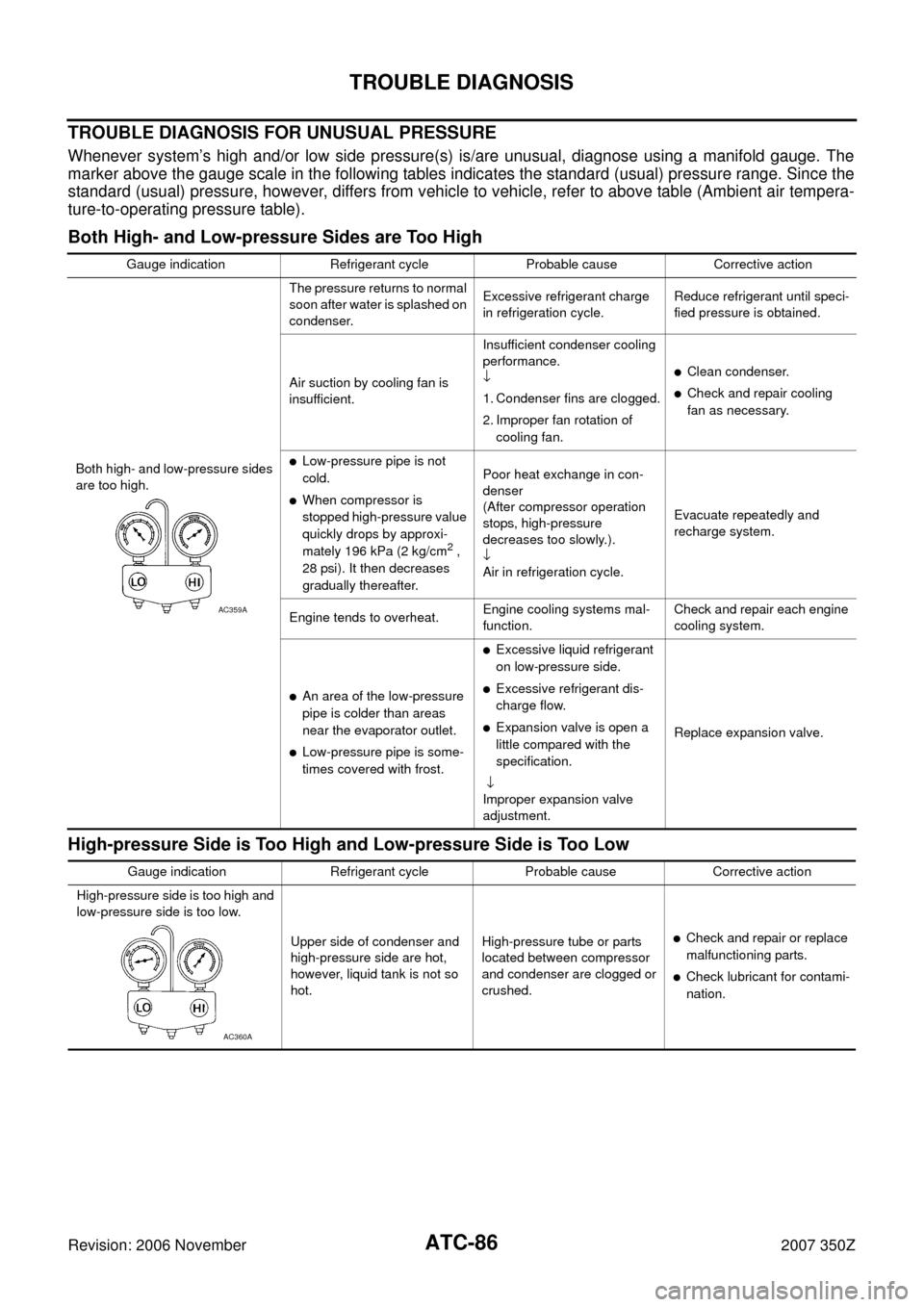
TROUBLE DIAGNOSIS FOR UNUSUAL PRESSURE
Whenever system’s high and/or low side pressure(s) is/are unusual, diagnose using a manifold gauge. The
marker above the gauge scale in the following tables indicates the standard (usual) pressure range. Since the
standard (usual) pressure, however, differs from vehicle to vehicle, refer to above table (Ambient air tempera-
ture-to-operating pressure table).
Both High- and Low-pressure Sides are Too High
High-pressure Side is Too High and Low-pressure Side is Too Low
Gauge indication Refrigerant cycle Probable cause Corrective action
Both high- and low-pressure sides
are too high.The pressure returns to normal
soon after water is splashed on
condenser.Excessive refrigerant charge
in refrigeration cycle.Reduce refrigerant until speci-
fied pressure is obtained.
Air suction by cooling fan is
insufficient.Insufficient condenser cooling
performance.
↓
1. Condenser fins are clogged.
2. Improper fan rotation of
cooling fan.
�Clean condenser.
�Check and repair cooling
fan as necessary.
�Low-pressure pipe is not
cold.
�When compressor is
stopped high-pressure value
quickly drops by approxi-
mately 196 kPa (2 kg/cm
2 ,
28 psi). It then decreases
gradually thereafter.Poor heat exchange in con-
denser
(After compressor operation
stops, high-pressure
decreases too slowly.).
↓
Air in refrigeration cycle.Evacuate repeatedly and
recharge system.
Engine tends to overheat.Engine cooling systems mal-
function.Check and repair each engine
cooling system.
�An area of the low-pressure
pipe is colder than areas
near the evaporator outlet.
�Low-pressure pipe is some-
times covered with frost.
�Excessive liquid refrigerant
on low-pressure side.
�Excessive refrigerant dis-
charge flow.
�Expansion valve is open a
little compared with the
specification.
↓
Improper expansion valve
adjustment.Replace expansion valve.
AC359A
Gauge indication Refrigerant cycle Probable cause Corrective action
High-pressure side is too high and
low-pressure side is too low.
Upper side of condenser and
high-pressure side are hot,
however, liquid tank is not so
hot.High-pressure tube or parts
located between compressor
and condenser are clogged or
crushed.
�Check and repair or replace
malfunctioning parts.
�Check lubricant for contami-
nation.
AC360A
Page 88 of 142
ATC-88
TROUBLE DIAGNOSIS
Revision: 2006 November2007 350Z
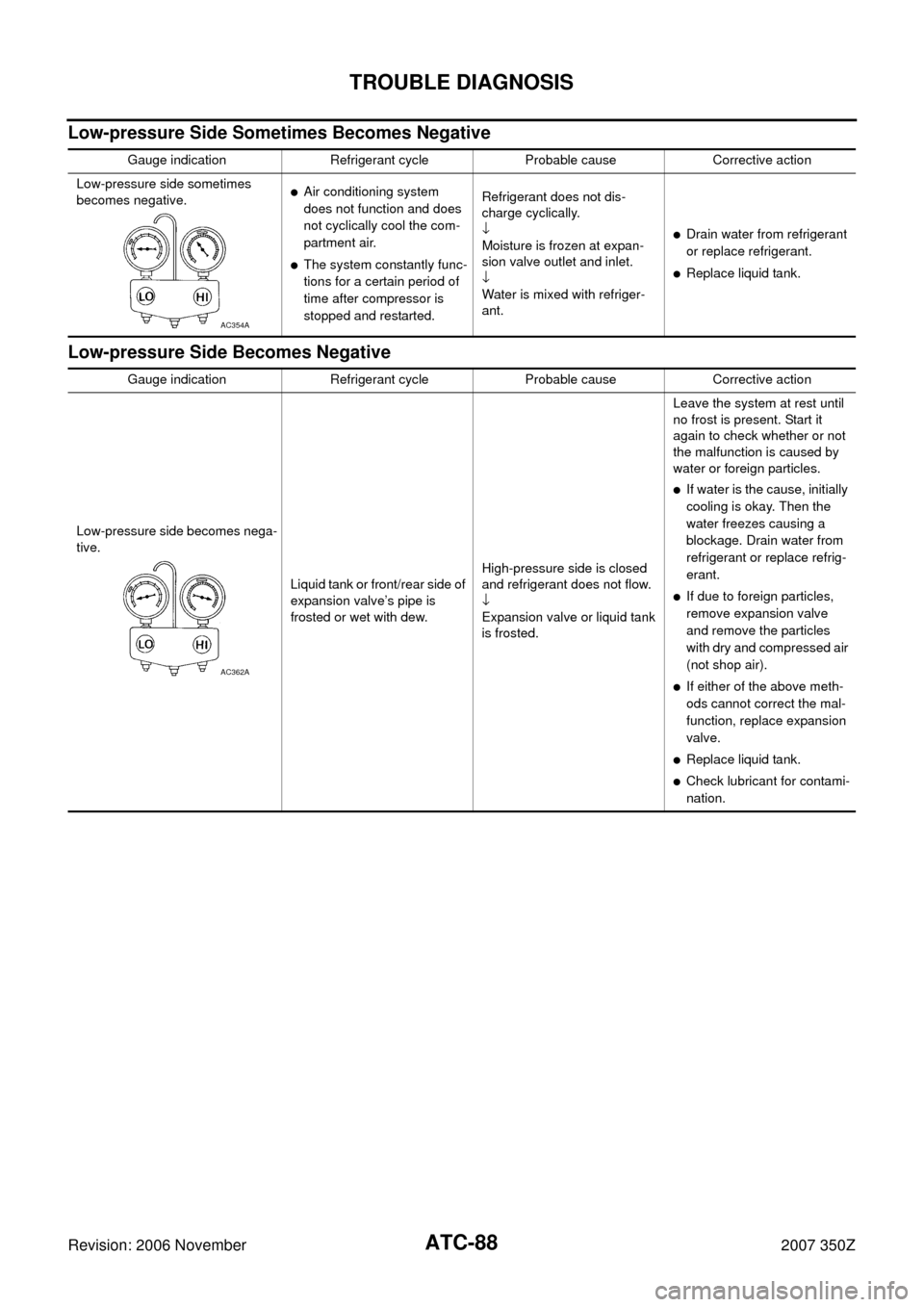
Low-pressure Side Sometimes Becomes Negative
Low-pressure Side Becomes Negative
Gauge indication Refrigerant cycle Probable cause Corrective action
Low-pressure side sometimes
becomes negative.
�Air conditioning system
does not function and does
not cyclically cool the com-
partment air.
�The system constantly func-
tions for a certain period of
time after compressor is
stopped and restarted.Refrigerant does not dis-
charge cyclically.
↓
Moisture is frozen at expan-
sion valve outlet and inlet.
↓
Water is mixed with refriger-
ant.
�Drain water from refrigerant
or replace refrigerant.
�Replace liquid tank.
AC354A
Gauge indication Refrigerant cycle Probable cause Corrective action
Low-pressure side becomes nega-
tive.
Liquid tank or front/rear side of
expansion valve’s pipe is
frosted or wet with dew.High-pressure side is closed
and refrigerant does not flow.
↓
Expansion valve or liquid tank
is frosted.Leave the system at rest until
no frost is present. Start it
again to check whether or not
the malfunction is caused by
water or foreign particles.
�If water is the cause, initially
cooling is okay. Then the
water freezes causing a
blockage. Drain water from
refrigerant or replace refrig-
erant.
�If due to foreign particles,
remove expansion valve
and remove the particles
with dry and compressed air
(not shop air).
�If either of the above meth-
ods cannot correct the mal-
function, replace expansion
valve.
�Replace liquid tank.
�Check lubricant for contami-
nation.
AC362A
Page 94 of 142
ATC-94
TROUBLE DIAGNOSIS
Revision: 2006 November2007 350Z
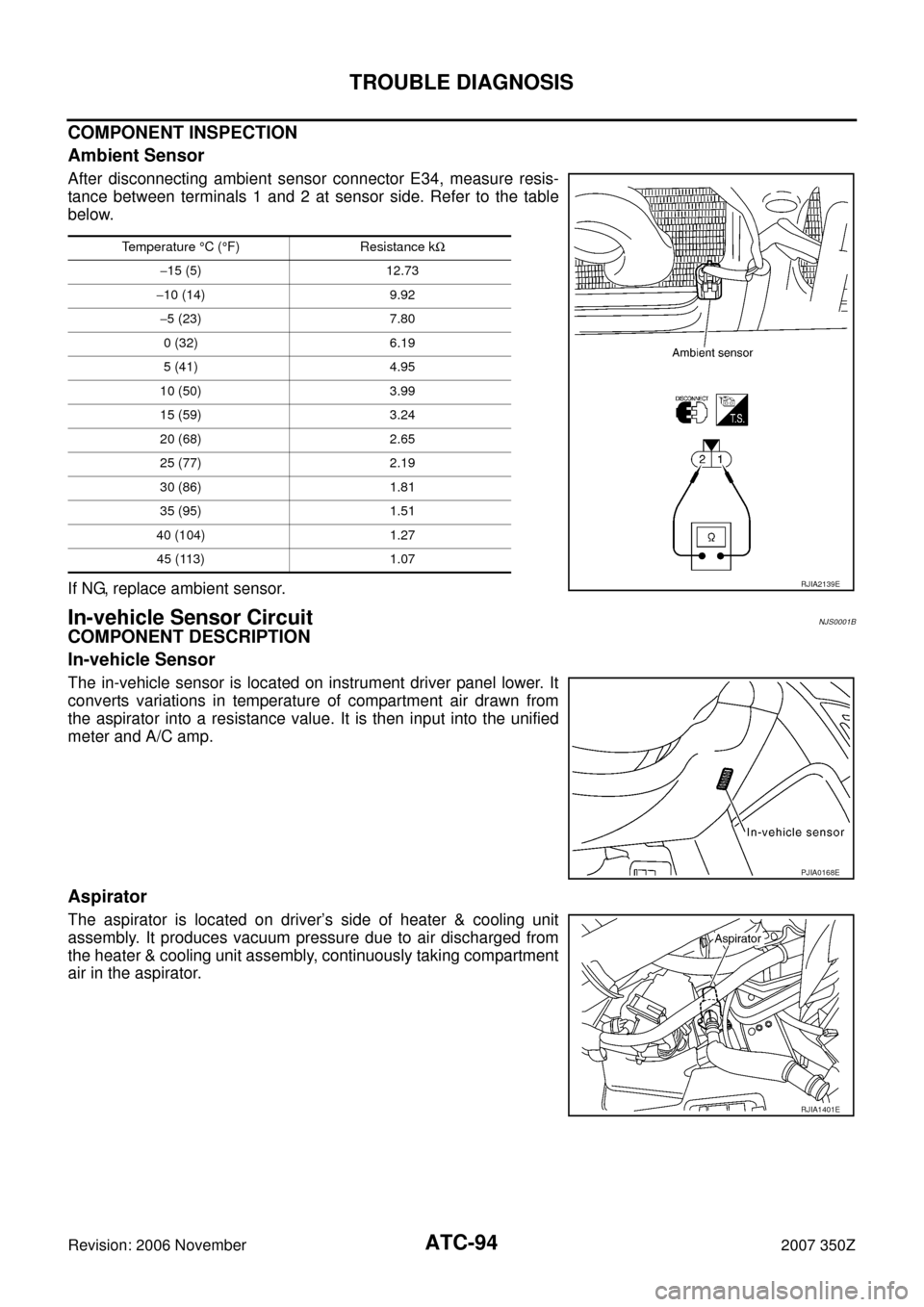
COMPONENT INSPECTION
Ambient Sensor
After disconnecting ambient sensor connector E34, measure resis-
tance between terminals 1 and 2 at sensor side. Refer to the table
below.
If NG, replace ambient sensor.
In-vehicle Sensor CircuitNJS0001B
COMPONENT DESCRIPTION
In-vehicle Sensor
The in-vehicle sensor is located on instrument driver panel lower. It
converts variations in temperature of compartment air drawn from
the aspirator into a resistance value. It is then input into the unified
meter and A/C amp.
Aspirator
The aspirator is located on driver’s side of heater & cooling unit
assembly. It produces vacuum pressure due to air discharged from
the heater & cooling unit assembly, continuously taking compartment
air in the aspirator.
Temperature °C (°F) Resistance kΩ
−15 (5) 12.73
−10 (14) 9.92
−5 (23) 7.80
0 (32) 6.19
5 (41) 4.95
10 (50) 3.99
15 (59) 3.24
20 (68) 2.65
25 (77) 2.19
30 (86) 1.81
35 (95) 1.51
40 (104) 1.27
45 (113) 1.07
RJIA2139E
PJIA0168E
RJIA1401E
Page 100 of 142
ATC-100
TROUBLE DIAGNOSIS
Revision: 2006 November2007 350Z
Intake Sensor CircuitNJS0001D
COMPONENT DESCRIPTION
Intake Sensor
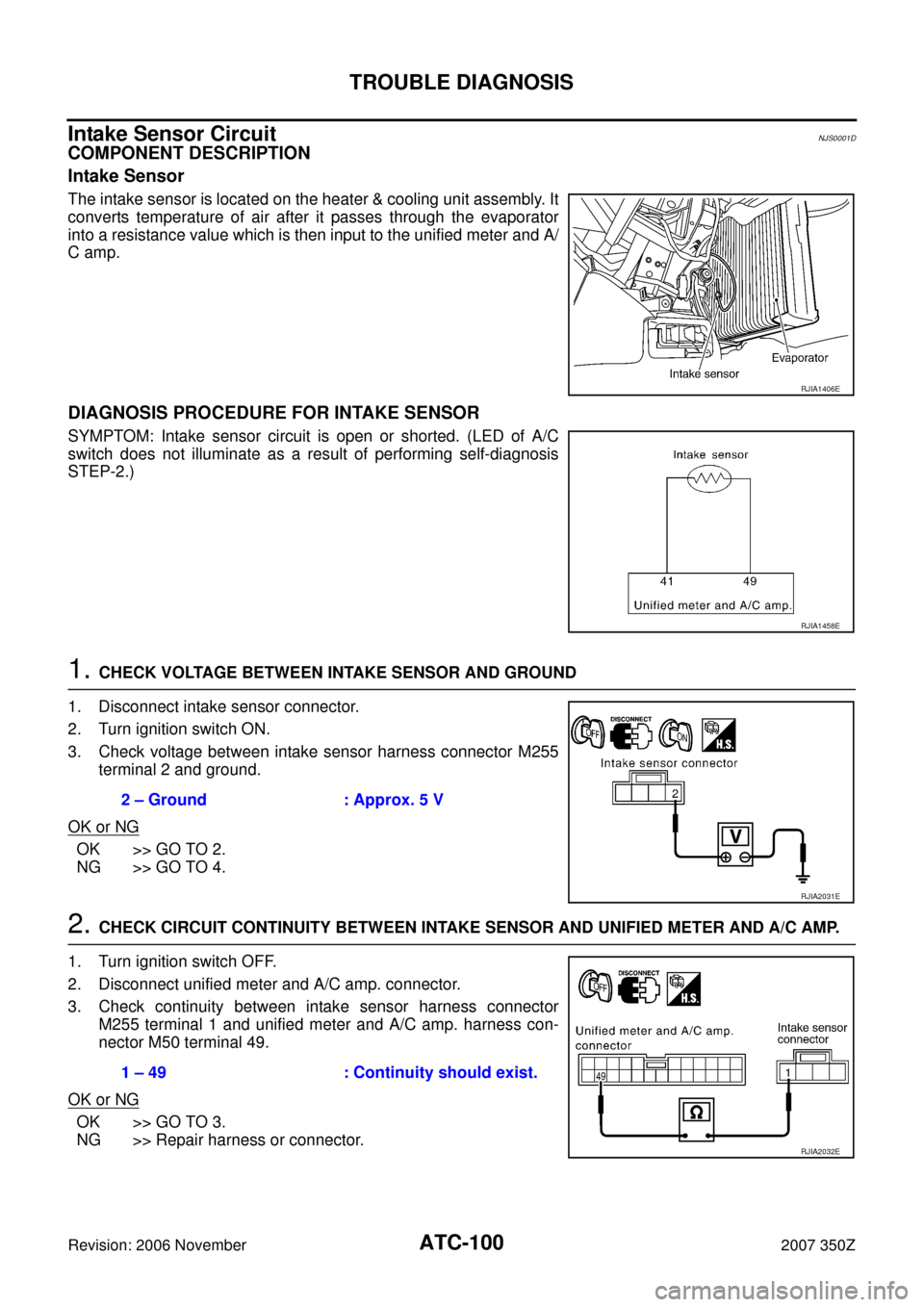
The intake sensor is located on the heater & cooling unit assembly. It
converts temperature of air after it passes through the evaporator
into a resistance value which is then input to the unified meter and A/
C amp.
DIAGNOSIS PROCEDURE FOR INTAKE SENSOR
SYMPTOM: Intake sensor circuit is open or shorted. (LED of A/C
switch does not illuminate as a result of performing self-diagnosis
STEP-2.)
1. CHECK VOLTAGE BETWEEN INTAKE SENSOR AND GROUND
1. Disconnect intake sensor connector.
2. Turn ignition switch ON.
3. Check voltage between intake sensor harness connector M255
terminal 2 and ground.
OK or NG
OK >> GO TO 2.
NG >> GO TO 4.
2. CHECK CIRCUIT CONTINUITY BETWEEN INTAKE SENSOR AND UNIFIED METER AND A/C AMP.
1. Turn ignition switch OFF.
2. Disconnect unified meter and A/C amp. connector.
3. Check continuity between intake sensor harness connector
M255 terminal 1 and unified meter and A/C amp. harness con-
nector M50 terminal 49.
OK or NG
OK >> GO TO 3.
NG >> Repair harness or connector.
RJIA1406E
RJIA1458E
2 – Ground : Approx. 5 V
RJIA2031E
1 – 49 : Continuity should exist.
RJIA2032E
Page 112 of 142
ATC-112
HEATER & COOLING UNIT ASSEMBLY
Revision: 2006 November2007 350Z
HEATER & COOLING UNIT ASSEMBLYPFP:27110
Removal and InstallationNJS0001O
REMOVAL
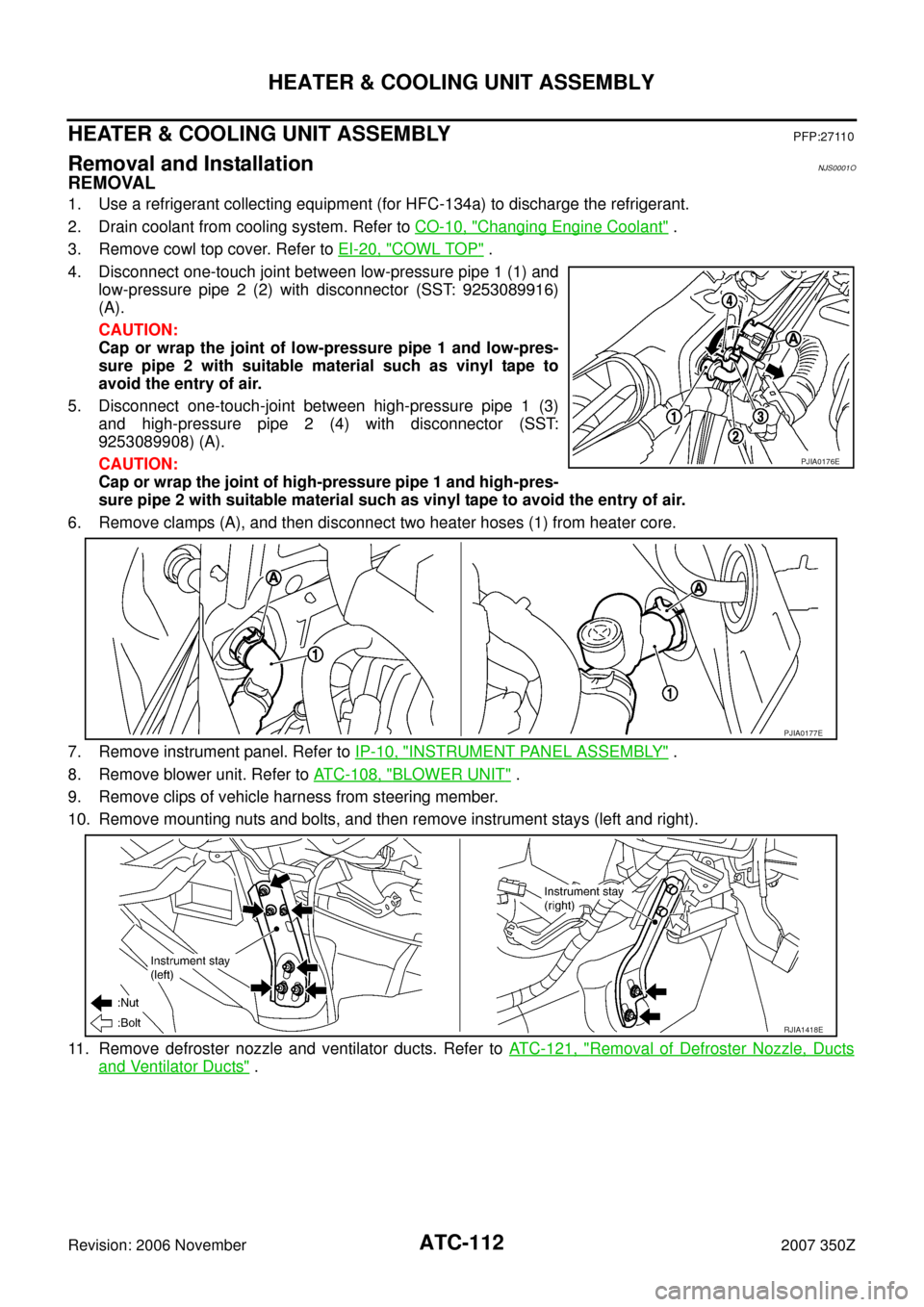
1. Use a refrigerant collecting equipment (for HFC-134a) to discharge the refrigerant.
2. Drain coolant from cooling system. Refer to CO-10, "
Changing Engine Coolant" .
3. Remove cowl top cover. Refer to EI-20, "
COWL TOP" .
4. Disconnect one-touch joint between low-pressure pipe 1 (1) and
low-pressure pipe 2 (2) with disconnector (SST: 9253089916)
(A).
CAUTION:
Cap or wrap the joint of low-pressure pipe 1 and low-pres-
sure pipe 2 with suitable material such as vinyl tape to
avoid the entry of air.
5. Disconnect one-touch-joint between high-pressure pipe 1 (3)
and high-pressure pipe 2 (4) with disconnector (SST:
9253089908) (A).
CAUTION:
Cap or wrap the joint of high-pressure pipe 1 and high-pres-
sure pipe 2 with suitable material such as vinyl tape to avoid the entry of air.
6. Remove clamps (A), and then disconnect two heater hoses (1) from heater core.
7. Remove instrument panel. Refer to IP-10, "
INSTRUMENT PANEL ASSEMBLY" .
8. Remove blower unit. Refer to ATC-108, "
BLOWER UNIT" .
9. Remove clips of vehicle harness from steering member.
10. Remove mounting nuts and bolts, and then remove instrument stays (left and right).
11. Remove defroster nozzle and ventilator ducts. Refer to ATC-121, "
Removal of Defroster Nozzle, Ducts
and Ventilator Ducts" .
PJIA0176E
PJIA0177E
RJIA1418E
Page 113 of 142
HEATER & COOLING UNIT ASSEMBLY
ATC-113
C
D
E
F
G
H
I
K
L
MA
B
AT C
Revision: 2006 November2007 350Z
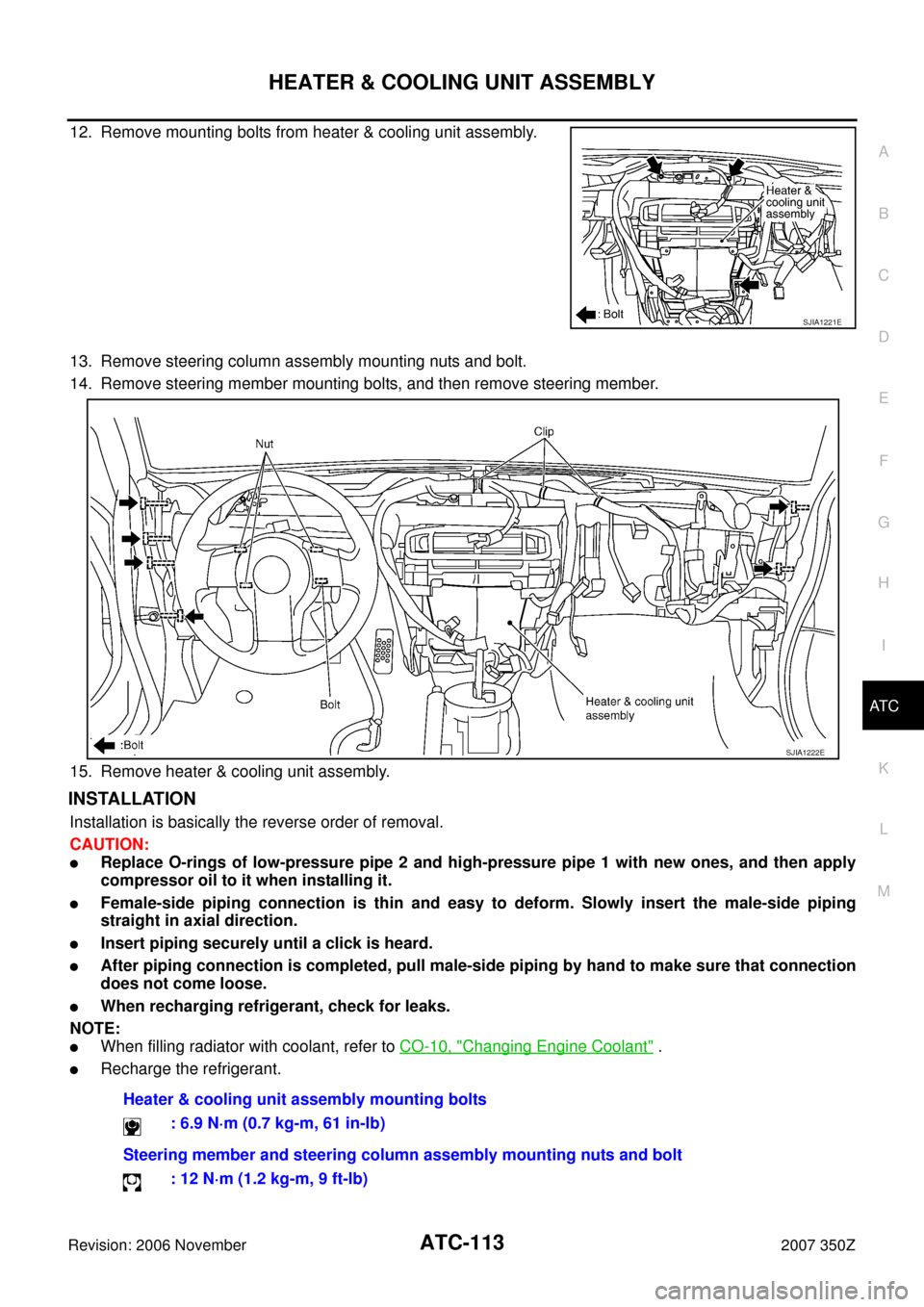
12. Remove mounting bolts from heater & cooling unit assembly.
13. Remove steering column assembly mounting nuts and bolt.
14. Remove steering member mounting bolts, and then remove steering member.
15. Remove heater & cooling unit assembly.
INSTALLATION
Installation is basically the reverse order of removal.
CAUTION:
�Replace O-rings of low-pressure pipe 2 and high-pressure pipe 1 with new ones, and then apply
compressor oil to it when installing it.
�Female-side piping connection is thin and easy to deform. Slowly insert the male-side piping
straight in axial direction.
�Insert piping securely until a click is heard.
�After piping connection is completed, pull male-side piping by hand to make sure that connection
does not come loose.
�When recharging refrigerant, check for leaks.
NOTE:
�When filling radiator with coolant, refer to CO-10, "Changing Engine Coolant" .
�Recharge the refrigerant.
SJIA1221E
SJIA1222E
Heater & cooling unit assembly mounting bolts
: 6.9 N·m (0.7 kg-m, 61 in-lb)
Steering member and steering column assembly mounting nuts and bolt
: 12 N·m (1.2 kg-m, 9 ft-lb)
Page 114 of 142
ATC-114
HEATER & COOLING UNIT ASSEMBLY
Revision: 2006 November2007 350Z
Disassembly and AssemblyNJS0001P
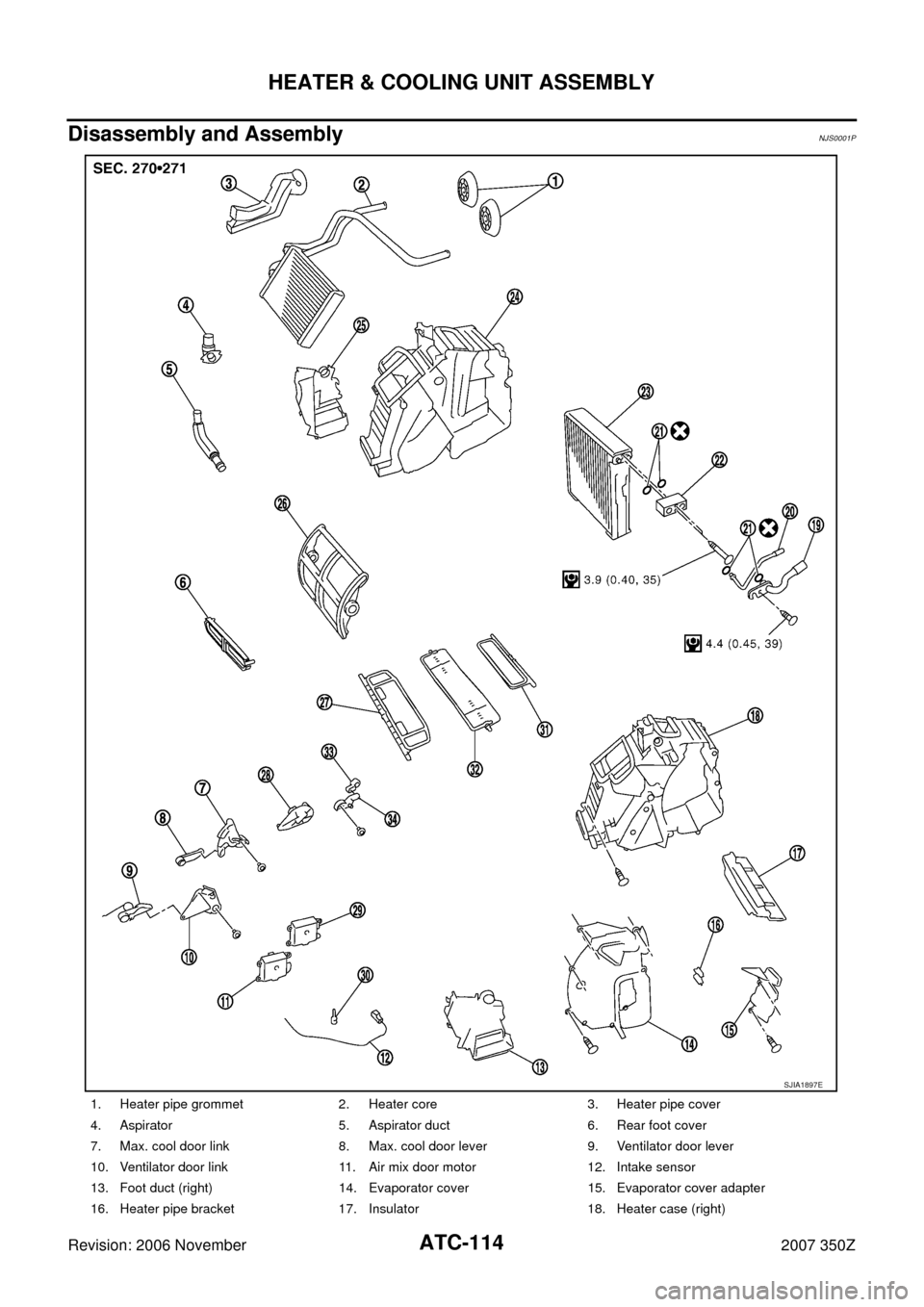
1. Heater pipe grommet 2. Heater core 3. Heater pipe cover
4. Aspirator 5. Aspirator duct 6. Rear foot cover
7. Max. cool door link 8. Max. cool door lever 9. Ventilator door lever
10. Ventilator door link 11. Air mix door motor 12. Intake sensor
13. Foot duct (right) 14. Evaporator cover 15. Evaporator cover adapter
16. Heater pipe bracket 17. Insulator 18. Heater case (right)
SJIA1897E
Page 115 of 142
HEATER & COOLING UNIT ASSEMBLY
ATC-115
C
D
E
F
G
H
I
K
L
MA
B
AT C
Revision: 2006 November2007 350Z
19. Low-pressure pipe 1 20. High-pressure pipe 2 21. O-ring
22. Expansion valve 23. Evaporator 24. Heater case (left)
25. Foot duct (left) 26. Air mix door (slide door) 27. Ventilator door
28. Side link 29. Mode door motor 30. Intake sensor bracket
31. Defroster door 32. Max. cool door 33. Defroster door lever
34. Defroster door link
: N·m (kg-m, in-lb)
: Always replace after every disassembly.