Page 252 of 481
251 Controls in detail
Useful features
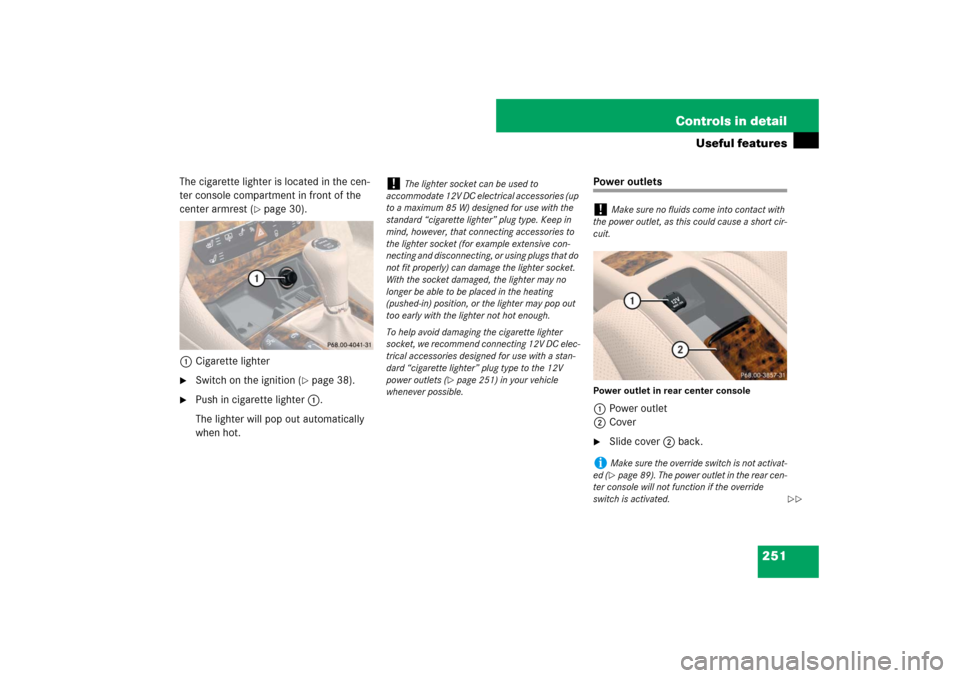
The cigarette lighter is located in the cen-
ter console compartment in front of the
center armrest (
�page 30).
1Cigarette lighter
�
Switch on the ignition (
�page 38).
�
Push in cigarette lighter1.
The lighter will pop out automatically
when hot.
Power outletsPower outlet in rear center console1Power outlet
2Cover�
Slide cover2 back.
!
The lighter socket can be used to
accommodate 12V DC electrical accessories (up
to a maximum 85 W) designed for use with the
standard “cigarette lighter” plug type. Keep in
mind, however, that connecting accessories to
the lighter socket (for example extensive con-
necting and disconnecting, or using plugs that do
not fit properly) can damage the lighter socket.
With the socket damaged, the lighter may no
longer be able to be placed in the heating
(pushed-in) position, or the lighter may pop out
too early with the lighter not hot enough.
To help avoid damaging the cigarette lighter
socket, we recommend connecting 12V DC elec-
trical accessories designed for use with a stan-
dard “cigarette lighter” plug type to the 12V
power outlets (
�page 251) in your vehicle
whenever possible.
!
Make sure no fluids come into contact with
the power outlet, as this could cause a short cir-
cuit.
i
Make sure the override switch is not activat-
ed (�page 89). The power outlet in the rear cen-
ter console will not function if the override
switch is activated.
��
Page 253 of 481
252 Controls in detailUseful featuresPower outlet in trunk1Power outlet
Heated steering wheel (Canada only)
The steering wheel heating warms up the
leather area of the steering wheel.
The stalk is on the lower left-hand side of
the steering wheel.
1Switching on
2Switching off
3Indicator lampSwitching on
�
Switch on the ignition (
�page 38).
�
Turn switch at the tip of stalk in direc-
tion of arrow1.
The steering wheel is heated. Indicator
lamp3 comes on.
i
The power outlet can be used to accommo-
date 12-V DC electrical accessories (e.g. air
pump, auxiliary lamps) up to a maximum 180 W.
i
The steering wheel heating is temporarily
suspended while indicator lamp3 remains on
when
�
the temperature of the vehicle interior is
above 86°F (30°C)
�
the temperature of the steering wheel is
above 95°F (35°C)
When these conditions do not apply anymore,
steering wheel heating continues.
��
Page 254 of 481

253 Controls in detail
Useful features
Switching off�
Turn switch at the tip of stalk in direc-
tion of arrow2.
The heated steering wheel is switched
off. Indicator lamp3 goes out.
For information on steering wheel, see
“Multifunction steering wheel”
(
�page 142).
Floormats
1Retainer pins
2Eyelets
Removing
�
Pull floormats off of retainer pins1.
�
Remove the floormats.
Installing
�
Lay down the floormat.
�
Press the floormat eyelets2 onto re-
tainer pins1.
i
Indicator lamp3 flashes or goes out
�
in case of power surge or undervoltage
�
in case of a steering wheel heating malfunc-
tion
i
The steering wheel heating switches off au-
tomatically when you remove the SmartKey from
the starter switch or, on vehicles with
KEYLESS-GO*, when you switch off the ignition
(
�page 61) and open the driver’s door.
Warning!
G
Whenever you are using floormats, make
sure there is enough clearance and that the
floormats are securely fastened.
Floormats should always be securely fas-
tened using eyelets2 and retainer pins1.
Before driving off, check that the floormats
are securely in place and adjust them if nec-
essary. A loose floormat could slip and
hinder proper functioning of the pedals.
Do not place several floormats on top of
each other as this may impair pedal
movement.
i
To install or remove the floormat more easi-
ly, move the driver’s seat or front passenger seat
as far to the rear as possible (
�page 42).
Page 273 of 481

272 OperationDriving instructionsPower assistance
Brakes
To help prevent brake disk corrosion after
driving on wet road surfaces (particularly
salted roads), it is advisable to brake the
vehicle with considerable force prior to
parking. The heat generated serves to dry
the brakes.
If your brake system is normally only sub-
jected to moderate loads, you should occa-
sionally test the effectiveness of the
brakes by applying above-normal braking
pressure at higher speeds. This will also
enhance the grip of the brake pads.
Warning!
G
With the engine not running, there is no
power assistance for the brake and steering
systems. In this case, it is important to keep
in mind that a considerably higher degree of
effort is necessary to brake and steer the
vehicle.
Warning!
G
After driving in heavy rain for some time
without applying the brakes or through wa-
ter deep enough to wet brake components,
the first braking action may be somewhat
reduced and increased pedal pressure may
be necessary to obtain expected braking ef-
fect. Maintain a safe distance from vehicles
in front.
Resting your foot on the brake pedal will
cause excessive and premature wear of the
brake pads.
It can also result in the brakes overheating,
thereby significantly reducing their effec-
tiveness. It may not be possible to stop the
vehicle in sufficient time to avoid an acci-
dent.
!
Because the ESP
® operates automatically,
the engine and ignition must be shut off
(SmartKey in starter switch position0 or1 or
KEYLESS-GO* start/stop button in position0
or1) when testing the brakes on a brake test dy-
namometer and such testing should be no longer
than 10 seconds.
Active braking action through ESP
® may other-
wise seriously damage the brake system which is
not covered by the Mercedes-Benz Limited War-
ranty.
Page 274 of 481

273 Operation
Driving instructions
Refer to the description of the Brake Assist
System (BAS) (
�page 92).Brake pad wear or a leak in the system may
be the reason for low brake fluid in the res-
ervoir.
The brake fluid level in the reservoir may
be too low if the brake warning lamp in the
instrument cluster comes on and an
acoustic warning sounds although the
parking brake is released (
�page 344).
Observe additional messages in the multi-
function display that may appear
(
�page 372).
Have the brake system inspected immedi-
ately. Contact an authorized
Mercedes-Benz Center.
All checks and service work on the brake
system should be carried out by qualified
technicians only. Contact an authorized
Mercedes-Benz Center.
Only install brake pads and brake fluid
recommended by Mercedes-Benz.After hard braking, it is advisable to drive
on for some time, rather than immediately
park, so that the air stream will cool down
the brakes faster.
Warning!
G
Make sure not to endanger any other road
users when carrying out these braking ma-
neuvers.
Warning!
G
If other than recommended brake pads are
installed, or other than recommended brake
fluid is used, the braking properties of the
vehicle can be degraded to an extent that
safe braking is substantially impaired. This
could result in an accident.
Be certain to read and observe the warning
notices on brake pad replacement
(�page 371).
!
When driving down long and steep grades,
relieve the load on the brakes by shifting into a
lower gear to use the engine’s braking power.
This helps prevent overheating of the brakes and
reduces brake pad wear.
Page 348 of 481

347 Practical hints
What to do if …
Problem
Possible cause/consequence
Suggested solution
D
The red coolant temperature
warning lamp comes on when
the engine is running.
There is insufficient coolant in the reservoir.
If this warning lamp comes on frequently,
there is a leak in the cooling system.
If the coolant level is correct, the electric
radiator fan may be broken.
�
Immediately add coolant to prevent
engine from overheating
(�page 290).
�
Have the cooling system checked.
�
If the coolant temperature is below
248°F (120°C), you can continue
driving to the nearest authorized
Mercedes-Benz Center.
�
Avoid high engine loads (e.g. driving
uphill) and stop-and-go driving.
D
The red coolant temperature
warning lamp comes on while
driving and you hear a warning
sound.
The coolant temperature has exceeded
248°F (120°C).
�
Stop in a safe location as soon as pos-
sible and allow the engine and coolant
to cool down.
Warning!
G
Driving when your engine is badly overheat-
ed can cause some fluids which may have
leaked into the engine compartment to
catch fire. You could be seriously burned.
Steam from an overheated engine can cause
serious burns and can occur just by opening
the engine hood. Stay away from the engine
if you see or hear steam coming from it.
Turn off the engine, get out of the vehicle
and do not stand near the vehicle until the
engine has cooled down.
