2007 KIA Sorento lock
[x] Cancel search: lockPage 174 of 325

Driving your vehicle44
4Low washer fluid level
warning indicator
(If equipped) This warning light indicates the washer
fluid reservoir is near empty. Refill the
washer fluid as soon as possible.4WD system warning
(if equipped) When the key is turned to the “ON” posi-
tion, the 4WD indicator light will come on
and then go off in a few seconds.
The 4WD indicator light will illuminate
when the transfer shift knob is set to 4HI
position (Part time 4WD only).
4WD LOW indicator light
(if equipped) When the key is turned to the “ON” posi-
tion, the 4WD LOW indicator will come
on and then go off in a few seconds. The
4WD LOW indicator light comes on when
the transfer shift knob is set to 4WD LOW
position.
Part-time 4WD : 4LO position
Full-time 4WD : Low position
Safety belt warning chime If the driver's safety belt is not fastened
when the ignition key is turned ON or if it
is unfastened after the key is ON, the
safety belt warning chime will sound for
approximately 6 seconds. At this time, if
the safety belt is fastened, the chime will
stop at once.Door ajar warning chime
(if equipped)If a door is opened while driving the vehi-
cle more than 3 mph (5 km/h), the warn-
ing chime will sound.Key reminder warning chime
(if equipped)If the driver’s door is opened while the
ignition key is left in the ignition switch,
the key reminder warning chime will
sound. This is to prevent you from locking
your keys in the vehicle.
CAUTION
If the 4WD indicator light ( )
blinks (full-time 4WD) or 4WD indi-cator light ( ) and 4WD LOW indi- cator light
()
illuminate at the
same time (part time 4WD), this indicates that there is a malfunctionin the 4WD system. If this occurs,have your vehicle checked by an Authorized Kia Dealer as soon aspossible.
4WD
LOW
4WD
LOW
Page 192 of 325
Driving your vehicle62
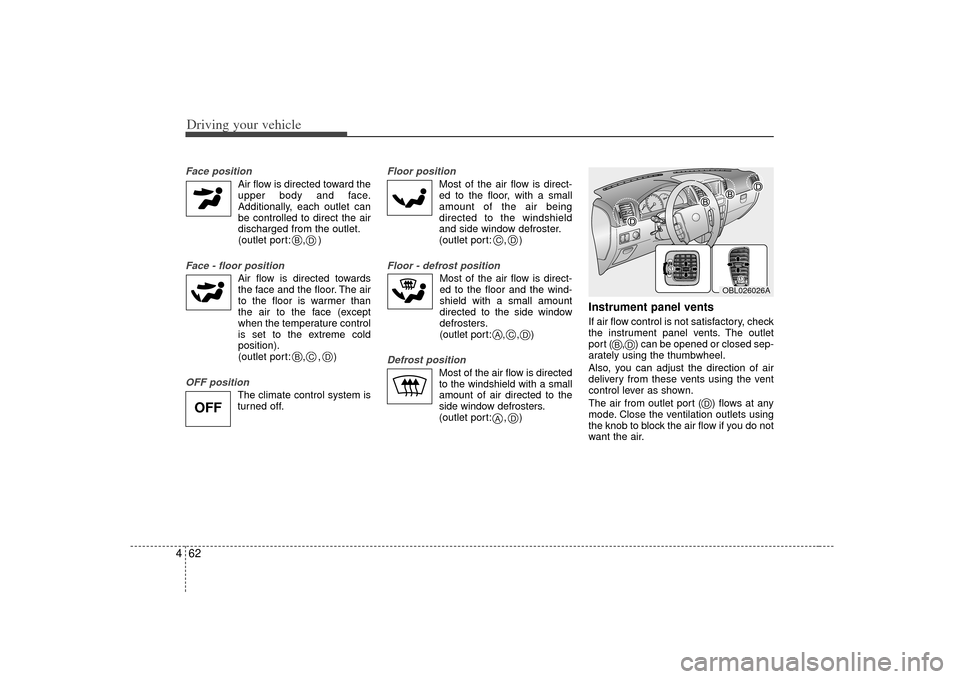
4Face position
Air flow is directed toward the
upper body and face.
Additionally, each outlet can
be controlled to direct the air
discharged from the outlet.
(outlet port: , )
Face - floor position
Air flow is directed towardsthe face and the floor. The air
to the floor is warmer than
the air to the face (except
when the temperature control
is set to the extreme cold
position).
(outlet port: , , )
OFF position
The climate control system is
turned off.
Floor position
Most of the air flow is direct-
ed to the floor, with a small
amount of the air being
directed to the windshield
and side window defroster.
(outlet port: , )
Floor - defrost position
Most of the air flow is direct-
ed to the floor and the wind-
shield with a small amount
directed to the side window
defrosters.
(outlet port:
, ,
)
Defrost position
Most of the air flow is directed
to the windshield with a small
amount of air directed to the
side window defrosters.
(outlet port: , )
Instrument panel ventsIf air flow control is not satisfactory, check
the instrument panel vents. The outlet
port ( , ) can be opened or closed sep-
arately using the thumbwheel.
Also, you can adjust the direction of air
delivery from these vents using the vent
control lever as shown.
The air from outlet port ( ) flows at any
mode. Close the ventilation outlets using
the knob to block the air flow if you do not
want the air.
BB
C
D
D
C
C
A
D
D
A
D
B
D
D
OFF
OBL026026A
Page 202 of 325
Driving your vehicle72
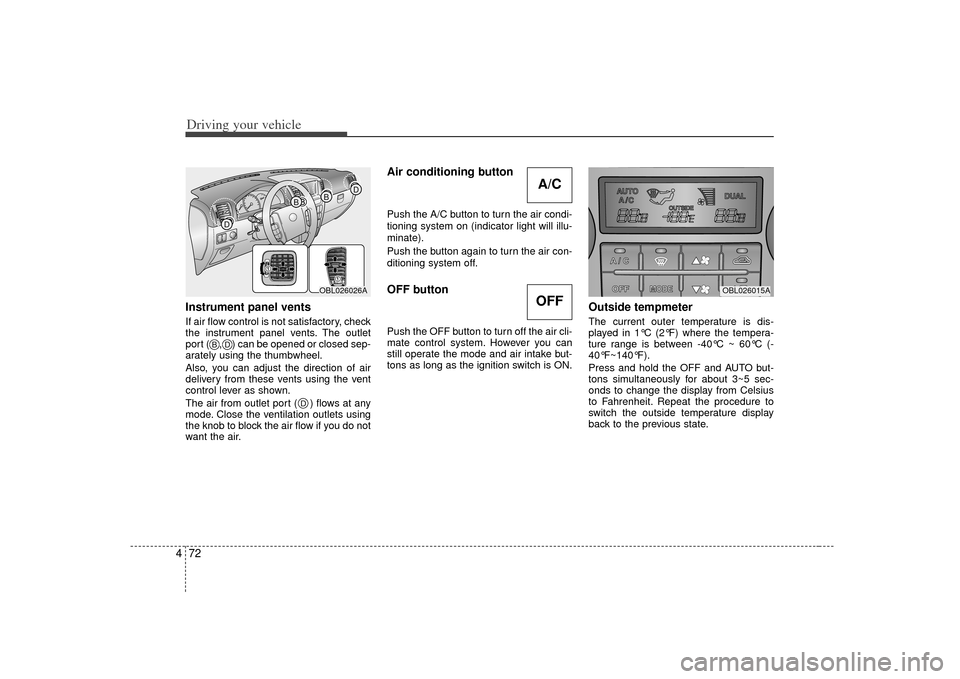
4Instrument panel ventsIf air flow control is not satisfactory, check
the instrument panel vents. The outlet
port ( , ) can be opened or closed sep-
arately using the thumbwheel.
Also, you can adjust the direction of air
delivery from these vents using the vent
control lever as shown.
The air from outlet port ( ) flows at any
mode. Close the ventilation outlets using
the knob to block the air flow if you do not
want the air.
Air conditioning button Push the A/C button to turn the air condi-
tioning system on (indicator light will illu-
minate).
Push the button again to turn the air con-
ditioning system off.OFF buttonPush the OFF button to turn off the air cli-
mate control system. However you can
still operate the mode and air intake but-
tons as long as the ignition switch is ON.
Outside tempmeter The current outer temperature is dis-
played in 1°C (2°F) where the tempera-
ture range is between -40°C ~ 60°C (-
40°F~140°F).
Press and hold the OFF and AUTO but-
tons simultaneously for about 3~5 sec-
onds to change the display from Celsius
to Fahrenheit. Repeat the procedure to
switch the outside temperature display
back to the previous state.
OBL026026A
D
D
B
B
B
D
D
A/COFF
MODE
OBL026015A
Page 213 of 325

55
Driving tips
BEFORE DRIVING Before entering vehicle: Be sure that all windows, outside mir-ror(s), and outside lights are clean.
Check the condition of the tires.
Check under the vehicle for any sign of leaks.
Be sure there are no obstacles behind you if you intend to back up.Necessary inspections Fluid levels, such as engine oil, engine
coolant, brake fluid, and washer fluid
should be checked on a regular basis,
with the exact interval depending on the
fluid. Further details are provided in
Section 7, Maintenance.
Before starting Close and lock all doors.
Position the seat so that all controls areeasily reached.
Adjust the inside and outside rearview mirrors.
Be sure that all lights work.
Check all gauges.
Check the operation of warning lights when the ignition switch is turned to
the ON position.
Release the parking brake and make sure the brake warning light goes out.
For safe operation, be sure you are famil-
iar with your vehicle and its equipment.
WARNING
- Driving under
the influence of alcohol or
drugs
Drinking and driving is dangerous.
Drunk driving is the number one
contributor to the highway death
toll each year. Even a small amount
of alcohol will affect your reflexes,
perceptions and judgement. Driving
while under the influence of drugs
is as dangerous or more dangerous
than driving drunk.
You are much more likely to have a
serious accident if you drink or take
drugs and drive.
If you are drinking or taking drugs,
don’t drive. Do not ride with a driv-
er who has been drinking or taking
drugs. Choose a designated driver
or call a cab.
Page 217 of 325

59
Driving tips
Winter driving We recommend that you carry emer-gency equipment, including tire chains,
a window scraper, windshield deicer, a
bag of sand or salt, flares, a small
shovel and jumper cables.
Make sure you have sufficient ethylene glycol coolant in the radiator.
Check the battery condition and cables. Cold temperatures reduce the
capacity of any battery, so it must be in
excellent condition to provide enough
winter starting power.
Make sure the engine oil viscosity is suitable for cold weather.
Check the ignition system for loose connections and damage.
Use antifreeze formulated windshield washer fluid. (Do not use engine
coolant antifreeze.)
Do not use the parking brake if it might freeze. When parking, shift to 1 (First)
or R (Reverse) with a manual trans-
mission or P (Park) with an automatic
transmission and block the rear
wheels.
Snow tires If you mount snow tires on your Kia,
make sure they are radial tires of the
same size and load range as the original
tires. Mount snow tires on all four wheels
to balance your vehicle’s handling in all
weather conditions. Keep in mind that the
traction provided by snow tires on dry
roads may not be as high as your vehi-
cle's original equipment tires. You should
drive cautiously even when the roads are
clear. Check with the tire dealer for max-
imum speed recommendations.Do not install studded tires without firstchecking local, state and municipal regu-lations for possible restrictions againsttheir use.
Driving in flooded areas Avoid driving through flooded areas
unless you are sure the water is no high-
er than the bottom of the wheel hub.
Drive through any water slowly. Allow
adequate stopping distance because
brake performance may be affected.
After driving through water, dry the
brakes by gently applying them several
times while the vehicle is moving slowly.
WARNING
- Snow tire size
Snow tires should be equivalent in
size and type to the vehicle's stan-
dard tires. Otherwise, the safety and
handling of your vehicle may be
adversely affected.
Page 225 of 325
517
Driving tips
Driving on off-road hillsOff-road driving often takes you up,
down, or across a hill. Driving safely on
hills requires excellent judgment and an
understanding of what your vehicle can
and can’t do. There are some hills that
simply should not be driven.
Approaching a hillWhen you approach a hill, you need to
decide if it’s one of those hills that’s just
too steep to climb, descend, or cross.
Steepness can be difficult to judge. On a
very small hill, for example, there may be
a smooth, constant incline with only a
small change in elevation where you can
easily see all the way to the top. On a
large hill, the incline may get steeper as
you near the top, but you may not see
this because the crest of the hill is hidden
by bushes, grass, or shrubs.
Here are some other things to consider
as you approach a hill:
Is there a constant incline, or does thehill get sharply steeper in places?
Is there good traction on the hillside, or will the surface cause tire slipping?
Is there a straight path up or down the hill so you won’t have to make turning
maneuvers?
Are there obstructions on the hill that can block your path (boulders, trees,
logs or ruts)? What’s beyond the hill? Is there a cliff,
an embankment, a drop-off, or a
fence? Get out of the vehicle and walk
the hill if you are unsure. It’s the smart
way to find out.
Is the hill simply too rough? Steep hills often have ruts, gullies, troughs, and
exposed rocks because they are more
susceptible to the effects of erosion.
How have weather conditions affected the terrain? Is there likely to be mud,
snow or ice on the hill?
What time of day is it? Are tempera- tures dropping so that wet surfaces will
start to freeze?
WARNING -
Driving on
hills
Many hills are simply too steep for
any vehicle. If you drive up them,
you will stall. If you drive down
them, you can’t control your speed.
In either case, you could flip over. If
you drive across them, you will roll
over. You could be seriously or
fatally injured. If you have any
doubt about the steepness, don’t
drive up or down the hill, even if it
means that you have to turn around
and find another route. Re-tracking
is a normal part of safe off-roading.
Page 226 of 325
Driving tips18
5Driving uphillOnce you decide you can safely drive up
the hill, you need to take some special
steps.
Use a low gear and get a firm grip on
the steering wheel.
Get a smooth start up the hill and try to maintain your speed. Don’t use more
power than you need, because you
don’t want your wheels to start spin-
ning or sliding.
Try to drive straight up the hill, if at all possible. If the path twists and turns,
you may have to find another route. Slow down as you approach the top of
the hill.
Attach a flag to the vehicle to make you more visible to approaching traffic on
trails or hills.
Sound the horn as you approach the top of the hill to let opposing traffic
know you’re there.
Use your headlights even during the day. They make you more visible to
other drivers.
Stalling while driving uphill
What should I do if my vehicle stalls, or isabout to stall, and I can’t make it up thehill?If your vehicle stalls, or is about to stall
while driving uphill, there are some
things you should do, and there are some
things you must not do. First, here’s what
you should do:
Push the brake pedal to stop the vehi- cle and keep it from rolling backwards.
Also, apply the parking brake.
If your engine is still running, shift the transmission into reverse, release the
parking brake, and slowly back down
the hill in reverse.
If your engine has stopped running, you’ll need to restart it. With the brake
pedal depressed and the parking
brake still applied, shift a manual trans-
mission to N (Neutral), or an automatic
transmission to P (Park) and restart
the engine. Then, shift to reverse,
release the parking brake, and slowly
back down the hill in reverse.
As you are backing down the hill, put your left hand on the steering wheel at
the 12 o’clock position. This way, you’ll
be able to tell if your wheels are
straight or turned to the left or right as
you back down.
WARNING -
Driving across
hills
Turning or driving across steep
hills can be dangerous. You could
lose traction, slide sideways, or just
reach an area too steep to traverse.
In any case, it could cause you to
roll over. You could be seriously or
fatally injured. When driving up
hills, always try to go as straight up
as possible.
WARNING
- Driving overhills
Driving to the top (crest) of a hill at
full speed can cause an accident
and result in serious or fatal injury.
There could be a drop-off, embank-
ment, cliff, another vehicle or peo-
ple sitting on the ground. As you
near the top of a hill, slow down and
stay alert.
Page 228 of 325
Driving tips20
5Driving downhillGoing downhill can be considerably more
dangerous than driving uphill. When off-
roading takes you downhill, you’ll want to
consider many of the same things you
thought about before you went uphill. As
a brief reminder, those include:
How steep is the downhill? Will I be
able to maintain vehicle control?
What’s the surface like? Smooth? Rough? Slippery? Hard-packed dirt?
Gravel?
Are there hidden surface obstacles? Ruts? Logs? Boulders?
What’s at the bottom of the hill? Is there a hidden creek bank or even a
river bottom with large rocks?
Have changes in the weather condi- tions and their effect on the terrain
since you went uphill made your task
more difficult?
Once you have decided that you can go
down a hill safely, try to keep your vehicle
headed straight down, and use a low
gear. This way, engine braking can help
your brakes so they won’t have to do all
the work. Descend slowly, keeping your
vehicle under control at all times. Avoid turns that take you across the
incline of the hill. A hill that’s not too
steep to drive down may be too steep to
drive across. You could roll over if you
don’t drive straight down.
Never go downhill with the clutch pedal
depressed. This is called “free-wheeling.”
Your brakes will have to do all the work
and could overheat and fade.
If your wheels lock up during downhill
braking, you may feel the vehicle starting
to slide sideways. To regain your direc-
tion, just ease off the brakes and steer to
keep the front of the vehicle pointing
straight downhill.
WARNING
- Braking
Heavy braking when going down a
hill can cause your brakes to over-
heat and fade. This could cause
loss of control and a serious acci-
dent. Apply the brakes lightly when
descending a hill and use a low
gear to keep vehicle speed under
control.
WARNING
- Wheel locking
Avoid braking so hard that you lock
the wheels when going downhill. If
your front wheels are locked, you
can’t steer your vehicle.
WARNING
- Downhill
Before beginning to go downhill, it
is critical that you ensure that no
cargo can shift forward while you
are heading downhill. Such shifting
could either endanger you and your
occupants, or interfere with your
ability to control the vehicle.