2007 KIA Sedona lug
[x] Cancel search: lugPage 11 of 344
Warnings and indicators / 3-118Interior lights / 3-123Lighting / 3-127
Wipers and washers / 3-130 Horn / 3-133
Defroster / 3-134
Hazard warning flasher / 3-135
Manual climate control system / 3-136
Automatic climate control system / 3-147
Windshield defrosting and defogging / 3-160 Luggage net holder / 3-163Roof rack / 3-164
Homelink® wireless control system / 3-165 Storage compartment / 3-169Interior features / 3-173 Antenna / 3-179
Audio remote control / 3-179 Audio system / 3-180
Rear seat entertainment system / 3-210
Features of your vehicle
3
Page 63 of 344
Features of your vehicle54
34. Remove the seat while lifting up the
rear portion of seat cushion (6).
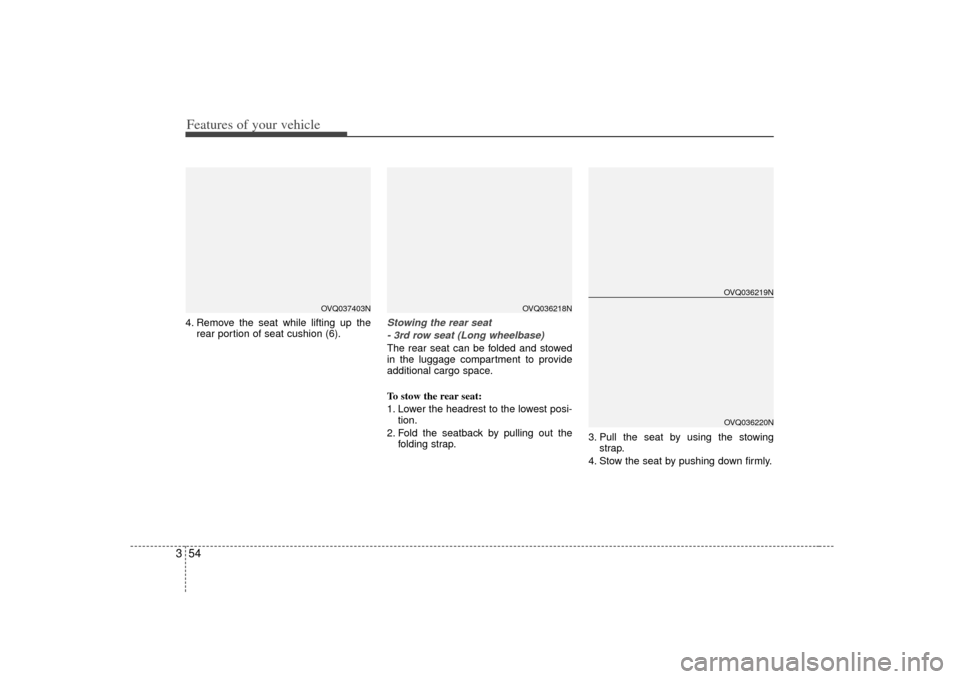
Stowing the rear seat
- 3rd row seat (Long wheelbase)The rear seat can be folded and stowed
in the luggage compartment to provide
additional cargo space.
To stow the rear seat:
1. Lower the headrest to the lowest posi- tion.
2. Fold the seatback by pulling out the folding strap. 3. Pull the seat by using the stowing
strap.
4. Stow the seat by pushing down firmly.
OVQ036218N
OVQ037403N
OVQ036219NOVQ036220N
Page 64 of 344

355
Features of your vehicle
To use the rear seat:
1. Lift the seat by pulling out the stowingstrap. 2. Release the strap and push the seat
forward firmly until it clicks into place to
insert the catches into the anchors.
✽ ✽NOTICEDo not push down the upper part of the
seatback when pushing the seat for-
ward. Doing so can prevent the catches
from being locked in position.
3. Make sure the catches are locked in
position by moving the seat forward
and backward or lifting the front por-
tion of the seat. If the seat moves, it is
not locked properly.
4. Pull out the folding strap.
5. Lift and pull the seatback backward firmly until it clicks into place.
Make sure the seatback is locked in
place.
6. Return the rear safety belt to the prop- er position.
OVQ036221N
OVQ036222N
OVQ036223N
WARNING
Make sure there is no body orobject around the seat and be
careful not to injure your hands or
body under the seat or in the mov-
ing parts when stowing or rein-
stalling the seat.
Do not sit on the seat stowed with the seatback upright in the lug-
gage compartment. Sitting on the
unstable and unlocked seat could
cause serious injuries in an acci-
dent.
Page 65 of 344

Features of your vehicle56
3
WARNING
- Cargo
Cargo should always be secured to
prevent it from being thrown about
the vehicle in a collision and caus-
ing injury to the vehicle occupants.
Special care should be taken of
objects placed in the rear seats,
since those may hit the front seat
occupants in a frontal collision.
CAUTION
- Rear safety
belts
When returning the rear seatbacks
to the upright position, rememberto return the rear shoulder belts totheir proper position. Routing the safety belt webbing through therear safety belt guides will helpkeep the belts from being trappedbehind or under the seats.
WARNING -
Cargo loading
Make sure the engine is off, the
transaxle is in P and the parking
brake is applied whenever loading
or unloading cargo. Failure to take
these steps may allow the vehicle to
move if shift lever is inadvertently
moved to another position.
CAUTION -
Avoid damag-
ing rear safety buckles
When you fold the rear seatback or
put luggage on the rear seat cush- ion, insert the buckle in the pocketbetween the rear seatback and cushion. Doing so can prevent thebuckle from being damaged by therear seatback or luggage.
1VQA2074B1VQA2074C1VQA2190A
3rd row2nd row
CAUTION
Before changing seat position, slip the seat belt into the trim panel andclose the power outlet cap.
Page 80 of 344

371
Features of your vehicle
We strongly recommend the use of a
child seat or infant seat for small children
and babies, and it is required by law in
almost all states. This child seat or infant
seat should be of appropriate size for the
child and should be installed in accor-
dance with the manufacturer's instruc-
tions.
Children riding in the car should sit on
the rear seat and must always be proper-
ly restrained to minimize the risk of injury
in an accident, sudden stop or sudden
maneuver. According to accident statis-
tics, children are safer when properly
restrained in the rear seats than in the
front seat.
Children could be injured or killed in a
crash if their restraints are not properly
secured. For small children and babies, a
child seat or infant seat must be used.
Before buying a particular child restraint
system, make sure it fits your car and
seat belts, and fits your child. Follow all
the instructions provided by the child
seat manufacturer when installing the
child restraint system.CHILD RESTRAINT SYSTEM
WARNING
- Child
restraints
A child restraint system must beplaced in the rear seat. Never
install a child or infant seat on the
front passenger's seat.
Should an accident occur and
cause the passenger air bag to
deploy, it could severely injure or
kill an infant or child seated in the
front seat.
Since a safety belt or child restraint system can become very
hot if it is in a closed vehicle, be
sure to check the seat cover and
buckles before placing a child
there.
(Continued)
(Continued)
When the child restraint systemis not in use, store it in the lug-
gage area or fasten it with a safe-
ty belt so that it will not be thrown
forward in the case of a sudden
stop or an accident.
Children who are too large to be in a child restraint should sit in
the rear seat and be restrained
with the available lap/shoulder
belts.
When using the vehicles lap/shoulder safety belts, always
make sure that the shoulder belt
portion is positioned midway
over the shoulder, never across
the neck or behind the back. The
lap belt portion of the lap/shoul-
der belt must always be posi-
tioned as low as possible on the
child's hips and as snug as pos-
sible.
If the vehicle’s safety belt will not properly fit the child, you must
use an appropriate child restraint
or booster seat in the rear.
(Continued)
1JBH3051
Page 94 of 344

385
Features of your vehicle
✽
✽NOTICE• If luggage or other objects are placed
on the front passenger's seat or if the
temperature of the seat changes while
the seat is unoccupied, the "PASSEN-
GER AIR BAG OFF" indicator may
blink. These conditions do not indi-
cate a problem.
•Do not put heavy objects on the front
passenger's seat. This may cause front
passenger air bag deployment in the
event of an accident, thus increasing
your repair costs.
WARNING
The front seat passenger air bag
is much larger than the steering
wheel air bag and inflates with
considerably more force. It can
seriously hurt or kill a passenger
who is not in the proper position
and wearing the safety belt prop-
erly. The front passengers should
always move their seat as far
back as practical and sit back in
their seat.
It is essential that the front pas-
senger always wears their safety
belts, even when the vehicle is
moving in a parking lot or up a dri-
veway into garage.
(Continued)
(Continued) Any other such replacement or
modification could adversely
affect the operation of the occu-
pant classification system and
your advanced air bags. For the
same reason, do not attach any-
thing to the seat, dashboard or
door, even temporarily. If the sys-
tem is adversely affected, it could
cause severe personal injuries or
death in a collision.
Do not put a heavy load in the front
passenger seatback pocket or on
the front passenger seat. Do not
hang onto the front passenger
seat. Do not hang any items such
as seatback table on the front pas-
senger seatback. Do not place feet
on the front passenger seatback.
Do not place any items under the
front passenger seat. Any of these
could interfere with proper sensor
operation.
(Continued)
Kia does not endorse nor will it support any changes to any part
or structure of the vehicle that
could affect the advanced air bag
system, including the occupant
classification system.
Specifically, the front passenger
seat, dashboard or door should
not be replaced except by an
authorized Kia dealer using origi-
nal Kia parts designed for this
vehicle and model.
(Continued)
1KMN3666
- Always sit in a proper seatingposition.
Page 119 of 344

Features of your vehicle110
3Trip odometerTRIP A: Trip odometer A
TRIP B: Trip odometer B
The trip odometer indicates the distance
of individual trips selected by the driver.
Trip odometer A and B can be reset to 0
by pressing the reset button for 1 second
or more, and then releasing.
Tachometer The tachometer indicates the approxi-
mate number of engine revolutions per
minute (rpm).
Use the tachometer to select the correct
shift points and to prevent lugging and/or
over-revving the engine.
The tachometer pointer may move slight-
ly when the ignition switch is in ACC or
ON position with the engine OFF. This
movement is normal and will not affect
the accuracy of the tachometer once the
engine is running.
Engine temperature gauge This gauge shows the temperature of the
engine coolant when the ignition switch
is ON.
Do not continue driving with an overheat-
ed engine. If your vehicle overheats, refer
to “Overheating” in the Index.
CAUTION
Do not operate the engine within
the tachometer's RED ZONE.
This may cause severe engine dam-age.
CAUTION
If the gauge pointer moves beyond
the normal range area toward the “H” position, it indicates overheat-ing that may damage the engine.
OVQ036031N
OVQ036406N
1VQA2125
Page 172 of 344
3 163
Features of your vehicle
How to cancel or return defogging logic
of automatic climate control system
1. Turn the ignition switch to the “ON”position.
2. Select the defrost position pressing defrost button ( ).
3. While holding the air conditioning but- ton (A/C) pressed, press the air intake
control button ( ) at least 5 times
within 3 seconds.
The display panel blinks 3 times with 0.5
second of interval. It indicates that the
defogging logic is canceled or returned to
the programmed status.
If the battery has been discharged or dis-
connected, it is reset as the defog logic
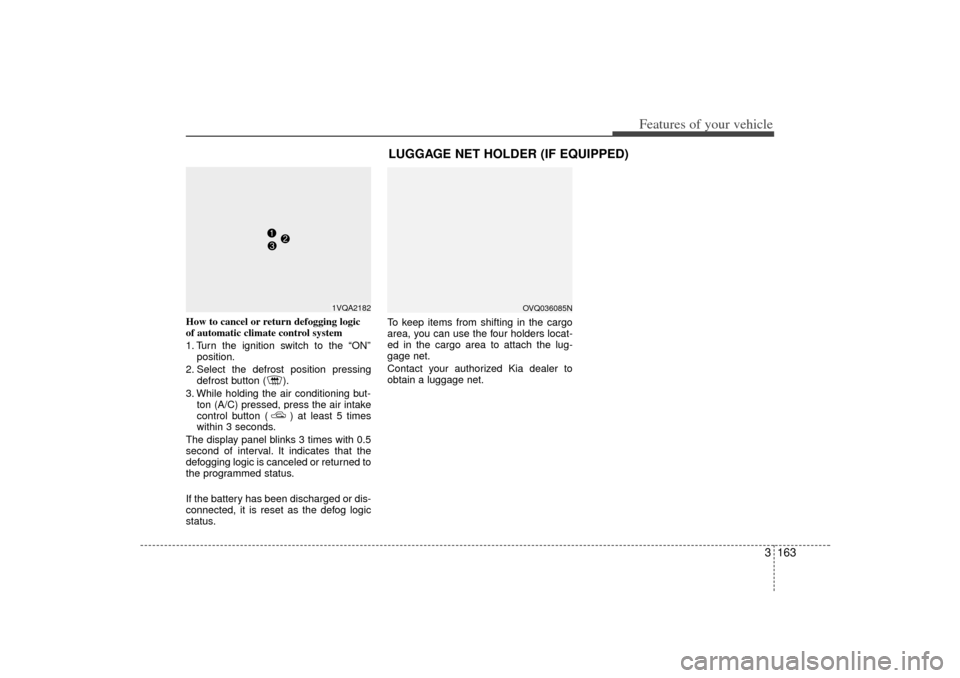
status. To keep items from shifting in the cargo
area, you can use the four holders locat-
ed in the cargo area to attach the lug-
gage net.
Contact your authorized Kia dealer to
obtain a luggage net.
LUGGAGE NET HOLDER (IF EQUIPPED)
OVQ036085N
1VQA2182