Page 283 of 329
Maintenance
18
7
1 23456789
Changing the engine oil and filter
Have engine oil and filter changed by
an authorized KIA dealer accordingto the Maintenance Schedule at thebeginning of this section. The high-pressure cooling system
has a reservoir filled with year-round
antifreeze coolant. The reservoir is
filled at the factory.
Check the antifreeze protection and
coolant level at least once a week, atthe beginning of the winter season,
and before traveling to a colder cli-
mate.
Checking the coolant level
WARNING
Used engine oil may cause irri- tation or cancer of the skin if left
in contact with the skin for pro-
longed periods of time. Used
engine oil contains chemicals
that have caused cancer in lab-
oratory animals. Always protect
your skin by washing your
hands thoroughly with soap and
warm water as soon as possibleafter handling used oil.
ENGINE COOLING SYSTEM
WARNING - Removing
radiator cap
Never attempt to remove the radiator cap while the engine
is operating or hot. Doing somight lead to cooling system
and engine damage and could
result in serious personal
injury from escaping hotcoolant or steam.
(Continued)
(Continued)
Turn the engine off and waituntil it cools down. Even then,
use extreme care when
removing the radiator cap.
Wrap a thick towel around it,
and turn it counterclockwise
slowly to the first stop. Step
back while the pressure is
released from the cooling sys-
tem. When you are sure all thepressure has been released,
press down on the cap, using
a thick towel, and continue
turning counterclockwise to
remove it.
Even if the engine is not oper- ating, do not remove the radi-ator cap or the drain plugwhile the engine and radiator
are hot. Hot coolant and steam
may still blow out under pres-
sure, causing serious injury.
Page 285 of 329
Maintenance
20
7
1 23456789
Changing the coolant
Have coolant changed by an author-
ized KIA dealer according to theMaintenance Schedule at the begin-ning of this section.
OLD056009
WARNING
Do not remove the radiator cap when the engine and radiator
are hot. Scalding hot coolant
and steam may blow out under
pressure. This could cause seri-
ous injury.
CAUTION
Put a thick cloth or fabric around the radiator cap beforerefilling the coolant in order toprevent the coolant from over- flowing into engine parts suchas generator.
Page 290 of 329
725
Maintenance
1 23456789
✽✽NOTICE
“COLD (C)” scale is for reference
only and should NOT be used todetermine transaxle fluid level. ✽
✽
NOTICE
New automatic transaxle fluid
should be red. The red dye is addedso the assembly plant can identify itas automatic transaxle fluid and dis-
tinguish it from engine oil or
antifreeze. The red dye, which is not
an indicator of fluid quality, is not
permanent. As the vehicle is driven,the automatic transaxle fluid will
begin to look darker. The color may
eventually appear light brown.
Therefore, have an Authorized Kia
dealer change the automatictransaxle fluid according to theScheduled Maintenance at thebeginning of this section.
Changing the automatic transaxle fluid
Have automatic transaxle fluid
changed by an authorized KIA deal-er according to the MaintenanceSchedule at the beginning of thissection.
CAUTION
Low fluid level causes transaxle slippage. Overfillingcan cause foaming, loss offluid and transaxle malfunc-tion.
The use of a non-specified fluid could result in transaxlemalfunction and failure.
WARNING - Parking brake
To avoid sudden movement of
the vehicle, apply parking brakeand depress the brake pedal
before moving the shift lever.
WARNING - Transaxle fluid
The transaxle fluid level should
be checked when the engine isat normal operating tempera-
ture. This means that the
engine, radiator, radiator hose
and exhaust system etc., are
very hot. Exercise great care not
to burn yourself during this pro-
cedure.
Page 291 of 329
Maintenance
26
7
1 23456789
LUBRICANTS AND FLUIDS
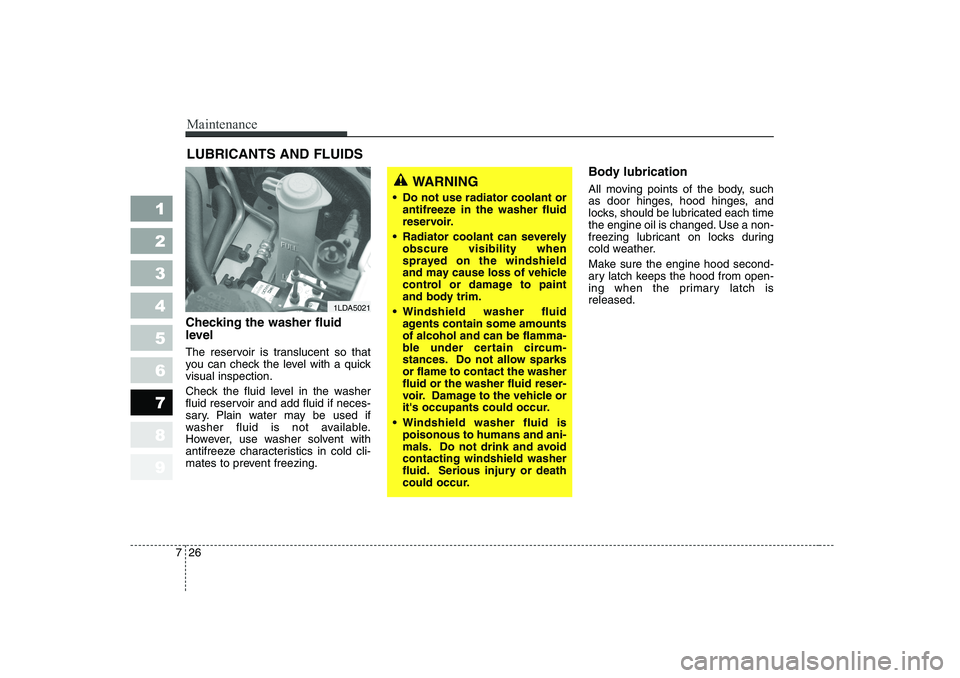
Checking the washer fluid
level
The reservoir is translucent so that
you can check the level with a quickvisual inspection.
Check the fluid level in the washer
fluid reservoir and add fluid if neces-
sary. Plain water may be used if
washer fluid is not available.
However, use washer solvent with
antifreeze characteristics in cold cli-
mates to prevent freezing. Body lubrication
All moving points of the body, such
as door hinges, hood hinges, and
locks, should be lubricated each time
the engine oil is changed. Use a non-
freezing lubricant on locks during
cold weather.
Make sure the engine hood second-
ary latch keeps the hood from open-
ing when the primary latch isreleased.
1LDA5021
WARNING
Do not use radiator coolant or antifreeze in the washer fluid
reservoir.
Radiator coolant can severely obscure visibility when
sprayed on the windshield
and may cause loss of vehicle
control or damage to paint
and body trim.
Windshield washer fluid agents contain some amountsof alcohol and can be flamma-
ble under certain circum-
stances. Do not allow sparksor flame to contact the washerfluid or the washer fluid reser-
voir. Damage to the vehicle or
it's occupants could occur.
Windshield washer fluid is poisonous to humans and ani-
mals. Do not drink and avoidcontacting windshield washer
fluid. Serious injury or death
could occur.
Page 324 of 329
Specifications
4
8
1 23456789
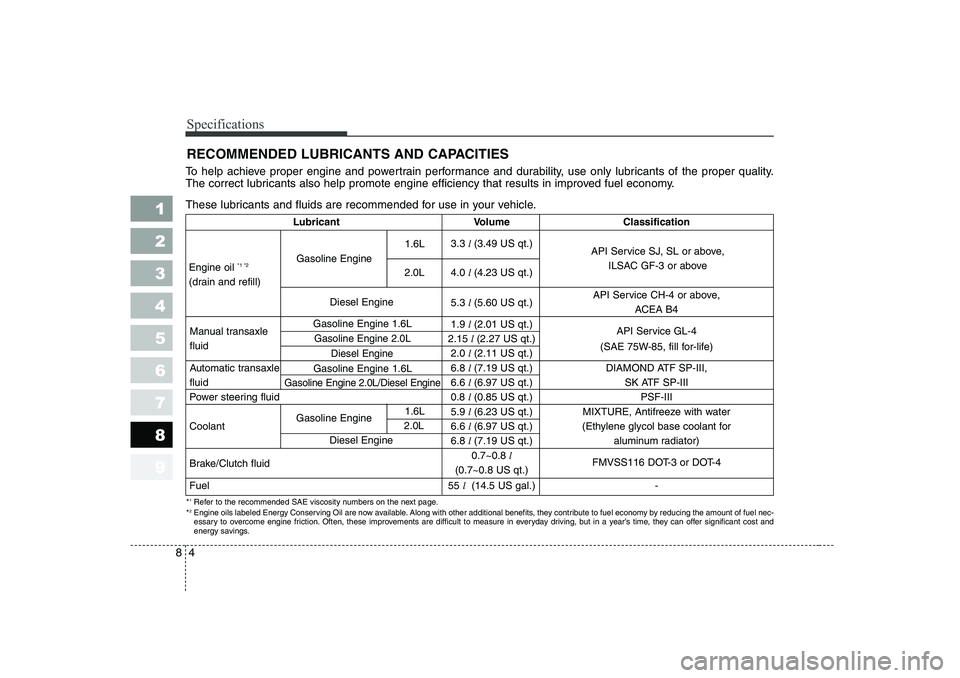
RECOMMENDED LUBRICANTS AND CAPACITIES
To help achieve proper engine and powertrain performance and durability, use only lubricants of the proper quality.
The correct lubricants also help promote engine efficiency that results in improved fuel economy.
These lubricants and fluids are recommended for use in your vehicle.
* 1
Refer to the recommended SAE viscosity numbers on the next page.
* 2
Engine oils labeled Energy Conserving Oil are now available. Along with other additional benefits, they contribute to fuel economy by reducing the amount of fuel nec-
essary to overcome engine friction. Often, these improvements are difficult to measure in everyday driving, but in a year’s time, they can offer significant cost and
energy savings.
Lubricant Volume Classification
3.3 l (3.49 US qt.)
4.0 l (4.23 US qt.)
API Service CH-4 or above,
5.3 l (5.60 US qt.)
ACEA B4
1.9 l (2.01 US qt.)
API Service GL-4
2.15 l (2.27 US qt.)
(SAE 75W-85, fill for-life)
2.0 l (2.11 US qt.)
6.8 l (7.19 US qt.) DIAMOND ATF SP-III,
6.6 l (6.97 US qt.) SK ATF SP-III
Power steering fluid 0.8 l (0.85 US qt.) PSF-III
5.9 l (6.23 US qt.) MIXTURE, Antifreeze with water
Coolant 6.6 l (6.97 US qt.) (Ethylene glycol base coolant for
6.8 l (7.19 US qt.) aluminum radiator)
Brake/Clutch fluid 0.7~0.8
l
FMVSS116 DOT-3 or DOT-4
(0.7~0.8 US qt.)
Fuel 55 l (14.5 US gal.) -
Engine oil *1 *2
(drain and refill)
Automatic transaxle fluidManual transaxlefluid Gasoline Engine
1.6L
2.0L
Gasoline Engine Diesel Engine
Diesel Engine API Service SJ, SL or above,
ILSAC GF-3 or above
1.6L
2.0L
Gasoline Engine 1.6L
Gasoline Engine 2.0L
Diesel Engine
Gasoline Engine 1.6L
Gasoline Engine 2.0L/Diesel Engine