Page 188 of 467

Raise the windshield and reinstall the side bars as soon as
the task that required their removal is completed and
before you return to on-road driving. Both you and your
passenger should wear seat belts at all times, on-road and
off-road, regardless of whether the windshield is raised
or folded down.
Outside rear view mirrors are mounted on the doors. If
you choose to remove the doors, see your authorized
dealer for a replacement cowl-mounted outside mirror.
Federal law requires outside mirrors on vehicles for
on-road use.WARNING!
Carefully follow these warnings to help protect against
personal injury:
•Do not drive your vehicle on-road with the windshield
down.
•Do not drive your vehicle unless the windshield is
securely fastened, either up or down.
•Eye protection, such as goggles, should be worn at all
times when the windshield is down.
•
Be sure that you carefully follow the instructions for
raising the windshield. Make sure that the folding wind-
shield, windshield wipers, side bars, and all associated
hardware and fasteners are correctly and tightly as-
sembled before driving your vehicle. Failure to follow
these instructions may prevent your vehicle from provid-
ing you and your passengers protection in some accidents.
•If you remove the doors, store them outside the vehicle.
In the event of an accident, a loose door may cause
personal injury.
188 UNDERSTANDING THE FEATURES OF YOUR VEHICLE
Page 191 of 467
WARNING!
You or others could be injured if you carry the side
bars loose in your vehicle. Remove the bars from the
vehicle or securely store them as described or they
may cause personal injury if an accident occurs. See
your authorized dealer for the cinch straps.
7. Remove the windshield wiper arms by first pulling
the wiper away from the windshield and out to the
“lock” position. Unsnap the wiper arm nut caps, and
remove retaining nuts. Lift the wiper arms off and store
in center console or securely behind the rear seat.
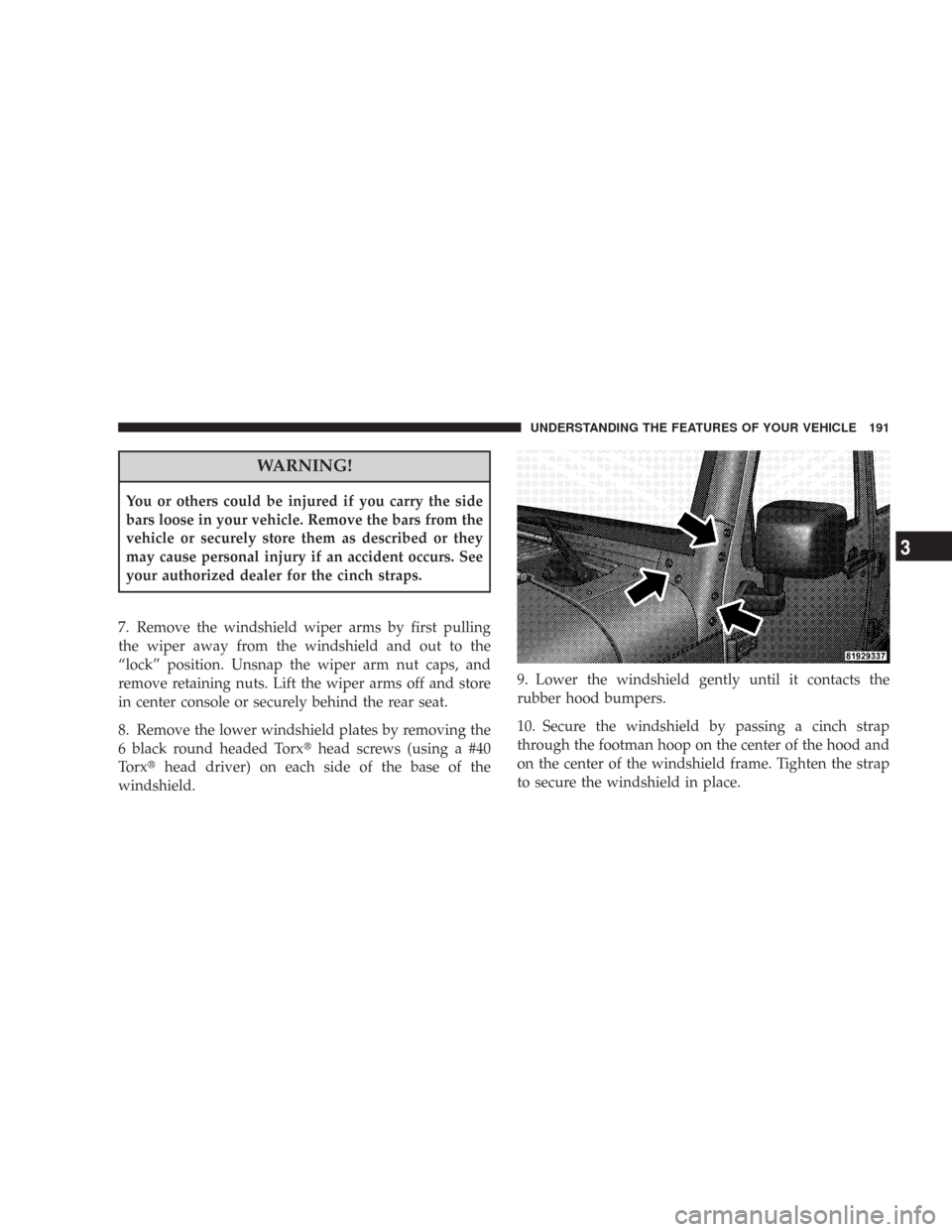
8. Remove the lower windshield plates by removing the
6 black round headed Torx�head screws (using a #40
Torx�head driver) on each side of the base of the
windshield.9. Lower the windshield gently until it contacts the
rubber hood bumpers.
10. Secure the windshield by passing a cinch strap
through the footman hoop on the center of the hood and
on the center of the windshield frame. Tighten the strap
to secure the windshield in place.
UNDERSTANDING THE FEATURES OF YOUR VEHICLE 191
3
Page 202 of 467
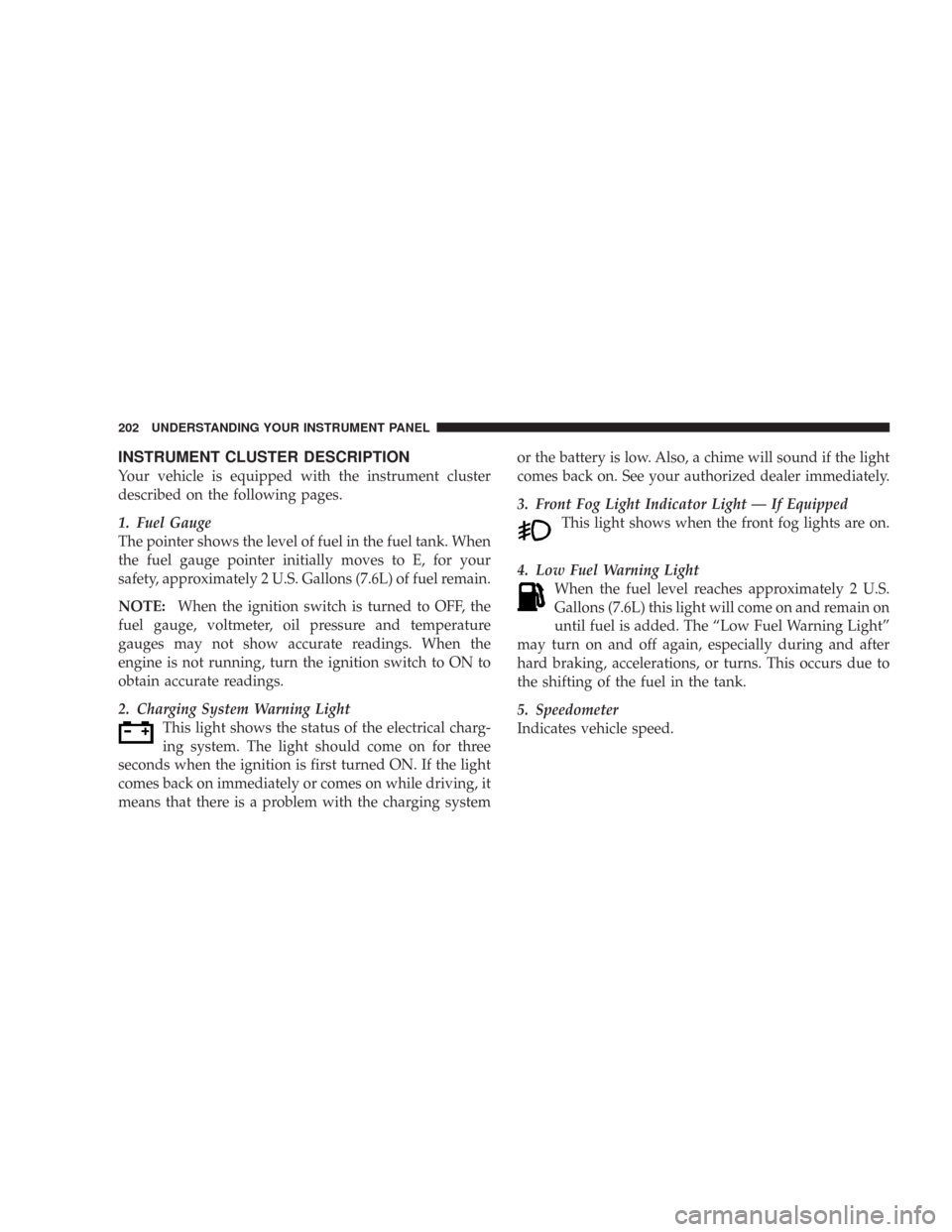
INSTRUMENT CLUSTER DESCRIPTION
Your vehicle is equipped with the instrument cluster
described on the following pages.
1. Fuel Gauge
The pointer shows the level of fuel in the fuel tank. When
the fuel gauge pointer initially moves to E, for your
safety, approximately 2 U.S. Gallons (7.6L) of fuel remain.
NOTE:When the ignition switch is turned to OFF, the
fuel gauge, voltmeter, oil pressure and temperature
gauges may not show accurate readings. When the
engine is not running, turn the ignition switch to ON to
obtain accurate readings.
2. Charging System Warning Light
This light shows the status of the electrical charg-
ing system. The light should come on for three
seconds when the ignition is first turned ON. If the light
comes back on immediately or comes on while driving, it
means that there is a problem with the charging systemor the battery is low. Also, a chime will sound if the light
comes back on. See your authorized dealer immediately.
3. Front Fog Light Indicator Light — If Equipped
This light shows when the front fog lights are on.
4. Low Fuel Warning Light
When the fuel level reaches approximately 2 U.S.
Gallons (7.6L) this light will come on and remain on
until fuel is added. The “Low Fuel Warning Light”
may turn on and off again, especially during and after
hard braking, accelerations, or turns. This occurs due to
the shifting of the fuel in the tank.
5. Speedometer
Indicates vehicle speed.
202 UNDERSTANDING YOUR INSTRUMENT PANEL
Page 203 of 467

6. Front Axle Lock Indicator Light — If Equipped
Indicates when the front axle lock has been
activated.
7. Seat Belt Indicator Light
A warning chime and an indicator light will alert
you to buckle the seat belts. When the belt is
buckled, the chime will stop, but the light will stay
on until it times out (about 6 seconds).
8. Turn Signal Indicator Lights
The arrows will flash with the exterior turn signals
when the turn signal lever is operated. A tone will
chime if the turn signals are left on for more than 1 mile
(2 km).
9. Oil Pressure Warning Light
Shows low engine oil pressure. The light will come
on and remain on when the ignition switch isturned from the OFF to the ON position, and the light
will turn off after the engine is started. If the bulb does
not come on, have the system checked by your autho-
rized dealer.
If the warning light comes on and remains on while
driving, stop the vehicle and shut off the engine. DO
NOT OPERATE THE VEHICLE UNTIL THE CAUSE IS
CORRECTED. Also, a single chime will sound.
10. High Beam Indicator Light
This light shows that the headlights are on high
beam. Pull the turn signal lever towards the
steering wheel to switch the headlights from high or low.
If the driver’s door is open, and the headlights or
parklights are left on, the “High Beam Indicator Light”
will flash and a chime will sound.
UNDERSTANDING YOUR INSTRUMENT PANEL 203
4
Page 204 of 467

11. Brake Warning Light
After ignition is turned on, illuminates to indicate
function check at vehicle start-up. Indicates park-
ing brake is applied. If the light stays on when the
parking brake is off, it indicates a possible brake system
fluid leak or low pressure level,see your authorized
dealer immediately.
If the parking brake is applied and the vehicle is in
motion, the red BRAKE warning light will “flash” and a
chime will sound.
The operation of the BRAKE warning light can be
checked by turning the ignition switch from the OFF
position to the ON position. The light should illuminate
for approximately two seconds. The light should then
turn off unless the parking brake is applied or a brake
fault is detected. If the light does not illuminate, have the
light inspected by an authorized dealer.12. Anti-Lock (ABS) Warning Light
After ignition is turned on, illuminates to indicate
function check at vehicle start-up. If light remains
on after start-up or comes on and stays on at road speeds,
it may indicate that the ABS has detected a malfunction
or has become inoperative. The system reverts to stan-
dard non-anti-lock brakes.
If both the red BRAKE warning light and the amber ABS
warning light are on, see your dealer immediately. Refer
to “Anti-Lock Brake System” in Section 5 of this manual.
13. Airbag Warning Light
This indicator lights and remains lit for 6 to 8
seconds when the ignition is first turned on. If
the light does not come on for 6 to 8 seconds,
stays on or comes on while driving, have the
airbag system checked by an authorized dealer.
204 UNDERSTANDING YOUR INSTRUMENT PANEL
Page 205 of 467

14. Rear Axle Lock Indicator Light — If Equipped
Indicates when the rear axle lock has been
activated.
15. Tachometer
Indicates the engine speed in revolutions per minute
(RPM).
CAUTION!
Do not operate the engine with the tachometer
pointer in the red area. Engine damage will occur.
16. Engine Coolant Temperature Warning Light
This light warns of an overheated engine condi-
tion. If the engine is critically hot, a warning chime
will sound 10 times. After the chime turns off, the
engine will still be critically hot until the light goes out.17. Sentry Key/Security Alarm Indicator Light — If
Equipped
Refer to “Sentry Key Immobilizer System” or “Vehicle
Security Alarm” in Section 2 of this manual.
18. Coolant Temperature Gauge
Indicates engine coolant temperature. The red
zone to the far right indicates possible overheat-
ing. Seek authorized service immediately if the
gauge operates in the red zone. In U.S. vehicles, tempera-
ture is indicated in degrees fahrenheit; in Canadian
vehicles in degrees centigrade.
19. Cruise Indicator Light
This light shows when the electronic speed
control system is turned on.
UNDERSTANDING YOUR INSTRUMENT PANEL 205
4
Page 207 of 467

can lead to tire failure. Under-inflation also reduces fuel
efficiency and tire tread life, and may affect the vehicle’s
handling and stopping ability.
Please note that the TPMS is not a substitute for proper
tire maintenance, and it is the driver ’s responsibility to
maintain correct tire pressure, even if under-inflation has
not reached the level to trigger illumination of the TPMS
low tire pressure telltale.
The “Tire Pressure Monitoring Telltale Light” will illumi-
nate in the instrument cluster, and an audible chime will
be activated when one or more tire pressures is low. The
“Tire Pressure Monitoring Telltale Light” will flash on
and off for 60 seconds when a system fault is detected.
The flash cycle will repeat every ten minutes or until the
fault condition is removed and reset.CAUTION!
The TPMS has been optimized for the original
equipment tires and wheels. TPMS pressures and
warnings have been established for the tire size
equipped on your vehicle. Undesirable system opera-
tion or sensor damage may result when using re-
placement equipment that is not of the same size,
type, and/or style. After-market wheels can cause
sensor damage. Do not use tire sealant from a can, or
balance beads if your vehicle is equipped with a
TPMS, as damage to the sensors may result.
UNDERSTANDING YOUR INSTRUMENT PANEL 207
4
Page 209 of 467

up on the accelerator and apply as little throttle as
possible. Be sure to adapt your speed and driving to the
prevailing road conditions. The “ESP/TCS Indicator
Light” will flash any time the ESP or TCS is active and
helping to improve vehicle stability. If the “ESP/TCS
Indicator Light” is on solid, the ESP system has been
turned off by the driver or a temporary condition exists
that will not allow full ESP function.
27. O/D (Overdrive) Off Indicator Light
This light will illuminate when the O/D OFF
button has been selected. The O/D OFF button is
located on the gear shift lever.
28. Sway Bar Indicator Light — If Equipped
This light will illuminate when the front sway
bar is disconnected.29. Electronic Stability Program (ESP) Warning
Light/Brake Assist System (BAS) Warning Light
The ESP/BAS warning light in the instrument
cluster comes on when the ignition switch is
turned to the “ON” position. The light should
go out with the engine running. If the ESP/
BAS warning light comes on continuously with the
engine running, a malfunction has been detected in either
the ESP or the BAS system. If this light stays illuminated,
have the ESP and BAS checked at your authorized dealer
as soon as possible. Refer to “Electronic Brake Control
System” in Section 5 for more information.
UNDERSTANDING YOUR INSTRUMENT PANEL 209
4