Page 284 of 467

NOTE:Pausing in transfer case N (Neutral) in vehicles
equipped with an automatic transmission may require
shutting the engine OFF to avoid gear clash while
completing the shift. If difficulty occurs, shift the auto-
matic transmission to N (Neutral), hold foot on brake,
and turn the engine OFF. Make shift to desired mode.
NOTE:Shifting into or out of 4L is possible with the
vehicle completely stopped, however, difficulty may oc-
cur due to the mating teeth not being properly aligned.
Several attempts may be required for clutch teeth align-
ment and shift completion to occur. The preferred
method is with the vehicle rolling at 2 to 3 mph (3 to 5
km/h). Avoid attempting to engage or disengage 4L with
the vehicle moving faster than 2 to 3 mph (3 to 5 km/h).WARNING!
Failure to engage a position completely can cause
transfer case damage or loss of power and vehicle
control. You could have an injury accident. Do not
drive the vehicle unless the transfer case is fully
engaged.
TRAC-LOK™ REAR AXLE — IF EQUIPPED
The Trac-Lok™ rear axle provides a constant driving
force to both rear wheels and reduces wheel spin caused
by the loss of traction at one driving wheel. If traction
differs between the two rear wheels, the differential
automatically proportions the usable torque by providing
more torque to the wheel that has traction.
284 STARTING AND OPERATING
Page 285 of 467
Trac-Lok™ is especially helpful during slippery driving
conditions. With both rear wheels on a slippery surface, a
slight application of the accelerator will supply maxi-
mum traction.
WARNING!
On vehicles equipped with a limited-slip differen-
tial, never run the engine with one rear wheel off the
ground. The vehicle may drive through the rear
wheel remaining on the ground and cause you to lose
control of your vehicle.
AXLE LOCK (TRU–LOK™) — RUBICON MODELS
The axle lock switch is located on the lower switch bank
(below the climate controls).
Axle Lock Switch
STARTING AND OPERATING 285
5
Page 290 of 467
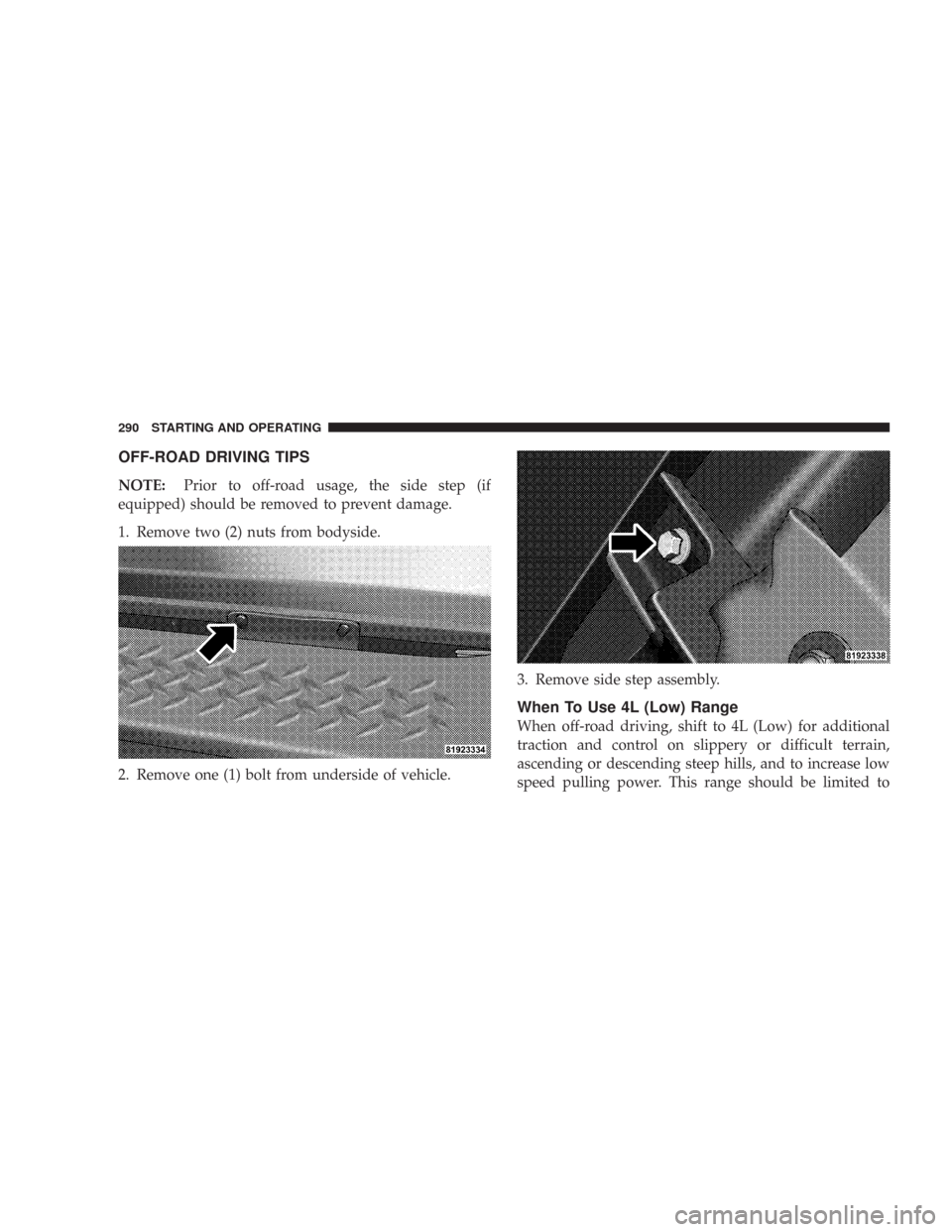
OFF-ROAD DRIVING TIPS
NOTE:Prior to off-road usage, the side step (if
equipped) should be removed to prevent damage.
1. Remove two (2) nuts from bodyside.
2. Remove one (1) bolt from underside of vehicle.3. Remove side step assembly.
When To Use 4L (Low) Range
When off-road driving, shift to 4L (Low) for additional
traction and control on slippery or difficult terrain,
ascending or descending steep hills, and to increase low
speed pulling power. This range should be limited to
290 STARTING AND OPERATING
Page 292 of 467

Standing Water
Avoid driving in standing water deeper than 20 inches,
and reduce speed appropriately to minimize wave ef-
fects. Maximum speed in 20 inches of water is less than 5
mph (8 km/h).
Maintenance
After driving through deep water, inspect your vehicle
fluids and lubricants (engine oil, transmission oil, axle,
transfer case) to assure the fluids have not been contami-
nated. Contaminated fluid (milky, foamy in appearance)
should be flushed/changed as soon as possible to pre-
vent component damage.
Driving In Snow, Mud and Sand
In heavy snow, when pulling a load, or for additional
control at slower speeds, shift the transmission to a low
gear and shift the transfer case to 4L (Low) if necessary.
Refer to “Four-Wheel Drive Operation” in this section.Do not shift to a lower gear than necessary to maintain
headway. Over-revving the engine can spin the wheels
and traction will be lost.
Avoid abrupt downshifts on icy or slippery roads, be-
cause engine braking may cause skidding and loss of
control.
Hill Climbing
NOTE:Before attempting to climb a hill, determine the
conditions at the crest and/or on the other side.
Before climbing a steep hill,shift the transmission to a
lower gear and shift the transfer case to 4L (Low). Use
first gear and 4L (Low) for very steep hills.
If you stall or begin to lose headwaywhile climbing a
steep hill, allow your vehicle to come to a stop and
immediately apply the brakes. Restart the engine and
shift to R (Reverse). Back slowly down the hill allowing
the compression braking of the engine to help regulate
292 STARTING AND OPERATING
Page 293 of 467

your speed. If the brakes are required to control vehicle
speed, apply them lightly and avoid locking or skidding
the tires.
WARNING!
If the engine stalls or you lose headway or cannot
make it to the top of a steep hill or grade, never
attempt to turn around. To do so may result in
tipping and rolling the vehicle. Always back care-
fully straight down a hill in R (Reverse) gear. Never
back down a hill in N (Neutral) using only the brake.
Remember, never drive diagonally across a hill-always
drive straight up or down.
If the wheels start to slip as you approach the crest of a
hill, ease off the accelerator and maintain headway byturning the front wheels slowly left and right. This may
provide a fresh “bite” into the surface and will usually
provide traction to complete the climb.
Traction Downhill
Shift the transmission into a low gear and the transfer
case to 4L (Low) range. Let the vehicle go slowly down
the hill with all four wheels turning against engine
compression drag. This will permit you to control the
vehicle speed and direction.
When descending mountains or hills, repeated braking
can cause brake fade with loss of braking control. Avoid
repeated heavy braking by downshifting the transmis-
sion whenever possible.
STARTING AND OPERATING 293
5
Page 446 of 467

DEPARTMENT OF TRANSPORTATION UNIFORM
TIRE QUALITY GRADES
The following describes the tire grading categories estab-
lished by the National highway Traffic Safety Adminis-
tration. The specific grade rating assigned by the tire’s
manufacturer in each category is shown on the sidewall
of the tires on your car.
All Passenger Car Tires Must Conform to Federal Safety
Requirements in Addition to These Grades.
Treadwear
The treadwear grade is a comparative rating based on the
wear rate of the tire when tested under controlled con-
ditions on a specified government test course. For ex-
ample, a tire graded 150 would wear one and a half (1
1/2) times as well on the government course as a tire
graded 100. The relative performance of tires depends
upon the actual conditions of their use, however, andmay depart significantly from the norm due to variations
in driving habits, service practices and differences in road
characteristics and climate.
Traction Grades
The traction grades, from highest to lowest, are AA, A, B,
and C. Those grades represent the tire’s ability to stop on
wet pavement as measured under controlled conditions
on specified government test surfaces of asphalt and
concrete. A tire marked C may have poor traction perfor-
mance.
WARNING!
The traction grade assigned to this tire is based on
straight-ahead braking traction tests, and does not
include acceleration, cornering, hydroplaning, or
peak traction characteristics.
446 IF YOU NEED CONSUMER ASSISTANCE
Page 453 of 467

Dimmer Switch, Headlight................. 100
Dipsticks
Oil (Engine).......................... 369
Disabled Vehicle Towing................... 359
Disarming, Theft System................... 19
Disposal
Engine Oil........................... 371
Used Coolant (Antifreeze)................ 383
Door Locks...........................29,30
Doors................................. 26
Drive Belts............................ 372
Driver’s Seat Back Tilt..................... 88
Driving............................... 289
Off-Pavement......................... 290
Off-Road............................ 290
Dual Top.............................. 120
Electrical Outlet, Auxiliary (Power Outlet)...... 116
Electrical Power Outlets................... 116Electronic Brake Control System............. 107
Anti-Lock Brake System................. 107
Brake Assist System.................... 108
Electronic Roll Mitigation................ 109
Electronic Stability Program............... 110
Traction Control System................. 108
Electronic Roll Mitigation (ERM)............. 109
Electronic Speed Control (Cruise Control)...... 104
Electronic Stability Program (ESP)............ 110
Electronic Throttle Control Warning Light...... 210
Electronic Vehicle Information Center (EVIC).... 210
Emergency Brake........................ 295
Emergency, In Case of
Brake Warning Light.................... 204
Coolant Temperature Gauge.............. 205
Hazard Warning Flasher................. 350
Jacking............................. 352
Jump Starting......................... 356
Tow Hooks.......................... 358
INDEX 453
10
Page 458 of 467

Cruise.............................. 205
Daytime Running...................... 101
Dimmer Switch, Headlight............... 100
Electronic Stability Program (ESP)
Indicator....................... 115,208,209
Electronic Throttle Control Warning......... 210
Engine Temperature Warning.............. 205
Fog .............................100,410
Hazard Warning Flasher................. 350
Headlight Switch....................... 99
Headlights........................... 409
High Beam........................... 203
High Beam Indicator.................... 203
Instrument Cluster...................... 99
Interior.............................. 97
Lights On Reminder.................... 100
Low Fuel............................ 202
LowTire ............................ 206
Oil Pressure.......................... 203Passing............................. 100
Rear Servicing........................ 411
Rear Tail............................ 411
Seat Belt Reminder..................... 203
Sentry Key........................... 205
Service.............................. 409
Side Marker.......................... 411
Tire Pressure Monitoring (TPMS)........... 206
Traction Control....................... 208
Turn Signal..................100,203,410,411
Warning (Instrument Cluster Description)..... 202
Loading Vehicle......................... 328
Tires ............................... 304
Locking Axle........................285,286
Locks
Door..............................29,30
Power Door........................... 31
Steering Wheel......................... 15
458 INDEX