Page 287 of 440
2. EconomyÐ
Improper inflation pressures can cause uneven wear
patterns to develop across the tire tread. These abnormal
wear patterns will reduce tread life resulting in a need for
earlier tire replacement. Under inflation, also increases
tire rolling resistance and results in higher fuel consump-
tion.
3. Ride Comfort and Vehicle StabilityÐ
Proper tire inflation contributes to a comfortable ride.
Over inflation produces a jarring and uncomfortable ride.
Tire Inflation Pressures
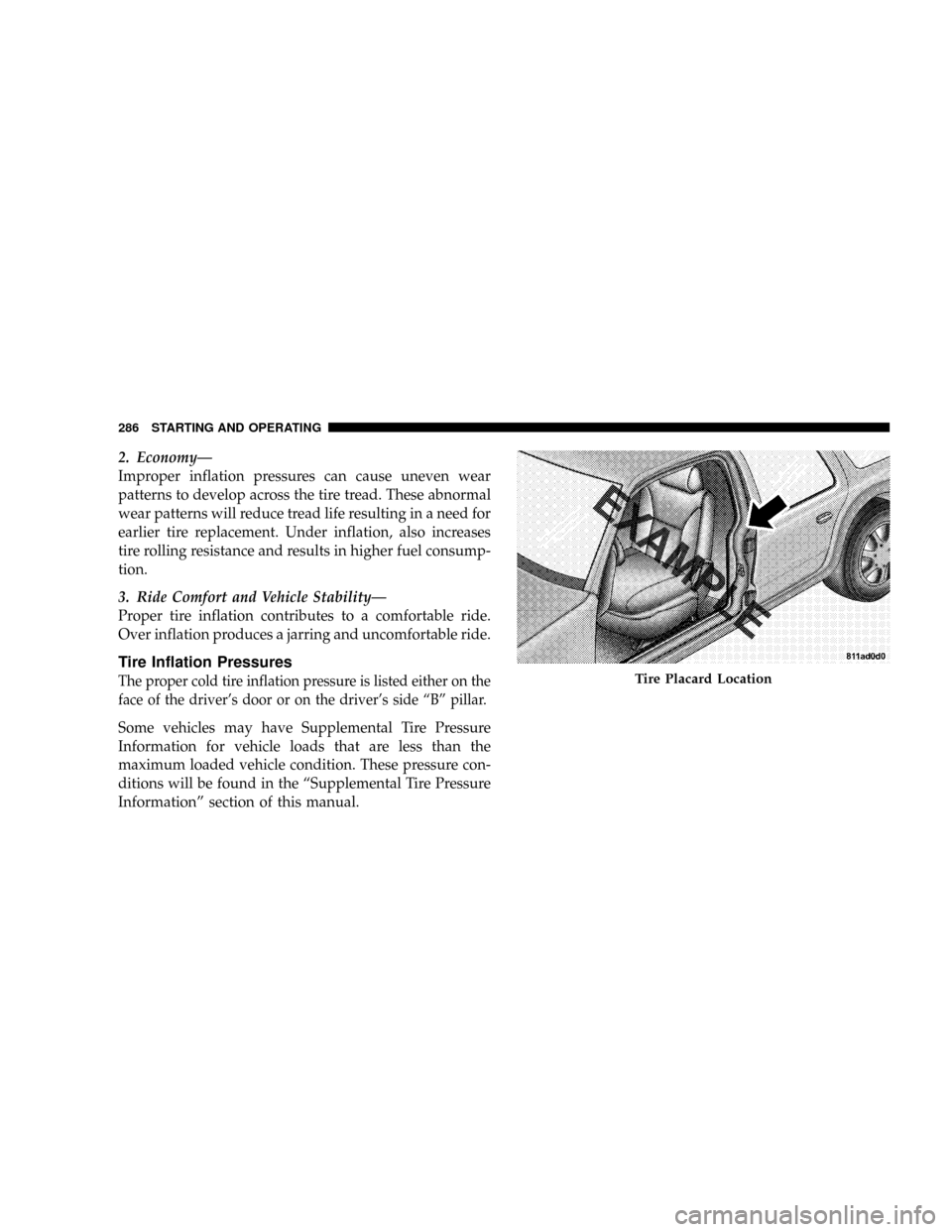
The proper cold tire inflation pressure is listed either on the
face of the driver's door or on the driver's side ªBº pillar.
Some vehicles may have Supplemental Tire Pressure
Information for vehicle loads that are less than the
maximum loaded vehicle condition. These pressure con-
ditions will be found in the ªSupplemental Tire Pressure
Informationº section of this manual.
Tire Placard Location
286 STARTING AND OPERATING
Page 288 of 440
The pressure should be checked and adjusted as well as
inspecting for signs of tire wear or visible damage at least
once a month. Use a good quality pocket-type gauge to
check tire pressure. Do not make a visual judgement
when determining proper inflation. Radial tires may look
properly inflated even when they are under inflated.
CAUTION!
After inspecting or adjusting the tire pressure, al-
ways reinstall the valve stem cap (if equipped). This
will prevent moisture and dirt from entering the
valve stem, which could damage the valve stem.
Inflation pressures specified on the placard are always
ªcold tire inflation pressure.º Cold tire inflation pressure
is defined as the tire pressure after the vehicle has not
been driven for at least 3 hours, or driven less than 1 mile(1 km) after a 3 hour period. The cold tire inflation
pressure must not exceed the maximum inflation pres-
sure molded into the tire sidewall.
Check tire pressures more often if subject to a wide range
of outdoor temperatures, as tire pressures vary with
temperature changes.
Tire pressures change by approximately 1 psi (7 kPa) per
12 ÉF (7 ÉC) of air temperature change. Keep this in mind
when checking tire pressure inside a garage, especially in
the winter.
Example: If garage temperature = 68 ÉF (20 ÉC) and the
outside temperature = 32 ÉF (0 ÉC) then the cold tire
inflation pressure should be increased by 3 psi (21 kPa),
which equals 1 psi (7 kPa) for every 12 ÉF (7 ÉC) for this
outside temperature condition.
STARTING AND OPERATING 287
5
Page 289 of 440
Tire pressure may increase from 2 to 6 psi (13 to 40 kPa)
during operation. DO NOT reduce this normal pressure
build up or your tire pressure will be too low.
Tire Pressures for High Speed Operation
The manufacturer advocates driving at safe speeds
within posted speed limits. Where speed limits or condi-
tions are such that the vehicle can be driven at high
speeds, maintaining correct tire inflation pressure is very
important. Increased tire pressure and reduced vehicle
loading may be required for high-speed vehicle opera-
tion. Refer to original equipment or an authorized tire
dealer for recommended safe operating speeds, loading
and cold tire inflation pressures.
WARNING!
High speed driving with your vehicle under maxi-
mum load is dangerous. The added strain on your
tires could cause them to fail. You could have a
serious accident. Don't drive a vehicle loaded to the
maximum capacity at continuous speeds above 75
mph (120 km/h).
288 STARTING AND OPERATING
Page 291 of 440
Do not install a wheel cover or attempt to mount a
conventional tire on the compact spare wheel, since the
wheel is designed specifically for the compact spare.
Do not install more than one compact spare tire/wheel
on the vehicle at any given time.
CAUTION!
Because of the reduced ground clearance, do not take
your vehicle through an automatic car wash with the
compact spare installed. Damage to the vehicle may
result.
Limited Use Spare Ð If Equipped
The limited use spare tire is for temporary emergency use
on your vehicle. This tire is identified by a limited use
spare tire warning label located on the limited use spare
tire and wheel assembly. This tire may look like theoriginal equipped tire on the front or rear axle of your
vehicle, but it is not. Installation of this limited use spare
tire affects vehicle handling. Since it is not the same tire,
replace (or repair) the original tire and reinstall on the
vehicle at the first opportunity.
WARNING!
The limited use spare tires are for emergency use
only. Installation of this limited use spare tire affects
vehicle handling. With this tire, do not drive more
than 60 mph (100 km/h). Keep inflated to the cold tire
inflation pressure listed on either your tire placard or
limited use spare tire and wheel assembly. Replace
(or repair) the original tire at the first opportunity
and reinstall it on your vehicle. Failure to do so could
result in loss of vehicle control.
290 STARTING AND OPERATING
Page 293 of 440
These indicators are molded into the bottom of the tread
grooves. They will appear as bands when the tread depth
becomes 1/16 inch (2 mm). When the tread is worn to the
tread wear indicators, the tire should be replaced.
Many states have laws requiring tire replacement at this
point.
Life of Tire
The service life of a tire is dependent upon varying
factors including but not limited to:
²Driving style
²Tire pressure
²Distance driven
WARNING!
Tires and spare tire should be replaced after six years,
regardless of the remaining tread. Failure to follow
this warning can result in sudden tire failure. You
could lose control and have an accident resulting in
serious injury or death.
Keep dismounted tires in a cool, dry place with as little
exposure to light as possible. Protect tires from contact
with oil, grease, and gasoline.
Replacement Tires
The tires on your new vehicle provide a balance of many
characteristics. They should be inspected regularly for
wear and correct cold tire inflation pressure. The manu-
facturer strongly recommends that you use tires equiva-
lent to the originals in size, quality and performance
when replacement is needed (refer to the paragraph on
292 STARTING AND OPERATING
Page 296 of 440
based on cold inflation tire pressure. This is defined as
the tire pressure after a vehicle has not been driven for
more than 3 hours - and in outside ambient tempera-
ture. Refer to the ªTires ± General Informationº in this
section for information on how to properly inflate the
vehicle's tires. The tire pressure will also increase as
the vehicle is driven - this is normal and there should
be no adjustment for this increased pressure.
²The TPM System will warn the driver of a low tire
pressure if the tire pressure falls below the low pres-
sure warning threshold for any reason, including low
temperature effects.
²The TPM System will continue to warn the driver of
low tire pressure as long as the condition exists, and
will not turn off until the tire pressure is at or above
recommended cold placard pressure. Once the low tire
pressure warning has been illuminated, the tire pres-
sure must be increased to the recommended coldplacard pressure in order for the TPM warning lamp to
be turned off. The system will automatically update
and the TPM warning lamp will extinguish once the
updated tire pressures have been received. The vehicle
may need to be driven for up to 10 minutes above 15
mph (25 km/h) to receive this information.
For example, your vehicle may have a recommended
cold (parked for more than 3 hours) placard of 35 ÉF (241
kPa). If the ambient temperature is 68 ÉF (20 ÉC) and the
measured tire pressure is 30 psi (207 kPa), a temperature
drop to 20 ÉF (-7 ÉC) will decrease the tire pressure to
approximately 26 psi (179 kPa). This tire pressure is
sufficiently low enough to turn ON the ªTire Pressure
Monitoring Lightº. Driving the vehicle may cause the tire
pressure to rise to approximately 30 psi (207 kPa), but the
ªTire Pressure Monitoring Lightº will still be ON. In this
situation, the ªTire Pressure Monitoring Lightº will turn
OFF only after the tires have been inflated to the vehicle's
recommended cold placard pressure value.
STARTING AND OPERATING 295
5
Page 298 of 440
Display Settings
²Your system can be set to display pressure units in PSI,
kPa, or BAR.NOTE:These display settings may not be available due
to Regulatory Authorities. In this case, the display will
only show approved units.
NOTE:A low spare tire will not cause the Tire Pressure
Monitoring Telltale Lamp to illuminate or the chime to
sound.
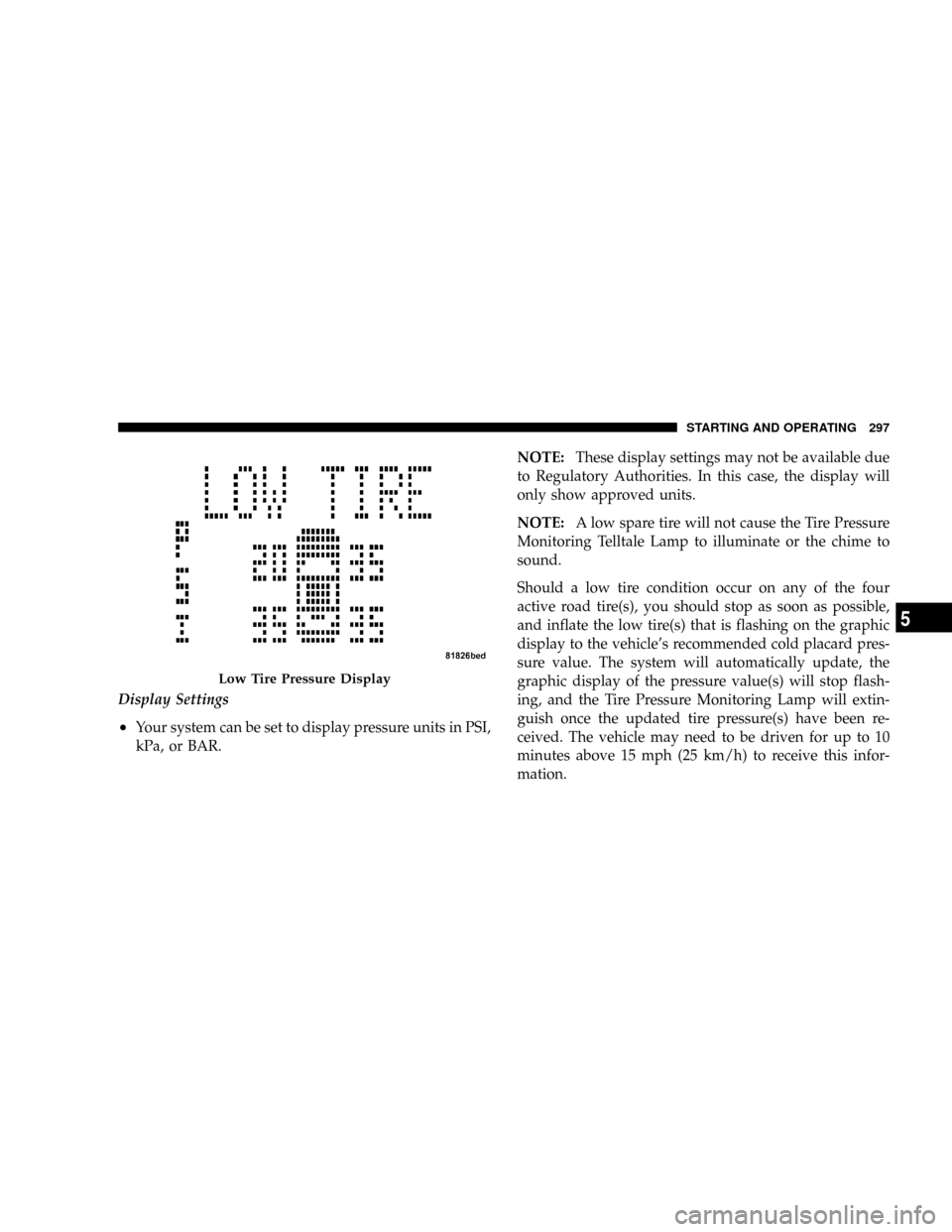
Should a low tire condition occur on any of the four
active road tire(s), you should stop as soon as possible,
and inflate the low tire(s) that is flashing on the graphic
display to the vehicle's recommended cold placard pres-
sure value. The system will automatically update, the
graphic display of the pressure value(s) will stop flash-
ing, and the Tire Pressure Monitoring Lamp will extin-
guish once the updated tire pressure(s) have been re-
ceived. The vehicle may need to be driven for up to 10
minutes above 15 mph (25 km/h) to receive this infor-
mation.
Low Tire Pressure Display
STARTING AND OPERATING 297
5
Page 301 of 440

CAUTION!
The TPMS has been optimized for the original
equipment tires and wheels. TPMS pressures have
been established for the tire size equipped on your
vehicle. Undesirable system operation or sensor
damage may result when using replacement equip-
ment that is not of the same size, type, and/or style.
Aftermarket wheels can cause sensor damage. Do not
use tire sealant from a can, or balance beads if your
vehicle is equipped with a TPMS, as damage to the
sensors may result.
CAUTION!
After inspecting or adjusting the tire pressure, al-
ways reinstall the valve stem cap. This will prevent
moisture and dirt from entering the valve stem,
which could damage the wheel rim sensor.
NOTE:
²The TPMS is not intended to replace normal tire care
and maintenance, or to provide warning of a tire
failure or condition.
²The TPMS should not be used as a tire pressure gauge
while adjusting your tire pressure.
²Driving on a significantly under-inflated tire causes
the tire to overheat and can lead to tire failure.
300 STARTING AND OPERATING