2007 ISUZU KB P190 Engine wiring
[x] Cancel search: Engine wiringPage 2313 of 6020
ENGINE DRIVEABILITY AND EMISSIONS 6E–143
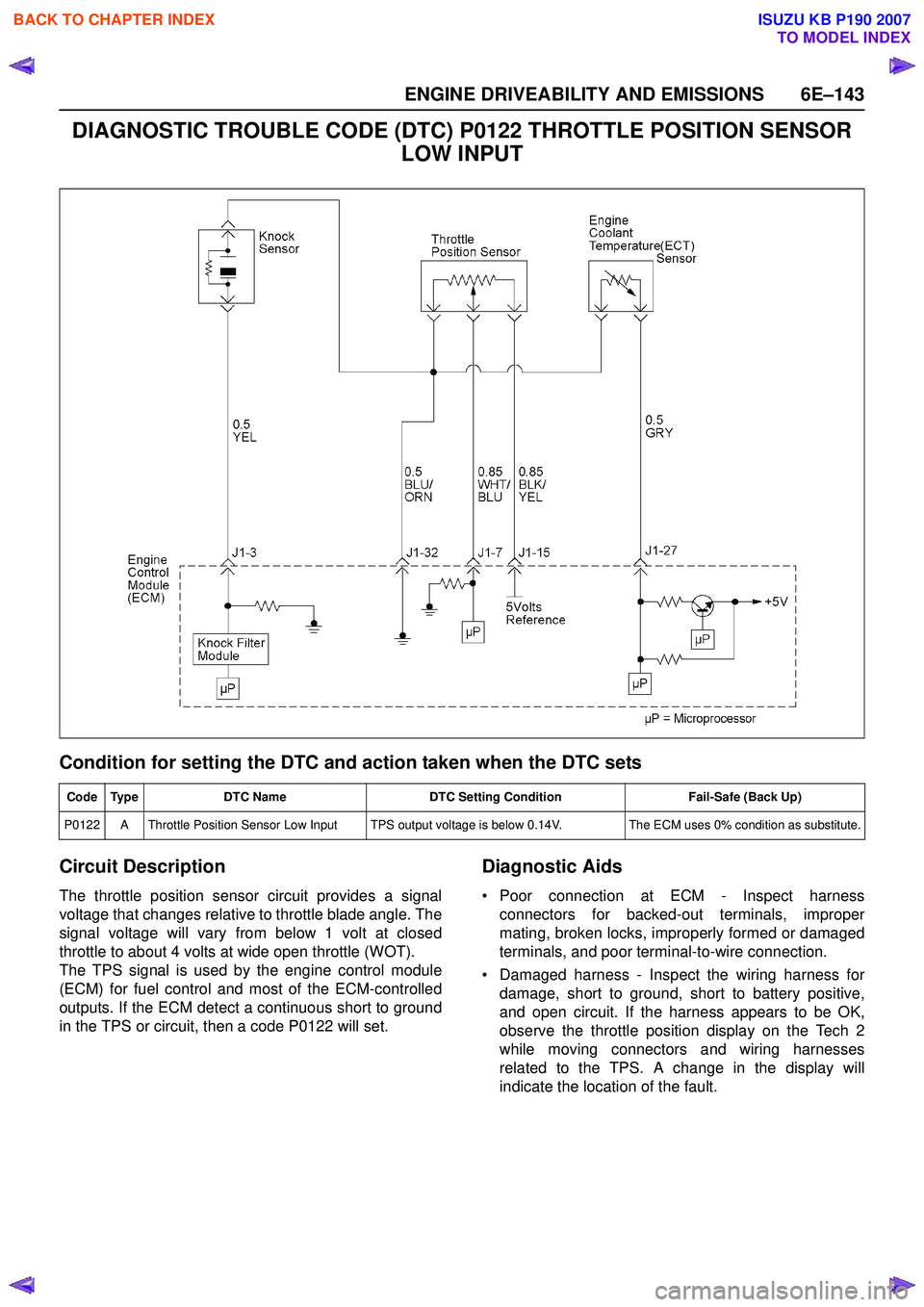
DIAGNOSTIC TROUBLE CODE (DTC) P0122 THROTTLE POSITION SENSOR LOW INPUT
Condition for setting the DTC and action taken when the DTC sets
Circuit Description
The throttle position sensor circuit provides a signal
voltage that changes relative to throttle blade angle. The
signal voltage will vary from below 1 volt at closed
throttle to about 4 volts at wide open throttle (WOT).
The TPS signal is used by the engine control module
(ECM) for fuel control and most of the ECM-controlled
outputs. If the ECM detect a continuous short to ground
in the TPS or circuit, then a code P0122 will set.
Diagnostic Aids
• Poor connection at ECM - Inspect harness connectors for backed-out terminals, improper
mating, broken locks, improperly formed or damaged
terminals, and poor terminal-to-wire connection.
• Damaged harness - Inspect the wiring harness for damage, short to ground, short to battery positive,
and open circuit. If the harness appears to be OK,
observe the throttle position display on the Tech 2
while moving connectors and wiring harnesses
related to the TPS. A change in the display will
indicate the location of the fault.
Code Type DTC Name DTC Setting Condition Fail-Safe (Back Up)
P0122 A Throttle Position Sensor Low Input TPS output voltage is below 0.14V. The ECM uses 0% condition as substitute.
BACK TO CHAPTER INDEX
TO MODEL INDEX
ISUZU KB P190 2007
Page 2317 of 6020
ENGINE DRIVEABILITY AND EMISSIONS 6E–147
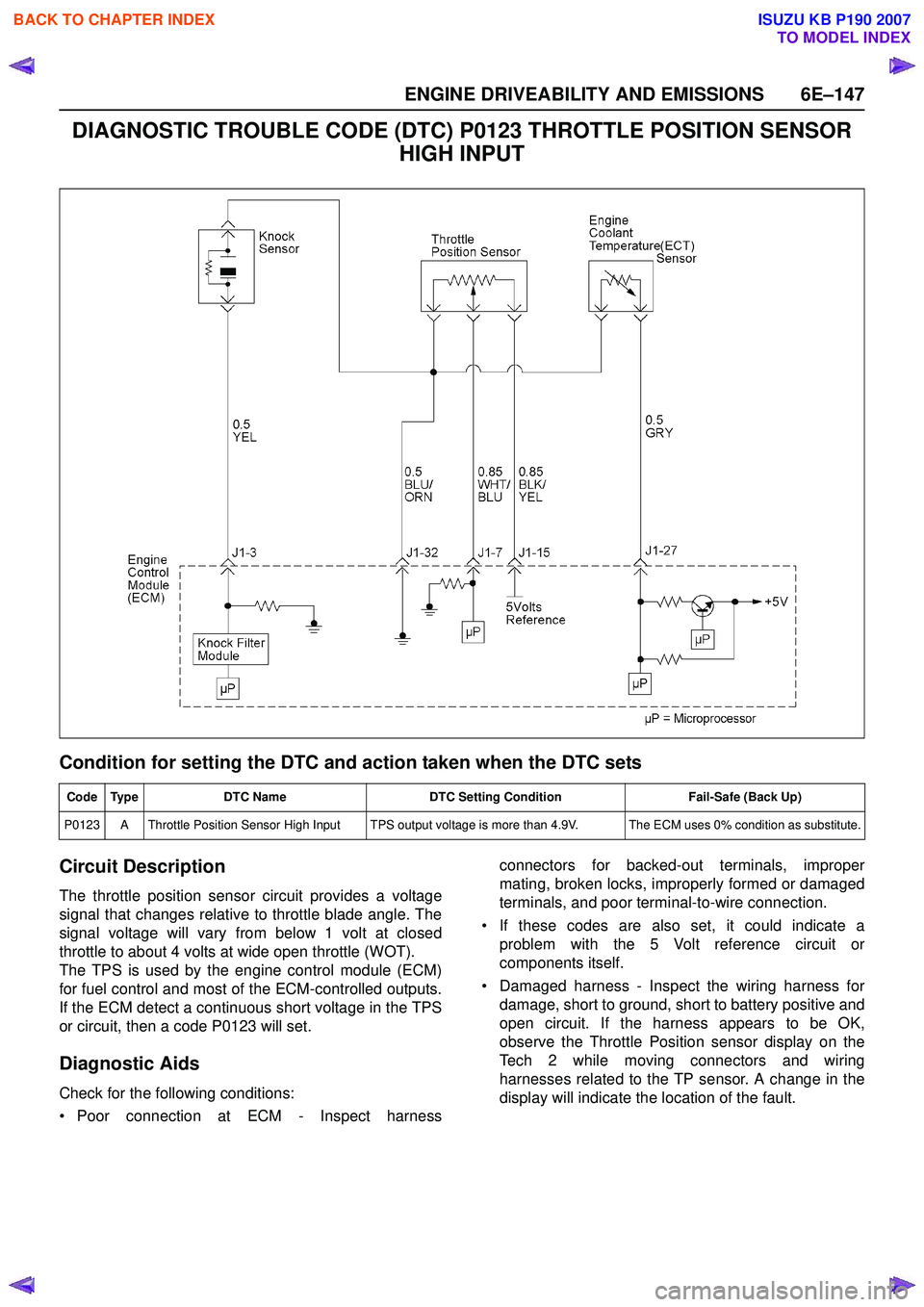
DIAGNOSTIC TROUBLE CODE (DTC) P0123 THROTTLE POSITION SENSOR HIGH INPUT
Condition for setting the DTC and action taken when the DTC sets
Circuit Description
The throttle position sensor circuit provides a voltage
signal that changes relative to throttle blade angle. The
signal voltage will vary from below 1 volt at closed
throttle to about 4 volts at wide open throttle (WOT).
The TPS is used by the engine control module (ECM)
for fuel control and most of the ECM-controlled outputs.
If the ECM detect a continuous short voltage in the TPS
or circuit, then a code P0123 will set.
Diagnostic Aids
Check for the following conditions:
• Poor connection at ECM - Inspect harness connectors for backed-out terminals, improper
mating, broken locks, improperly formed or damaged
terminals, and poor terminal-to-wire connection.
• If these codes are also set, it could indicate a problem with the 5 Volt reference circuit or
components itself.
• Damaged harness - Inspect the wiring harness for damage, short to ground, short to battery positive and
open circuit. If the harness appears to be OK,
observe the Throttle Position sensor display on the
Tech 2 while moving connectors and wiring
harnesses related to the TP sensor. A change in the
display will indicate the location of the fault.
Code Type DTC Name DTC Setting Condition Fail-Safe (Back Up)
P0123 A Throttle Position Sensor High Input TPS output voltage is more than 4.9V. The ECM uses 0% condition as substitute.
BACK TO CHAPTER INDEX
TO MODEL INDEX
ISUZU KB P190 2007
Page 2321 of 6020
ENGINE DRIVEABILITY AND EMISSIONS 6E–151
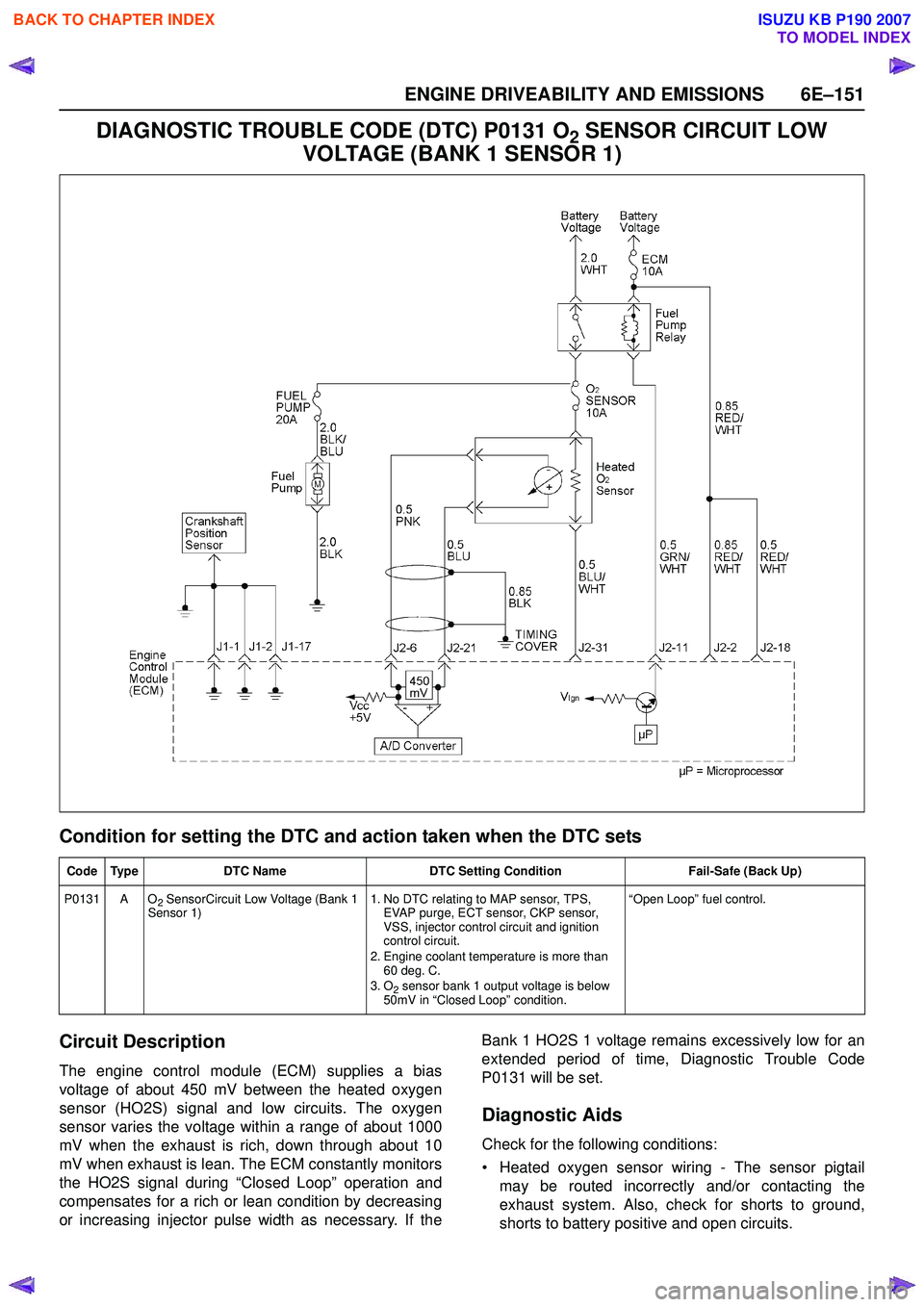
DIAGNOSTIC TROUBLE CODE (DTC) P0131 O2 SENSOR CIRCUIT LOW
VOLTAGE (BANK 1 SENSOR 1)
Condition for setting the DTC and action taken when the DTC sets
Circuit Description
The engine control module (ECM) supplies a bias
voltage of about 450 mV between the heated oxygen
sensor (HO2S) signal and low circuits. The oxygen
sensor varies the voltage within a range of about 1000
mV when the exhaust is rich, down through about 10
mV when exhaust is lean. The ECM constantly monitors
the HO2S signal during “Closed Loop” operation and
compensates for a rich or lean condition by decreasing
or increasing injector pulse width as necessary. If the Bank 1 HO2S 1 voltage remains excessively low for an
extended period of time, Diagnostic Trouble Code
P0131 will be set.
Diagnostic Aids
Check for the following conditions:
• Heated oxygen sensor wiring - The sensor pigtail may be routed incorrectly and/or contacting the
exhaust system. Also, check for shorts to ground,
shorts to battery positive and open circuits.
Code Type DTC Name DTC Setting Condition Fail-Safe (Back Up)
P0131 A O
2 SensorCircuit Low Voltage (Bank 1
Sensor 1) 1. No DTC relating to MAP sensor, TPS,
EVAP purge, ECT sensor, CKP sensor,
VSS, injector control circuit and ignition
control circuit.
2. Engine coolant temperature is more than 60 deg. C.
3. O
2 sensor bank 1 output voltage is below
50mV in “Closed Loop” condition. “Open Loop” fuel control.
BACK TO CHAPTER INDEX
TO MODEL INDEX
ISUZU KB P190 2007
Page 2334 of 6020
6E–164 ENGINE DRIVEABILITY AND EMISSIONS
Diagnostic Aids
Check for the following conditions:
• Poor connection at ECM - Inspect harness connectors for backed-out terminals, improper
mating, broken locks, improperly formed or damaged terminals, and poor terminal-to-wire connection.
• Damaged harness - Inspect the wiring harness for damage; shorts to ground, shorts to battery positive
and open circuits.
Diagnostic Trouble Code (DTC) P0135
O
2 Sensor Heater Circuit (Bank 1 Sensor 1)
Step Action Value(s) Yes No
1 Was the “On-Board Diagnostic (OBD) System Check” performed?
—Go to Step 2Go to
On Board
Diagnostic
(OBD) System Check
2 1. Connect the Tech 2. 2. Review and record the failure information.
3. Select “F0: Read DTC Infor By Priority” in “F0: Diagnostic Trouble Code”.
Is the DTC P0135 stored as “Present Failure”? — Go to Step 3Refer to
Diagnostic Aids and Go to Step
3
3 1. Using the Tech2, ignition “On” and engine “Off”. 2. Select “Clear DTC Information” with the Tech2 andclear the DTC information.
3. Operate the vehicle and monitor the “F5: Failed This Ignition” in “F2: DTC Information”.
Was the DTC P0135 stored in this ignition cycle? — Go to Step 4Refer to
Diagnostic Aids and Go to Step
4
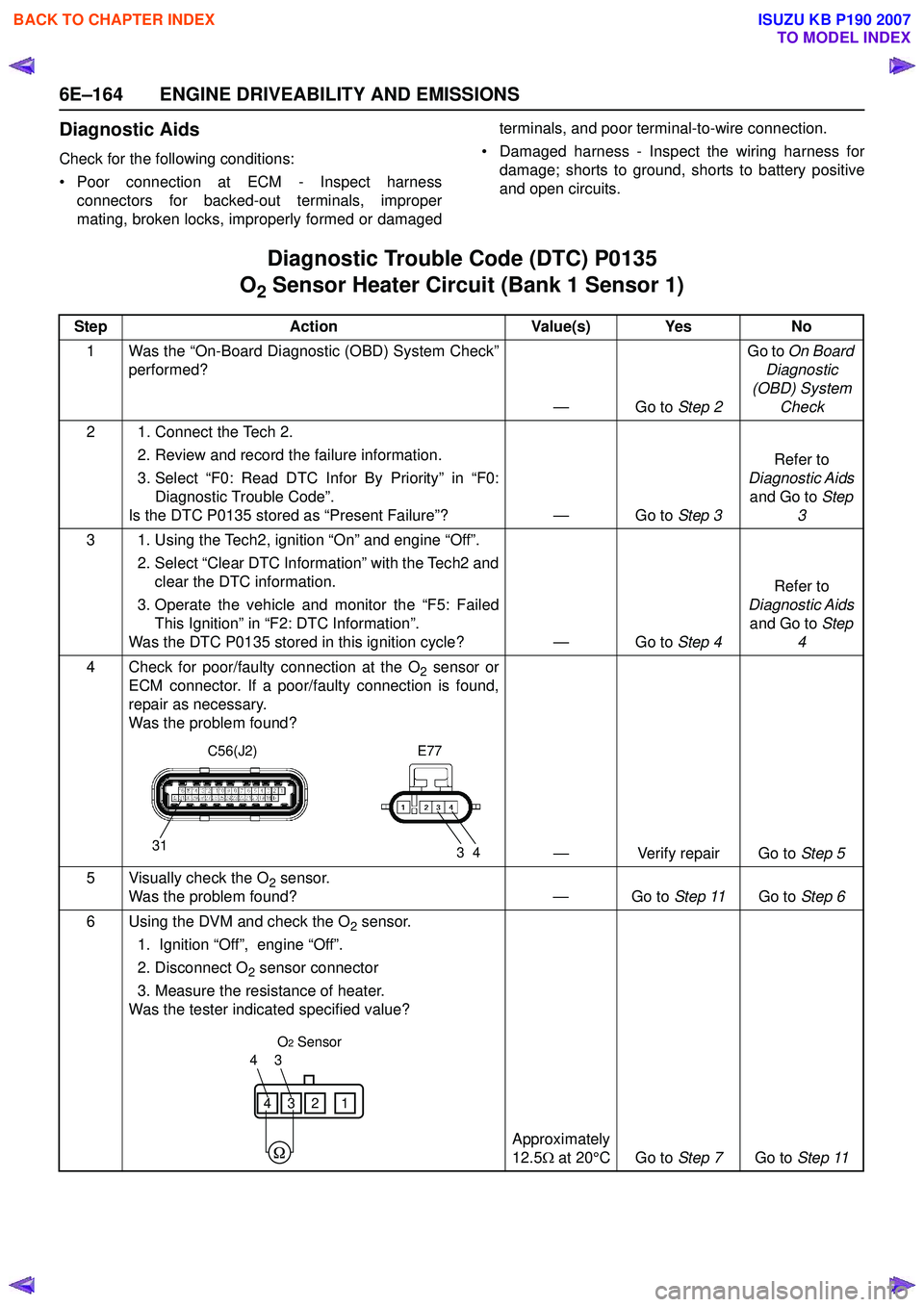
4 Check for poor/faulty connection at the O
2 sensor or
ECM connector. If a poor/faulty connection is found,
repair as necessary.
Was the problem found?
— Verify repair Go to Step 5
5 Visually check the O
2 sensor.
Was the problem found? — Go to Step 11Go to Step 6
6 Using the DVM and check the O
2 sensor.
1. Ignition “Off”, engine “Off”.
2. Disconnect O
2 sensor connector
3. Measure the resistance of heater.
Was the tester indicated specified value?
Approximately
12.5 Ω at 20°C Go to Step 7Go to Step 11
3431
C56(J2) E77
34
1234
O2 Sensor
BACK TO CHAPTER INDEX
TO MODEL INDEX
ISUZU KB P190 2007
Page 2347 of 6020
ENGINE DRIVEABILITY AND EMISSIONS 6E–177
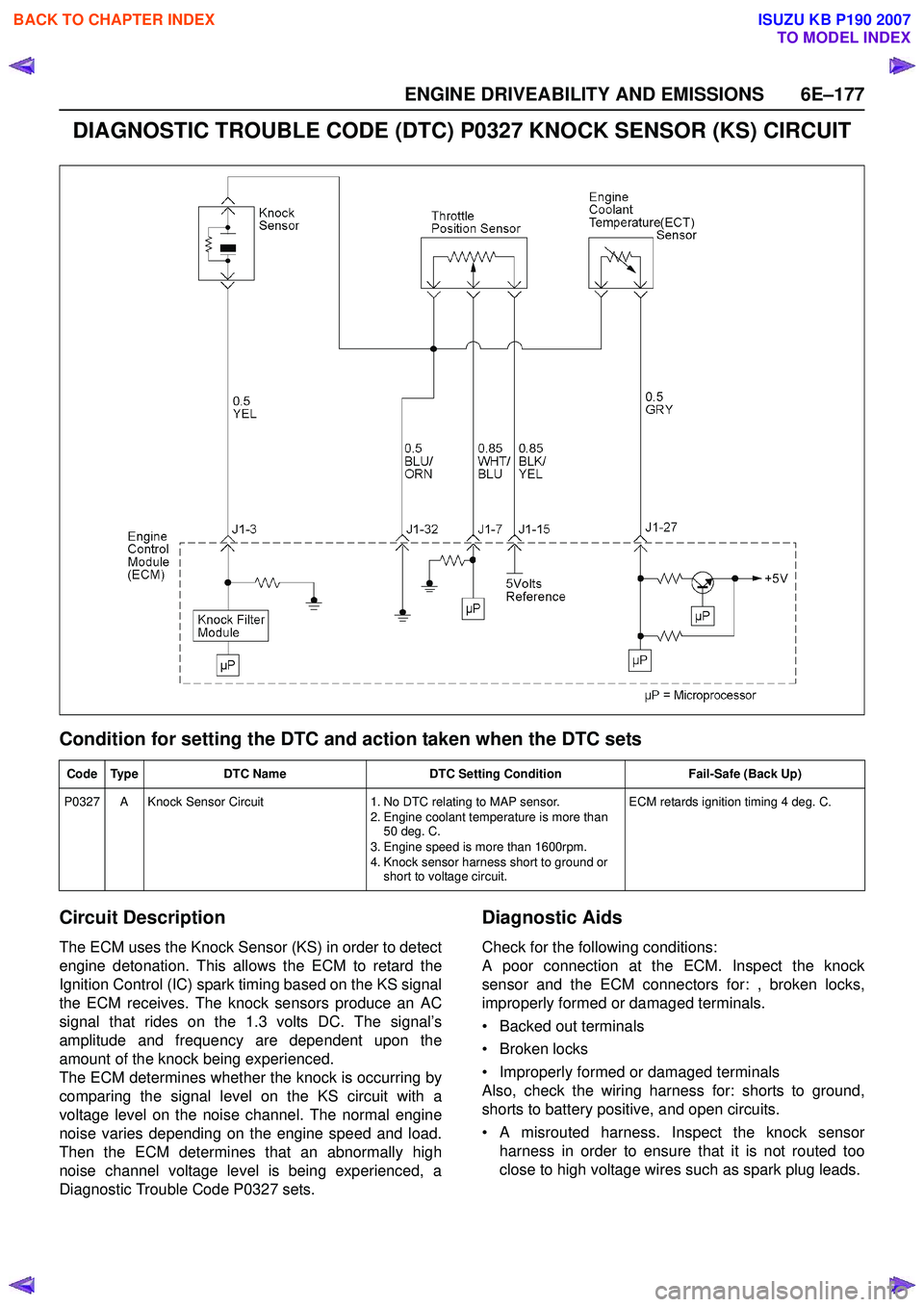
DIAGNOSTIC TROUBLE CODE (DTC) P0327 KNOCK SENSOR (KS) CIRCUIT
Condition for setting the DTC and action taken when the DTC sets
Circuit Description
The ECM uses the Knock Sensor (KS) in order to detect
engine detonation. This allows the ECM to retard the
Ignition Control (IC) spark timing based on the KS signal
the ECM receives. The knock sensors produce an AC
signal that rides on the 1.3 volts DC. The signal’s
amplitude and frequency are dependent upon the
amount of the knock being experienced.
The ECM determines whether the knock is occurring by
comparing the signal level on the KS circuit with a
voltage level on the noise channel. The normal engine
noise varies depending on the engine speed and load.
Then the ECM determines that an abnormally high
noise channel voltage level is being experienced, a
Diagnostic Trouble Code P0327 sets.
Diagnostic Aids
Check for the following conditions:
A poor connection at the ECM. Inspect the knock
sensor and the ECM connectors for: , broken locks,
improperly formed or damaged terminals.
• Backed out terminals
• Broken locks
• Improperly formed or damaged terminals
Also, check the wiring harness for: shorts to ground,
shorts to battery positive, and open circuits.
• A misrouted harness. Inspect the knock sensor harness in order to ensure that it is not routed too
close to high voltage wires such as spark plug leads.
Code Type DTC Name DTC Setting Condition Fail-Safe (Back Up)
P0327 A Knock Sensor Circuit 1. No DTC relating to MAP sensor.
2. Engine coolant temperature is more than 50 deg. C.
3. Engine speed is more than 1600rpm.
4. Knock sensor harness short to ground or short to voltage circuit. ECM retards ignition timing 4 deg. C
.
BACK TO CHAPTER INDEX
TO MODEL INDEX
ISUZU KB P190 2007
Page 2351 of 6020
ENGINE DRIVEABILITY AND EMISSIONS 6E–181
Diagnostic Aids
An intermittent may be caused by a poor connection,
rubbed-through wire insulation or a wire broken inside
the insulation. Check for:
• Poor connection - Inspect the ECM harness and connectors for improper mating, broken locks,
improperly formed or damaged terminals, and poor
terminal-to-wire connection. • Damaged harness - Inspect the wiring harness for
damage; shorts to ground, shorts to battery positive
and open circuits. If the harness appears to be OK,
disconnect the ECM, turn the ignition on and observe
a voltmeter connected to the 58X reference circuit at
the ECM harness connector while moving connectors
and wiring harnesses related to the ECM. A change
in voltage will indicate the location of the fault.
Diagnostic Trouble Code (DTC) P0336
Crankshaft Position Sensor Circuit Range/performance (58x)
Diagnostic Trouble Code (DTC) P0337
Crankshaft Position Sensor Circuit Low Input (58x)
Step Action Value(s) Yes No
1 Was the “On-Board Diagnostic (OBD) System Check” performed?
—Go to Step 2Go to
On Board
Diagnostic
(OBD) System Check
2 1. Connect the Tech 2. 2. Review and record the failure information.
3. Select “F0: Read DTC Infor By Priority” in “F0: Diagnostic Trouble Code”.
Is the DTC P0336 or P0337 stored as “Present
Failure”? — Go to Step 3Refer to
Diagnostic Aids and Go to Step
3
3 1. Using the Tech2, ignition “On” and engine “Off”. 2. Select “Clear DTC Information” with the Tech2 andclear the DTC information.
3. Operate the vehicle and monitor the “F5: Failed This Ignition” in “F2: DTC Information”.
Was the DTC P0336 or P0337 stored in this ignition
cycle? — Go to Step 4Refer to
Diagnostic Aids and Go to Step
4
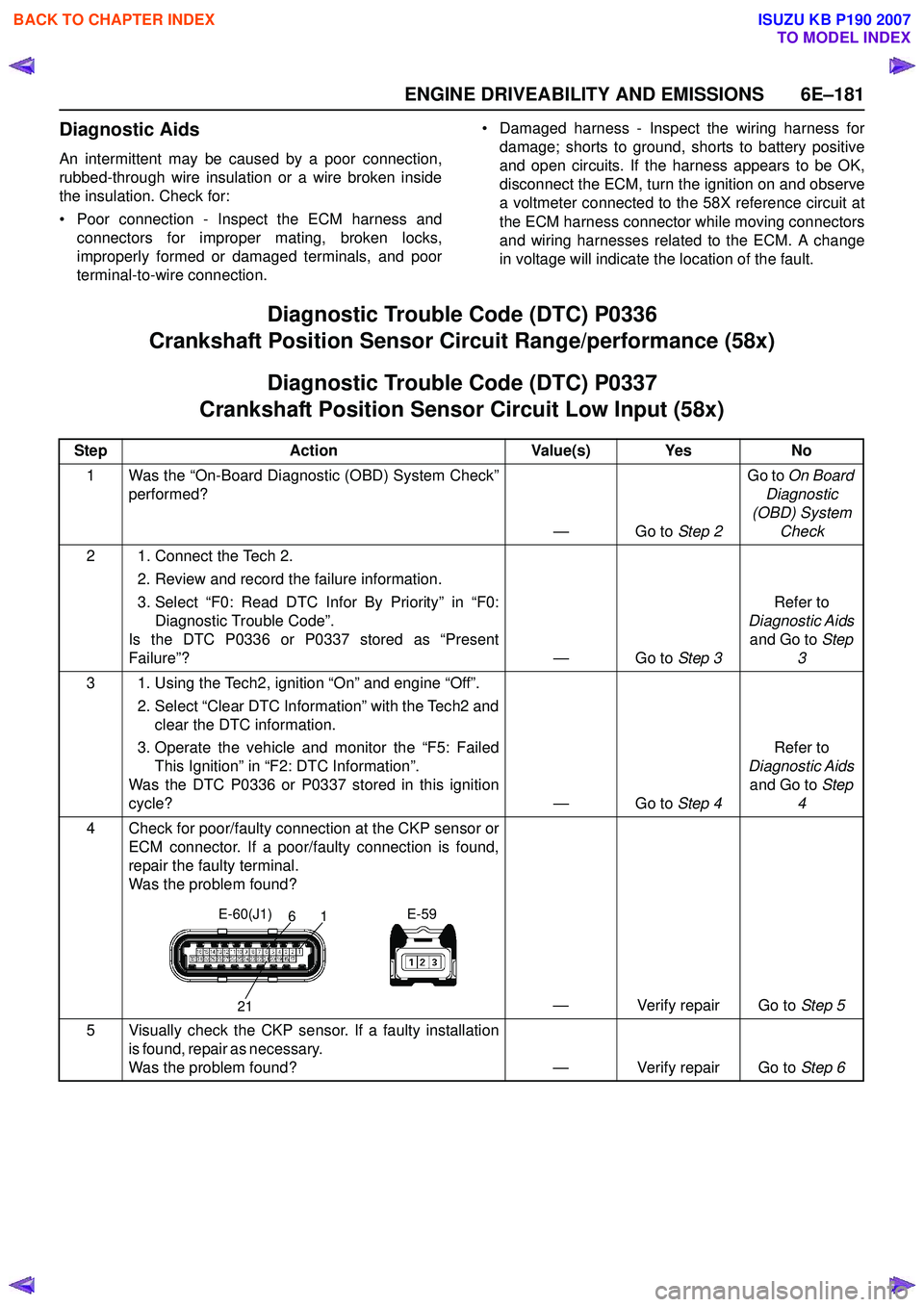
4 Check for poor/faulty connection at the CKP sensor or ECM connector. If a poor/faulty connection is found,
repair the faulty terminal.
Was the problem found?
— Verify repair Go to Step 5
5 Visually check the CKP sensor. If a faulty installation i s f o u n d , r e p a i r a s n e c e s s a r y.
Was the problem found? — Verify repair Go to Step 6
21
61
E-60(J1)
E-59
BACK TO CHAPTER INDEX
TO MODEL INDEX
ISUZU KB P190 2007
Page 2357 of 6020
ENGINE DRIVEABILITY AND EMISSIONS 6E–187
mating, broken locks, improperly formed or damaged
terminals, and poor terminal-to-wire connections.
• Damaged harness - Inspect the wiring harness for damage; Open circuits, shorts to ground, or shorts to
Voltage. If the harness appears to be OK, observe the Tech 2 display related to DTC P0351 or P0352
while moving the connector and wiring related to the
ignition system. A change in the display will indicate
the location of the fault.
Diagnostic Trouble Code (DTC) P0351 Ignition 1 Control Circuit
Diagnostic Trouble Code (DTC) P0352 Ignition 2 Control Circuit
Step Action Value(s) Yes No
1 Was the “On-Board Diagnostic (OBD) System Check” performed?
—Go to Step 2Go to
On Board
Diagnostic
(OBD) System Check
2 1. Connect the Tech 2. 2. Review and record the failure information.
3. Select “F0: Read DTC Infor By Priority” in “F0: Diagnostic Trouble Code”.
Is the DTC P0351 or P0352 stored as “Present
Failure”? — Go to Step 3Refer to
Diagnostic Aids and Go to Step
3
3 1. Using the Tech2, ignition “On” and engine “Off”. 2. Select “Clear DTC Information” with the Tech2 andclear the DTC information.
3. Operate the vehicle and monitor the “F5: Failed This Ignition” in “F2: DTC Information”.
Was the DTC P0351 or P0352 stored in this ignition
cycle? — Go to Step 4Refer to
Diagnostic Aids and Go to Step
4
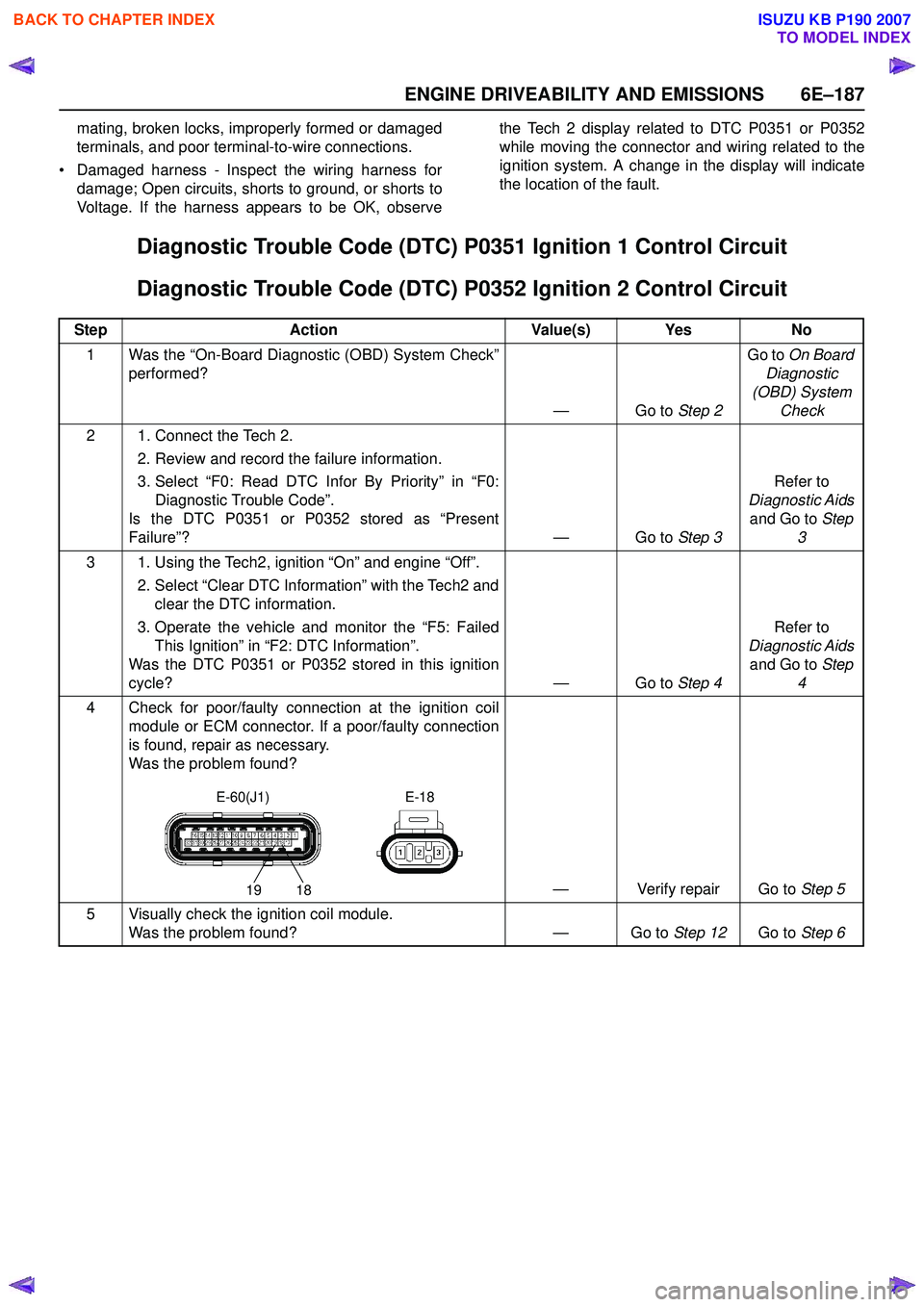
4 Check for poor/faulty connection at the ignition coil module or ECM connector. If a poor/faulty connection
is found, repair as necessary.
Was the problem found?
— Verify repair Go to Step 5
5 Visually check the ignition coil module. Was the problem found? — Go to Step 12Go to Step 6
19 18
E-60(J1) E-18
BACK TO CHAPTER INDEX
TO MODEL INDEX
ISUZU KB P190 2007
Page 2385 of 6020
ENGINE DRIVEABILITY AND EMISSIONS 6E–215
Diagnostic Aids
Check for the following conditions:
• Heated oxygen sensor wiring - The sensor pigtail may be routed incorrectly and contacting the exhaust
system.
• Poor ECM to engine block ground.
• Fuel pressure - The system will go lean if pressure is too low. The ECM can compensate for some
decrease. However, if fuel pressure is too low, a
diagnostic Trouble Code P1171 may be set. Refer to
Fuel System Diagnosis .
• Lean injector(s) - Perform “Injector Balance Test.” • Vacuum leaks - Check for disconnected or damaged
vacuum hoses and for vacuum leaks at the intake
manifold, throttle body, and PCV system.
• Exhaust leaks - An exhaust leak may cause outside air to be pulled into the exhaust gas stream past the
HO2S, causing the system to appear lean. Check for
exhaust leaks that may cause a false lean condition
to be indicated.
• Fuel contamination - Water, even in small amounts, can be delivered to the fuel injectors. The water can
cause a lean exhaust to be indicated, Excessive
alcohol in the fuel can also cause this condition.
Refer to Fuel System Diagnosis for the procedure to
check for fuel contamination.
Diagnostic Trouble Code (DTC) P1171
Fuel Supply System Lean During Power Enrichment
Step Action Value(s) Yes No
1 Was the “On-Board Diagnostic (OBD) System Check” performed?
—Go to Step 2Go to
On Board
Diagnostic
(OBD) System Check
2 1. Connect the Tech 2. 2. Review and record the failure information.
3. Select “F0: Read DTC Infor By Priority” in “F0: Diagnostic Trouble Code”.
Is the DTC P1171 stored as “Present Failure”? — Go to Step 3Refer to
Diagnostic Aids and Go to Step
3
3 1. Using the Tech2, ignition “On” and engine “Off”. 2. Select “Clear DTC Information” with the Tech2 andclear the DTC information.
3. Operate the vehicle and monitor the “F5: Failed This Ignition” in “F2: DTC Information”.
Was the DTC P1171 stored in this ignition cycle? — Go to Step 4Refer to
Diagnostic Aids and Go to Step
4
4 1. Using the Tech 2, ignition “On” and engine “Off”. 2. Monitor the “Throttle Position” in the data display.
Does the Tech 2 indicate correct “Throttle Position” in
accordance with accelerator pedal operation? — Go to Step 6Go to Step 5
5 Check for the following conditions. • Objects blocking the throttle valve.
• Incorrectly installed.
If a problem is found, repair as necessary.
Was the problem found? — Verify repair Go to Step 12
6 1. Using the Tech 2, ignition “On” and engine “On”. 2. Monitor the “Manifold Absolute Pressure” in thedata display.
Does the Tech 2 indicate correct “Manifold Absolute
Pressure” in accordance with engine speed or
acceleration? — Go to Step 8Go to Step 7
BACK TO CHAPTER INDEX
TO MODEL INDEX
ISUZU KB P190 2007