2007 Hyundai Matrix air conditioning
[x] Cancel search: air conditioningPage 108 of 490

1FEATURES OF YOUR HYUNDAI
96
!
CAUTION:
If the windows fog up with the Recir- culation or A.Q.S mode selected, set the air intake control to the Fresh airposition or A.Q.S control to "OFF".
Recirculation mode :
Air from within the passenger compart- ment will be drawn through the heating system and heated or cooled accordingto the function selected.
Exhaust gas cutoff mode :
Air enters the vehicle from the outside.But if exhaust gas enters the vehiclefrom the outside, the exhaust gas cut- off mode ( ) is automatically conv- erted to the ( ) mode, to preventexhaust gas from entering the vehicle. NOTE: It should be noted that prolonged operation of the heating system inrecirculation mode (
) will give
rise to misting of the winds-hield and side windows and the air withinthe passenger compartment will be- come stale. In addition, prolonged use of the air conditioning with therecirculation mode (
) selected
may result in the air within the pas- senger compartment becoming ex-cessively dry.
B980D01Y-AAT Heating and Cooling System Off
Press the "OFF" switch to stop the operation of the heating and cooling system. HFC239
Page 110 of 490

1FEATURES OF YOUR HYUNDAI
98
Floor-Defrost Level
When selecting the "Floor-Defrost Level" mode, the indicator light will come on and the air will be discharged throughthe windshield defroster nozzle, the floor vents, side defroster nozzle and side ventilator. HFC234
HFC233
Floor-Level
When selecting the "Floor-Level", theindicator light will come on and the airwill be discharged through the floor vents, windsheld defroster nozzle, side defroster nozzle and side ventilator.
B980F02E-GAT Defrost Switch When the "Defrost" button is pressed, the " " mode will be automatically selected and the air will be dischargedthrough the windshield defroster nozzle, side defroster nozzle and side ventila- tor. To assist in defrosting, the airconditioning will operate if ambient tem- perature is higher than 3.5°C and auto- matically turns off if the ambient tem-perature drops below 3.5°C. HFC241
Page 165 of 490

2
DRIVING YOUR HYUNDAI
19
o Keep your car clean. For maximum service, your Hyundai should be kept clean and free of corrosive materials. It is especially important that mud, dirt, ice, etc. not be al-lowed to accumulate on the under- side of the car. This extra weight can result in increased fuel con-sumption and also contribute to cor- rosion.
o Travel lightly. Don't carry unneces- sary weight in your car. Weight re-duces fuel economy.
o Don't let the engine idle longer than necessary. If you are waiting (andnot in traffic), turn off your engine and restart only when you're readyto go.
o Remember, your Hyundai does not
require extended warm-up. After theengine has started, allow the engine to run for 10 to 20 seconds prior to placing the vehicle in gear. In verycold weather, however, give your engine a slightly longer warm-up pe- riod. o Don't "lug" or "over-rev" the engine.
Lugging is driving too slowly in toohigh a gear resulting in the engine bucking. If this happens, shift to a lower gear. Over-revving is racingthe engine beyond its safe limit. This can be avoided by shifting at the recommended speeds.
o Use your air conditioning sparingly. The air conditioning system is oper-ated by engine power so your fueleconomy is reduced when you use it.SMOOTH CORNERING
C150A01A-AAT Avoid braking or gear changing in cor- ners, especially when roads are wet. Ideally, corners should always be taken under gentle acceleration. If you followthese suggestions, tire wear will be held to a minimum.
Page 176 of 490

3 WHAT TO DO IN AN EMERGENCY
4IF THE ENGINE OVERHEATS
D030A02A-AAT If your temperature gauge indicates overheating, you experience a loss of power, or hear loud pinging or knock- ing, the engine is probably too hot. Ifthis happens to you, you should:
1. Pull off the road and stop as soon as it is safe to do so.
2. Place the gear selector lever in "P"
(automatic) or neutral (manual transaxle) and set the parking brake. If the air conditioning is on, turn it off.
3. If engine coolant is running out un- der the car or steam is coming outfrom the hood, stop the engine. Donot open the hood until the engine coolant has stopped running or the steaming has stopped. If there is novisible loss of engine coolant and no steam, leave the engine running and check to be sure the enginecooling fan is operating. If the fan is not running, turn the engine off.
4. Check to see if the water pump drive belt is missing. If it is not missing,check to see that it is tight. If the drive belt seems to be satisfactory,
3. Attach the clamps of the jumper
cable in the exact location shown.First, attach one clamp of the jumper cable to the positive (+) post or cable of the discharged battery. Thenattach the other end of the same cable to the positive (+) post or cable of the booster battery. Next,using the other cable, attach one clamp to the negative (-) post or cable of the booster battery. Thenattach the other end of that cable to a solid metal part of the engine away from the battery. Do not con-nect the cable to any moving part.
4. Start the engine in the car with the
booster battery and let it run for afew minutes. This will help to as- sure that the booster battery is fully charged. During the jumping opera-tion, run the engine in this vehicle at about 2,000 rpm.
5. Start the engine in the car with the discharged battery using the nor-mal starting procedure. After the engine starts, leave the jumpercables connected and let the engine run at fast idle or about 2,000 rpm for several minutes. 6. Carefully remove the jumper cables
in the reverse order of attachment.
If you do not know why your batterybecame discharged (because the lightswere left on, etc.), have the charging system checked by your Hyundai dealer.
Page 177 of 490

3
WHAT TO DO IN AN EMERGENCY
5
!
!
!
check for coolant leaking from the radiator, hoses or under the car. (Ifthe air conditioning had been in use, it is normal for cold water to be draining from it when you stop).
WARNING (Diesel only):
Never work on injection system with engine running or within 30 sec- onds after shutting off engine. Highpressure pump, rail, injectors and high pressure pipes are subject to high pressure even after the enginestopped. The fuel jet produced by fuel leaks may cause serious in- jury, if it touch the body. Peopleusing pacemakers should not move than 30cm closer to the ECU or wiring harness within the engine 5. If the water pump drive belt is bro-
ken or coolant is leaking out, stopthe engine immediately and call the nearest Hyundai dealer for assis- tance. CAUTION:
Serious loss of engine coolant indi- cates there is a leak in the cooling system and this should be checkedas soon as possible by a Hyundai dealer.
room while engine is running, since the high currents in the CommonRail system produce considerable magnetic fields.
6. If you cannot find the cause of the
overheating, wait until the engine temperature has returned to nor- mal. Then, if the engine coolant hasbeen lost, carefully add coolant to the reservoir (page 6-14) to bring the fluid level in the reservoir up tothe halfway mark.
WARNING:
While the engine is running, keephair, hands, and clothing away from moving parts such as the fan and drive belts to prevent injury.
WARNING:
Do not remove the radiator cap whenthe engine is hot. This can allowcoolant to be blown out of the open- ing and cause serious burns. 7. Proceed with caution, keeping alert
for further signs of overheating. If overheating happens again, call a Hyundai dealer for assistance.
!
Page 199 of 490

5VEHICLE MAINTENANCE REQUIREMENTS
6
F030C02FC-GAT R : Replace I : Inspect and, after inspection, clean, adjust, repair or replace if necessary
DESCRIPTION
GENERAL MAINTENANCE COOLING SYSTEMCOOLANT MANUAL TRANSAXLE OIL AUTOMATIC TRANSAXLEFLUIDBRAKE HOSES AND LINESBRAKE FLUIDREAR BRAKE DRUMS/LININGS, PARKING BRAKEBRAKE PADS, CALIPERS AND ROTORSEXHAUST PIPE AND MUFFLERSUSPENSION MOUNTING BOLTSSTEERING GEAR BOX, LINKAGE & BOOTS/LOWER ARM BALL JOINTPOWER STEERING PUMP, BELT AND HOSESDRIVE SHAFTS AND BOOTSAIR CONDITIONING REFRIGERANTAIR CONDITIONER FILTER (IN FRONT OF BLOWER UNIT)
NO.
12 3 4 5 6789
101112131415
120 96
I I IIIIIIIIIIII
R
105
84
I I III I IIII I
R
90 72
I I
R I IIIIIIIIII
R
7560
I I III I IIII I
R
60 48
I I IIIIIIIIIIII
R
4536
I I III I IIII I
R
30 24
I I IIIIIIIIIIII
R
1512
I I III I IIII I
R
KILOMETERS X 1000 MONTHS
European Community Only Except European Community
See Note (1) See Note (2)European Community Only Except European Community
Note : (1) FOR THE FIRST TIME, REPLACE THE COOLANT AT 90,000 KM OR 60 MONTHS.
AFTER THAT, REPLACE IT EVERY 45,000 KM OR 24 MONTHS.
(2) FOR EVERY 45,000 KM OR 24 MONTHS, WHICHEVER OCCURS FIRST : "R"
Page 204 of 490

5
VEHICLE MAINTENANCE REQUIREMENTS
11
F070L01A-AAT
o Suspension Mounting Bolts
Check the suspension connections for looseness or damage. Retighten to thespecified torque.F070J01A-AAT
o Brake Pads, Calipers and
Rotors
Check the pads for excessive wear,
discs for run out and wear, and cali- pers for fluid leakage.
F070K01A-AAT
o Exhaust Pipe and Muffler
Visually inspect the exhaust pipes,
muffler and hangers for cracks, dete- rioration, or damage. Start the engineand listen carefully for any exhaust gas leakage. Tighten connections or replace parts as necessary. F070M01A-AAT
o Steering Gear Box, Linkage &
Boots/Lower arm Ball Joint
With the vehicle stopped and engine
off, check for excessive free-play in the steering wheel. Check the linkage for bends or damage. Check the dustboots and ball joints for deterioration, cracks, or damage. Replace any dam- aged parts.
F070N01A-AAT
o Power Steering Pump, Belt
and Hoses
Check the power steering pump and
hoses for leakage and damage. Re- place any damaged or leaking parts immediately. Inspect the power steer-ing belt for evidence of cuts, cracks, excessive wear, oiliness and proper tension. Replace or adjust it if neces-sary. F070P01A-AAT
o Driveshafts and Boots
Check the drive shafts, boots andclamps for cracks, deterioration, or damage. Replace any damaged parts and, if necessary, repack the grease. F070Q01A-AAT
o Air Conditioning Refrigerant
Check the air conditioning lines and connections for leakage and damage.Check air conditioning performance according to the relevant shop manual if necessary.
Page 205 of 490
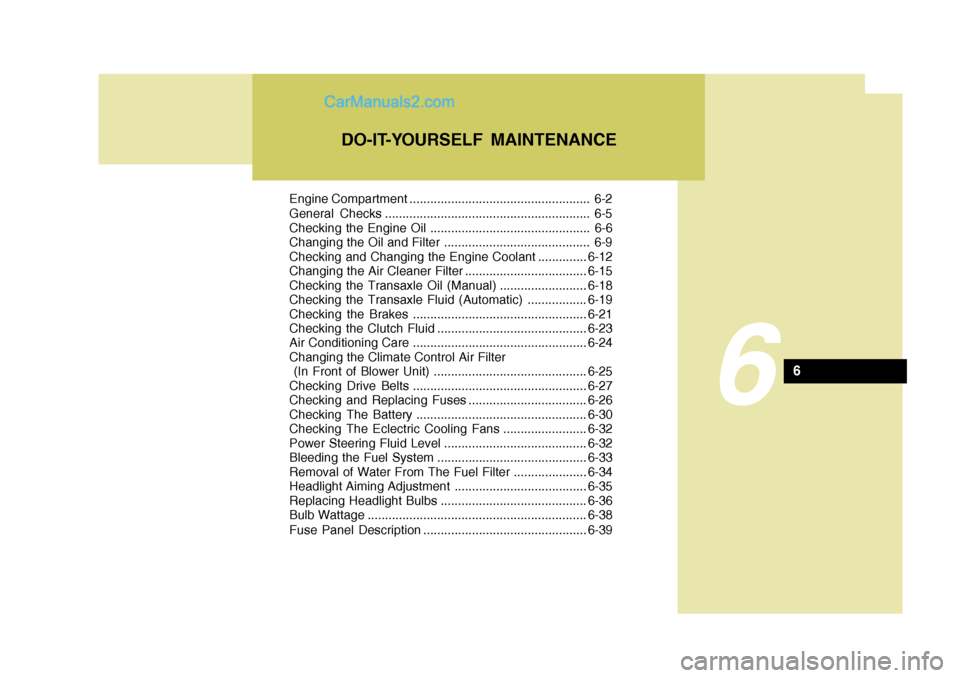
Engine Compartment .................................................... 6-2
General Checks ........................................................... 6-5
Checking the Engine Oil .............................................. 6-6
Changing the Oil and Filter .......................................... 6-9
Checking and Changing the Engine Coolant..............6-12
Changing the Air Cleaner Filte r ...................................6-15
Checking the Transaxle Oil (Manual) ......................... 6-18
Checking the Transaxle Fluid (Automatic) .................6-19
Checking the Brakes .................................................. 6-21
Checking the Clutch Fluid ........................................... 6-23
Air Conditioning Care .................................................. 6-24
Changing the Climate Control Air Filter
(In Front of Blower Unit) ............................................ 6-25
Checking Drive Belts .................................................. 6-27
Checking and Replacing Fuses ..................................6-26
Checking The Battery ................................................. 6-30
Checking The Eclectric Cooling Fans ........................6-32
Power Steering Fluid Level ......................................... 6-32
Bleeding the Fuel System ........................................... 6-33
Removal of Water From The Fuel F ilter..................... 6-34
Headlight Aiming Adjustment ...................................... 6-35
Replacing Headlight Bulbs .......................................... 6-36
Bulb Wattage ............................................................... 6-38
Fuse Panel Descripti on ............................................... 6-39
DO-IT-YOURSELF MAINTENANCE
6
6