2007 Hyundai Getz roof
[x] Cancel search: roofPage 334 of 463
1- 68 FEATURES OF YOUR HYUNDAI
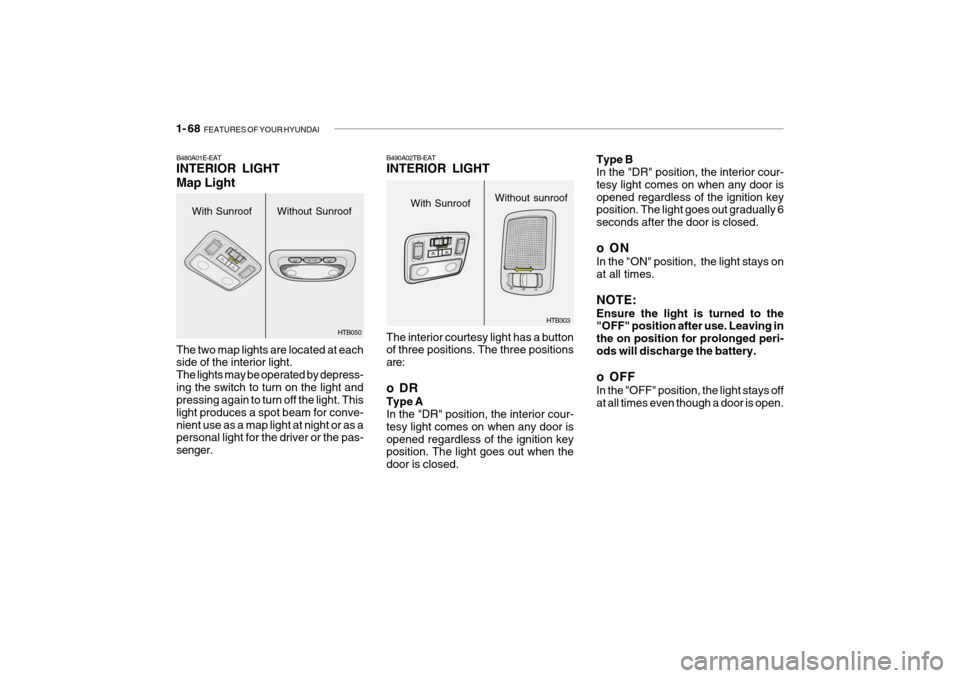
With Sunroof
B480A01E-EAT INTERIOR LIGHT Map Light The two map lights are located at each side of the interior light. The lights may be operated by depress-ing the switch to turn on the light and pressing again to turn off the light. This light produces a spot beam for conve-nient use as a map light at night or as a personal light for the driver or the pas- senger.Without Sunroof
HTB050
The interior courtesy light has a button of three positions. The three positions are:
oDR Type A In the "DR" position, the interior cour- tesy light comes on when any door isopened regardless of the ignition key position. The light goes out when the door is closed.
B490A02TB-EAT INTERIOR LIGHT
HTB303
With Sunroof
Without sunroof
Type B In the "DR" position, the interior cour- tesy light comes on when any door isopened regardless of the ignition key position. The light goes out gradually 6 seconds after the door is closed.
oON In the "ON" position, the light stays on at all times. NOTE: Ensure the light is turned to the "OFF" position after use. Leaving in the on position for prolonged peri-ods will discharge the battery.
o OFF In the "OFF" position, the light stays off at all times even though a door is open.
Page 335 of 463
FEATURES OF YOUR HYUNDAI 1- 69
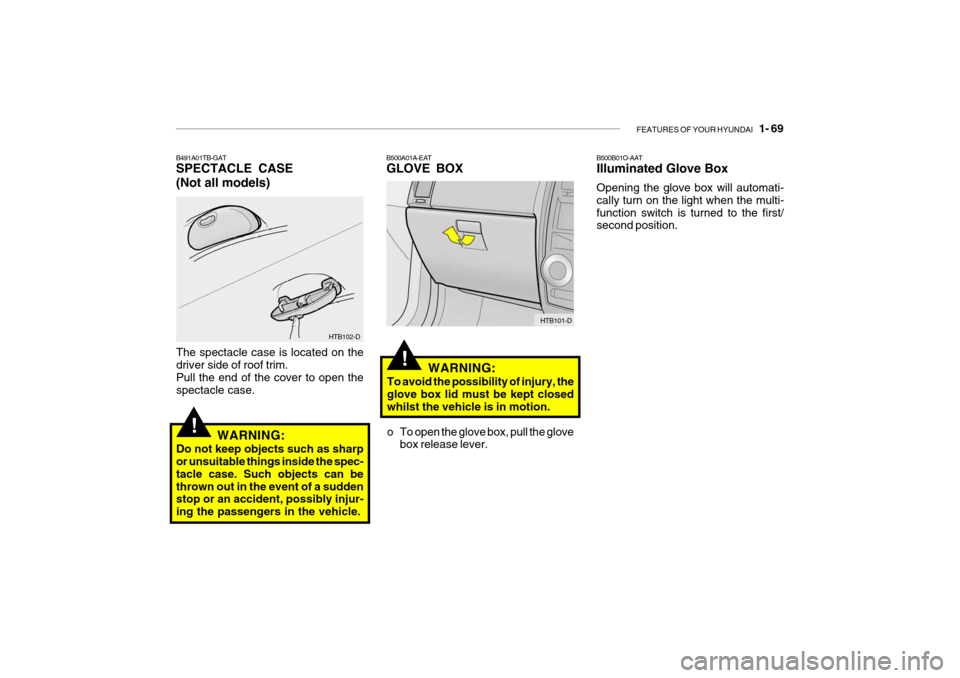
B491A01TB-GAT SPECTACLE CASE (Not all models)
HTB102-D
The spectacle case is located on the driver side of roof trim. Pull the end of the cover to open the spectacle case.
!
!
WARNING:
To avoid the possibility of injury, the glove box lid must be kept closed whilst the vehicle is in motion.
o To open the glove box, pull the glove box release lever.
B500A01A-EAT GLOVE BOX
HTB101-D
WARNING:
Do not keep objects such as sharp or unsuitable things inside the spec- tacle case. Such objects can bethrown out in the event of a sudden stop or an accident, possibly injur- ing the passengers in the vehicle. B500B01O-AAT Illuminated Glove Box Opening the glove box will automati- cally turn on the light when the multi-function switch is turned to the first/ second position.
Page 360 of 463
1- 94 FEATURES OF YOUR HYUNDAI
HTB2043
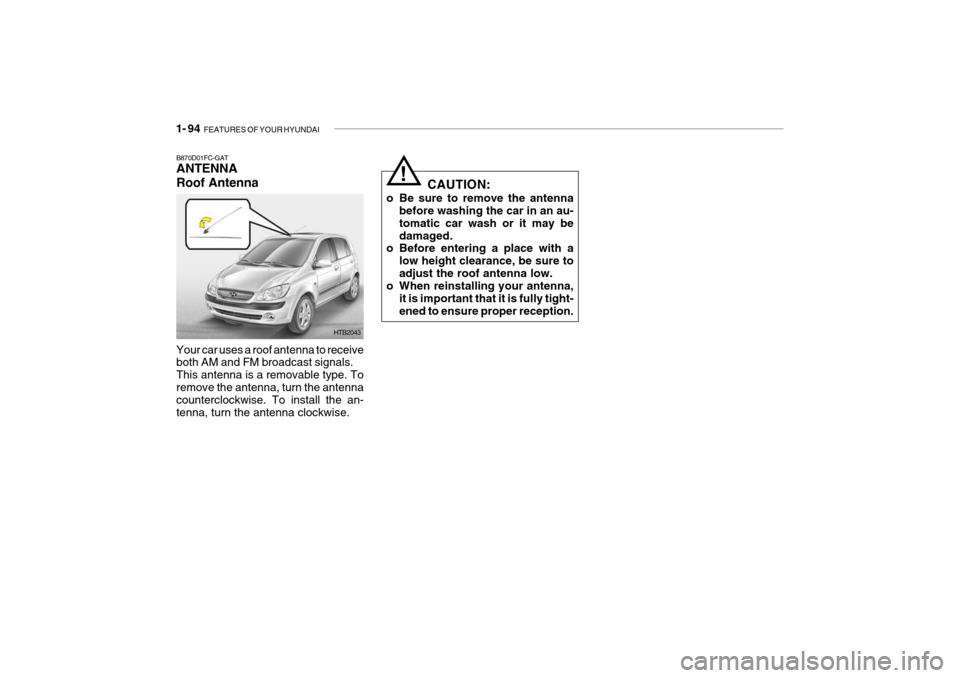
B870D01FC-GAT ANTENNA Roof Antenna Your car uses a roof antenna to receive both AM and FM broadcast signals. This antenna is a removable type. Toremove the antenna, turn the antenna counterclockwise. To install the an- tenna, turn the antenna clockwise. CAUTION:
o Be sure to remove the antenna before washing the car in an au-tomatic car wash or it may bedamaged.
o Before entering a place with a
low height clearance, be sure toadjust the roof antenna low.
o When reinstalling your antenna,
it is important that it is fully tight-ened to ensure proper reception.
!
Page 367 of 463

DRIVING YOUR HYUNDAI 2- 7
!
!
C055B01B-GAT STARTING AND STOPPING THE ENGINE FOR TURBO CHARGERINTERCOOLER (DIESEL EN-GINE)
(1) Do not race the engine or sudden
accelerate the engine immediately after start it. If the engine is cold, allow the engine to idle for severalseconds before it is driven to en- sure sufficient lubrication of the turbo charger unit.
(2) After high speed or extended driv- ing, requiring a heavy engine load,the engine should be allowed to idleabout 1 minute before turning it off. This idle time will allow the turbo charger to cool prior to shutting theengine off.
WARNING:
Do not turn the engine off immedi- ately after it has been subjected to a heavy load. Doing so may causesevere damage to the engine or turbo charger unit.
WARNING:
Be sure that the clutch is fully de- pressed when starting a manualtransaxle vehicle. Otherwise there is the potential to cause damage to the vehicle or injury to someoneinside or outside the vehicle as a result of the forward or backward movement of the vehicle that willoccur if the clutch is not depressed when the vehicle is started. SC060B1-E FUEL ECONOMY The following suggestions are made to assist in achieving the greatest degreeof fuel economy.
o Maintaining a constant check on
fuel consumption will enable the most economical use pattern and driving style to be adopted.
o Avoid using the vehicle for very short journeys if possible, particu-larly when a cold start is involved.
o Ensure that tyre pressures are main- tained at the correct level.
o Use only the recommended grade of fuel.
o Avoid carrying unnecessary weight,
and if a roof rack is in use, removeit as soon as possible after use.
o Anticipate the road and conditions
ahead to enable adjustments inspeed to be made smoothly. Avoid heavy acceleration and sharp brak- ing.
o Avoid cruising at unnecessary high speeds.
5. Turn the ignition key to the "Start"
position and release it when theengine starts.
Page 403 of 463

5- 2 VEHICLE MAINTENANCE REQUIREMENTS
SF020A1-E MAINTENANCE AND SERVICING REQUIREMENTS To ensure the continued reliability and safety of the vehicle, certain routinemaintenance operations are required at specific mileage or time intervals. It is the responsibility of the vehicle owner to ensure that the maintenance schedules shown in both this OwnersManual and the Warranty and Service Passport are adhered to. The new vehicle warranty may be invalidated if the routine maintenance operations are not performed in line with the recommendations outlinedand the safety and durability of the vehicle adversely affected. It is recommended that all mainte- nance operations with the exception of the daily operating checks are en-trusted to a Hyundai authorised re- pairer to ensure that the latest repairer and maintenance procedures andspecialised servicing tools are em- ployed. In addition, the use of genuine Hyundai replacement parts will ensurethat the vehicle safety and perfor- mance will not be compromised. NOTE:
The inspection and testing of cer-
tain electronic fuel injection/engine management and automatic trans- mission control systems require specialised electronic equipmentspecifically designed for Hyundai vehicles. The use of general pur- pose electrical test equipment mayresult in damage to the control unit microprocessors.
SF020C2-E
Specified Scheduled Procedures
The Specified scheduled procedures
are listed in the maintenance charts beginning at page 5-3. The opera- tions specified must be performed at the time or mileage intervals shownirrespective of whether the mileage interval has been reached before the specified time interval. Certain lubricants and components
degrade with both time and mileage(e.g. engine oil and brake fluid) and therefore it is not permissable to base the maintenance schedule upon mile-age alone. It is strongly recommended that the maintenance operations are performed by the factory-trained ordistributor-trained technicians at your Hyundai authorised repairer becauseof the need for specialised knowledge and tooling and to ensure that no possibility of invalidating the manufac-turers warranty exists.
The maintenance schedules relate to
vehicles operated under normal con- ditions, vehicles which are operated under adverse conditions will requiremore frequent maintenance which is described at page 5-6. NOTE:
Service schedules may change de-
pending on individual country needs. Please ask your localHyundai authorised repairer for a copy of the service schedule that relates to that country.
SF030B1-E
SERVICE HISTORY
It is important that all scheduled main-
tenance services are recorded in thewarranty and service passport to en-sure that proof of maintenance is avail- able when warranty service is required.
Page 407 of 463

5- 6 VEHICLE MAINTENANCE REQUIREMENTS
MAINTENANCE UNDER SEVERE USAGE CONDITIONS
The following items must be serviced more frequently on cars normally used under severe driving conditions. Refer to the chart below for the appropriate maintenance intervals. R : REPLACE I : INSPECT AND, AFTER INSPECTION, CLEAN, ADJUST, REPAIRER OR REPLACE IF NECESSARY
F040A02TB-EAT
ENGINE OIL AND FILTER AIR CLEANER FILTERSPARK PLUGSTIMING BELTBRAKE PADSREAR BRAKE LININGS AND CYLINDERSSUSPENSION AND STEERING SYSTEM MANUAL TRANSAXLE OIL AUTOMATIC TRANSAXLE FLUIDPOLLEN FILTER(FOR EVAPORATOR AND BLOWER UNIT) EVERY 6,000 MILESMORE FREQUENTLY
MORE FREQUENTLY EVERY 37,000 MILES OR 48 MONTHSMORE FREQUENTLYMORE FREQUENTLY MORE FREQUENTLY EVERY 60,000 MILESEVERY 27,000 MILES
MORE FREQUENTLY
MAINTENANCE OPERATIONMAINTENANCE ITEM
R RR RI II
RR R A, B, C, D, E, F, G, H, I, K C, EB, I D, E, F, G, I C, D, G, HC, D, G, HC, D, E, F C, D, E, G, H, I, J E, F, G, H, I C,E
MAINTENANCE INTERVALS
DRIVING
CONDITION
SEVERE DRIVING CONDITIONS
A - Repeatly driving short distance of less than 5miles(8km) in normal temperature or less than 10miles(16km) in freezing temperature
B - Extensive engine idling or low speed driving for long distances
C - Driving on rough, dusty, muddy, unpaved, graveled or salt- spread roads
D - Driving in areas using salt or other corrosive materials or in very cold weather E - Driving in sandy areas
F - Driving in heavy traffic area over 90°F(32°C) G - Driving on uphill, downhill, or mountain roadH - Towing a Trailer, or using a camper, or roof rack
I - Driving as a patrol car, taxi, other commercial use or vehicle towing
J - Driving over 100 MPH(170 Km/h)K - Frequently driving in stop-and-go conditions
Page 444 of 463

DO-IT-YOURSELF MAINTENANCE 6- 33
G200E01TB
G200E02TB-GAT Inner Panel
FUSE RATING
10A 10A10A15A10A10A 20A 15A10A 20A 10A 15A20A10A10A10A 30A 15A10A15A15A15APROTECTED COMPONENTS
Air conditioner
Stop/Tail Light (LH) A/Bag IndicatorAudio, Electronic Outside Mirror
Turn signal Light, Back-up Light
Stop/Tail Light (RH)Cluster
Power outlet PCM, ABS controlAir BagDoor Lock System, SunroofRear Wiper Motor
Start Relay, 9oTheft alarm system Seat Warmer Rear window DefrosterECM
Hazard Warning Light, ETACM Front Wiper Motor Rear Fog Light
Fog light, ETACM, Power Window, Headlight leveling Device
Blower, SunroofRear window DefrosterHeadlight (RH)Front Fog Light
High Beam Light Indicator, Headlight (LH) Room Lamp, Audio, Cluster
DESCRIPTION
A/C SW
TAIL LH
A/BAG IND
AUDIO
T/SIG
TAIL RH
CLUSTER
P/OUTLET ECU 1
A/BAG
D/LOCK
RR/WPR STARTS/HTD
HTD MIR ECU2
STOP
HAZARD
FRT WPR R/FOG
IGNITION BLOWER PR HTD
H/LP RH F/FOG
H/LP LH
POWER CONN & R/LP
Page 460 of 463

10- 2 INDEX
A
ACTIVE HEADRESTS ................................................ 1-14
ADJUSTING ARMREST ............................................. 1-15
ADJUSTING HEAD RESTRAINTS............................. 1-13
AIR BAG ..................................................................... 1-34
AIR CONDITIONING SWI TCH .................................... 1-89
AIR CONDITIONI NG SYSTEM MAINTENANCE ........ 6-18
AIR CLEANER FILTER ............................................... 6-11
ANTENNA ................................................................... 1-94
ANTI-LOCK BRAKE SYSTEM .................................... 2-14
ANTI-THEFT ALARM SYSTEM ................................... 1-8
ASHTRAY ................................................................... 1-64
AUDIO REMOTE CONTROL SW ITCH ........................1-82
AUTOMATIC TRANSAXLE ......... ................................. 2-9
AUTOMATIC TRANSAXLE FLUID ..............................6-15
B
BATTERY MAINTENANCE ........................................ 6-22
BEFORE STARTING THE ENGINE ............................ 2-3
BONNET REL EASE ................................................... 1-73
BRAKE SYSTEM CHECKI NG .................................... 6-17
CCARE OF SEAT BELTS ............................................. 1-21
CARGO AREA COVER .............................................. 1-77CATALYTIC CONVERTOR OPERATING
PRECAUTIONS ....................................................... 7-3
CENTRAL DOOR LOCKS ............................................ 1-7
CHANGING A FLAT TYRE .......................................... 3-6
CHILD-PROOF REAR DOOR LOCK ............................ 1-8
CHILD RESTRAINT SYSTEM .................................... 1-25
CIGAR LIGHTER ........................................................ 1-62
COMBINATION IGNITION SWITCH AND STEERING LOCK ................................................... 2-3
CONSOLE TRAY ........................................................ 1-64
DDAILY OPERATING CHECKS ..................................... 6-5
DIGITAL CLOCK ......................................................... 1-62
DOOR LOCKS ............................................................. 1-6
DOOR WINDOWS ...................................................... 1-11
DRINK HOLDER ......................................................... 1-64
DRIVE BELTS ............................................................ 6-20
DRIVING FOR ECONOMY ......................................... 2-15
EEFFECTIVE BRA KING............................................. 2-13
ELECTRIC COOLING FANS ....................................... 6-23
ELECTRONIC STABILITY PROGRAM .......................2-14
EMERGENCY TOWING ............................................. 3-12
EMISSION CONTROL SYSTEM ................................. 7-2