DO-IT-YOURSELF MAINTENANCE 6- 25
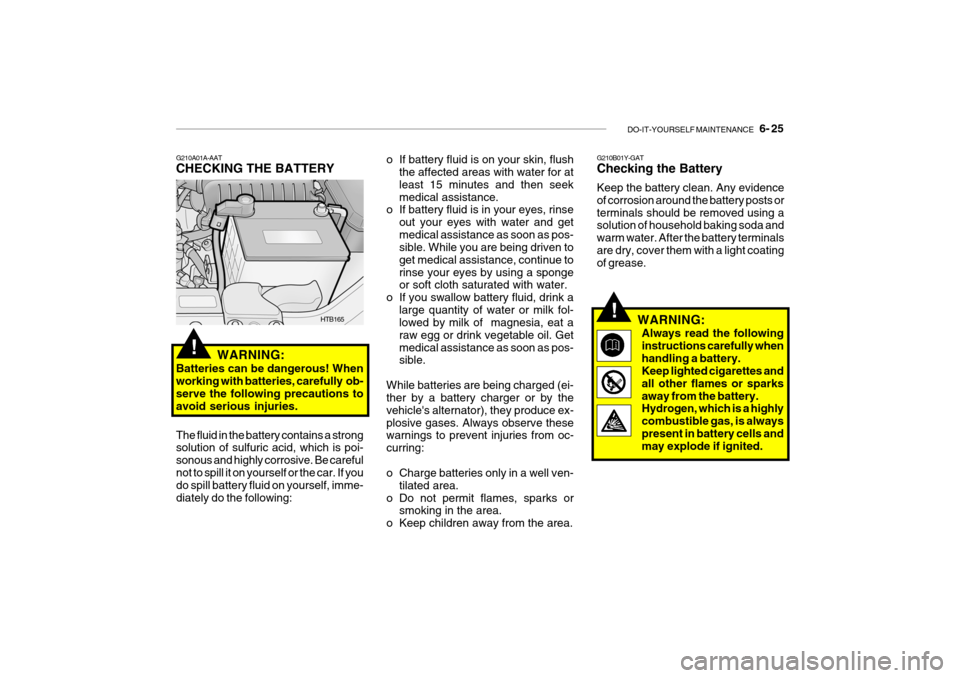
G210A01A-AAT CHECKING THE BATTERY
WARNING:
Batteries can be dangerous! When working with batteries, carefully ob-serve the following precautions to avoid serious injuries. HTB165
The fluid in the battery contains a strongsolution of sulfuric acid, which is poi- sonous and highly corrosive. Be carefulnot to spill it on yourself or the car. If you do spill battery fluid on yourself, imme- diately do the following:
!
o If battery fluid is on your skin, flush the affected areas with water for at least 15 minutes and then seekmedical assistance.
o If battery fluid is in your eyes, rinse
out your eyes with water and getmedical assistance as soon as pos- sible. While you are being driven to get medical assistance, continue torinse your eyes by using a sponge or soft cloth saturated with water.
o If you swallow battery fluid, drink a large quantity of water or milk fol-lowed by milk of magnesia, eat a raw egg or drink vegetable oil. Getmedical assistance as soon as pos- sible.
While batteries are being charged (ei-ther by a battery charger or by the vehicle's alternator), they produce ex-plosive gases. Always observe these warnings to prevent injuries from oc- curring:
o Charge batteries only in a well ven- tilated area.
o Do not permit flames, sparks or smoking in the area.
o Keep children away from the area.
!
G210B01Y-GAT Checking the Battery Keep the battery clean. Any evidence of corrosion around the battery posts orterminals should be removed using a solution of household baking soda and warm water. After the battery terminalsare dry, cover them with a light coating of grease.
WARNING:
Always read the following instructions carefully whenhandling a battery. Keep lighted cigarettes and all other flames or sparksaway from the battery. Hydrogen, which is a highly combustible gas, is alwayspresent in battery cells and may explode if ignited.
DO-IT-YOURSELF MAINTENANCE 6- 21
G190B01TB-GAT CHECKING DRIVE BELTS (Diesel) At the scheduled maintenance inspec- tion, belts should be examined forcracks, wear, fraying or other evidence of deterioration and replaced if neces- sary.Belt routing should also be checked to be sure there is no interference be- tween the belts and other parts of theengine.
!
SG200A1-E FUSIBLE LINKS The fusible link prevents damage to the wiring harness in the event of an elec-trical system malfunction. Failure of a fusiblelink is indicative of a serious overload condition having occurred andtherefore the electrical system should be checked by a Hyundai authorised repairer before a replacement link isfitted.
WARNING:
Under no circumstances should afusible link be replaced with any- thing other than a new link of the same rating. The use of higher ratedlinks or other means of connecting the circuit will create a potential fire hazard.G200B01E-EAT INDIVIDUAL CIRCUIT FUSES The fuse box containing the individual circuit fuses will be found in the back-side of multi box located in the right side of driver. The multi box is removed by pulling lightly and then releasing the lid.A fuse rating grid will be found on the reverse side of the cover. In the event of fuse failure, the fuse should be re-placed with one of equivalent rating. A fuse removal tool is provided within the fuse box to facilitate replacement. HTB180-D
A/C comp.
Water pump pulley
G190B01TB
Alternator Power steering pump
Tensioner
Crankshaft pulley