2007 Hyundai Getz instrument cluster
[x] Cancel search: instrument clusterPage 267 of 463

1. FEATURES OF YOUR HYUNDAI
Fuel Recommendations ................................................................... 1-2
Running In Your new Hyundai ......................................................... 1-4
Immobilizer system .......................................................................... 1-5
Door locks (Anti-theft alarm system) ............................................... 1-6Power windows.............................................................................. 1-11
Seat ................................................................................................ 1-12
Seat Belt ......................................................................................... 1-19
Child restraint system .................................................................... 1-25
Supplemental restraint (AIRBAG) system .....................................1-34
Instrument cluster and indicator lights ............................................1-42
Warning Light and Indicator ............................................................ 1-46
Trip computer ................................................................................. 1-55
Multi-Function Light Switch............................................................ 1-57
Windshield wiper/Washer Switch ...................................................1-59
Sunroof ........................................................................................... 1-65
Mirror ......... ..................................................................................... 1-70
Bonnet Release .............................................................................. 1-73
How to use luggage Room ............................................................. 1-77
Heating and cooling control ............................................................ 1-83
Stereo sound system ..................................................................... 1-92
Antenna .......................................................................................... 1-94
1
Page 303 of 463
FEATURES OF YOUR HYUNDAI 1- 37
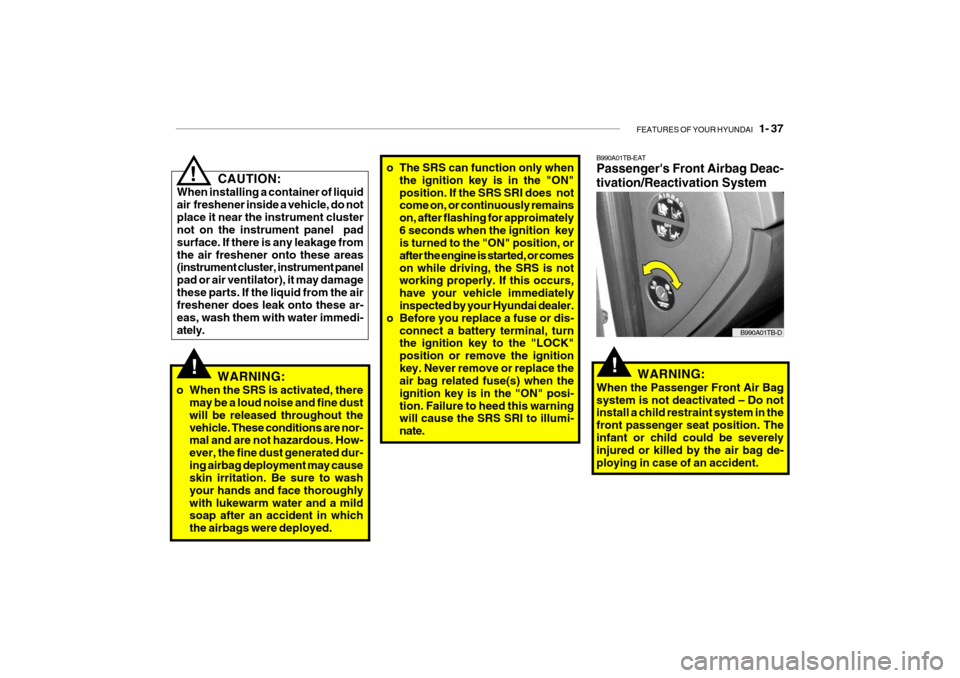
B990A01TB-EAT Passenger's Front Airbag Deac- tivation/Reactivation System
B990A01TB-D
WARNING:
When the Passenger Front Air Bag system is not deactivated – Do not install a child restraint system in the front passenger seat position. Theinfant or child could be severely injured or killed by the air bag de- ploying in case of an accident.
!!
! CAUTION:
When installing a container of liquid air freshener inside a vehicle, do notplace it near the instrument cluster not on the instrument panel pad surface. If there is any leakage fromthe air freshener onto these areas (instrument cluster, instrument panel pad or air ventilator), it may damagethese parts. If the liquid from the air freshener does leak onto these ar- eas, wash them with water immedi-ately.
WARNING:
o When the SRS is activated, there may be a loud noise and fine dustwill be released throughout thevehicle. These conditions are nor- mal and are not hazardous. How- ever, the fine dust generated dur-ing airbag deployment may cause skin irritation. Be sure to wash your hands and face thoroughlywith lukewarm water and a mild soap after an accident in which the airbags were deployed. o The SRS can function only when
the ignition key is in the "ON"position. If the SRS SRI does not come on, or continuously remains on, after flashing for approimately6 seconds when the ignition key is turned to the "ON" position, or after the engine is started, or comeson while driving, the SRS is not working properly. If this occurs, have your vehicle immediatelyinspected by your Hyundai dealer.
o Before you replace a fuse or dis-
connect a battery terminal, turn the ignition key to the "LOCK" position or remove the ignitionkey. Never remove or replace the air bag related fuse(s) when the ignition key is in the "ON" posi-tion. Failure to heed this warning will cause the SRS SRI to illumi- nate.
Page 304 of 463

1- 38 FEATURES OF YOUR HYUNDAI
!WARNING:
o Should at any time a fault develop in the passenger air bag system whilst the front passenger air bag is deactivated, the passenger front air bag OFF indicator warning lightwill immediately go out and the SRS service reminder warning light will be displayed.
o Should this condition happen the rear facing child seat must be re-moved as soon as possible fromthe front passenger seat and the vehicle should taken to the near- est Hyundai Authorised Repairerto have the SRS air bag system checked out.
The passenger front air bag deactiva-tion system is intended to reduce un- necessary repair costs for the replace-ment of the passenger air bag system as a result of collision damage when the passengers seat is unoccupied andalso to facilitate for the fitting of a rear facing child seat in the front passenger seat position.
To Deactivate Or Reactvate the Passengers Front Air Bag. To deactivate the passengers front air bag, insert the ignition key into the ON/ OFF switch located on the left side ofthe crash pad and turn it to the "OFF" position. The passengers front air bag OFF indicator light located within theinstrument cluster will illuminate and stay on until the passenger front air bag is reactivated. To reactivate the passengers front airbag, insert the ignition key into the ON/OFF switch located on the left sideof the crash pad and turn it to the "ON" position. The passenger’s front air bag OFF indicator light located within theinstrument cluster will not now be illumi- nated.
!
CAUTION:
When a rear facing seat is fitted to the passenger front seat position the following must be adhered – the
passenger's front air bag must be deactivated, the passenger seat mustbe located in its rear most position and only a Hyundai approved rear facing child seat must be fitted.
Page 307 of 463

FEATURES OF YOUR HYUNDAI 1- 41
The infant or child could be se- verely injured by an airbag de- ployment in case of an accident.
o Modification to SRS components or wiring, including the additionof any kind of badges to the padcovers or modifications to the body structure, can adversely affect SRS performance and lead to possibleinjury.
o For cleaning the airbag pad cov-
ers, use only a soft, dry cloth orone which has been moistened with plain water. Solvents or clean- ers could adversely affect theairbag covers and proper deploy- ment of the system.
o No objects should be placed over
or near the airbag modules on thesteering wheel, instrument panel, and the front passenger's panelabove the glove box, because any such object could cause harm if the vehicle is in a crash severeenough to cause the airbags to inflate.
o If the airbags inflate, they must be
replaced by a Hyundai authorisedrepairer. o Do not tamper with or disconnect
SRS wiring, or other components of the SRS system. Doing so couldresult in injury, due to accidental firing of the airbags or by render- ing the SRS inoperative.
o If components of the airbag sys- tem must be discarded, or if thevehicle must be scrapped, certainsafety precautions must be ob- served. Your Hyundai authorised repairer knows these precautionsand can give you the necessary information. Failure to follow these precautions and procedures couldincrease the risk of personal in- jury.
o If you sell your vehicle, make cer- tain that this manual is transferredto the new owner together with the vehicle.
o If your car was flooded and has soaked carpeting or water onflooring, you shouldn't try to startengine; have the car towed to Hyundai authorised repairer.
!WARNING:
o Extreme Hazard! Do not use a rear- ward facing restraint on a seat protected by an airbag in front of it! If you must use a rear facing childseat on the front seat, first deacti- vate the air bag system and ensure that the passenger's front air bag'off' indicator light in the instru- ment cluster is displayed.
o Do not install a child restraint sys- tem in the front passenger seatposition. A child restraint system must
never be placed in the front seat.
B240C01HP
Page 308 of 463
1- 42 FEATURES OF YOUR HYUNDAI
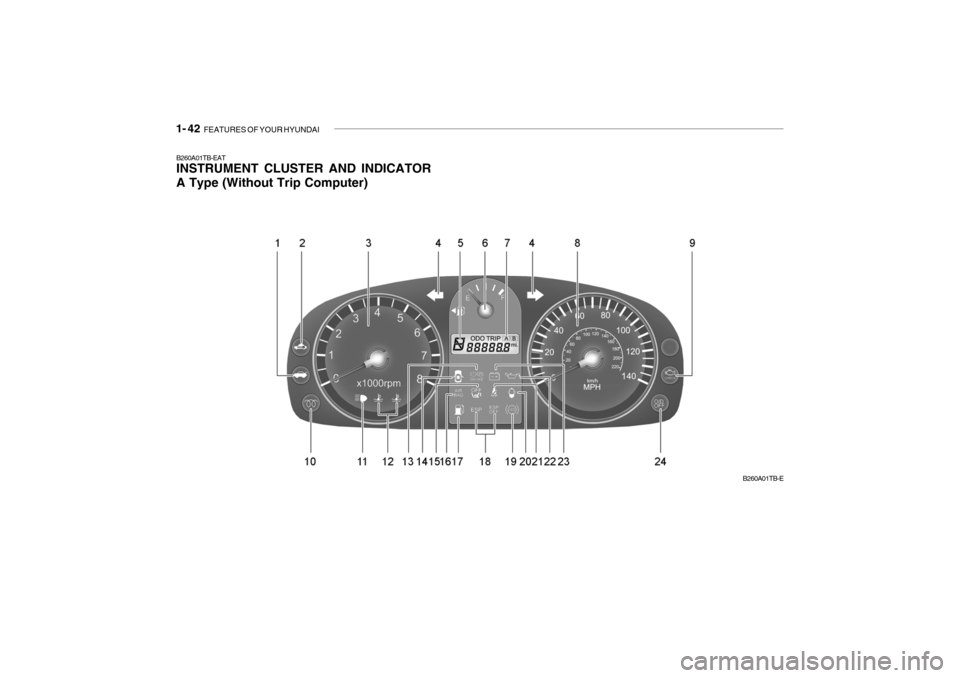
B260A01TB-EAT INSTRUMENT CLUSTER AND INDICATOR A Type (Without Trip Computer)
B260A01TB-E
Page 323 of 463

FEATURES OF YOUR HYUNDAI 1- 57
SB220A1-E MULTI FUNCTION SWITCH Turn Signal Operation To signal an intention to turn right, the switch lever should be pressed down. To signal an intention to turn left, theswitch lever should be pushed upwards. In both instances, the turn signal lights and the instrument cluster warning lightwill flash. Upon completion of the ma- noeuvre, the lever will, under normal circumstances, return to the "Off" posi-tion. However, if the manoeuvre in- volved only a small movement of the steering wheel, the signal may need tobe cancelled manually. If either turn signal indicator flashes more rapidly than normal or refuses to flash at all, amalfunction of the turn signal system may exist. SB220B1-E Lane Change Signal To indicate an intention to change lanes, moving the lever slightly towards the direction of the relevant turn signal willcause the turn signal lights to flash. When the lever is released, it will return to the "off" position.
HTB018-D
B400B04TB-E
4. Drive Distance
o This mode indicates the drive dis-
tance travelled since the last drive time reset.
o Pressing the trip computer switch for more than 1 second, when thedrive distance is being displayed,clears the drive distance to zero.
Page 373 of 463

DRIVING YOUR HYUNDAI 2- 13
HTB217-D
SC130A1-E OVERDRIVE SWITCH
The overdrive switch prevents the transaxle upshifting higher than third gear when the switch is turned "OFF".The transaxle will start from rest in first gear and upshift to second and third gear depending upon the roadspeedand throttle opening but will not upshift to fourth gear. When the overdrive switch is turned "ON", the transaxlewill start from rest in first gear and will upshift, depending upon roadspeed and throttle opening to second, thirdand fourth gear. Therefore, when the overdrive switch is turned "OFF", the transaxle performs as a three speedunit and the overdrive warning light located in the instrument cluster will be illuminated. When the overdrive switch is turned "ON", the transaxle functionsas a fully automatic four speed unit with the maximum fuel economy po- tential of the vehicle being realized. SC140A1-E EFFECTIVE BRAKING Braking system performance and fric- tion material life are greatly affected by the driving style adopted. The follow- ing suggestions are made to assist inachieving the best results from the braking system.
o Anticipate the road and conditions
ahead in order that heavy braking may be avoided.
o When descending long gradients, use the engine to assist in retardingthe vehicle to minimize the possibil-ity of brake fade occurring.
o When trailer towing, ensure that the
trailer brakes function correctly anduse engine braking to assist the vehicle braking system. o Use only genuine Hyundai replace-
ment brake pads and shoes to en- sure consistent friction characteris-tics and wear rates.
o After driving through deep water
(e.g. fording), the brakes may be-come wet and performance reduced. Always check brake efficiency after emerging from the water and dry thebrakes by lightly depressing the brake pedal several times whilst driving slowly.
o Apply the parking brake only when the vehicle is at rest.
o Since the power assistance pro- vided by the brake servo is derived from the engine, coasting with the engine turned off or towing of thevehicle with the engine turned off will result in greatly increased pedal pressures being required to stop thevehicle.
o Do not hold the vehicle on an incline
with the accelerator pedal. This cancause the transmission to overheat. Always use the brake pedal or park- ing brake.
Page 375 of 463

DRIVING YOUR HYUNDAI 2- 15
!
It is not a substitute for safe driving practices. Factors including speed, road conditions and driver steering input canall affect whether ESP will be effective in preventing a loss of control. It is still your responsibility to drive and cornerat reasonable speeds and to leave a sufficient margin of safety.
WARNING:
Electronic stability program is a driv- ing aid; all normal precautions for driving in inclement weather and on slippery road surfaces should beobserved.
! CAUTION:
Driving with varying tyre or wheel size may cause the ESP system to malfunction. When replacing tyres,make sure they are the same size as your original tyres. C310D01JM-EAT Indicators and Warning The indicators should illuminate when the ignition key is turned to ON orSTART but should go out after approxi- mately 3 seconds. If the indicators do not illuminate, or theESP-OFF indicator does not go out after approximately 3 seconds, have the vehicle checked by Hyundaiauthorised repairer. Should there be any unusual conditions in the device whilst driving, ESP-OFF indicator illuminates as a warning. If ESP-OFF indicator illuminates, pullyour car to a safe place and stop the engine. Then, start the engine again to check ifthe ESP-OFF indicator goes out. If the indicator remains lit even after the engine has been started, have your car checked by Hyundai authorised repairer.
C310B01JM-AAT ESP ON/OFF Mode When the ESP is operating, the ESP indicator in the instrument cluster willblink. If you turn the system off by pressing the ESP switch, the ESP-OFF indica-tor will come on and stay on. In the ESP-OFF mode, the stability control will be deactivated. Adjust your drivingaccordingly. To turn the system back on, press the switch again. The ESP- OFF indicator should go off. NOTE: The ESP mode will automatically be turned ON after the engine is turned off and restarted.