Page 177 of 282

2 DRIVING YOUR HYUNDAI
14
!
CAUTION:
Driving with varying tire or wheel size may cause the ESP system to malfunction. When replacing tires,make sure they are the same size as your original tires.!
ELECTRONIC STABILITY PROGRAM (ESP)
C310A01JM-AAT (If Installed) It is not a substitute for safe driving practices. Factors including speed, roadconditions and driver steering input can all affect whether ESP will be effective in preventing a loss of control. It is stillyour responsibility to drive and corner at reasonable speeds and to leave a sufficient margin of safety.
B310A01MC C310B01JM-AAT ESP ON/OFF Mode When the ESP is operating, the ESP indicator in the instrument cluster willblink. If you turn the system off by pressing the ESP switch, the ESP-OFF indica-tor will come on and stay on. In the ESP-OFF mode, the stability control will be deactivated. Adjust your drivingaccordingly. To turn the system back on, press the switch again. The ESP- OFF indicator should go off. NOTE: The ESP mode will automatically be turned ON after the engine is turnedoff and restarted.
The Electronic Stability Program (ESP)system is designed to stabilize thevehicle during cornering maneuvers. ESP checks where you are steering and where the vehicle is actually going.ESP applies the brakes at individual wheels and intervenes in the engine management system to stabilize thevehicle. The Electronic Stability Program (ESP) system is an electronic system de- signed to help the driver maintain ve- hicle control under adverse conditions. WARNING:
Electronic stability program is onlya driving aid; all normal precautionsfor driving in inclement weather and on slippery road surfaces should be observed.
Page 185 of 282

2 DRIVING YOUR HYUNDAI
22HIGHER SPEED MOTORING
C160K01A-AAT Carry Emergency Equipment Depending on the severity of the weather where you drive your car, you should carry appropriate emergencyequipment. Some of the items you may want to carry include tire chains, tow straps or chains, flashlight, emer-gency flares, sand, a shovel, jumper cables, a window scraper, gloves, ground cloth, coveralls, a blanket, etc.
C160J01A-AAT Don't Let Ice and Snow Accumu- late Underneath Under some conditions, snow and ice can build up under the fenders andinterfere with the steering. When driv- ing in severe winter conditions where this may happen, you should periodi-cally check underneath the car to be sure the movement of the front wheels and the steering components is notobstructed.
C170A01A-AAT Pre-Trip Inspections 1. Tires: Adjust the tire inflation pressures to specification. Low tire inflation pres-sures will result in overheating and possible failure of the tires. Avoid using worn or damaged tireswhich may result in reduced traction or tire failure. NOTE: Never exceed the maximum tire in- flation pressure shown on the tires.
2. Fuel, engine coolant and
engine oil:
High speed travel consumes more fuel than urban motoring. Do not forget tocheck both engine coolant and engine oil. 3. Drive belt: A loose or damaged drive belt may result in overheating of the engine.USE OF LIGHTS
C180A01A-AAT Check your lights regularly for correct operation and always keep them clean. When driving during the day in condi- tions of poor visibility, it is helpful todrive with headlights on low beam. This enables you to be seen as well as to see.
Page 202 of 282
3
WHAT TO DO IN AN EMERGENCY
13
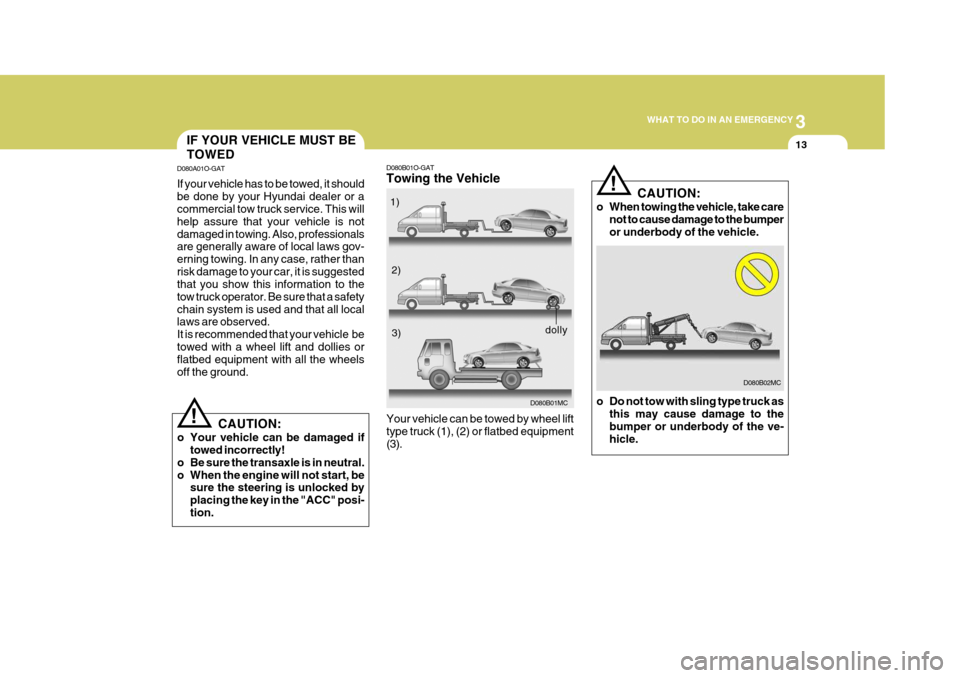
D080B01O-GAT Towing the Vehicle
D080B01MC
Your vehicle can be towed by wheel lift type truck (1), (2) or flatbed equipment(3). 1)
2)3)
dolly
D080B02MC
CAUTION:
o When towing the vehicle, take care not to cause damage to the bumper or underbody of the vehicle.
o Do not tow with sling type truck as this may cause damage to thebumper or underbody of the ve- hicle.
!
IF YOUR VEHICLE MUST BE TOWED
D080A01O-GAT If your vehicle has to be towed, it should be done by your Hyundai dealer or a commercial tow truck service. This will help assure that your vehicle is notdamaged in towing. Also, professionals are generally aware of local laws gov- erning towing. In any case, rather thanrisk damage to your car, it is suggested that you show this information to the tow truck operator. Be sure that a safetychain system is used and that all local laws are observed. It is recommended that your vehicle betowed with a wheel lift and dollies or flatbed equipment with all the wheels off the ground.
! CAUTION:
o Your vehicle can be damaged if towed incorrectly!
o Be sure the transaxle is in neutral.
o When the engine will not start, be sure the steering is unlocked byplacing the key in the "ACC" posi-tion.
Page 204 of 282
3
WHAT TO DO IN AN EMERGENCY
15
CAUTION
It should be tightened firmly with your fingers until there is no more play in the towing hole. Towing hookis located in the jack case on the spare tire.
!
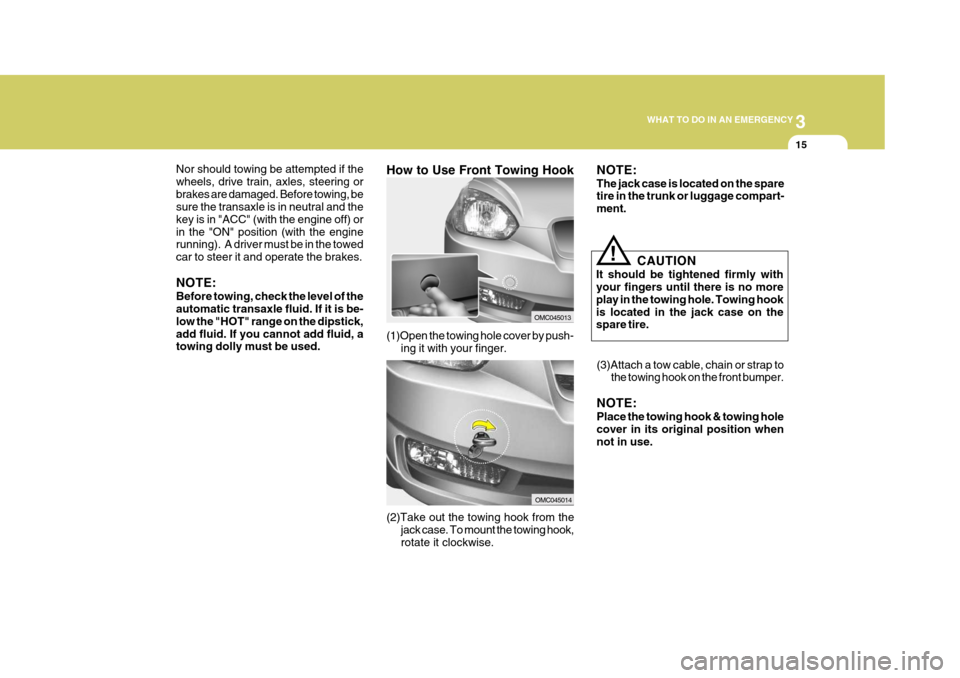
(3)Attach a tow cable, chain or strap to the towing hook on the front bumper.
NOTE: Place the towing hook & towing hole cover in its original position when not in use.
(2)Take out the towing hook from the jack case. To mount the towing hook, rotate it clockwise.
OMC045014
Nor should towing be attempted if the wheels, drive train, axles, steering orbrakes are damaged. Before towing, be sure the transaxle is in neutral and the key is in "ACC" (with the engine off) orin the "ON" position (with the engine running). A driver must be in the towed car to steer it and operate the brakes. NOTE: Before towing, check the level of the automatic transaxle fluid. If it is be- low the "HOT" range on the dipstick,add fluid. If you cannot add fluid, a towing dolly must be used.
(1)Open the towing hole cover by push-
ing it with your finger.
OMC045013
How to Use Front Towing Hook
NOTE: The jack case is located on the spare tire in the trunk or luggage compart- ment.
Page 205 of 282
3 WHAT TO DO IN AN EMERGENCY
16IF YOU LOSE YOUR KEYS
D120A01A-GAT If you lose your keys, many Hyundai dealers can make you a new key if you have your key number. If you lock the keys inside your car andyou cannot obtain a new key, many Hyundai dealers can use special tools to open the door for you. Information about the key of immobi- lizer system (If Installed) will be foundon page 1-5.
CAUTION:
If the car is being towed with all four wheels on the ground, it can be towed only from the front. Be surethat the transaxle is in neutral. Do not tow at speeds greater than 50 km/h (30 mph) and for more than 25 km (15miles). Be sure the steering is unlocked by placing the key in the "ACC" posi-tion. A driver must be in the towed vehicle to operate the steering and brakes.
!
Page 218 of 282
5VEHICLE MAINTENANCE REQUIREMENTS
6
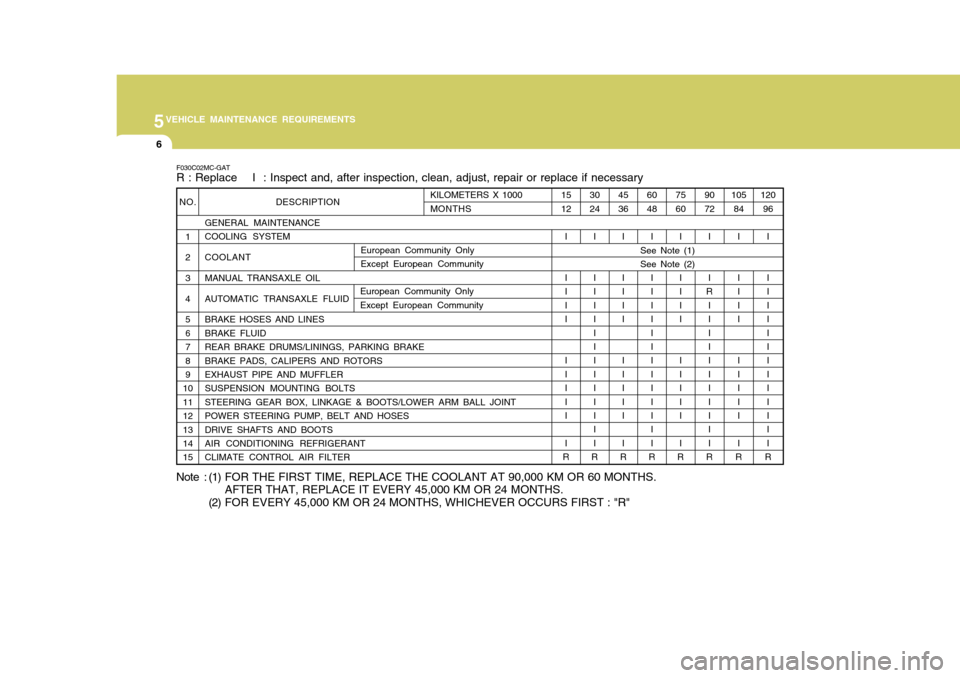
F030C02MC-GAT R : Replace I : Inspect and, after inspection, clean, adjust, repair or replace if necessary
Note : (1) FOR THE FIRST TIME, REPLACE THE COOLANT AT 90,000 KM OR 60 MONTHS. AFTER THAT, REPLACE IT EVERY 45,000 KM OR 24 MONTHS.
(2) FOR EVERY 45,000 KM OR 24 MONTHS, WHICHEVER OCCURS FIRST : "R"
NO.
1 23 4 5 678 9
10 11121314 15 DESCRIPTION
GENERAL MAINTENANCE COOLING SYSTEM COOLANT MANUAL TRANSAXLE OILAUTOMATIC TRANSAXLE FLUID BRAKE HOSES AND LINES BRAKE FLUIDREAR BRAKE DRUMS/LININGS, PARKING BRAKEBRAKE PADS, CALIPERS AND ROTORS EXHAUST PIPE AND MUFFLER SUSPENSION MOUNTING BOLTSSTEERING GEAR BOX, LINKAGE & BOOTS/LOWER ARM BALL JOINTPOWER STEERING PUMP, BELT AND HOSESDRIVE SHAFTS AND BOOTSAIR CONDITIONING REFRIGERANT CLIMATE CONTROL AIR FILTER
120 96
I I IIII I IIII I II
R
105
84
I I III I III I I
R
90 72
I I
R I II I IIII I II
R
7560
I I III I III I I
R
60 48
I I IIII I IIII I II
R
4536
I I III I III I I
R
30 24
I I IIII I IIII I II
R
1512
I I III I III I I
R
KILOMETERS X 1000 MONTHS
See Note (1) See Note (2)
European Community Only Except European Community
European Community Only Except European Community
Page 219 of 282

5
VEHICLE MAINTENANCE REQUIREMENTS
7
ENGINE OIL AND FILTER (
GASOLINE)
ENGINE OIL AND FILTER (DIESEL) AIR CLEANER FILTER SPARK PLUGS
TIMING BELT (GASOLINE)
BRAKE PADS, CALIPERS AND ROTORSREAR BRAKE DRUMS/LININGS, PARKING BRAKE
STEERING GEAR BOX, LINKAGE & BOOTS/ LOWER ARM BALL JOINT
DRIVE SHAFTS AND BOOTS MANUAL TRANSAXLE OIL AUTOMATIC TRANSAXLEFLUID CLIMATE CONTROL AIR FILTER R R R RR
II I I
RR R
European Community Only Except European Community
MAINTENANCE ITEM
EVERY 7,500 KM OR 6 MONTHS EVERY 7,500 KM OR 6 MONTHSEVERY 5,000 KM OR 6 MONTHS MORE FREQUENTLY MORE FREQUENTLYEVERY 60,000 KM OR 48 MONTHS MORE FREQUENTLY MORE FREQUENTLY MORE FREQUENTLY EVERY 15,000 KM OR 12 MONTHS EVERY 100,000 KM EVERY 45,000 KMEVERY 40,000 KM MORE FREQUENTLY A, B, C, D, E, F, G, H, I, K A, B, C, D, E, F, G, H, I, K C, E B, HB, D, E, F, G C, D, G, H C, D, G, H C, D, E, F C, D, E, F A, C, D, E, F, G, H, I, J A, C, E, F, G, H, I C, E
MAINTENANCE INTERVALS
DRIVING
CONDITION
MAINTENANCE
OPERATION
MAINTENANCE UNDER SEVERE USAGE CONDITIONS
F040A02MC-GAT The following items must be serviced more frequently on cars normally used under severe driving conditions. Refer to the
chart below for the appropriate maintenance intervals.
R : Replace I : Inspect and, after inspection, clean, adjust, repair or replace if necessary
European Community Only Except European Community
SEVERE DRIVING CONDITIONSA - Repeatedly driving short distance of less than 8km(5miles) in normal temperature or less than 16km(10miles) in freezing temperature
B - Extensive engine idling or low speed driving for long distances
C - Driving on rough, dusty, muddy, unpaved, graveled or salt- spread roads
D - Driving in areas using salt or other corrosive materials or in very cold weather E - Driving in sandy areas
F - Driving in heavy traffic area over 32°C(90°F) G - Driving on uphill, downhill, or mountain road H - Towing a Trailer, or using a camper, or roof rack
I - Driving as a patrol car, taxi, other commercial use or vehicle towing
J - Driving over 170 Km/h(100 MPH)K - Frequently driving in stop-and-go conditions
Page 223 of 282
5
VEHICLE MAINTENANCE REQUIREMENTS
11
F070M01A-AAT
o Steering Gear Box, Linkage &
Boots/Lower arm Ball Joint
With the vehicle stopped and engine off, check for excessive free-play in the steering wheel. Check the linkage for bends or damage. Check the dustboots and ball joints for deterioration, cracks, or damage. Replace any dam- aged parts. F070N01A-AAT
o Power Steering Pump, Belt
and Hoses
Check the power steering pump and hoses for leakage and damage. Re- place any damaged or leaking partsimmediately. Inspect the power steer- ing belt for evidence of cuts, cracks, excessive wear, oiliness and propertension. Replace or adjust it if neces- sary. F070P01A-AAT
o Drive Shafts and Boots
Check the drive shafts, boots and clamps for cracks, deterioration, or damage. Replace any damaged parts and, if necessary, repack the grease. F070Q01A-AAT
o Air Conditioning Refrigerant
Check the air conditioning lines and connections for leakage and damage. Check air conditioning performance according to the relevant shop manual if necessary.