2007 HUMMER H3 towing
[x] Cancel search: towingPage 119 of 480
Shifting Out of Park (P)
(Automatic Transmission)
Your vehicle has an automatic transmission shift
lock control system. You have to apply your
regular brake before you can shift from PARK (P)
when the ignition is in ON. SeeAutomatic
Transmission Operation on page 106.
If you cannot shift out of PARK (P), ease pressure
on the shift lever and push the shift lever all the way
into PARK (P) as you maintain brake application.
Then move the shift lever into the gear you wish.
Press the shift lever button before moving the
shift lever.
Parking Your Vehicle
(Manual Transmission)
Your vehicle has a manual transmission. Before
you get out of your vehicle, move the shift
lever into REVERSE (R), and rmly apply the
parking brake. Once the shift lever has been
placed into REVERSE (R) with the clutch pedal
pressed in, turn the ignition key to LOCK, remove
the key and release the clutch.
If you are parking on a hill, or if your vehicle is
pulling a trailer, seeTowing a Trailer on page 297.
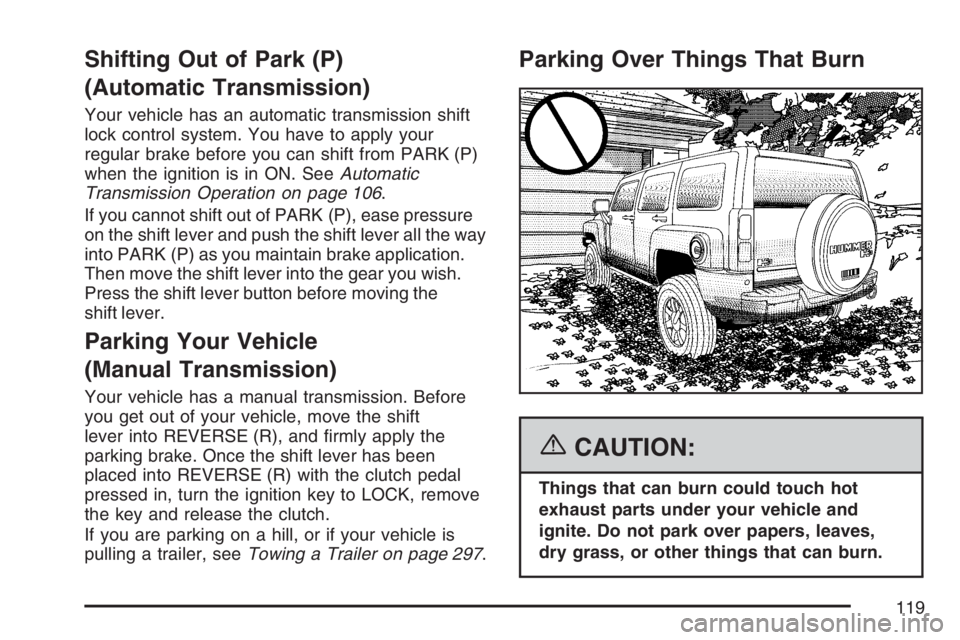
Parking Over Things That Burn
{CAUTION:
Things that can burn could touch hot
exhaust parts under your vehicle and
ignite. Do not park over papers, leaves,
dry grass, or other things that can burn.
119
Page 121 of 480

Running the Engine While Parked
It is better not to park with the engine running. But if
you ever have to, here are some things to know.
{CAUTION:
Idling the engine with the climate control
system off could allow dangerous exhaust
into your vehicle. See the earlier caution
underEngine Exhaust on page 120.
Also, idling in a closed-in place can let
deadly carbon monoxide (CO) into your
vehicle even if the climate control fan is at
the highest setting. One place this can
happen is a garage. Exhaust — with
CO — can come in easily. NEVER park in
a garage with the engine running.
Another closed-in place can be a blizzard.
SeeWinter Driving on page 281.
{CAUTION:
It can be dangerous to get out of your
vehicle if the automatic transmission shift
lever is not fully in PARK (P) with the
parking brake rmly set. Your vehicle can
roll. Do not leave your vehicle when the
engine is running unless you have to. If
you have left the engine running, the
vehicle can move suddenly. You or others
could be injured. To be sure your vehicle
will not move, even when it is on fairly
level ground, always set the parking brake
and move the automatic transmission
shift lever to PARK (P), or the manual
transmission shift lever to NEUTRAL.
Follow the proper steps to be sure your vehicle will
not move. SeeShifting Into Park (P) (Automatic
Transmission) on page 117andParking Your
Vehicle (Manual Transmission) on page 119.
If you are pulling a trailer with your vehicle, see
Towing a Trailer on page 297.
121
Page 182 of 480

Brake System Warning Light
Your vehicle’s hydraulic brake system is divided
into two parts. If one part is not working, the
other part can still work and stop you. For good
braking, though, you need both parts working well.
If the warning light comes on, there could be a
brake problem. Have your brake system inspected
right away.
This light should come on briey when you turn
the ignition key to ON. If it does not come on
then, have it xed so it will be ready to warn you
if there is a problem.When the ignition is on, the brake system
warning light will also come on when you set
your parking brake. SeeParking Brake on
page 116for more information. The light will stay
on if your parking brake does not release fully.
If it stays on after your parking brake is fully
released, it means you have a brake problem.
If the light comes on while you are driving, pull
off the road and stop carefully. You may notice that
the pedal is harder to push, or the pedal may go
closer to the oor. It may take longer to stop.
If the light is still on, have the vehicle towed for
service. SeeTowing Your Vehicle on page 294.
United StatesCanada
182
Page 187 of 480

This light should come on, as a check to show
you it is working, when the ignition is on and
the engine is not running. If the light does
not come on, have it repaired. This light will also
come on during a malfunction in one of two ways:
Light Flashing— A misre condition has been
detected. A misre increases vehicle emissions
and may damage the emission control system
on your vehicle. Diagnosis and service may
be required.
Light On Steady— An emission control system
malfunction has been detected on your vehicle.
Diagnosis and service may be required.
If the Light is Flashing
The following may prevent more serious damage
to your vehicle:
Reducing vehicle speed
Avoiding hard accelerations
Avoiding steep uphill grades
If you are towing a trailer, reduce the amount of
cargo being hauled as soon as it is possible
If the light stops ashing and remains on steady,
see “If the Light Is On Steady” following.If the light continues to ash, when it is safe to
do so, stop the vehicle. Find a safe place to park
your vehicle. Turn the key off, wait at least
10 seconds and restart the engine. If the light
remains on steady, see “If the Light Is On Steady”
following. If the light is still ashing, follow the
previous steps, and see your dealer for service
as soon as possible.
If the Light Is On Steady
You may be able to correct the emission system
malfunction by considering the following:
Did you recently put fuel into your vehicle?
If so, reinstall the fuel cap, making sure to fully
install the cap. SeeFilling the Tank on page 318.
The diagnostic system can determine if the fuel cap
has been left off or improperly installed. A loose
or missing fuel cap will allow fuel to evaporate into
the atmosphere. A few driving trips with the cap
properly installed should turn the light off.
Did you just drive through a deep puddle of water?
If so, your electrical system may be wet. The
condition will usually be corrected when the
electrical system dries out. A few driving trips
should turn the light off.
187
Page 233 of 480

Your Driving, the Road, and Your Vehicle.... 234
Defensive Driving...................................... 234
Drunken Driving........................................ 235
Control of a Vehicle.................................. 238
Braking...................................................... 238
Anti-Lock Brake System (ABS).................. 239
Braking in Emergencies............................. 241
Traction Control System (TCS).................. 241
Locking Rear Axle..................................... 243
StabiliTrak
®System................................... 244
Steering.................................................... 245
Off-Road Recovery.................................... 247
Passing..................................................... 247
Loss of Control.......................................... 249
Off-Road Driving........................................ 250
Assist Steps.............................................. 271
Driving at Night......................................... 272Driving in Rain and on Wet Roads............ 273
City Driving............................................... 276
Freeway Driving........................................ 277
Before Leaving on a Long Trip.................. 278
Highway Hypnosis..................................... 279
Hill and Mountain Roads........................... 279
Winter Driving........................................... 281
If Your Vehicle is Stuck in Sand,
Mud, Ice, or Snow ................................. 286
Rocking Your Vehicle to Get It Out........... 286
Recovery Loops........................................ 287
Loading Your Vehicle................................ 289
Towing........................................................ 294
Towing Your Vehicle ................................. 294
Recreational Vehicle Towing...................... 295
Towing a Trailer........................................ 297
Trailer Recommendations.......................... 310
Section 4 Driving Your Vehicle
233
Page 287 of 480

By slowly spinning the wheels in the forward
and reverse directions, you will cause a rocking
motion that may free your vehicle. If that does
not get your vehicle out after a few tries, it
may need to be towed out. Or, you can use the
recovery loops. If your vehicle does need to
be towed out, seeTowing Your Vehicle
on page 294.
Recovery Loops
{CAUTION:
These loops, when used, are under a lot
of force. Keep people away from the
vicinity of the loops and any chains or
cables during use. Always pull the vehicle
straight out. Never pull on the loops at a
sideways angle. The loops could break off
and you or others could be injured from
the chain or cable snapping back.Notice:Never use the recovery loops to tow
the vehicle. Your vehicle could be damaged
and it would not be covered by warranty.
Your vehicle has
two recovery loops
at the front of the
vehicle and one at the
rear of the vehicle.
You may need to use them if you are stuck
off-road and need to be pulled to some place
where you can continue driving.Rear of Vehicle
287
Page 290 of 480

The Tire and Loading Information label also shows
the size of your vehicle’s original equipment tires
(C) and the recommended cold tire ination
pressures (D). For more information on tires and
ination seeTires on page 367andInation - Tire
Pressure on page 375.
There is also important information on the
Certication/Tire label. It tells you the Gross
Vehicle Weight Rating (GVWR) and the Gross
Axle Weight Rating (GAWR) for the front and
rear axles. See “Certication/Tire Label” later in
this section.
Steps for Determining Correct Load Limit
1. Locate the statement “The combined weight
of occupants and cargo should never exceed
XXX kg or XXX lbs” on your vehicle’s placard.
2. Determine the combined weight of the driver
and passengers that will be riding in your
vehicle.
3. Subtract the combined weight of the driver
and passengers from XXX kg or XXX lbs.4. The resulting gure equals the available
amount of cargo and luggage load capacity.
For example, if the “XXX” amount equals
1400 lbs and there will be ve 150 lb
passengers in your vehicle, the amount of
available cargo and luggage load capacity
is 650 lbs (1400−750 (5 x 150) = 650 lbs).
5. Determine the combined weight of luggage
and cargo being loaded on the vehicle.
That weight may not safely exceed the
available cargo and luggage load capacity
calculated in Step 4.
6. If your vehicle will be towing a trailer, the load
from your trailer will be transferred to your
vehicle. Consult this manual to determine how
this reduces the available cargo and luggage
load capacity of your vehicle.
SeeTowing a Trailer on page 297for important
information on towing a trailer, towing safety,
and trailering tips.
290
Page 294 of 480

If you put things inside your vehicle — like
suitcases, tools, packages, or anything
else — they will go as fast as the vehicle goes.
If you have to stop or turn quickly, or if there
is a crash, they will keep going.
{CAUTION:
Things you put inside your vehicle can
strike and injure people in a sudden stop
or turn, or in a crash.
Put things in the cargo area of your
vehicle. Try to spread the weight
evenly.
Never stack heavier things, like
suitcases, inside the vehicle so that
some of them are above the tops
of the seats.
Do not leave an unsecured child
restraint in your vehicle.
CAUTION: (Continued)
CAUTION: (Continued)
When you carry something inside the
vehicle, secure it whenever you can.
Do not leave a seat folded down
unless you need to.
There is also important loading information for
off-road driving in this manual. See“Loading Your
Vehicle for Off-Road Driving”underOff-Road
Driving on page 250.
Towing
Towing Your Vehicle
Consult your dealer or a professional towing service
if you need to have your disabled vehicle towed.
SeeRoadside Assistance Program on page 454.
If you want to tow your vehicle behind another
vehicle for recreational purposes (such as behind
a motorhome), see “Recreational Vehicle
Towing” following.
294