Page 49 of 228

The instrument panel has many
indicators to give you important
info rmation about your vehicl e.
This indicator has two functions:
Itcomesonwhenyouturnthe
ignition switch to the ON (II)
position. It is a reminder to check
the parking brake. A beeper
sounds if you drive with the
parking brake not fully released.
Driving with the parking brake not
fully released can damage the
brakes and tires.
If you turn the ignition switch to the
ON (II) position before fastening
your seat belts, the beeper sounds,
and the indicator flashes. If you do
not fasten your seat belts before the
beep er stops, the indicator stops
fl ashing but remains on.
If this indicator comes on when the
engine is running, the battery is not
being charged. For more information,
see page .
The
engine can be severely damaged
if this indicator flashes or stays on
wh en the engine is running. For
more information, see page .
If
either of you do not fasten your
seat belt while driving, the beep er
will sound and the indicator will flash
again at regular intervals. For more
info rmation, see page .
If
your passenger does not fasten
their seat belt, the indicator comes
on about 6 seconds after the ignition
switch is turned to the ON (II)
position.
If it stays on after you have fully
released the parking brake while
the engine is running, or if it
comes on while driving, there
could be a problem with the brake
system. For more information, see
page .
This indicator comes on when you
turn the ignition switch to the ON
(II) position. It reminds you and your
passenger to f asten your seat belts.
A beeper also sounds if you and your
passenger have not f astened your
seat belts.
2. 1.
16
186
186 188
Instrument Panel Indicators
Seat Belt Reminder
Indicator Parking Brake and
Brake System
Indicator
Charging System
Indicator L ow Oil Pressure
Indicator
46
U.S. Canada
Page 119 of 228
Larger or smaller wheels and tires
can interf ere with the operation of
your vehicle’s anti-lock brakes and
other systems.
Removing parts f rom your vehicle,
or replacing components with
non-Honda components could
seriously af f ect your vehicle’s
handling, stability, and reliability.
Lowering the vehicle with a non-
Honda suspension kit that
signif icantly reduces ground
clearance can allow the
undercarriage to hit speed bumps
or other raised objects, which
could cause the airbags to deploy.
Raising your vehicle with a
non-Honda suspension kit can
af f ect the handling and stability. If you plan to modif y your vehicle,
consult your dealer.
Modif ying your steering wheel or
any other part of your vehicle’s
saf ety systems could make the
systems inef f ective.
Non-Honda wheels can cause
excessive stress on suspension
components.
Herearesomeexamples: Modif ying Your Vehicle
A ccessories and Modif ications
116
Page 120 of 228
Your vehicle has several convenient
storage areas:Upper and lower console
compartments
However, carrying too much cargo,
or improperly storing it, can af f ect
your vehicle’s handling, stability,
stopping distance, and tires, which
may make it unsaf e. Bef ore carrying
anytypeof cargo,besuretoreadthe
f ollowing pages. Trunk Seat-back pocket
Consolesidenet
Door pockets
Dashboard lower pocket
Carrying Cargo
Bef ore Driving
117
UPPER AND LOWER CONSOLE
COMPARTMENTS
DOOR POCKETS
TRUNK SEAT-BACK POCKET CONSOLE SIDE NET DASHBOARD LOWER POCKET
Page 125 of 228
Use caution if you ever drive your
vehicleonveryroughorrutted
roads. You could damage the
suspension and underbody by
bottoming out. Going too f ast over
parking lot ‘‘speed bumps’’ can
also cause damage.Because of the low-prof ile tires
f itted to your vehicle, the alloy
wheels are closer to the ground.
Driving over a pothole or road
debris at too high a speed can
seriously damage a wheel. Slow
down under these conditions.
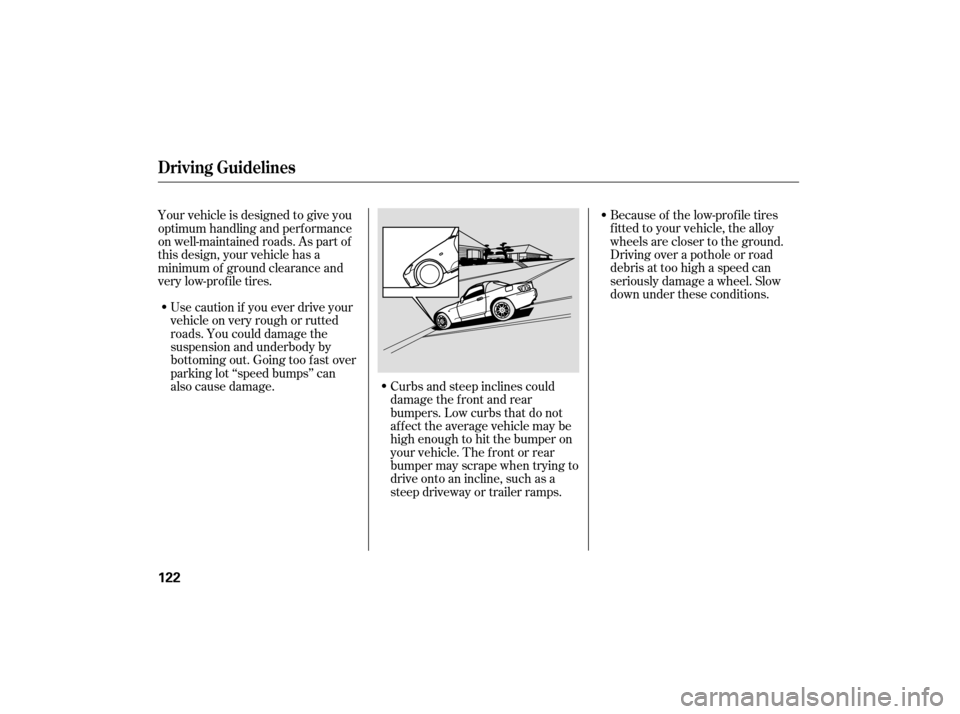
Your vehicle is designed to give you
optimum handling and perf ormance
on well-maintained roads. As part of
this design, your vehicle has a
minimum of ground clearance and
very low-prof ile tires.
Curbs and steep inclines could
damage the f ront and rear
bumpers. Low curbs that do not
affect the average vehicle may be
high enough to hit the bumper on
your vehicle. The f ront or rear
bumper may scrape when trying to
drive onto an incline, such as a
steep driveway or trailer ramps.
Driving Guidelines
122
Page 126 of 228
Youshoulddothefollowingchecks
and adjustmen ts before you drive
your vehicle.
Make sure all windows, mirrors,
and outside lights are clean and
unobstructed. Remove frost, snow,
or ice. Check
that any items you may be
carrying are stored properly or
fastened down securely. Fasten
your seat belt. Check that
your passenger has fastened his or
her seat belt (see page ).
When you start the engine, check
the gauges and indicato rs in the
instrument panel (see page ).
Check
the seat adjustment (see
page ).
Check the adjustment of the
inside and outside mirrors (see
page ).
Make sure the doors are securely
closed and locked.
Check that the hood is f ully closed.
Check that the trunk is f ully
closed.
Visually check the tires. If a tire
looks low, use a gauge to check its
pressure.
1.
2.
12
3.
4. 5.
6.
7.
8.
9.
10.
67
75 45
Preparing to Drive
Driving
123
Page 134 of 228
Your vehicle is not designed to tow a
trailer; Attempting to do so can void
your warranties.
Driving
with varying tire or wheel
sizes may cause the VSA to
malfunction. When replacing tires,
make sure they are of the same size
and type as your original tires (see
page ).
Deactivate the VSA system if you
need to drive with the compact spare
tire installed (see page ).
If you install winter tires, make sure
they are the same size as those that
were originally supplied with your
vehicle. Exercise the same caution
during winter driving as you would if
your vehicle was not equipped with
VSA.
In certain unusual conditions when
your vehicle gets stuck in shallow
mud or f resh snow, it may be easier
to free it with the VSA temporarily
switched of f . When the VSA system
is of f , the traction control system is
alsooff.Youshouldonlyattemptto
f ree your vehicle with the VSA of f if
you are not able to f ree it when the
VSA is on. Immediately af ter f reeing your
vehicle, be sure to switch the VSA on
again. We do not recommend driving
your vehicle with the VSA and
traction control systems switched off.
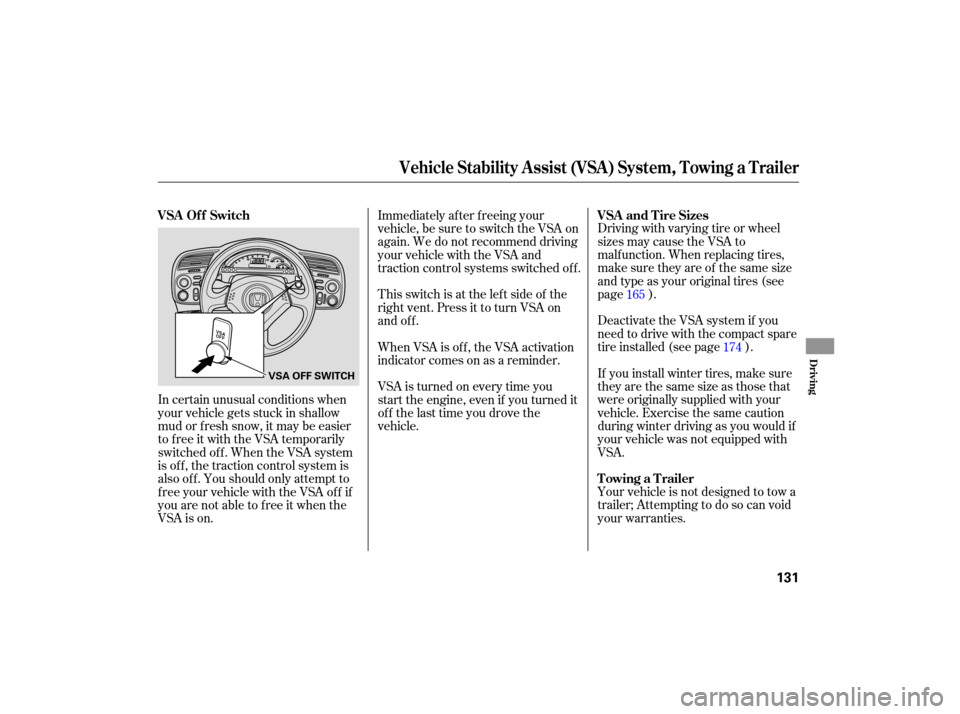
When VSA is off, the VSA activation
indicator comes on as a reminder. This switch is at the lef t side of the
right vent. Press it to turn VSA on
and off.
VSA is turned on every time you
start the engine, even if you turned it
off the last time you drove the
vehicle.
165
174
VSA Of f Switch
Towing a Trailer VSA and Tire Sizes
Vehicle Stability Assist (VSA) System, Towing a Trailer
Driving
131
VSA OFF SWITCH
Page 136 of 228

This section explains why it is
important to keep your vehicle well
maintained and how to follow basic
maintenance safety precautions.
If you have the skills and tools to
perform more complex maintenance
tasks on your vehicle, you may want
to purchase the service manual. See
page f or inf ormation on how to
obtain a copy, or see your dealer. This section also includes
instructions on how to read the
maintenance minder messages on
the information display, a
maintenance record, and instructions
for simple maintenance tasks you
may want to take care of yourself. ......................
Maintenance Saf ety .134
....................
Maintenance Minder . 135
....................
Maintenance Record .143
..............................
Fluid Locations .145
........................
Adding Engine Oil .146
.........
Changing the Oil and Filter . 147
..............................
Engine Coolant .149
....................
Windshield Washers .151
........
Manual Transmission Fluid . 152
..........................
Dif f erential Fluid .153
................
Brake and Clutch Fluid . 154
.............................................
Lights .155
................
Cleaning the Seat Belts . 160
.....................................
Floor Mats .161
..................
DustandPollenFilter . 161
..............................
Audio Antenna .161
.................................
Wiper Blades .162
...........................................
Wheels .163
...............................................
Tires .163
...................
Checking the Battery . 169
.............................
Vehicle Storage .171
215
Maintenance
Maint enance
133
Page 144 of 228

�µ�µ
�Ì �µ�µ�µ
U.S.
Vehicles:
Youshouldcheckthefollowing
items at the specified interval s. If
you are unsure of how to perform
any check, turn to the appropriate
page listed.
Engine oil level Check every
time you fill the fuel tank. See
page . Lights
Check the operation of
the headlights, parking lights,
taillights, high-mount brake light,
and license plate lights monthly.
See page .
According to state and federal
regulations, failure to perform
maintenance on the items marked
with will not void your emissions
warranties. However, all
maintenance services should be
pe rformed in accordance with the
intervals indicated by the
info rmation display. Tires Check the tire pressu re
monthly. Examine the tread for
wear and foreign objects. See page
.
Brakes
and clutch Check the
fluid level monthly. See page .
Engine
coolant level Check the
radiator reserve tank every time
youfillthefueltank.Seepage .
113
114
154
164 155
CONT INUED
Maintenance, replacement, or
repair of emissions control
devices and systems may be done
by any automotive repair
establishment or individual using
parts that are ‘‘certif ied’’ to EPA
standards.
Owner’s Maintenance Checks
Maintenance Minder
Maint enance
141