Page 48 of 228
�Î
�Î
The U.S. instrument panel is shown. Differences for Canadian models are noted in the text.
Instrument Panel
Instru me ntsand Cont ro ls
45
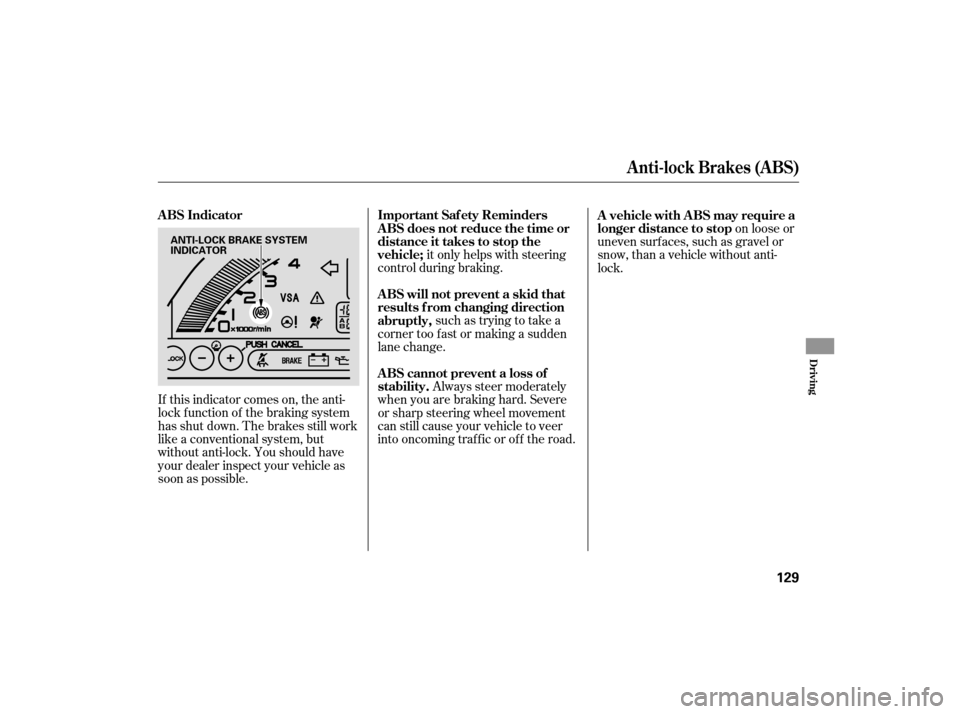
TRUNK-OPEN INDICATOR
IMMOBILIZER SYSTEM INDICATOR
SEAT
BELT
REMINDER
INDICATOR ANTI-LOCK BRAKE
SYSTEM (ABS)
INDICATOR
ELECTRIC POWER
STEERING (EPS)
INDICATOR DOOR-OPEN
INDICATOR
LOW
FUEL
INDICATOR
TURN
SIGNAL AND HAZARD WARNING INDICATORS
HIGH BEAM
INDICATOR
VEHICLE
STABILITY
ASSIST (VSA) SYSTEM
INDICATOR (P.50)
(P.50)
(P.47)
(P.46) PARKING BRAKE AND
BRAKE SYSTEM INDICATOR
CHARGING SYSTEM INDICATOR
LOW
OIL PRESSURE INDICATORMALFUNCTION
INDICATOR LAMP
CRUISE
CONTROL INDICATOR (P.47)
(P.47) MAINTENANCE
MINDER
INDICATOR
(P.47)(P.49) (P.47)
(P.48)
(P.50)
(P.48) (P.49)
DAYTIME
RUNNING
LIGHTS INDICATOR
SUPPLEMENTAL RESTRAINT SYSTEM
INDICATOR
VSA
ACTIVATION INDICATOR
(P.48) (P.46, 188)
(P.46, 186)
(P.46,
186) (P.47,
187)
(P.49)
(P.51,
135)
INFORMATION
DISPLAY
OUTSIDE
TEMPERATURE INDICATOR (P.53)
Page 50 of 228

See page .
This indicator comes on if the trunk
lid is not closed tightly.
This indicator comes on if either
door is not closed tightly.
This indicator comes on when you
set the cruise control. See page
for information on operating the
cruise control.
This
indicator normally comes on for
a few seconds when you turn the
ignition switch to the ON (II)
position, and when you push the
START button. If it comes on at any
other time, there is a problem with
theABS.Ifthishappens,haveyour
vehicle checked at a dealer. With
this indicator on, your vehicle still
has normal braking ability but no
an ti-lock function. For more
info rmation, see page .
This
indicator comes on briefly when
you turn the ignition switch to the
ON (II) position. If it comes on at
any other time, it indicates a
poten tial problem with your airbags.
This indicator will also alert you to a
poten tial problem with your
automatic seat belt tensioners,
driver’s seat position sensor, or the
passenger’s seat weight sensors. For
more information, see page .
128187
106
25
Instrument Panel Indicators
Supplemental Restraint
System Indicator
Malf unction Indicator
Lamp
Trunk-open Indicator
Door-open Indicator
Cruise Control Indicator
Anti-lock Brake System
(A BS) Indicator
Inst rument s and Cont rols
47
Page 73 of 228
The convertible top on your vehicle
lowers and raises electrically.
It is advisable to raise the top
whenever you park the vehicle. This
helps to protect the vehicle f rom
unexpected weather changes, and
f rom thef t of your valuables.Bef ore operating the convertible top,
make sure the vehicle is parked on
level ground, the rear def ogger is of f ,
and there is enough clearance above
the top.
Apply the parking brake. The
convertible top will not operate
unless the parking brake is f ully
engaged.
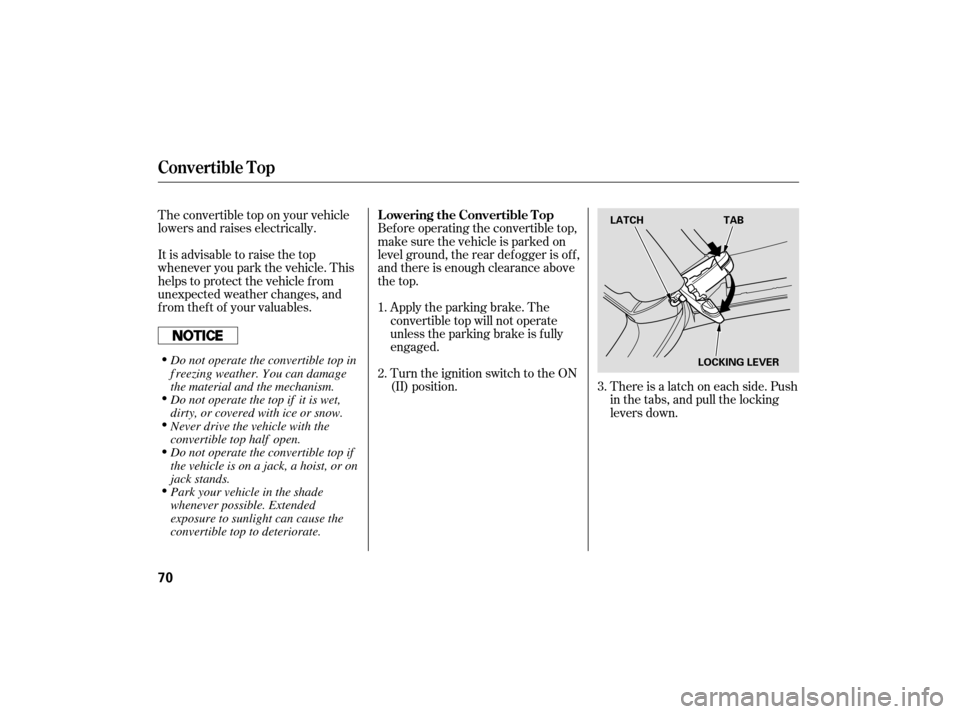
Thereisalatchoneachside.Push
in the tabs, and pull the locking
levers down.
Turn the ignition switch to the ON
(II) position.
1.
2.
3.
Lowering the Convertible Top
Convertible Top
70
LATCH
TAB
LOCKING LEVER
Park your vehicle in the shade
whenever possible. Extended
exposure to sunlight can cause the
convertible top to deteriorate. Do not operate the convertible top if
the vehicle is on a jack, a hoist, or on
jack stands. Never drive the vehicle with the
convertible top half open. Do not operate the top if it is wet,
dirty, or covered with ice or snow. Do not operate the convertible top in
f reezing weather. Y ou can damage
the material and the mechanism.
Page 78 of 228
Do not lean or sit on an open door.
Do not push or pull the door glass
to open and close the door.
The convertible top seals are
designed to promote the f low of
water of f the roof . Spraying high-
pressure water directly on the
seals can distort them, causing a
leak. Use only a low-pressure
water stream when using a hose,
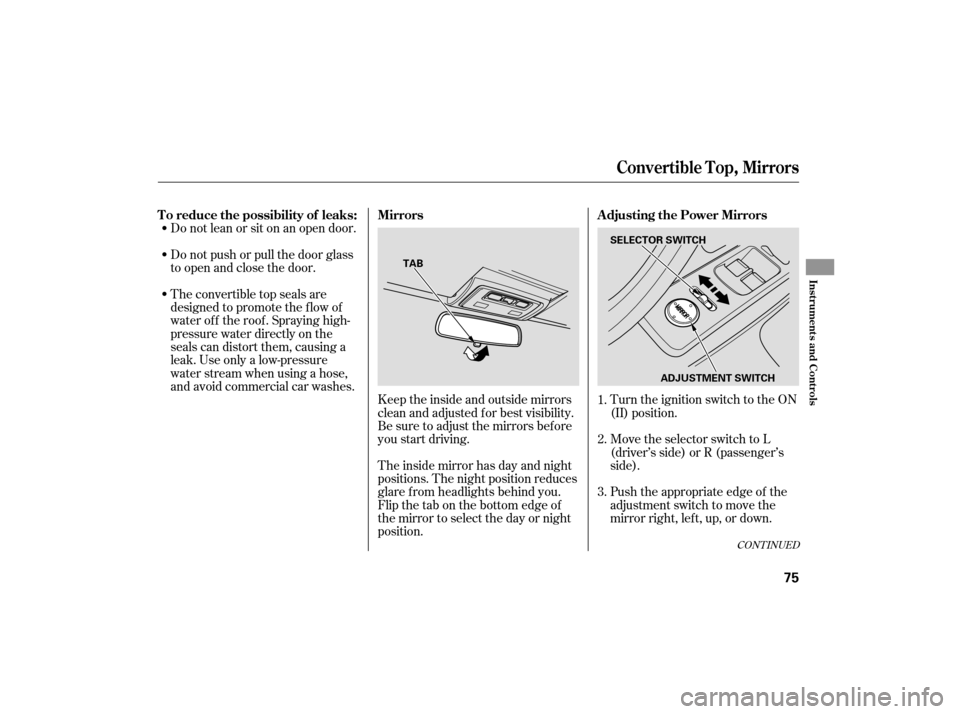
and avoid commercial car washes.The inside mirror has day and night
positions. The night position reduces
glare f rom headlights behind you.
Flip the tab on the bottom edge of
the mirror to select the day or night
position. Keeptheinsideandoutsidemirrors
clean and adjusted f or best visibility.
Be sure to adjust the mirrors bef ore
you start driving. Turn the ignition switch to the ON
(II) position.
Push the appropriate edge of the
adjustment switch to move the
mirrorright,left,up,ordown. Move the selector switch to L
(driver’s side) or R (passenger’s
side).
1.
2.
3.
CONT INUED
To reduce the possibility of leaks: Mirrors
Adjusting the Power Mirrors
Convertible Top, Mirrors
Inst rument s and Cont rols
75
TABSELECTOR SWITCH
ADJUSTMENT SWITCH
Page 124 of 228
This section gives you tips on
starting the engine under various
conditions, and how to operate the
manual transmission. It also includes
important inf ormation on parking
your vehicle and the braking system.........................
Driving Guidelines .122
........................
Preparing to Drive .123
.......................
Starting the Engine .124
...................
Manual Transmission . 125
...........................................
Parking .127
.............................
Braking System .127
...............
Anti-lock Brakes (ABS) . 128
Vehicle Stability Assist (VSA) ........................................
System .130
...........................
Towing a Trailer .131
Driving
Driving
121
Page 130 of 228

Make sure the convertible top and
the windows are closed.
Turn of f the lights.
Place any packages, valuables, etc.,
in the trunk or take them with you.
Lock the doors.
Never park over dry leaves, tall
grass, or other f lammable
materials. The hot three way
catalytic converter could cause
these materials to catch on fire.If the vehicle is f acing uphill, turn
the front wheels away from the
curb, and put the transmission in
f irst gear.
If the vehicle is f acing downhill,
turn the front wheels toward the
curb, and put the transmission in
reverse gear.
Make sure the parking brake is
f ully released bef ore driving away.
Driving with the parking brake
partially set can overheat or
damage the rear brakes.
Resting your f oot on the pedal keeps
the brakes applied lightly, builds up
heat, and reduces their ef f ectiveness.
It also keeps your brake lights on all
the time, conf using drivers behind
you.
Constant application of the brakes
when going down a long hill builds
up heat and reduces their ef f ective-
ness. Use the engine to assist the
brakes by taking your f oot of f the
accelerator and downshif ting to a
lower gear. Your vehicle is equipped with disc
brakes at all f our wheels. A power
assist helps reduce the ef f ort needed
on the brake pedal. The anti-lock
brake system (ABS) helps you retain
steering control when braking very
hard.
Always use the parking brake when
you park your vehicle. Make sure
the parking brake is set f irmly, or
your vehicle may roll if it is parked
on an incline.
CONT INUED
Parking
Parking T ips Braking System
Parking, Braking System
Driving
127
Page 131 of 228

Check the brakes after driving
through deep water. Apply the
brakes moderately to see if they f eel
normal. If not, apply them gently and
f requently until they do. Be extra
cautious in your driving.
The hydraulic system that operates
the brakes has two separate circuits.
Each circuit works diagonally across
the vehicle (the lef t-f ront brake is
connected with the right-rear brake,
etc.). If one circuit should develop a
problem, you will still have braking
at two wheels.If the brake pads need replacing, you
will hear a distinctive, metallic
screeching sound when you apply
the brake pedal. If you do not have
the brake pads replaced, they will
screech all the time. It is normal f or
the brakes to occasionally squeal or
squeak when you apply them.
The anti-lock brake system (ABS)
helps prevent the brakes f rom
locking up, and helps you retain
steering control by pumping the
brakes rapidly, much f aster than a
person can do it.The ABS also balances the f ront-to-
rear braking distribution according
to vehicle loading.
Let the ABS work f or you by always
keeping f irm, steady pressure on the
brake pedal. This is sometimes
ref erred to as ‘‘stomp and steer.’’
You will f eel a pulsation in the brake
pedal when the ABS activates, and
may hear some noise. This is normal:
it is the ABS rapidly pumping the
brakes. On dry pavement, you will
need to press on the brake pedal
very hard before the ABS activates.
However, you may f eel the ABS
activate immediately if you are trying
to stop on snow or ice.
You should never pump the brake pedal.
Braking System Design
Brake Pad Wear Indicators
Anti-lock Brakes (ABS)
Braking System, Anti-lock Brakes (ABS)
128
Page 132 of 228
If this indicator comes on, the anti-
lock f unction of the braking system
has shut down. The brakes still work
like a conventional system, but
without anti-lock. You should have
your dealer inspect your vehicle as
soon as possible.it only helps with steering
control during braking.
such as trying to take a
corner too f ast or making a sudden
lane change.
Always steer moderately
when you are braking hard. Severe
or sharp steering wheel movement
can still cause your vehicle to veer
into oncoming traffic or off the road. on loose or
uneven surfaces, such as gravel or
snow, than a vehicle without anti-
lock.
ABS Indicator
A BS does not reduce the time or
distance it takes to stop the
vehicle; Important Saf ety Reminders
A BS will not prevent a skid that
results f rom changing direction
abruptly,
A BS cannot prevent a loss of
stability.A vehicle with A BS may require a
longer distance to stop
Anti-lock Brakes (ABS)
Driving
129
ANTI-LOCK BRAKE SYSTEM
INDICATOR