Page 140 of 228

CONT INUED
Negative mileage means your
vehicle has passed the maintenance
required point. If you do not perf orm the indicated
maintenance, negative mileage is
displayed and begins to blink af ter
the vehicle has been driven 10 miles
(10 km) or more.
Immediately have the indicated
maintenancedonebyyourdealer.
When the remaining engine oil lif e is
0 percent, the engine oil lif e indicator
will blink. The display comes on
everytimeyouturntheignition
switch to the ON (II) position. The
maintenance minder indicator
( ) also comes on and remains
on in the instrument panel. When
you see this message, immediately
have the indicated maintenance done
by your dealer.
When the remaining engine oil lif e is
5 to 1 percent, you will see a
‘‘SERVICE OIL LIFE’’ message
along with the same maintenance
item code(s), every time you turn the
ignition switch to the ON (II)
position. The maintenance minder
indicator ( ) also comes on and
remains on in the instrument panel.
Maintenance Minder
Maint enance
137
Page 142 of 228
If maintenance service is done by
someone other than your dealer,
reset the maintenance minder as
f ollows:Turn the ignition switch to the ON
(II) position.
Press the TRIP button until the
engine oil lif e indicator is
displayed.
Your dealer will reset the display
af ter completing the required
maintenance service. You will see
‘‘OIL LIFE 100%’’ on the inf ormation
display the next time you turn the
ignition switch to the ON (II)
position.
Press the TRIP button f or about
10 seconds. The engine oil lif e
indicator and the maintenance
item code(s) will blink.Press the TRIP button f or about 5
seconds. The maintenance items
code(s) will disappear, and the
engine oil lif e will reset to ‘‘100.’’
3.
1.
2. 4.
Maintenance Minder
Resetting the Engine Oil Lif e
Indicator
Maint enance
139
ENGINE OIL LIFE INDICATOR
ENGINE OIL LIFE INDICATOR
Page 178 of 228
Thesizedifferencemayalsocause
damage to the rear dif f erential, so do
not mount the compact spare on the
rear. If either rear tire goes f lat,
remove the f ront tire on that same
side, mount the compact spare tire
on the f ront, then mount the f ront
tire on the rear.Park the vehicle on f irm, level, and
non-slippery ground. Put the
transmission in reverse. Apply the
parking brake.
Turn on the hazard warning lights,
and turn the ignition switch to the
LOCK (0) position. Have your
passenger get out of the vehicle
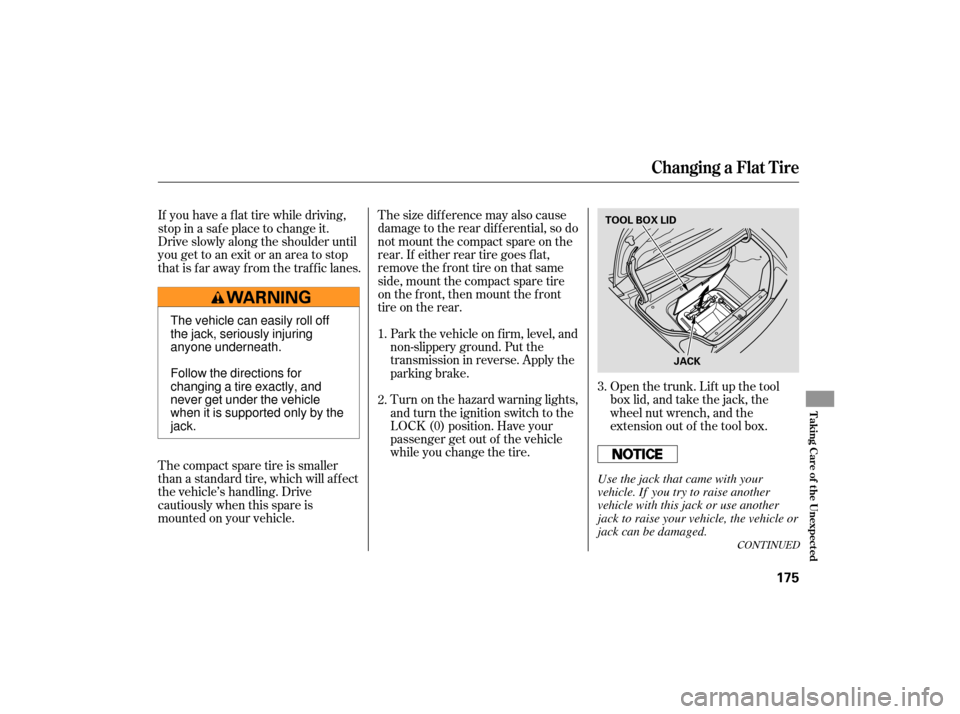
while you change the tire. Open the trunk. Lift up the tool
box lid, and take the jack, the
wheel nut wrench, and the
extension out of the tool box.
Thecompactsparetireissmaller
than a standard tire, which will affect
the vehicle’s handling. Drive
cautiously when this spare is
mounted on your vehicle. If you have a f lat tire while driving,
stop in a saf e place to change it.
Drive slowly along the shoulder until
you get to an exit or an area to stop
that is far away from the traffic lanes.
3.
1.
2.
CONT INUED
Changing a Flat Tire
T aking Care of t he Unexpect ed
175
TOOL BOX LID
JACK
The vehicle can easily roll off
the jack, seriously injuring
anyone underneath.
Follow the directions for
changing a tire exactly, and
never get under the vehicle
when it is supported only by the
jack. Use the jack that came with your
vehicle. If you try to raise another
vehicle with this jack or use another
jack to raise your vehicle, the vehicle or
jack can be damaged.
Page 183 of 228

Diagnosing why the engine won’t
start falls into two areas, depending
on what you hear when you press
the ENGINE START button.
You hear nothing, or almost
nothing. The engine’s starter
motor does not operate at all, or
operates very slowly.
You can hear the starter motor
operating normally, or the starter
motor sounds like it is spinning
faster than normal, but the engine
does not start up and run. When
you press the ENGINE
START button, you do not hear the
norm al noise of the engine trying to
start. You may hear a clicking sound
or series of clicks, or nothing at all.
Check these things:
Check the transmission interlock.
The clutch pedal must be pushed
all the way to the floor or the
starter will not operate.
Turn the ignition switch to the ON
(II) position. Turn on the
headlights, and check their
brightness. If the headlights are
very dim or do not come on at all,
the battery is discharged. See
on page . Press
the ENGI NE START button,
then release it. If the headlights do
not dim, check the condition of the
fuses.IfthefusesareOK,thereis
probably something wrong with
the electrical circuit for the
ignition switch or starter motor.
You will need a qualified mechanic
to determine the problem. (See
on page .)
182 196
Nothing Happens or the Starter
Motor Operates Very Slowly
Jump Starting Emergency T owing
If theEngineWon’tStart
180
Page 190 of 228

If the indicator comes on repeatedly,
even though it may go off as you
continue driving, have your vehicle
checked by a dealer as soon as
possible.
If
this indicator comes on
while driving, it means one
of the engine’s emissions control
systems may have a problem. Even
though you may feel no difference in
your vehicle’s performance, it can
reduce your fuel economy and cause
increased emissions. Continued
operation may cause serious damag e.
Your vehicle has certain ‘‘readiness
codes’’ that are part of the on-board
diagnostics for the emissions
systems. In some states, part of the
emissions testing is to make sure
these codes are set. If they are not
set, the test cannot be completed. To
check if they are set, turn the
ignition switch to the ON (II)
position, without starting the engine.
The malfunction indicator lamp will
come on for 20 seconds. If it then
goes off, the readiness codes are set.
If it blinks five times, the readiness
codes are not set. If possible, do not
take your vehicle for a state
emissions test until the readiness
codes are set. Ref er to for more
inf ormation (see page ).
If you have recently ref ueled your
vehicle, the indicator coming on
could be due to a loose or missing
f uel f ill cap. You will also see a
‘‘CHECK FUEL CAP’’ message on
the inf ormation display. Tighten the
cap until it clicks at least once.
Tightening the cap will not turn the
indicator of f immediately; it can take
several days of normal driving. If your vehicle’s battery has been
disconnected or gone dead, these
codes are erased. It can take several
days of driving under various
conditions to set the codes again.
210
Malf unction Indicator L amp
State
Emissions T esting
Readiness Codes
T aking Care of t he Unexpect ed
187
If you keep driving with the
malf unction indicator lamp on, you can
damage your vehicle’s emissions
controls and engine. Those repairs may
not be covered by your vehicle’s
warranties.
Page 191 of 228

If the brake system indicator comes
on while driving, the brake fluid level
is probably low. Press lightly on the
brake pedal to see if it feels normal.
If it does, check the brake fluid level
thenexttimeyoustopataservice
station (see page ).
If the fluid level is low, take your
vehicle to a dealer, and have the
brake system inspected for leaks or
worn brake pads. However,
if the brake pedal does not
feel normal, you should take
immediate action. A problem in one
part of the system’s dual circuit
design will still give you braking at
two wheels. You will feel the brake
pedal go down much farther before
the vehicle begins to slow down, and
you will have to press harder on the
pedal.
Slow down by shifting to a lower
gear, and pull to the side of the road
when it is safe. Because of the long
distance needed to stop, it is
hazardous to drive the vehicle. You
should have it towed and repaired as
soon as possible (see on page ).
If you must drive the vehicle a short
distance in this condition, drive
slowly and caref ully.
The brake system
indicator normally
comes on when
you turn the ignition switch to the
ON (II) position, and as a reminder
to check the parking brake. It will
stay on if you do not f ully release the
parking brake.
154 196Emergency
Towing
Brake System Indicator
188
Canada
U.S.
Page 194 of 228

CONTINUED
If something electrical in your
vehicle stops working, check for a
blown fuse first. Determine from the
chart on pages and , or the
diagram on the f use box lid, which
f use or f uses control that device.
Check those f uses f irst, but check all
the f uses bef ore deciding that a
blown f use is the cause. Replace any
blown f uses, and check if the device
works.
Turn the ignition switch to the
LOCK (0) position. Make sure the
headlights and all other
accessories are of f .
Remove the cover f rom the f use
box. Check each of the large f uses in
the primary under-hood f use box
by looking through the top at the
wire inside. Removing these f uses
requires a Phillips-head
screwdriver.
Check the smaller f uses in the
under-hood f use boxes and all the
fuses in the interior fuse box by
pulling out each one with the f use
puller provided in the interior f use
box.
1.
2. 3.
4.
194 195
Fuses
Checking and Replacing Fuses
T aking Care of t he Unexpect ed
191
BLOWN
FUSE PULLER
Page 202 of 228

Thediagramsinthissectiongive
you the dimensions and capacities of
your vehicle and the locations of the
identif ication numbers. It also
includes inf ormation you should
know about your vehicle’s tires and
emissions control systems.................
Identif ication Numbers . 200
................................
Specif ications .202
DOT Tire Quality Grading ......................
(U.S. Vehicles) .204
Unif orm Tire Quality ..................................
Grading .204
.................................
Treadwear .204
......................................
Traction .204
.............................
Temperature .205
.................................
Tire Labeling .206 .......................
Emissions Controls .207
.....................
The Clean Air Act .207
Crankcase Emissions Control ....................................
System .207
Evaporative Emissions Control ....................................
System .207
Onboard Ref ueling Vapor ................................
Recovery .207
...
Exhaust Emissions Controls . 208
....................
PGM-FI System .208
Ignition Timing Control ................................
System .208
Three Way Catalytic ...........................
Converter .208
....................
Replacement Parts . 208
..
Three Way Catalytic Converter . 209
..............
State Emissions Testing . 210
T echnical Inf ormation
Technical Inf ormation
199
