Page 146 of 228
CONT INUED
Maintenance Record
Maint enance
143
mi
mi
mi
mi
mi
mi
mimi
mi
mi
mi
mi
mi
mi
Mileage
km
km
km
km
km
km
km Signature
Date
Mileage
km
km
km
km
km
km
km Signature
Date
Maintenance
Performed
AB123456
AB123456
AB123456
AB123456
AB123456
AB123456
AB123456 Maintenance
Performed
AB123456
AB123456
AB123456
AB123456
AB123456
AB123456
AB123456
You or the servicing dealer can record all completed maintenance here. When maintenance is performed, record the mileage, circle the coded item(s)
completed, and write in any other non-coded items (such as brake fluid replacement) below the codes. Keep the receipts for all work done on your
vehicle. Maintenance can also be recorded in your Honda service history booklet.
Page 150 of 228

�µ
The oil’s viscosity or weight is
provided on the container’s label.
Select the oil f or your vehicle
according to this chart.
An oil with a viscosity of 10W-30 is
pref erred f or optimum f uel economy
and year-round protection in your
vehicle. You may use 5W-40 oil if the
temperature in your area goes below
0°F ( 20°C).
Your vehicle does not require any oil
additives. Additives may adversely
af f ect the engine or transmission
perf ormance and durability. You may use a synthetic motor oil if
it meets the same requirements
given f or a conventional motor oil: it
displays the API Certif ication Seal,
and it is the proper weight. You must
f ollow the oil and f ilter change
intervals shown on the information
display.
Always change the oil and f ilter
according to the maintenance
messages shown on the inf ormation
display. The oil and f ilter collect
contaminants that can damage your
engine if they are not removed
regularly.
Run the engine until it reaches
normal operating temperature,
then shut it off.
Changing the oil and f ilter requires
special tools and access f rom
underneath the vehicle. The vehicle
should be raised on a service station-
type hydraulic lif t f or this service.
Unless you have the knowledge and
proper equipment, you should have
this maintenance done by a skilled
mechanic.
1.
CONT INUED
Synthetic Oil
Engine Oil A dditives
Changing the Oil and Filter
A dding Engine Oil, Changing the Oil and Filter
Maint enance
147
Ambient Temperature
Page 156 of 228
Use an SAE 90 viscosity hypoid gear
oil, API service classif ied GL5 or
GL6 only.
Put a new washer on the f iller bolt,
then reinstall the f iller bolt. Tighten
it securely. Tightening torque:
If you are not sure how to check and
add f luid, contact your dealer.
Check the f luid level with the
dif f erential at normal operating
temperature and the vehicle sitting
on level ground. Remove the
dif f erential f luid f iller bolt and
washer, and caref ully f eel inside the
bolt hole with your f inger. The f luid
level should be up to the edge of the
bolt hole. If it is not, slowly add f luid
until it starts to run out of the hole. The dif f erential should be drained
and ref illed with new f luid according
to the intervals shown on the
inf ormation display.
Dif f erential Fluid
Maint enance
153
CORRECT LEVEL
FILLER BOLT
33 lbf·ft (45 N·m , 4.6 kgf·m)
Page 164 of 228

The floor mats that came with your
vehicle hook over the f loor mat
anchors. This keeps them f rom
sliding f orward and possibly
interf ering with vehicle operation.
If you remove a f loor mat, make sure
tore-anchoritwhenyouputitback
in your vehicle.If you use a non-Honda f loor mat,
make sure it f its properly and that it
canbeusedwiththefloormat
anchor. Do not put additional f loor
mats on top of the anchored mat.
This f ilter removes the dust and
pollenthatisbroughtinfromthe
outside through the heating and
cooling system.
Have your dealer replace the filter
when this service is indicated by a
maintenance message on the
inf ormation display. It should be
replaced every 15,000 miles (24,000
km) if you drive primarily in urban
areas that have high concentrations
of soot in the air, or if the f low f rom
the heating and cooling system
becomeslessthanusual.
Floor Mats
Dust and Pollen FilterA udio A ntenna
Floor Mats, Dust and Pollen Filter, A udio A ntenna
Maint enance
161
Your vehicle is equipped with an
antenna at the right rear f ender.
Bef ore using a ‘‘drive-through’’ car
wash, remove the antenna by
unscrewing it by hand. This prevents
the antenna f rom being damaged by the
car wash brushes.
Page 181 of 228
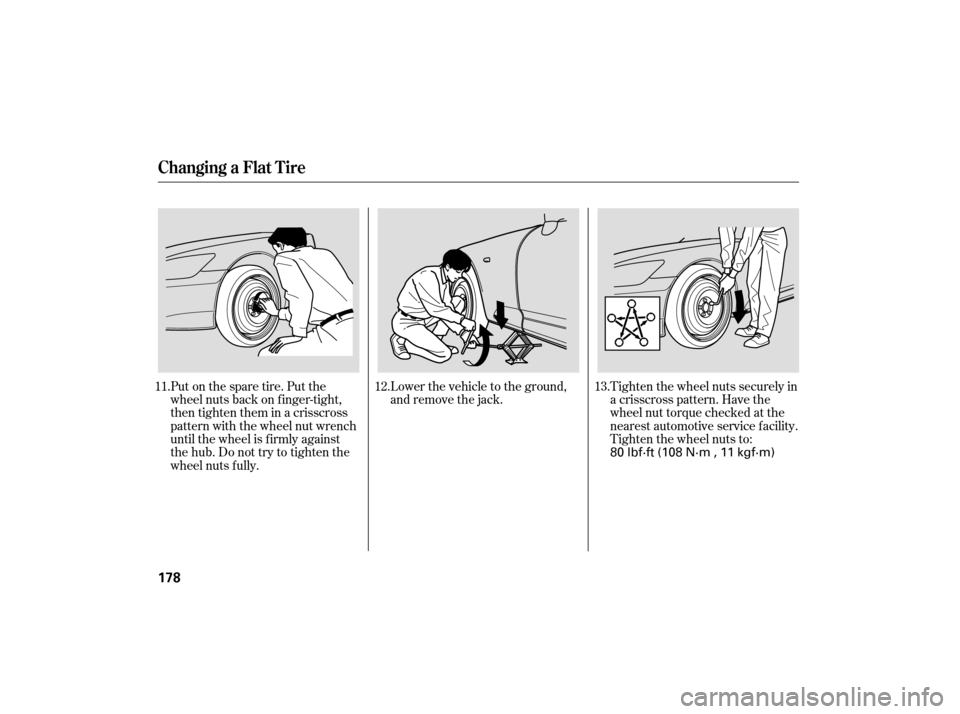
Put on the spare tire. Put the
wheel nuts back on f inger-tight,
then tighten them in a crisscross
pattern with the wheel nut wrench
until the wheel is f irmly against
the hub. Do not try to tighten the
wheel nuts f ully.Lower the vehicle to the ground,
and remove the jack.
Tighten the wheel nuts securely in
a crisscross pattern. Have the
wheel nut torque checked at the
nearest automotive service f acility.
Tighten the wheel nuts to:
13.
11. 12.
Changing a Flat Tire
178
80 lbf·ft (108 N·m , 11 kgf·m)
Page 189 of 228

Safely pull off the road, and shut
off the engine. Turn on the hazard
warning indicators.
Let the vehicle sit for a minute.
Op en the hood, and check the oil
level (see page ). An engine
very low on oil can lose pressure
during cornering and other driving
maneuvers.
If necessary, add oil to bring the
level back to the full mark on the
dipsti ck (see page ).
Start the engine, and watch the oil
pressure indicator. If it does not go
out within 10 seconds, turn off the
engine. There is a mechanical
problem that needs to be repaired
befo re you can continue driving
(see on page
). If the charging system
indicator comes on brightly
when the engine is running, the
battery is not being charged.
Immediately turn of f all electrical
accessories. Try not to use other
electrically operated controls such as
the power windows. Keep the engine
running; starting the engine will
discharge the battery rapidly.
Go to a service station or garage
where you can get technical
assistance.
This indicator should never
come on when the engine is
running. If it starts f lashing or stays
on, the oil pressure has dropped very
low or lost pressure. Serious engine
damage is possible, and you should
take immediate action. 1.
2.
3.
4.113
146
196
L ow Oil Pressure Indicator, Charging System Indicator
L ow Oil Pressure Indicator
Emergency T owingCharging System Indicator
186
Running the engine with low oil
pressure can cause serious mechanical
damage almost immediately. Turn of f
the engine as soon as you can saf ely get
the vehicle stopped.
Page 191 of 228

If the brake system indicator comes
on while driving, the brake fluid level
is probably low. Press lightly on the
brake pedal to see if it feels normal.
If it does, check the brake fluid level
thenexttimeyoustopataservice
station (see page ).
If the fluid level is low, take your
vehicle to a dealer, and have the
brake system inspected for leaks or
worn brake pads. However,
if the brake pedal does not
feel normal, you should take
immediate action. A problem in one
part of the system’s dual circuit
design will still give you braking at
two wheels. You will feel the brake
pedal go down much farther before
the vehicle begins to slow down, and
you will have to press harder on the
pedal.
Slow down by shifting to a lower
gear, and pull to the side of the road
when it is safe. Because of the long
distance needed to stop, it is
hazardous to drive the vehicle. You
should have it towed and repaired as
soon as possible (see on page ).
If you must drive the vehicle a short
distance in this condition, drive
slowly and caref ully.
The brake system
indicator normally
comes on when
you turn the ignition switch to the
ON (II) position, and as a reminder
to check the parking brake. It will
stay on if you do not f ully release the
parking brake.
154 196Emergency
Towing
Brake System Indicator
188
Canada
U.S.
Page 199 of 228
If your vehicle needs to be towed,
call a prof essional towing service or
organization. Never tow your vehicle
with just a rope or chain. It is very
dangerous.The operator will load
your vehicle on the back of a truck.
Any other method of towing will
damage the drive system. When you
contact the towing agency, inf orm
them a f lat-bed is required. If your vehicle gets stuck in sand,
mud, or snow, call a towing service
to pull it out (see the previous
column).
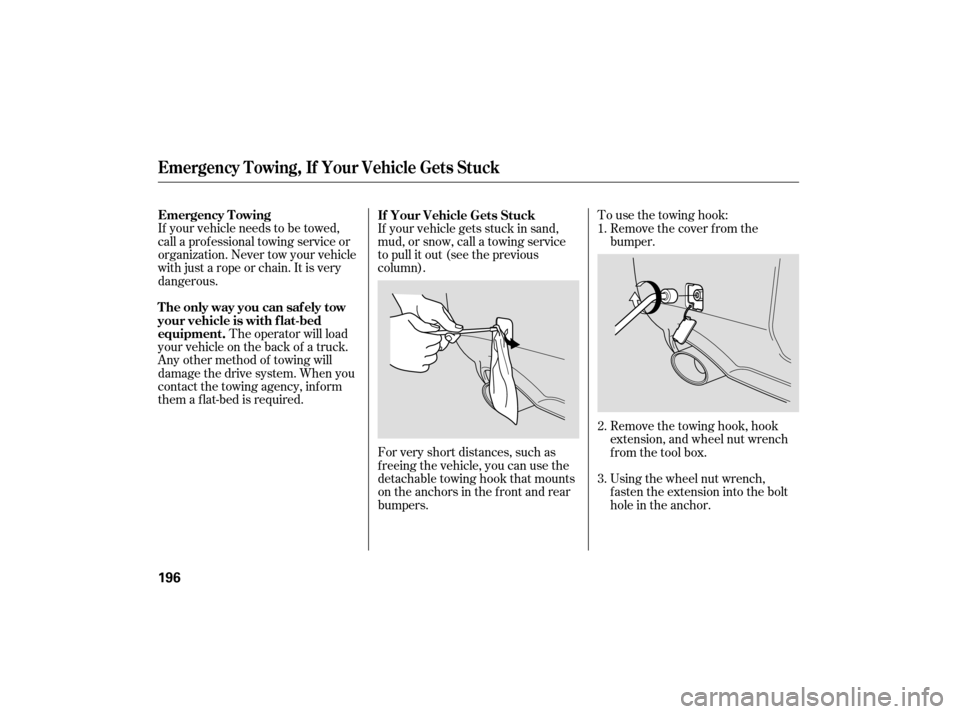
For very short distances, such as
f reeing the vehicle, you can use the
detachable towing hook that mounts
on the anchors in the front and rear
bumpers.To use the towing hook:
Remove the cover f rom the
bumper.
Using the wheel nut wrench,
fasten the extension into the bolt
hole in the anchor. Remove the towing hook, hook
extension, and wheel nut wrench
f rom the tool box.
1.
2.
3.
Emergency T owing
The only way you can saf ely tow
your vehicle is with f lat-bed
equipment.
If Your Vehicle Gets Stuck
Emergency Towing, If Your Vehicle Gets Stuck
196