Page 116 of 228
Remove the dipstick again, and
ch eck the level. It should be
between the upper and lower
marks.
If it is near or below the lower mark,
see on page .
Wait a f ew minutes af ter turning the
engine of f bef ore you check the oil.
Remove the dipstick (black
handle).
Insert the dipstick all the way back
into its hole. Wipe of f the dipstick with a clean
cloth or paper towel.
To close the hood, lif t it up slightly to
remove the support rod f rom the
hole. Put the support rod back into
its holding clip. Lower the hood to
about a f oot (30 cm) above the
f ender, then let it drop. Make sure it
is securely latched. Holding the grip, pull the support
rod out of its clip. Insert the end
into the designated hole in the
hood.
3. 4.
1.
2.
3.
146
Service Station Procedures
A dding Engine Oil
Oil Check
Bef ore Driving
113
UPPER MARK
LOWER MARK
DIPSTICK
CLIP
SUPPORT ROD GRIP
Page 118 of 228

Your dealer has Honda accessories
that allow you to personalize your
vehicle. These accessories have
been designed and approved for your
vehicle, and are covered by warranty. Befo
re installing any accessory:
Make sure the accessory does not
obscure any lights, or interfere
with proper vehicle operation or
performance.
Al though non-Honda accessories
may fit on your vehicle, they may not
meet factory specifications, and
could adversely affect your vehicle’s
handling and stability. When
properly installed, cellular
phones, alarms, two-way radios, and
low-powered audio systems should
not interfere with your vehicle’s
computer controlled systems, such
as your airbags and anti-lock brakes.
Modifying
your vehicle, or installing
some non-Honda accessories, can
make it unsafe. Before you make any
modifications or add any accessories,
be sure to read the following
inf ormation. Be sure electronic accessories do
not overload electrical circuits
(see page ) or interf ere with
the proper operation of your
vehicle.
Bef ore installing any electronic
accessory, have the installer
contact your dealer. If possible,
have your dealer inspect the f inal
installation.190
A ccessories
A ccessories and Modif ications
Bef ore Driving
115
Improper accessories or
modifications can affect your
vehicle’s handling, stability, and
performance, and cause a
crash in which you can be hurt
or killed.
Follow all instructions in this
owner’s manual regarding
accessories and modifications.
Page 126 of 228
Youshoulddothefollowingchecks
and adjustmen ts before you drive
your vehicle.
Make sure all windows, mirrors,
and outside lights are clean and
unobstructed. Remove frost, snow,
or ice. Check
that any items you may be
carrying are stored properly or
fastened down securely. Fasten
your seat belt. Check that
your passenger has fastened his or
her seat belt (see page ).
When you start the engine, check
the gauges and indicato rs in the
instrument panel (see page ).
Check
the seat adjustment (see
page ).
Check the adjustment of the
inside and outside mirrors (see
page ).
Make sure the doors are securely
closed and locked.
Check that the hood is f ully closed.
Check that the trunk is f ully
closed.
Visually check the tires. If a tire
looks low, use a gauge to check its
pressure.
1.
2.
12
3.
4. 5.
6.
7.
8.
9.
10.
67
75 45
Preparing to Drive
Driving
123
Page 130 of 228

Make sure the convertible top and
the windows are closed.
Turn of f the lights.
Place any packages, valuables, etc.,
in the trunk or take them with you.
Lock the doors.
Never park over dry leaves, tall
grass, or other f lammable
materials. The hot three way
catalytic converter could cause
these materials to catch on fire.If the vehicle is f acing uphill, turn
the front wheels away from the
curb, and put the transmission in
f irst gear.
If the vehicle is f acing downhill,
turn the front wheels toward the
curb, and put the transmission in
reverse gear.
Make sure the parking brake is
f ully released bef ore driving away.
Driving with the parking brake
partially set can overheat or
damage the rear brakes.
Resting your f oot on the pedal keeps
the brakes applied lightly, builds up
heat, and reduces their ef f ectiveness.
It also keeps your brake lights on all
the time, conf using drivers behind
you.
Constant application of the brakes
when going down a long hill builds
up heat and reduces their ef f ective-
ness. Use the engine to assist the
brakes by taking your f oot of f the
accelerator and downshif ting to a
lower gear. Your vehicle is equipped with disc
brakes at all f our wheels. A power
assist helps reduce the ef f ort needed
on the brake pedal. The anti-lock
brake system (ABS) helps you retain
steering control when braking very
hard.
Always use the parking brake when
you park your vehicle. Make sure
the parking brake is set f irmly, or
your vehicle may roll if it is parked
on an incline.
CONT INUED
Parking
Parking T ips Braking System
Parking, Braking System
Driving
127
Page 136 of 228

This section explains why it is
important to keep your vehicle well
maintained and how to follow basic
maintenance safety precautions.
If you have the skills and tools to
perform more complex maintenance
tasks on your vehicle, you may want
to purchase the service manual. See
page f or inf ormation on how to
obtain a copy, or see your dealer. This section also includes
instructions on how to read the
maintenance minder messages on
the information display, a
maintenance record, and instructions
for simple maintenance tasks you
may want to take care of yourself. ......................
Maintenance Saf ety .134
....................
Maintenance Minder . 135
....................
Maintenance Record .143
..............................
Fluid Locations .145
........................
Adding Engine Oil .146
.........
Changing the Oil and Filter . 147
..............................
Engine Coolant .149
....................
Windshield Washers .151
........
Manual Transmission Fluid . 152
..........................
Dif f erential Fluid .153
................
Brake and Clutch Fluid . 154
.............................................
Lights .155
................
Cleaning the Seat Belts . 160
.....................................
Floor Mats .161
..................
DustandPollenFilter . 161
..............................
Audio Antenna .161
.................................
Wiper Blades .162
...........................................
Wheels .163
...............................................
Tires .163
...................
Checking the Battery . 169
.............................
Vehicle Storage .171
215
Maintenance
Maint enance
133
Page 144 of 228

�µ�µ
�Ì �µ�µ�µ
U.S.
Vehicles:
Youshouldcheckthefollowing
items at the specified interval s. If
you are unsure of how to perform
any check, turn to the appropriate
page listed.
Engine oil level Check every
time you fill the fuel tank. See
page . Lights
Check the operation of
the headlights, parking lights,
taillights, high-mount brake light,
and license plate lights monthly.
See page .
According to state and federal
regulations, failure to perform
maintenance on the items marked
with will not void your emissions
warranties. However, all
maintenance services should be
pe rformed in accordance with the
intervals indicated by the
info rmation display. Tires Check the tire pressu re
monthly. Examine the tread for
wear and foreign objects. See page
.
Brakes
and clutch Check the
fluid level monthly. See page .
Engine
coolant level Check the
radiator reserve tank every time
youfillthefueltank.Seepage .
113
114
154
164 155
CONT INUED
Maintenance, replacement, or
repair of emissions control
devices and systems may be done
by any automotive repair
establishment or individual using
parts that are ‘‘certif ied’’ to EPA
standards.
Owner’s Maintenance Checks
Maintenance Minder
Maint enance
141
Page 158 of 228

The low beam headlight bulbs are a
type of high voltage discharge tube.
High voltage can remain in the
circuit even with the light switch of f
and the key removed. Because of
this, you should not attempt to
examine or change a low beam
headlight bulb yourself . If a low
beam headlight bulb fails, take the
vehicle to your dealer to have it
replaced.Halogen bulbs are used f or the high
beam headlight bulbs. When
replacing a high beam headlight bulb,
handle it by its base, and protect the
glass from contact with your skin or
hard objects. If you touch the glass,
clean it with denatured alcohol and a
clean cloth.
Theheadlightswereproperlyaimed
when your vehicle was new. If you
regularly carry heavy items in the
trunk, readjustment may be required.
Adjustment should be done by your
dealer or other qualif ied mechanic.
CONT INUED
Headlight A iming
Replacing a Headlight Bulb
Lights
Maint enance
155
Halogen headlight bulbs get very hot
when lit. Oil, perspiration, or a scratch
on the glass can cause the bulb to
overheat and shatter.
Page 159 of 228
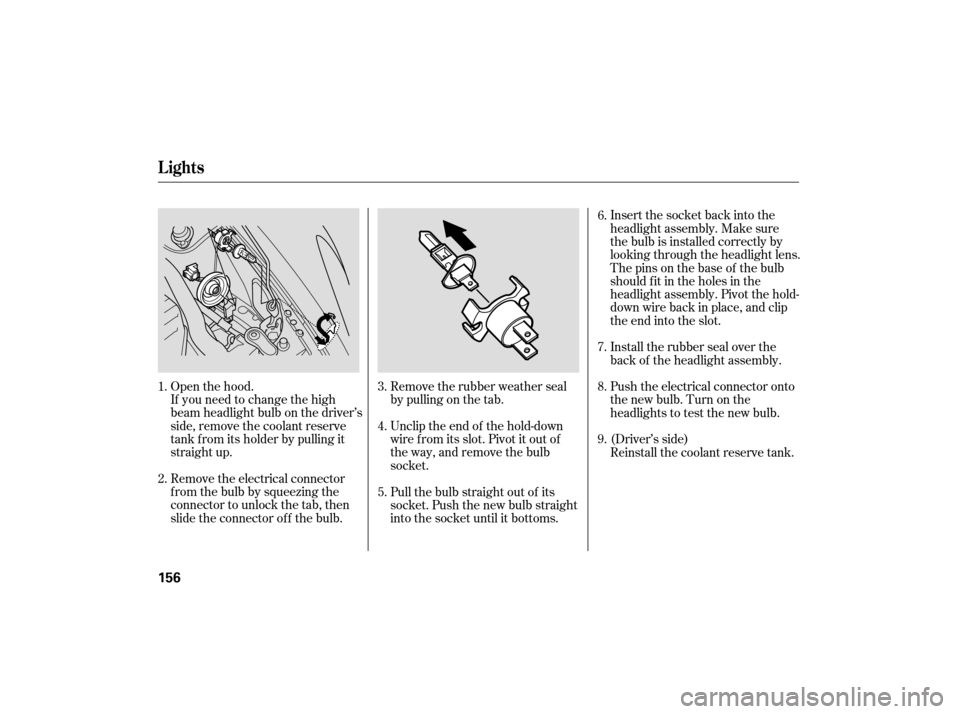
Open the hood.
If you need to change the high
beam headlight bulb on the driver’s
side, remove the coolant reserve
tank f rom its holder by pulling it
straight up.
Remove the electrical connector
f rom the bulb by squeezing the
connector to unlock the tab, then
slide the connector of f the bulb.Remove the rubber weather seal
by pulling on the tab.
Unclip the end of the hold-down
wire f rom its slot. Pivot it out of
the way, and remove the bulb
socket.Insert the socket back into the
headlight assembly. Make sure
the bulb is installed correctly by
looking through the headlight lens.
The pins on the base of the bulb
should f it in the holes in the
headlight assembly. Pivot the hold-
down wire back in place, and clip
the end into the slot.
Install the rubber seal over the
back of the headlight assembly.
Push the electrical connector onto
the new bulb. Turn on the
headlights to test the new bulb.
Pull the bulb straight out of its
socket. Push the new bulb straight
into the socket until it bottoms. Reinstall the coolant reserve tank. (Driver’s side)
1.
2. 3.
4.
5.6.
7.
8.
9.
Lights
156

