Page 172 of 228
Check the condition of the battery
monthlybylookingatthetest
indicator window. The label on the
battery explains the test indicato r’s
colors. Check
the terminals for corrosion (a
white or yellowish powder). To
remove it, cover the terminals with a
solution of baking soda and water. It
will bubble up and turn brown. When
this stops, wash it off with plain
water. Dry off the battery with a
cloth or paper towel. Coat the
terminals with grease to help prevent
future corrosion. If
your vehicle’s battery is
disconnected, or goes dead, the
clock setting in the instrument panel
will be canceled. To reset the time,
see page .
If your vehicle’s battery is
disconnected, or goes dead, the
audio system will disable itsel f. The
nexttimeyouturnontheradio,you
may see ‘‘CODE’’ (U.S. model) or
‘‘Code’’ (Canadian model) in the
f requency display. Use the preset
buttons to enter the code (see page ). 54
105
CONT INUED
Checking the Battery
Maint enance
169
TEST INDICATOR WINDOW
Page 174 of 228

If you need to park your vehicle f or
an extended period (more than 1
month), there are several things you
should do to prepare it f or storage.
Proper preparation helps prevent
deterioration and makes it easier to
get your vehicle back on the road. If
possible, store your vehicle indoors.Fill the f uel tank.
Change the engine oil and f ilter.
Wash and dry the exterior
completely.
Cleantheinterior.Makesurethe
carpeting, floor mats, etc., are
completely dry.
Raise the convertible top cover.
Leave the parking brake off. Put
the transmission in reverse. Block the rear wheels.
If the vehicle is to be stored f or a
longer period, it should be
supported on jackstands so the
tires are of f the ground.
Leave one window open slightly (if
the vehicle is being stored
indoors).
Disconnect the battery.
Cover the vehicle with a
‘‘breathable’’ cover, one made
f rom a porous material such as
cotton. Non-porous materials, such
as plastic sheeting, trap moisture,
which can damage the paint.
Support the f ront wiper blade
arms with a f olded towel or rag so
they do not touch the windshield.
To minimize sticking, apply a
silicone spray lubricant to all door
and trunk seals. Also, apply a
vehiclebodywaxtothepainted
surfaces that mate with the door
and trunk seals. If possible, periodically run the
engine until it reaches f ull
operating temperature (the
cooling f an cycles on and of f
twice). Pref erably, do this once a
month.
Vehicle Storage
Maint enance
171
Page 176 of 228

This section covers the more
common problems that motorists
experience with their vehicles. It
gives you inf ormation about how to
safely evaluate the problem and what
to do to correct it. If the problem has
stranded you on the side of the road,
you may be able to get going again.
If not, you will also f ind instructions
on getting your vehicle towed.......................
Compact Spare Tire .174
....................
Changing a Flat Tire .175
.............
If the Engine Won’t Start . 180
................................
Jump Starting .182
..............
If the Engine Overheats . 183
.........
Low Oil Pressure Indicator . 186
..........
Charging System Indicator . 186
.......
Malf unction Indicator Lamp . 187
...............
Brake System Indicator . 188
.......
Closing the Convertible Top . 189
..............................................
Fuses .190
..........
Checking and Replacing . 191
..............................
Fuse Locations .194
......................
Emergency Towing .196
..........
If Your Vehicle Gets Stuck . 196
Taking Care of the Unexpected
T aking Care of t he Unexpect ed
173
Page 187 of 228

Look for any obvious coolant leaks,
such as a split radiator hose.
Everything is still extremely hot,
so use caution. If you find a leak, it
must be repaired before you
continue driving (see
on page ).
If
the temperatu re gauge stays at
the red mark, turn off the engine.
If you do not see steam or spray,
leave the engine running, and
watch the temperature gauge. If
the high heat is due to overloading,
the engine should start to cool
down almost immediately. If it
does, wait until the temperature
gauge comes down to the midpoint,
th en continue driving.
If
you see steam and/or spray
coming from under the hood, turn
off the engine. Wait until you see
no more signs of steam or spray,
th en open the hood.
Safely
pull to the side of the road.
Put the transmission in neutral,
and set the parking brake. Turn
off the all accessories, and turn on
the hazard warning indicators.
If you don’t find an obvious leak,
check the coolant level in the
radiator reserve tank. Add coolant
if the level is below the MIN mark
(see on
page ).
2. 1.
3. 4.
5.
6.
149 196
Emergency
Towing
A dding Engine Coolant
If theEngineOverheats
184
Steam and spray from an
overheated engine can
seriously scald you.
Do not open the hood if steam
is coming out.
Page 188 of 228

If there was no coolant in the
reserve tank, you may need to add
coolant to the radiator. Let the
engine cool down until the reading
reaches the middle of the
temperature gauge or lower
befo re checking the radiato r. Using
gloves or a large heavy
cloth, turn the radiator cap
counterclockwise, without pushing
down, to the first stop. After the
pressure releases, push down on
the cap, and turn it until it comes
off. Put
the radiator cap back on
tightl y. Run the engine, and check
the temperatu re gauge. If it goes
back to the red mark, the engine
needs repair (see on page ).
If the temperature stays normal,
check the coolant level in the
radiator reserve tank. If it has
gone down, add coolant to the
MAX mark. Put the cap back on
tightly.
Start the engine, and set the
temperature control dial to
maximum heat. Add coolant to the
radiator up to the base of the f iller
neck. If you do not have the
proper coolant mixture available,
you can add plain water.
Remember to have the cooling
system drained and ref illed with
the proper mixture as soon as you
can.
9. 8.
7. 10.
11.196
Emergency
Towing
If theEngineOverheats
T aking Care of t he Unexpect ed
185
Removing the radiator cap
while the engine is hot can
cause the coolant to spray out,
seriously scalding you.
Always let the engine and
radiator cool down before
removing the radiator cap.
Page 191 of 228

If the brake system indicator comes
on while driving, the brake fluid level
is probably low. Press lightly on the
brake pedal to see if it feels normal.
If it does, check the brake fluid level
thenexttimeyoustopataservice
station (see page ).
If the fluid level is low, take your
vehicle to a dealer, and have the
brake system inspected for leaks or
worn brake pads. However,
if the brake pedal does not
feel normal, you should take
immediate action. A problem in one
part of the system’s dual circuit
design will still give you braking at
two wheels. You will feel the brake
pedal go down much farther before
the vehicle begins to slow down, and
you will have to press harder on the
pedal.
Slow down by shifting to a lower
gear, and pull to the side of the road
when it is safe. Because of the long
distance needed to stop, it is
hazardous to drive the vehicle. You
should have it towed and repaired as
soon as possible (see on page ).
If you must drive the vehicle a short
distance in this condition, drive
slowly and caref ully.
The brake system
indicator normally
comes on when
you turn the ignition switch to the
ON (II) position, and as a reminder
to check the parking brake. It will
stay on if you do not f ully release the
parking brake.
154 196Emergency
Towing
Brake System Indicator
188
Canada
U.S.
Page 199 of 228
If your vehicle needs to be towed,
call a prof essional towing service or
organization. Never tow your vehicle
with just a rope or chain. It is very
dangerous.The operator will load
your vehicle on the back of a truck.
Any other method of towing will
damage the drive system. When you
contact the towing agency, inf orm
them a f lat-bed is required. If your vehicle gets stuck in sand,
mud, or snow, call a towing service
to pull it out (see the previous
column).
For very short distances, such as
f reeing the vehicle, you can use the
detachable towing hook that mounts
on the anchors in the front and rear
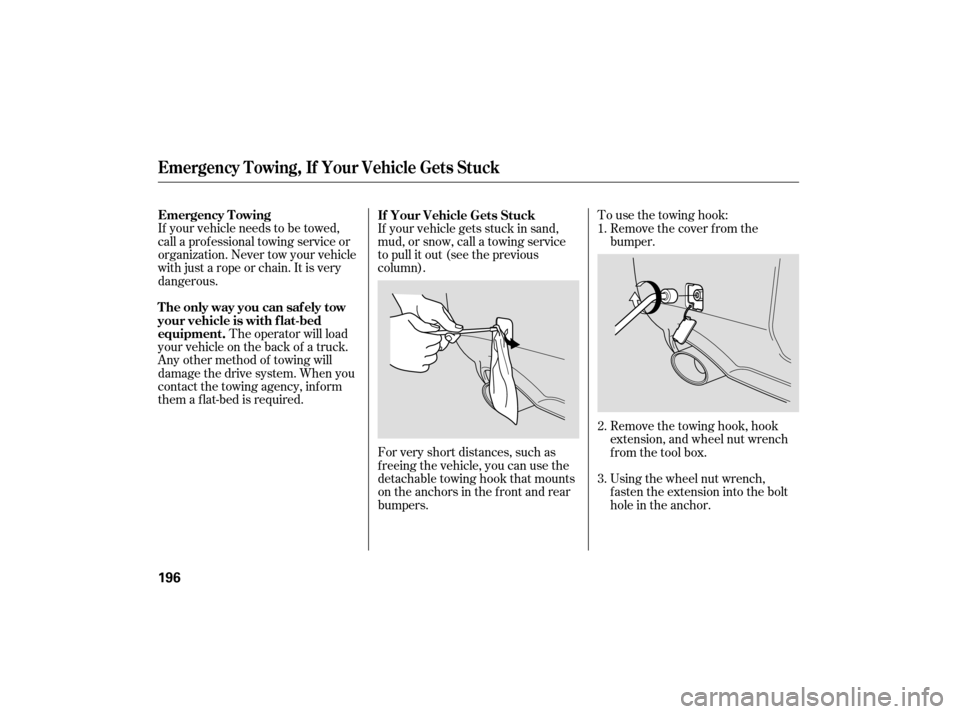
bumpers.To use the towing hook:
Remove the cover f rom the
bumper.
Using the wheel nut wrench,
fasten the extension into the bolt
hole in the anchor. Remove the towing hook, hook
extension, and wheel nut wrench
f rom the tool box.
1.
2.
3.
Emergency T owing
The only way you can saf ely tow
your vehicle is with f lat-bed
equipment.
If Your Vehicle Gets Stuck
Emergency Towing, If Your Vehicle Gets Stuck
196
Page 200 of 228
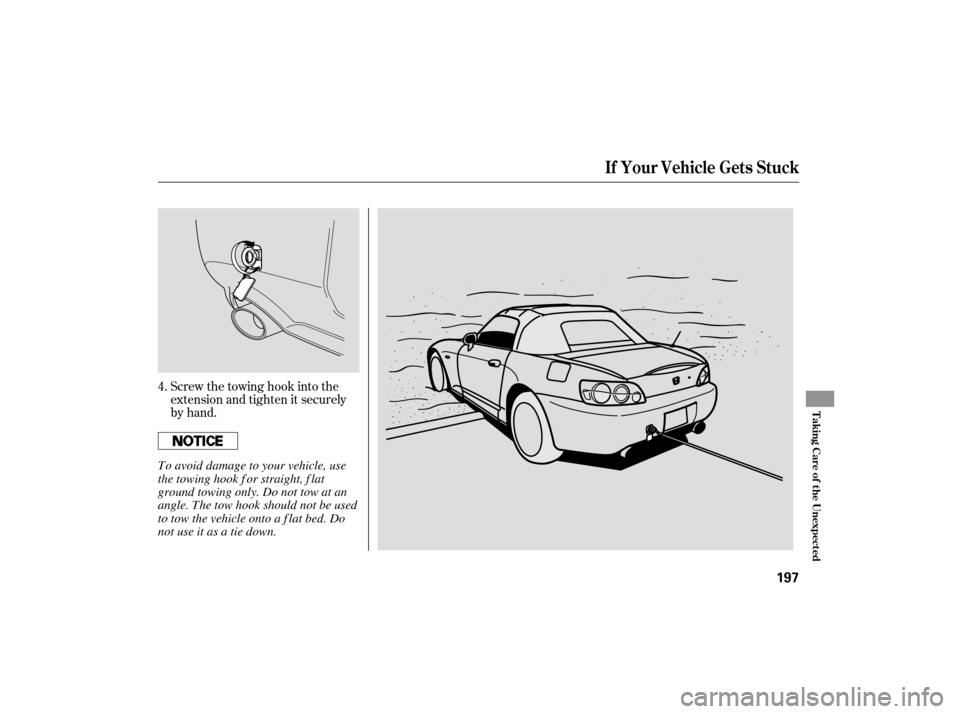
Screw the towing hook into the
extension and tighten it securely
by hand.
4.
If Your Vehicle Gets Stuck
T aking Care of t he Unexpect ed
197
To avoid damage to your vehicle, use
the towing hook f or straight, f lat
ground towing only. Do not tow at an
angle. The tow hook should not be used
to tow the vehicle onto a f lat bed. Do
not use it as a tie down.