Page 245 of 331
�µ�µ�µ
�µ
�µ �µ
Youshouldcheckthefollowing
items at the specified interval s. If
you are unsure of how to perform
any check, turn to the appropriate
page listed.
Engine oil level Check every
time you fill the fuel tank. See
page .
Engine coolant level Check the
radiator reserve tank every time
you fill the fuel tank. See page .
Automatic transmission Check
the fluid level monthly. See page
.
Brakes Check the fluid level
monthly. See page .
Tires Check the tire pressure
monthly. Examine the tread for
wear and foreign objects. See page
. Lights
Check the operation of
the headlights, parking lights,
taillights, high-mount brake light,
and licen se plate lights monthly.
See page .
182 182
251 253
265 255
CONT INUED
Maintenance Minder
Owner’s Maintenance Checks
Maint enance
241
Page 246 of 331

�Î
�Î
�Ì �Ì
�Ì
�Î
Maintenance Minder
242
: Maintenance
Sub Items
Replace dust and pollen filter
Inspect drive belt
Replace transmission and transfer fluid
Replace spark plugs
Replace timing belt and inspect water pump
Inspect valve clearance
Replace engine coolant
Replace VTM-4 rear differential fluid
Maintenance
Main Items
Replace engine oil
Replace engine oil and oil filter
Inspect front and rear brakes
Check parking brake adjustment
Inspect these items:
Tie rod ends, steering gear box, and boots
Suspension components
Driveshaft boots
Brake hoses and lines (including ABS)
All fluid levels and condition of fluids
Exhaust system
Fuel lines and connect ions
Maintenance Sub Items
Rotate tires
Replace air cleaner element
If you drive in dusty conditions, replace
every 15,000 miles (24,000 km). 2
3
4
5
Symbol
A
B
Symbol 1
2 Symbol
6
If you drive primarily in urban areas that have high
concentrations of soot in the air from industry and from diesel-
powered vehicles, replace every 15,000 miles (24,000 km).
Driving in mountainous areas at very low vehicle speeds or
trailer towing results in higher transmission and transfer
temperatures or frequently fully loaded. This requires
transmission and transfer fluid changes more frequently
than recommended by the Maintenance Minder.
If you regulary drive your vehicle under these conditions, have
the transmission and transfer fluid changed every 30,000 miles
(48,000 km).
If you drive regularly in very high tempera tures (over 110°F,
43°C), in very low temperatures (under-20°F, -29°C), or towing a
trailer, replace every 60,000 mile (U.S.)/100,000 km (Canada)
Driving in mountainous areas at very low vehicle speeds or
trailer towing results in higher level of me chanical (shear) stress
to fluid or frequently fully loaded. This requires differential fluid
changes more frequently than recommended by the
Maintenance Minder. If you regularly drive your vehicle under
these conditions, have the differential fluid changed at
7,500 miles (12,000 km), then every 15,000 miles (24,000 km).
1
1
If the message ‘‚SERVICE DUE NOW ’’ does not appear more than 12 months
after the display is reset, change the engine oil every year.
See information on maintenance and emissions warranty on page .
Independent of the maintenance messages in the information display,
replace the brake fluid every 3 years.
Inspect idle speed every 160,000 miles (256,000 km).
Adjust the valves during services A, B, 1, 2, or 3 only if they are noisy.
NOTE: 1:
240
Maintenance Minder
Page 247 of 331
CONT INUED
Maintenance Record
Maint enance
243
mi
mi
mi
mi
mi
mi
mimi
mi
mi
mi
mi
mi
mi
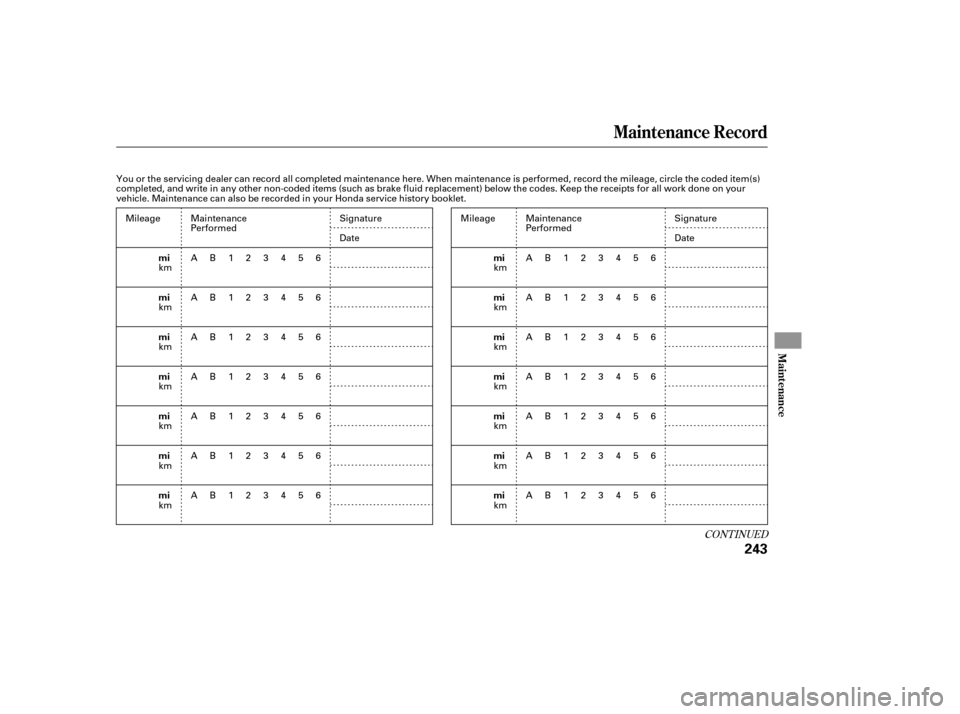
You or the servicing dealer can record all completed maintenance here. When maintenance is performed, record the mileage, circle the coded item(s)
completed, and write in any other non-coded items (such as brake fluid replacement) below the codes. Keep the receipts for all work done on your
vehicle. Maintenance can also be recorded in your Honda service history booklet.
Mileage
km
km
km
km
km
km
kmMaintenance
Performed
AB123456
AB123456
AB123456
AB123456
AB123456
AB123456
AB123456
Signature
Date
Mileage
km
km
km
km
km
km
km Signature
Date
Maintenance
Performed
AB123456
AB123456
AB123456
AB123456
AB123456
AB123456
AB123456
Page 248 of 331
Maintenance Record
244
mi
mi
mi
mi
mi
mi
mimi
mi
mi
mi
mi
mi
mi
Mileage
km
km
km
km
km
km
km Signature
Date
Maintenance
Performed
AB123456
AB123456
AB123456
AB123456
AB123456
AB123456
AB123456 Mileage
km
km
km
km
km
km
km Signature
Date
Maintenance
Performed
AB123456
AB123456
AB123456
AB123456
AB123456
AB123456
AB123456
Page 251 of 331
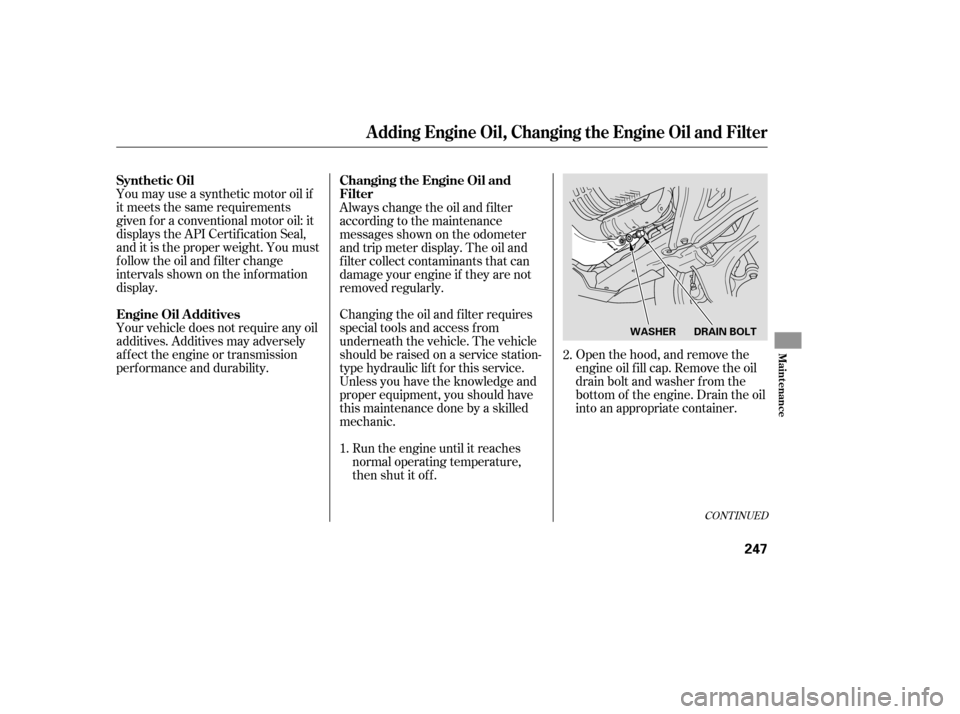
Open the hood, and remove the
engine oil f ill cap. Remove the oil
drain bolt and washer f rom the
bottom of the engine. Drain the oil
into an appropriate container.
Your vehicle does not require any oil
additives. Additives may adversely
af f ect the engine or transmission
perf ormance and durability. You may use a synthetic motor oil if
it meets the same requirements
given f or a conventional motor oil: it
displays the API Certif ication Seal,
and it is the proper weight. You must
f ollow the oil and f ilter change
intervals shown on the information
display.
Run the engine until it reaches
normal operating temperature,
then shut it off.
Changing the oil and f ilter requires
special tools and access f rom
underneath the vehicle. The vehicle
should be raised on a service station-
type hydraulic lif t f or this service.
Unless you have the knowledge and
proper equipment, you should have
this maintenance done by a skilled
mechanic. Always change the oil and f ilter
according to the maintenance
messages shown on the odometer
and trip meter display. The oil and
f ilter collect contaminants that can
damage your engine if they are not
removed regularly.
1.
2.
CONT INUED
Synthetic Oil
Engine Oil A dditivesChanging the Engine Oil and
Filter
A dding Engine Oil, Changing the Engine Oil and Filter
Maint enance
247
WASHER
DRAIN BOLT
Page 256 of 331
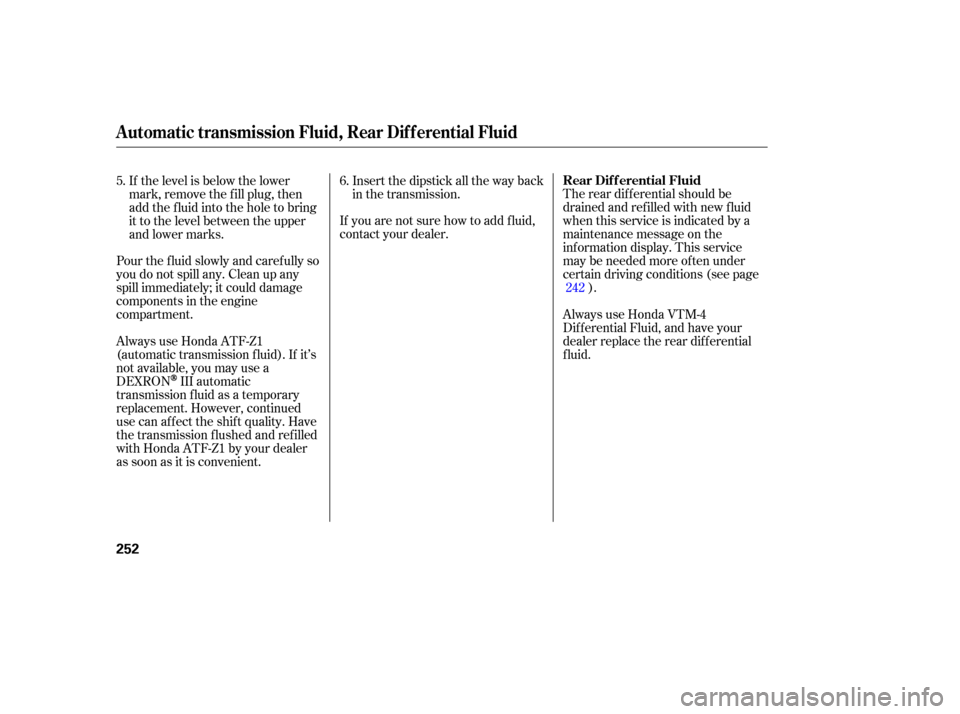
The rear differential should be
drained and refilled with new fluid
when this service is indicated by a
maintenance message on the
info rmation display. This service
may be needed more often under
certain driving conditions (see page
).
Always use Honda VTM-4
Dif f erential Fluid, and have your
dealer replace the rear differential
f luid.
Insert the dipstick all the way back
in the transmission.
If the level is below the lower
mark, remove the f ill plug, then
add the f luid into the hole to bring
it to the level between the upper
and lower marks.
Pour the f luid slowly and caref ully so
you do not spill any. Clean up any
spill immediately; it could damage
components in the engine
compartment.
Always use Honda ATF-Z1
(automatic transmission f luid). If it’s
not available, you may use a
DEXRON
III automatic
transmission f luid as a temporary
replacement. However, continued
use can affect the shift quality. Have
the transmission f lushed and ref illed
with Honda ATF-Z1 by your dealer
as soon as it is convenient. If you are not sure how to add f luid,
contact your dealer. 6.
5.
242
Automatic transmission Fluid, Rear Dif f erential Fluid
Rear Dif f erential Fluid
252
Page 257 of 331
The transf er assembly should be
drained and ref illed with new f luid
when this service is indicated by a
maintenance message on the
inf ormation display.
Always use Hypoid gear oil GL4 or
GL5 with a viscosity of SAE 90 or
80W-90, and have your dealer
replace the transfer assembly fluid.Check the brake f luid level in the
reservoir monthly.
Replace the brake f luid according to
the time recommendation in the
maintenance minder schedule.
Brake f luid marked DOT 5 is not
compatible with your vehicle’s
braking system and can cause
extensive damage. Using any non-Honda brake f luid can
cause corrosion and decrease the lif e
of the system. Have the brake
system f lushed and ref illed with
Honda Heavy Duty Brake Fluid
DOT 3 as soon as possible. Always use Honda Heavy Duty
Brake Fluid DOT 3. If it is not
available, you should use only DOT 3
or DOT 4 f luid, f rom a sealed
container, as a temporary
replacement.
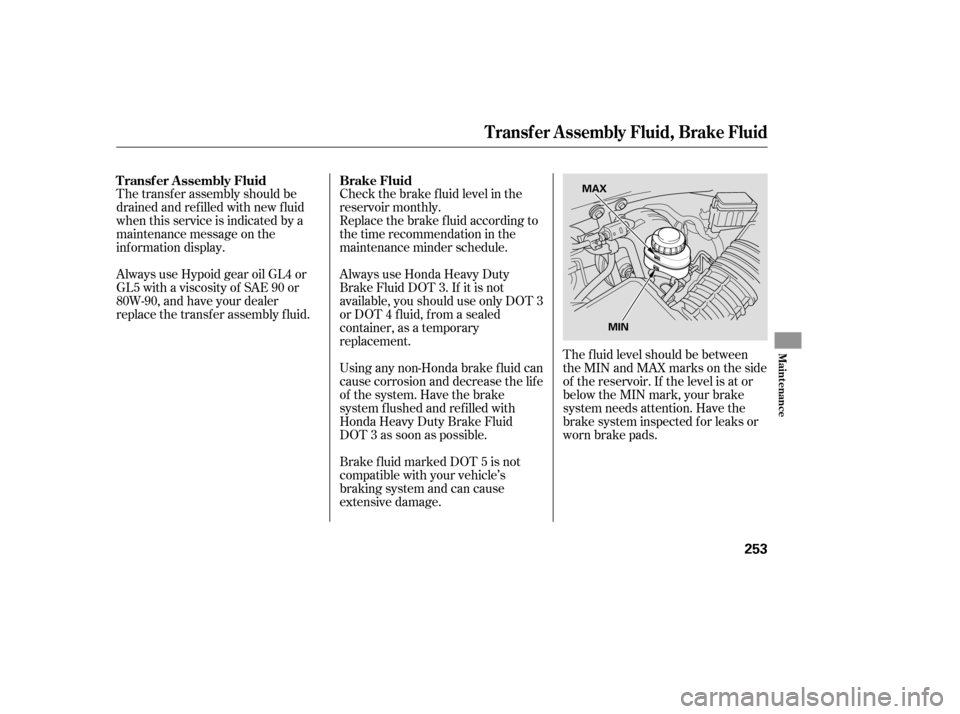
The f luid level should be between
theMINandMAXmarksontheside
of the reservoir. If the level is at or
below the MIN mark, your brake
system needs attention. Have the
brake system inspected f or leaks or
worn brake pads.
Brake Fluid
Transf er Assembly Fluid
Transf er A ssembly Fluid, Brake Fluid
Maint enance
253
MAX
MIN
Page 258 of 331

�µ�µ
The timing belt should be replaced
at the intervals shown in the
maintenance minder schedule.
Replace the belt at 60,000 miles (U.S.)
or 100,000 km (Canada) if you
regularly drive your vehicle in one or
more of these conditions:
Remove the cover, then check the
level on the side of the reservoir
when the engine is cold.
The f luid should be between the
UPPER LEVEL and LOWER LEVEL.
If not, add power steering f luid to the
UPPER LEVEL mark, and put the
cover back in place. Pour the f luid slowly and caref ully so
you do not spill any. Clean up any
spill immediately; it could damage
components in the engine
compartment.
A low power steering f luid level can
indicate a leak in the system. Check
the f luid level f requently, and have
the system inspected as soon as
possible. Always use Honda Power Steering
Fluid. You may use another power
steering f luid as an emergency
replacement, but have the power
steering system f lushed and ref illed
with Honda PSF as soon as possible.
In very high temperatures
(over 110°F, 43°C).
In very low temperatures
(under 20°F, 29°C).
Towing a trailer.
Timing Belt
Power Steering Fluid
Power Steering Fluid, Timing Belt
254
UPPER LEVEL
LOWER LEVEL
COVER
Turning the steering wheel to f ull lef t
or right lock and holding it there can
damage the power steering pump.