Page 77 of 331

The information display in the
instrument panel shows you the
engine oil life and maintenance
service items when the ignition
switch is in the ON (II) position. This
information helps to keep you aware
of the periodic maintenance your
vehicle needs for continued trouble-
free driving. Refer to page for
more information.
If
your fuel fill cap is loose or
missing, a ‘‘TIGHTEN FUEL CAP’’
message appears on the information
display after you start the engine.
Turn the engine off, and confirm the
fuel cap is installed. If it is, loosen it,
then retighten it until it clicks at least
once. When you restart the engine,
the message appears again. The
message goes off after several days
of normal driving once you tighten
or replace the fuel cap. To scroll to
another message, press the select
button. If
the system still detects a leak in
your vehicle's evaporative emissions
system, the malfunction indicator
lamp (MIL) comes on. If the fuel cap
was not already tightened, turn the
engine off, and check or retighten the
fuel cap until it clicks at least once.
The MIL goes off after several days of
normal driving once the cap is
tightened or replaced. If the MIL does
not go off, have your vehicle inspected 235
Maintenance
Minder Display
Tighten Fuel Cap Message
Gauges
Instrument sand Cont ro ls
73
by a dealer. For more information, see
page 289.
Page 181 of 331
Bef ore you begin driving your
vehicle, you should know what
gasoline to use and how to check the
levels of important f luids. You also
need to know how to properly store
luggage or packages. The
inf ormation in this section will help
you. If you plan to add any
accessories to your vehicle, please
read the information in this section
first..............................
Break-in Period .178
.................
Fuel Recommendation .178
.........
Service Station Procedures .179
....................................
Ref ueling .179
Opening and Closing the
.......................................
Hood .181
...................................
Oil Check .182
.............
Engine Coolant Check .182
...............................
Fuel Economy .183
...
Accessories and Modif ications .184
.............................
Carrying Cargo .186
Bef ore Driving
Bef ore Driving
177
Page 182 of 331

Help assure your vehicle’s future
reliability and performance by paying
extra attention to how you drive
during the first 600 miles (1,000 km).
During this period:
Avoid full-throttle starts and rapid
accele ration.
Do not change the oil until the
scheduled maintenance time.
Avoidhardbrakingforthefirst
200
miles (300 km).
Do not tow a trailer.
You should also follow these
recommendations with an
overhauled or exch anged engine, or
when the brakes are replaced. Your
vehicle is designed to operate
on unleaded gasoline with a pump
octane number of 87 or higher. Use
of a lower octane gasoline can cause
a persi stent, heavy metallic rapping
noise that can lead to engine damage.
We recommended using a quality
gasoline containing detergent
additives that help prevent fuel
system and engine deposits.
In addition, in order to maintain good
performance, fuel economy, and
emissions control, we strongly
recommend, in areas where it is
available, the use of gasoline that
does NOT contain manganese-b ased
fuel additives such as MMT.
Use of gasoline with these additives
may adversely affect performance,
and cause the malfunction indicator
lamp on your instrument panel to
come on. If this happens, contact your
authorized dealer for service.
Some gasoline today is blended with
oxygenates such as ethanol or
MTBE. Your vehicle is designed to
operate on oxyg enated gasoline
containing up to 10 % eth anol by
volume and up to 15 % MTBE by
volume. Do not use gasoline
containing methanol.
If you notice any undesirable
operating symptoms, try another
service station or switch to another
brand of gasoline.
Premium f uel is recommended when
towing in certain conditions (see
page ).
For f urther important f uel-related
inf ormation, please ref er to your .
224
Break-in Period
Fuel Recommendation
Quick Start Guide
Break-in Period, Fuel Recommendation
178
Page 183 of 331
CONT INUED
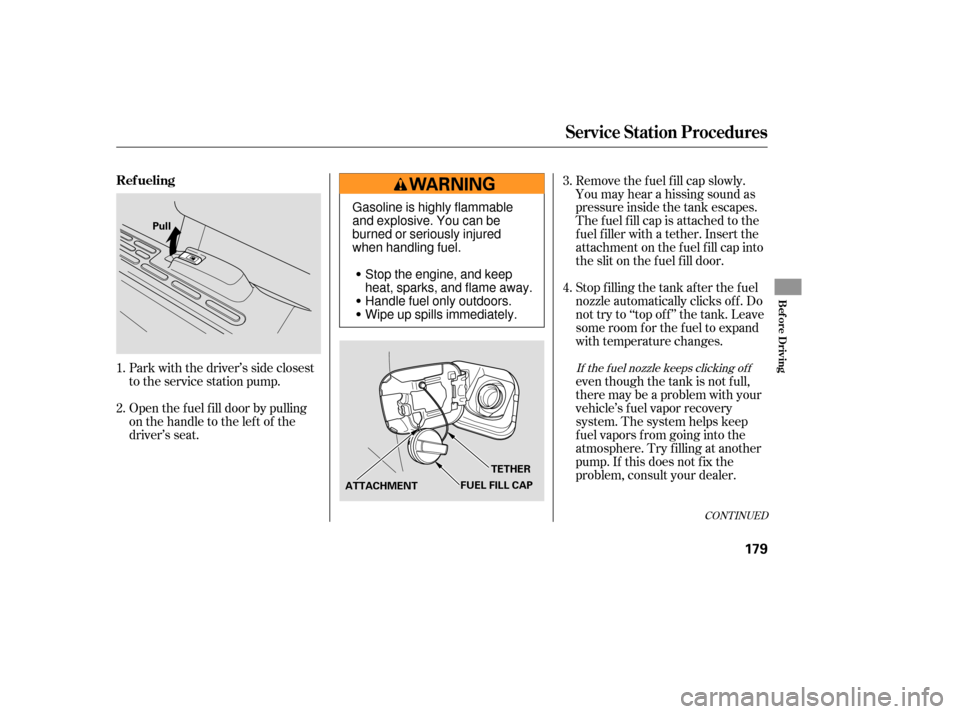
Open the f uel f ill door by pulling
onthehandletotheleftof the
driver’s seat. Park with the driver’s side closest
to the service station pump.Stop f illing the tank af ter the f uel
nozzle automatically clicks of f . Do
not try to ‘‘top of f ’’ the tank. Leave
some room f or the f uel to expand
with temperature changes. Remove the f uel f ill cap slowly.
You may hear a hissing sound as
pressure inside the tank escapes.
The fuel fill cap is attached to the
f uel f iller with a tether. Insert the
attachment on the fuel fill cap into
the slit on the f uel f ill door.
even though the tank is not f ull,
there may be a problem with your
vehicle’s fuel vapor recovery
system. The system helps keep
f uel vapors f rom going into the
atmosphere. Try f illing at another
pump. If this does not f ix the
problem, consult your dealer.
1.
2. 3.
4.
If the f uel nozzle keeps clicking of f
Ref ueling
Service Station Procedures
Bef ore Driving
179
Pull
FUEL FILL CAP
ATTACHMENT TETHER
Gasoline is highly flammable
and explosive. You can be
burned or seriously injured
when handling fuel.
Stop the engine, and keep
heat, sparks, and flame away.
Handle fuel only outdoors.
Wipe up spills immediately.
Page 184 of 331

Whenever filling a fuel container,
use an approved fuel container, and
place it on the ground. Do not fill the
fuel container in the vehicl e,
including the pickup bed and the
In-Bed Trunk. Make sure to put the
fuel pump nozzle in the fuel filler of
the container securely and to handle
it properly.
Your vehicle has a warning label for
filling a portable fuel container on
the left rear side of the pickup bed.
Before
placing the fuel container in
the vehicle, wipe up any spill
completely. Gasoline or fuel vapors are
extremely flammable and explosive.
Improperly handling fuel can cause
anexplosioninwhich youcanbe
seriously injured.
Screw
the fuel fill cap back on
until it clicks at least once. If you
do not properly tighten the cap,
the malf unction indicator lamp
maycomeon(seepage ).You
will also see a ‘‘TIGHTEN FUEL
CAP’’ message on the inf ormation
display.
Push the f uel f ill door closed until
it latches.
5.
6.
289
Service Station Procedures
Filling a Port able Fuel Cont ainer
180
Do not fill a portable fuel
container in the pickup bed.
Static electricity can ignite gas
vapors and you can be burned.
Page 187 of 331
For example, an underinflated tire
causes more ‘‘rolling resistance,’’
which uses more fuel.
The build-up of snow or mud on
your vehicl e’s underside or on the
truck bed adds weight and rolling
resistan ce. Frequent cleaning
helps your fuel mileage and
reduces the chance of corrosion.
Drive moderately. Rapid
acceleration, abrupt cornering,
and hard braking use more fuel.
Always drive in the highest gear
possible. Try
to maintain a constant speed.
Everytimeyouslowdownand
speed up, your vehic le uses extra
fuel. Use cruise control when
appropriate.
Combine several short trips into
one.
The air conditioning puts an extra
load on the engine which makes it
usemorefuel.Usethefresh-air
ventilation when possible.
Always
maintain your vehicle
according to the maintenance
messages displayed on the
inf ormation display. See on page
.
241
Improving Fuel Economy
Owner’s
Maintenance Checks
Fuel Economy
Bef ore Driving
183
Page 209 of 331

Each wheel is equipped with a tire
pressure sensor mounted inside the
tire behind the valve stem. You must
use TPMS specific wheels. It is
recommended that you always have
your tires serviced by your dealer or
qualified technician.
The
appropriate tire indicator and
low tire pressu re indicator comes on
if a tire becomes significantly
underinflated. See
on page .
Driving
on a signifi cantly under-
inflated tire causes the tire to
ov erheat and can lead to tire failure.
Under-infl ation also reduces fuel
efficiency and tire tread life, and may
affect the vehicle’s handling and
stopping ability.
Al though your tire pressure is
monito red, each tire should be
checked monthly, including the
spare.
Set to the recommended inflation
pressure as specified on the vehicle
placard and in this owner’s manual
(see page ).
Check
the pressure with the tires
cold, after the vehic le has been
parked for at least 3 hours. This
indicator comes on and stays on
if there is a problem with the tire
pressure monitoring system.
If this happens, the system will shut
off and no longer monitor tire
pressures. Have the system checked
by your dealer as soon as possible.
If you have a flat tire, the low tire
pressu re and tire monitor indicators
will come on. Replace the indicated
flat tire with the compact spare tire
(see page ). Never use a puncture-repairing agent
in a f lat tire. If used, you will have to
replace the tire pressure sensor.
Havetheflattirerepairedbyyour
dealer as soon as possible. After you replace the flat tire with
thecompactsparetire,thelowtire
pressure indicator stays on. This is
normal; the system is not monitoring
the spare tire pressure. Manually
check the spare tire pressure to be
sure it is correct.
266 204
275
CONT INUED
Tire Pressure Monitoring
System (T PMS) Indicator Low Tire
Pressure Indicator T ire Pressure Monitor
Changing a T ire with T PMS
Tire Pressure Monitoring System (TPMS)
Driving
205
Page 245 of 331
�µ�µ�µ
�µ
�µ �µ
Youshouldcheckthefollowing
items at the specified interval s. If
you are unsure of how to perform
any check, turn to the appropriate
page listed.
Engine oil level Check every
time you fill the fuel tank. See
page .
Engine coolant level Check the
radiator reserve tank every time
you fill the fuel tank. See page .
Automatic transmission Check
the fluid level monthly. See page
.
Brakes Check the fluid level
monthly. See page .
Tires Check the tire pressure
monthly. Examine the tread for
wear and foreign objects. See page
. Lights
Check the operation of
the headlights, parking lights,
taillights, high-mount brake light,
and licen se plate lights monthly.
See page .
182 182
251 253
265 255
CONT INUED
Maintenance Minder
Owner’s Maintenance Checks
Maint enance
241


