2007 HONDA PILOT tires
[x] Cancel search: tiresPage 66 of 319

This indicator normally comes on for
a few seconds when you turn the
ignition switch to the ON (II)
position, and when the ignition
switch is turned to the START (III)
position. If it comes on at any other
time, there is a problem with the
ABS. If this happens, have your
vehicle checked at a dealer. With
this on, your vehicle still has normal
braking ability but no anti -lock
brakes. For more information, see
page .
This
indicator has two functions:
Itcomesonwhenyouturnthe
ignition switch to the ON (II)
position. It is a reminder to check
the parking brake. A beeper
sounds if you drive with the
parking brake not fully released.
Driving with the parking brake not
fully released can damage the
brakes and tires.
If it stays on after you have fully
released the parking brake while
the engine is running, or if it
comes on while driving, there
could be a problem with the brake
system. For more information, see
page .
This
indicator comes on briefly when
you turn the ignition switch to the
ON (II) position. If it comes on at
any other time, it indicates a
poten tial problem with your front
airbags. This indica tor will also alert
you to a poten tial problem with your
side airbags, passenger’s side airbag
automatic cutoff system, side curtain
airbags, automatic seat belt
tensioners, driver’s seat position
sensor, or the front passenger’s seat
weight sensors. For more
info rmation, see page .
This indicator comes on when you
turn the ignition switch to the ON
(II) position. If it comes on at any
other time, it indicates that the
passenger’s side airbag has
automatically shut off. For more
inf ormation, see page . 1.
2.
33
34 278 210
Instrument Panel Indicators
Anti-lock Brake System
(A BS) Indicator
Parking Brake and Brake System
Indicator
Supplemental Restraint
System Indicator
Side Airbag Of f
Indicator
Inst rument s and Cont rols
63
U.S. Canada
U.S. Canada
Page 68 of 319

This indicator normally comes on for
a few seconds when you turn the
ignition switch to the ON (II)
position.
The
appropriate tire indicator will
come on along with the low tire
pressure indicator if a tire is
extrem ely underinflated or has
suddenly lost pressure. See
for what to
do if this indicator comes on. If
this indicator comes on and stays
on at any other time, or if it does not
come on when you turn the ignition
switch to the ON (II) position, there
is a problem with the TPMS. With
this indicator on, the low tire
pressure indicator and the tire
pressu re monitor will not come on
when a tire loses pressure. Take the
vehicle to your dealer to have the
system checked.
This
indicator normally comes on for
a few seconds when you turn the
ignition switch to the ON (II)
position.
If it comes on while driving, it
indicates that one or more of your
vehicl e’s tires are extremely low on
pressure.
If this happens, pull to the side of the
ro ad when it is safe, check which tire
has lost the pressure on the tire
pressure monitor, and determine the
cause. If it is because of a f lat tire,
replace the flat tire with the compact
spare (see page ), and have the
f lat tire repaired as soon as possible.
If two or more tires are underinf lated,
call a prof essional towing service
(see page ). Ref er to page f or more inf ormation. 266
279
205 Tire Pressure Monitoring
System (T PMS) Indicator
Low Tire Pressure
Indicator T ire Pressure Monitor
Low
Tire Pressure Indicator
Instrument Panel Indicators
Inst rument s and Cont rols
65
Page 195 of 319

Removing parts f rom your vehicle,
or replacing components with
non-Honda components could
seriously af f ect your vehicle’s
handling, stability, and reliability.Raising your vehicle with a
non-Honda suspension kit can
af f ect the handling and stability.
Herearesomeexamples:
Lowering your vehicle with a
non-Honda suspension kit that
signif icantly reduces ground
clearance can allow the
undercarriage to hit speed bumps
or other raised objects, which
could cause the airbags to deploy. If you plan to modif y your vehicle,
consult your dealer.Modif ying your steering wheel or
any other part of your vehicle’s
safety features can make the
systems inef f ective. Larger or smaller wheels and tires
can interf ere with the operation of
your vehicle’s anti-lock brakes and
other systems. Non-Honda wheels, because they
are a universal design, can cause
excessive stress on suspension
components and will not be
compatible with the tire pressure
monitoring system (TPMS).
Modif ying Your Vehicle
A ccessories and Modif ications
192
Page 196 of 319
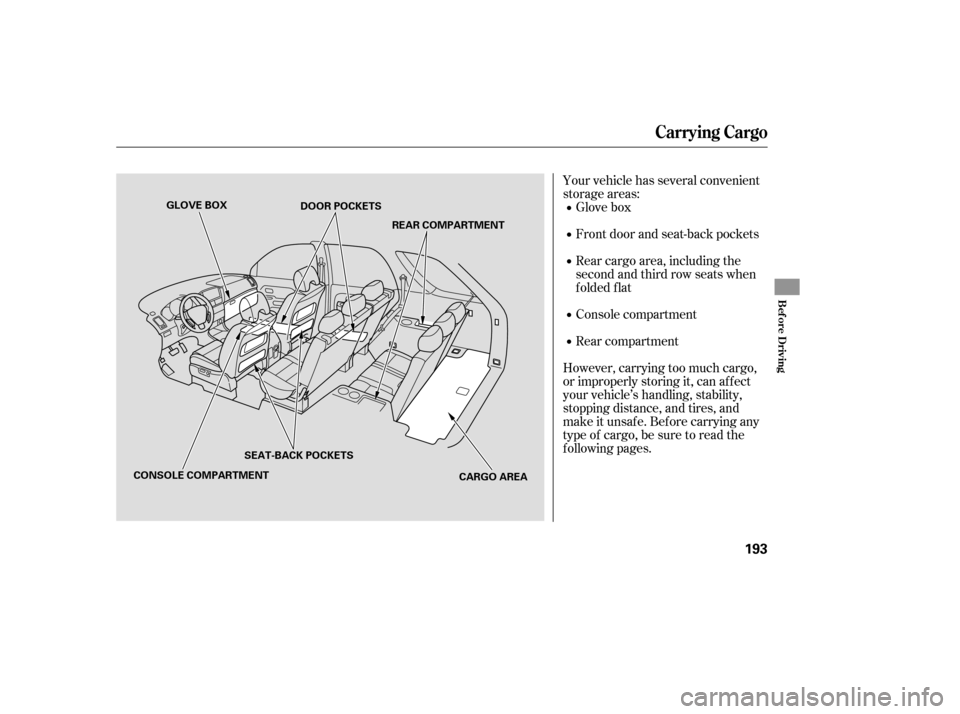
Your vehicle has several convenient
storage areas:Glove box
Front door and seat-back pockets
Rear cargo area, including the
second and third row seats when
folded flat
Console compartment
Rear compartment
However, carrying too much cargo,
or improperly storing it, can af f ect
your vehicle’s handling, stability,
stopping distance, and tires, and
make it unsaf e. Bef ore carrying any
type of cargo, be sure to read the
f ollowing pages.
Carrying Cargo
Bef ore Driving
193
GLOVE BOX
CARGO AREA
CONSOLE COMPARTMENT DOOR POCKETS
SEAT-BACK POCKETS REAR COMPARTMENT
Page 201 of 319

Your vehicle has a higher ground
clearance that allows you to travel
over bumps, obstacles, and rough
terrain. It also provides good
visibility so you can anticipate
problems earlier.
Because your vehicle rides higher
off the ground, it has a high center
of gravity that can cause it to roll
over if you make abrupt turns. Utility
vehicl es have a signifi cantly higher
roll over rate than other types of
ve hicles.
To prevent rollovers or loss of
control:
Take corners at slower speeds
than you would with a passenger
vehicle.
Avoid sharp turns and abrupt
maneuvers whenever possible. Do
not carry heavy cargo on the
roof. Do not modify your vehicle in any
way that would raise the center of
gravity.
Check the adjustment of the
inside and outside mirrors (see
page ).
Check
the seat adjustment (see
page ).
Check
that any items you may be
carrying are stored properly or
fastened down securely.
Youshoulddothefollowingchecks
and
adjustmen ts before you drive
your vehicle.
Make sure all windows, mirrors,
and outside lights are clean and
unobstructed. Remove frost, snow,
or ice.
Vi sually check the tires. If a tire
looks low, use a gauge to check its
pressure (see page ).
Your
vehicle is equipped with a four-
wheel drive (4WD) system. When
the system senses a loss of front-
wheel traction, it automatically
transfers some power to the rear
wh eels. This gives you better
traction and mobility.
You still need to exercise the same
care when accelerating, steering, and
brakingthatyouwouldinatwo-
wheel drive vehicle. 3. 2. 1.
4.
5.
87
92 258
Four-wheel drive models
See page f or additional driving of f -highway guidelines. 222
Driving Guidelines
Preparing to Drive
198
Page 207 of 319

The vehicle must be stopped with
the engine running.do
any of the f ollowing: Press the VTM-4 LOCK button.
Move the shift lever to D or D .
Move the shift lever to first (1),
second (2), or reverse (R) gear.
Turn the ignition switch to the
LOCK (0) position.
Press the VTM-4 LOCK button.
The indicator in the button comes
on.
The VTM-4 Lock will temporarily
disengage when the vehicle speed
exceeds 18 mph (30 km/h). The
indicator in the button will remain on.
The variable torque management
4WD (VTM-4) system automatically
transf ers varying amounts of engine
torque to the rear wheels under
lower traction conditions.
If more traction is needed when your
vehicle is stuck, or is likely to
become stuck, you can use the
VTM-4 LOCK button to increase
torque to the rear wheels.
To get unstuck, apply light pressure
to the accelerator pedal. Do not spin
the f ront tires f or more than a f ew
seconds. Because of the amount of
torque applied to the rear tires, they
should not spin. This is normal. If
you are not able to move the vehicle,
stop and reverse direction. 1.
2.
3.
3
To Engage the VTM-4 Lock To Disengage the VTM-4 Lock,
VTM-4 System
204
Do not continuously spin the f ront tires
of your vehicle. Continuously spinning
the f ront tires can cause transmission
or rear dif f erential damage.
Do not use the VTM-4 LOCK button on
dry, paved roads. Driving on dry,
paved roads with VTM-4 Lock ON may
damage the rear dif f erential when
making a turn. Strange noise and
vibration can also result.
Page 208 of 319

Your vehicle is equipped with a tire
pressure monitoring system (TPMS)
that turns on every time you start the
engine and monitors the pressure in
your tires while driving.
Each tire has its own pressure
sensor. If the air pressure of a tire
becomes significantly low, the
sensor in that tire immediately sends
a signal that causes the low tire
pressure indicator and the
appropriate tire on the tire pressu re
monitor to come on. Each
tire, including the spare, should
be checked monthly when cold and
set to the recommended inflation
pressure as specif ied in the vehicle
placard and this owner’s manual (see
page ).
Although your tire pressure is
monitored, you must manually check
thetirepressuresmonthly.
If you think you can saf ely drive a
short distance to a service station,
proceed slowly, and inf late the tire to
the recommended pressure shown
on the driver’s doorjamb.
When the tire pressure monitoring
system warning indicator is on, one
or more of your tires is signif icantly
under-inf lated. You should stop and
check your tires as soon as possible,
and inflate them to the proper
pressureasindicatedonthevehicle’s
tire inf ormation placard.
If the tire is f lat, or if the tire
pressure is too low to continue
driving, replace the tire with the
compact spare tire.
Driving on a signif icantly under-
inf lated tire causes the tire to
overheat and can lead to tire failure.
Under-inf lation also reduces f uel
efficiency and tire tread life, and may
af f ect the vehicle’s handling and
stopping ability. 289
Tire Pressure Monitoring System (TPMS)
Low Tire Pressure
Indicator
Driving
205
Page 209 of 319

The appropriate tire indicator and
low tire pressu re indicator comes on
if a tire becomes significantly
underinflated. See
on page .
This indicator comes on and stays on
if there is a problem with the tire
pressure monitoring system.
If you see this message, the system
is off and is not monitoring the tire
pressures. Have the system checked
by your dealer as soon as possible.
If you have a flat tire, the low tire
pressu re and tire monitor indicators
will come on. Replace the indicated
flat tire with the compact spare tire
(see page ). Each wheel is equipped with a tire
pressure sensor mounted inside the
tire behind the valve stem. You must
use TPMS specif ic wheels. It is
recommended that you always have
your tires serviced by your dealer or
qualif ied technician.
Af ter you replace the f lat tire, the
low tire pressure indicator stays on.
This is normal; the system is not
monitoring the spare tire pressure.
Manually check the spare tire
pressure to be sure it is correct.
Never use a puncture-repairing agent
in a f lat tire. If used, you will have to
replace the tire pressure sensor.
Havetheflattirerepairedbyyour
dealer as soon as possible.
266 205
As required by the FCC:
This device complies with Part 15 of theFCC rules. Operation is subject to thef ollowing two conditions: (1) This devicemay not cause harmf ul interf erence, and(2) this device must accept anyinterf erence received, includinginterf erence that may cause undesiredoperation.
Changes or modif ications not expresslyapproved by the party responsible f orcompliance could void the user’sauthority to operate the equipment.
This device complies with IndustryCanada Standard RSS-210.Operation is subject to the f ollowing twoconditions: (1) this device may not causeinterf erence, and (2) this device mustaccept any interf erence that may causeundesired operation of the device.
Tire Pressure Monitoring System (TPMS)
Tire Pressure Monitor
Low Tire
Pressure Indicator
Changing a T ire with T PMS Tire Pressure Monitoring
System (T PMS) Indicator
206