Page 213 of 275

Your tires have wear indica tors
molded into the tread. When the
tread wears down, you will see a
band 1/2 inch (12.7 mm) wide band
across the tread. This shows there is
less than 1/16 inch (1.6 mm) of tread
left on the tire.
A tire this worn gives very little
traction on wet roads. You should
replace the tire if you can see three
or more tread wear indicators.
Every
time you check inflation, you
should also examine the tires for
damage, foreign objects, and wear.
Youshouldlookfor: Bumps or bulges in the tread or
side of the tire. Replace the tire if
youfindeitheroftheseconditions.
Cu ts, splits, or cracks in the side
of the tire. Replace the tire if you
can see fabric or cord.
Excessive tread wear.
Thecompactsparetirepressureis:
For
convenience, the recommended
tire sizes and cold tire pressures are
on a label on the driver’s doorjamb.
For additional technical inf ormation
about your tires, see page . 246
Tires
Tire Inspection
210
TREAD WEAR INDICATORSINDICATOR LOCATION MARKS
60 psi (420 kPa , 4.2 kgf/cm)
Page 214 of 275

Replace your tires with radial tires of
the same size, load range, speed
rating, and maximum cold tire
pressure rating (as shown on the
tire’s sidewall).
Mixing radial and bias-ply tires on
your vehicle can reduce braking
ability, traction, and steering
accuracy. Using tires of a dif f erent
size or construction can cause the
ABS to work inconsistently.
TheABSworksbycomparingthe
speed of the wheels. When replacing
tires, use the same size originally
supplied with the vehicle. Tire size
and construction can affect wheel
speed and may cause the system to
activate.
To help increase tire lif e and
distribute wear more evenly, rotate
the tires according to the
maintenance messages displayed on
the information display. Move the
tires to the positions shown in the
chart each time they are rotated. If
you purchase directional tires, rotate
only f ront-to-back.
In addition to proper inf lation,
correct wheel alignment helps to
decrease tire wear. If you f ind a tire
is worn unevenly, have your dealer
check the wheel alignment.
Have your dealer check the tires if
you f eel a consistent vibration while
driving. A tire should always be
rebalanced if it is removed f rom the
wheel. When you have new tires
installed, make sure they are
balanced. This increases riding
comf ort and tire lif e. For best results,
have the installer perform a dynamic
balance.
CONT INUED
Replacing T ires and Wheels
Tire Rotation
T ire Maintenance
Tires
Maint enance
211
Front
Front
(For Non-directional
Tires and Wheels) (For Directional
Tires and Wheels)
On vehicles with aluminum wheels,
improper wheel weights can damage
your vehicle’s wheels. Use only Honda
wheel weights f or balancing.
Page 215 of 275
Wheels:
Tires:
See page for DOT tire quality
grading inf ormation, and page f or tire size and labeling
inf ormation.
It is best to replace all f our tires at
thesametime.If thatisnotpossible
or necessary, replace the two f ront
tires or two rear tires as a pair.
Replacing just one tire can seriously
af f ect your vehicle’s handling.
If you ever replace a wheel, make
sure that the wheel’s specif ications
match those of the original wheels.
Replacement wheels are available at
your dealer.
246
248
(SC model)
(SC model)
(On all models except SC)
(On all models except SC)
Wheel and T ire Specif ications
Tires
212
16x61/2JJ
P215/70R16 99S 18 x 7JJ
P225/55R18 97H
Installing improper tires on your
vehicle can affect handling and
stability. This can cause a crash
in which you can be seriously
hurt or killed.
Always use the size and type of
tires recommended in this
owner’s manual.
Page 216 of 275

�´Because your vehicle has limited tire
clearance, Honda strongly
recommends using the chains listed
below, made by Security Chain
Company (SCC).
Because your vehicle has limited tire
clearance, use only SAE Class ‘‘S’’
cable-type traction devices, with
rubber chain tensioners, on the f ront
tires. Use traction devices only when
required by driving conditions or
local laws. Make sure they are the
correct size f or your tires. Metal link-
type ‘‘chains’’ should not be used.
When installing cables, f ollow the
manuf acturer’s instructions, and
mount them as tight as you can.
Make sure they are not contacting
the brake lines or suspension. Drive
slowly with them installed. If you
hear them coming into contact with
the body or chassis, stop and
investigate. Remove them as soon as
youbegindrivingonclearedroads.
Tires marked ‘‘M S’’ or ‘‘All
Season’’ on the sidewall have an all-
weather tread design suitable for
most winter driving conditions.
For the best perf ormance in snowy
or icy conditions, you should install
snow tires or tire chains. They may
be required by local laws under
certain conditions.
If you mount snow tires on your
vehicle, make sure they are radial
tires of the same size and load range
as original tires. Mount snow tires on
all f our wheels. The traction
provided by snow tires on dry roads
maybelowerthanyouroriginaltires.
Check with the tire dealer f or
maximum speed recommendations.
Cable-type:SCC Super Z6 SZ 139
SC model
On all models except SCTire Chains
Winter Driving
Snow T ires
Tires
Maint enance
213
Traction devices that are the wrong
size or improperly installed can
damage your vehicle’s brake lines,
suspension, body, and wheels. Stop
driving if they are hitting any part of
the vehicle.
Page 218 of 275

Fill the f uel tank.
Change the engine oil and f ilter.
Wash and dry the exterior
completely.
Cleantheinterior.Makesurethe
carpeting, floor mats, etc., are
completely dry.Block the rear wheels.
If the vehicle is to be stored f or a
longer period, it should be
supported on jackstands so the
tires are of f the ground.
Cover the vehicle with a
‘‘breathable’’ cover, one made
f rom a porous material such as
cotton. Non-porous materials, such
as plastic sheeting, trap moisture,
which can damage the paint.
If you need to park your vehicle f or
an extended period (more than 1
month), there are several things you
should do to prepare it f or storage.
Proper preparation helps prevent
deterioration and makes it easier to
get your vehicle back on the road. If
possible, store your vehicle indoors. Leave one window open slightly (if
the vehicle is being stored
indoors).
Disconnect the battery.
Support the f ront and rear wiper
blade arms with a f olded towel or
ragsotheydonottouchthe
windshield.
To minimize sticking, apply a
silicone spray lubricant to all door
and tailgate seals. Also, apply a
vehiclebodywaxtothepainted
surfaces that mate with the door
and tailgate seals.
Leave the parking brake off. Put
the transmission in reverse
(manual) or Park (automatic). If possible, periodically run the
engine until it reaches f ull
operating temperature (the
cooling f ans cycle on and of f
twice). Pref erably, do this once a
month.
Vehicle Storage
Maint enance
215
Page 221 of 275
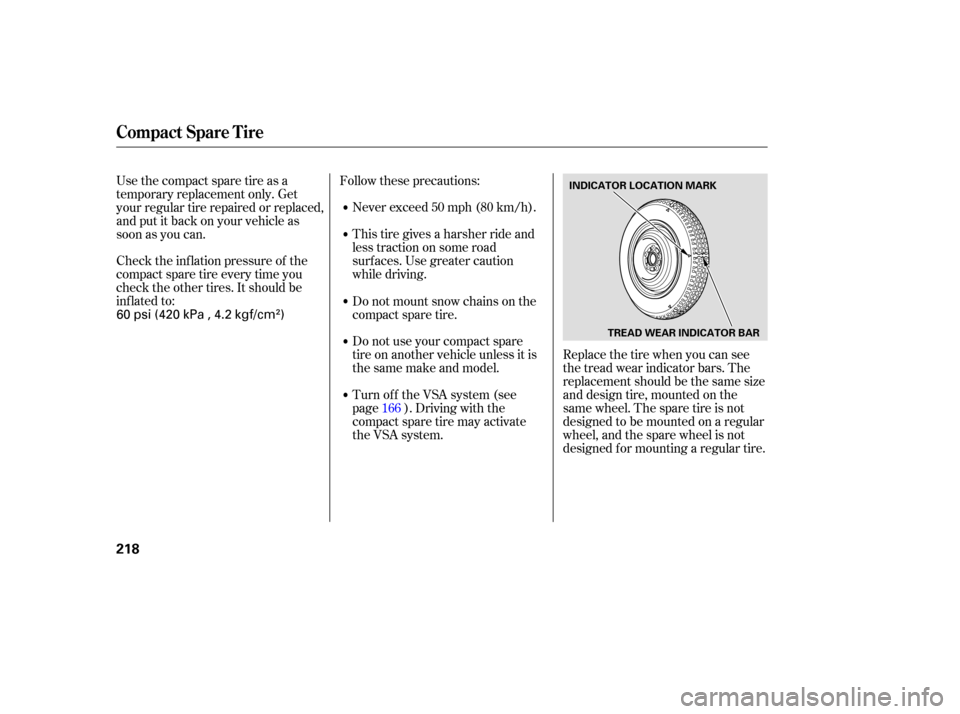
Check the inflation pressure of the
compact spare tire every time you
check the other tires. It should be
inflated to: Follow
these precautions:
Never exceed 50 mph (80 km/h).
This tire gives a harsher ride and
less traction on some road
surfaces. Use greater caution
while driving.
Use
the compact spare tire as a
temporary replacement only. Get
your regular tire repaired or replaced,
and put it back on your vehicle as
soon as you can.
Replace the tire when you can see
the tread wear indica tor bars. The
replacement should be the same size
and design tire, mounted on the
same wheel. The spare tire is not
designed to be mounted on a regular
wheel, and the spare wheel is not
designed for mounting a regular tire.
Do
not mount snow chains on the
compact spare tire.
Do not use your compact spare
tire on another vehicle unless it is
thesamemakeandmodel.
Turn of f the VSA system (see
page ). Driving with the
compact spare tire may activate
the VSA system. 166
Compact Spare Tire
218
INDICATOR LOCATION MARK
TREAD WEAR INDICATOR BAR
60 psi (420 kPa , 4.2 kgf/cm)
Page 242 of 275
The operator will load
your vehicle on the back of a truck.
Any other method of towing will
damage the drive system. When you
contact the towing agency, inf orm
them a f lat-bed is required. If your vehicle needs to be towed,
call a prof essional towing service or
organization. Never tow your vehicle
with just a rope or chain. It is very
dangerous.
The only way you can saf ely tow
your vehicle is with f lat-bed
equipment.
Emergency Towing
T aking Care of t he Unexpect ed
239
Towing with only two tires on the
ground will damage parts of the 4WD
system. It should be transported on a
f lat-bed truck or trailer.
Page 244 of 275

Thediagramsinthissectiongive
you the dimensions and capacities of
your vehicle and the locations of the
identif ication numbers. It also
includes inf ormation you should
know about your vehicle’s tires and
emissions control systems.................
Identif ication Numbers .242
................................
Specif ications .244
DOT Tire Quality Grading
......................
(U.S. Vehicles) .246
Unif orm Tire Quality ..................................
Grading .246
.................................
Treadwear .246
......................................
Traction .246
.............................
Temperature .247
.................................
Tire Labeling .248
Tire Pressure Monitoring System
(TPMS)-Required .............
Federal Explanation .249 .......................
Emissions Controls .251
.....................
The Clean Air Act .251
Crankcase Emissions Control
....................................
System .251
Evaporative Emissions Control ....................................
System .251
Onboard Ref ueling Vapor ................................
Recovery .251
...
Exhaust Emissions Controls .252
....................
PGM-FI System .252
Ignition Timing Control
................................
System .252
Three Way Catalytic ...........................
Converter .252
....................
Replacement Parts .252
..
Three Way Catalytic Converter .253
Emissions Testing ......................... 254
T echnical Inf ormation
Technical Inf ormation
241

