Page 69 of 352
Canadian models only
If equipped
This indicator comes on when the
washer fluid level is low. Add washer
fluid when you see this indicator
(see page ).
This indicator comes on when the
security system is set. See page
for more information on the
security system.
This
indicator comes on for a few
seconds when you turn the ignition
switch to the ON (II) position. It
remindsyouthatitistimetotake
your vehicle in for scheduled
maintenance. The maintenance main
items and sub items will be displayed
in the information display. See page
f or more inf ormation on the
maintenance minder.
This indicator goes of f when your
dealer resets it after completing the
required maintenance service.
272
257
207
Washer L evel Indicator
Security System Indicator
Maintenance Minder
Indicator
Instrument Panel Indicators
Inst rument s and Cont rols
65
SECURITY SYSTEM INDICATOR
Page 71 of 352
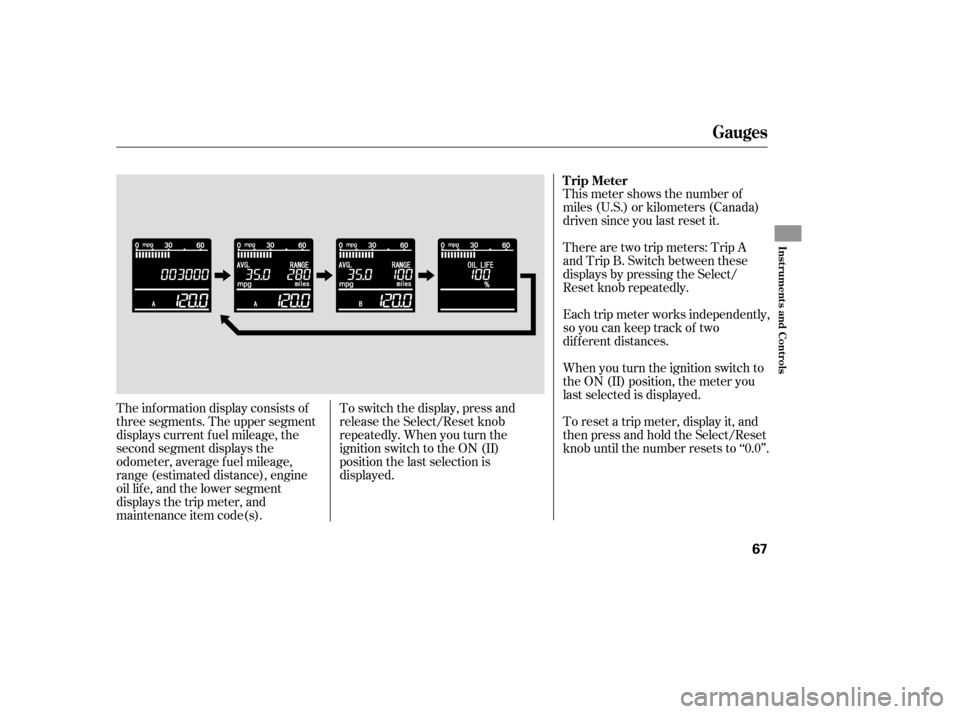
This meter shows the number of
miles (U.S.) or kilometers (Canada)
driven since you last reset it.
The inf ormation display consists of
threesegments.Theuppersegment
displays current f uel mileage, the
second segment displays the
odometer, average f uel mileage,
range (estimated distance), engine
oil lif e, and the lower segment
displays the trip meter, and
maintenance item code(s). To switch the display, press and
release the Select/Reset knob
repeatedly. When you turn the
ignition switch to the ON (II)
position the last selection is
displayed.There are two trip meters: Trip A
and Trip B. Switch between these
displays by pressing the Select/
Reset knob repeatedly.
Each trip meter works independently,
so you can keep track of two
dif f erent distances.
When you turn the ignition switch to
the ON (II) position, the meter you
last selected is displayed.
To reset a trip meter, display it, and
then press and hold the Select/Reset
knob until the number resets to ‘‘0.0’’. Trip Meter
Gauges
Inst rument s and Cont rols
67
Page 75 of 352
If your fuel fill cap is loose or
missing, a ‘‘CHECK FUEL CAP’’
messa ge appears on the information
display after you start the engine.
For more information, see page .The
information display in the
instrument panel shows you the
engine oil life and maintenance
service items when the ignition
switch is in the ON (II) position. This
information helps to keep you aware
of the periodic maintenance your
vehicle needs for continued trouble-
f ree driving. Ref er to page f or
more inf ormation.
216
257
Gauges
Maintenance Minder
Check Fuel Cap Message
Inst rument s and Cont rols
71
Page 218 of 352

Help assure your vehicle’s f uture
reliability and perf ormance by paying
extra attention to how you drive
during the f irst 600 miles (1,000 km).Avoid full-throttle starts and rapid
acceleration.
Do not change the oil until the
scheduled maintenance time.
Avoidhardbrakingforthefirst
200 miles (300 km).
During this period:
You should also f ollow these
recommendations with an
overhauled or exchanged engine, or
when the brakes are replaced.
Do not tow a trailer. Your vehicle is designed to operate
on unleaded gasoline with a pump
octane number of 87 or higher. Use
of a lower octane gasoline can cause
a persistent, heavy metallic rapping
noise that can lead to engine damage.
In addition, in order to maintain good
perf ormance, f uel economy, and
emissions control, we strongly
recommend, in areas where it is
available, the use of gasoline that
does NOT contain manganese-based
f uel additives such as MMT.
Use of gasoline with these additives
may adversely af f ect perf ormance,
and cause the malfunction indicator
lamp on your instrument panel to
come on. If this happens, contact your authorized dealer f or service.
Some gasoline today is blended with
oxygenates such as ethanol or
MTBE. Your vehicle is designed to
operate on oxygenated gasoline
containing up to 10 % ethanol by
volume and up to 15 % MTBE by
volume. Do not use gasoline
containing methanol.
If you notice any undesirable
operating symptoms, try another
service station or switch to another
brand of gasoline.
For f urther important f uel-related
inf ormation, please ref er to your
.
We recommended using a quality
gasoline containing detergent
additives that help prevent fuel
system and engine deposits.
Break-in Period Fuel Recommendation
Quick Start Guide
Break-in Period, Fuel Recommendation
214
Page 223 of 352

Refer to
on page for
inform ation about checking other
items on your vehicle. Always
maintain your vehicle
according to the maintenance
messages displayed in the
information display. See
on page
.
an underinf lated tire
causes more ‘‘rolling resistance,’’
which uses more f uel.
The build-up of snow or mud on
your vehicle’s underside adds
weight and rolling resistance.
Frequent cleaning helps your f uel
mileage and reduces the chance of
corrosion.
Drive moderately. Rapid
acceleration, abrupt cornering,
and hard braking use more f uel.
Always drive in the highest gear
possible. Try to maintain a constant speed.
Everytimeyouslowdownand
speed up, your vehicle uses extra
f uel. Use cruise control when
appropriate.
Combine several short trips into
one.
The air conditioning puts an extra
load on the engine which makes it
usemorefuel.Usethefresh-air
ventilation when possible.
262
262
For example,
Owner’s Maintenance
Checks Improving Fuel Economy
Owner’s
Maintenance Checks
Service Station Procedures, Fuel Economy
Bef ore Driving
219
Page 257 of 352

Before you leave the pavement, be
sure to do all scheduled maintenance
and service, and inspect your vehicle
f or any problems. Pay special
attention to the condition of the tires,
and check the tire pressures.
After you return to the pavement,
caref ully inspect your vehicle to
make sure there is no damage that
could make driving it unsaf e.
Recheck the condition of the tires
and the tire pressures.
The route presents limits (too steep
or bumpy roads). You have limits
(driving skill and comfort). And your
vehicle has limits (traction, stability,
and power).
Driving of f -highway can be
hazardous if you f ail to recognize
limits and take the proper
precautions.Forbettertractiononallsurfaces,
accelerate slowly and gradually build
up speed. If you try to start too fast
on wet soil, mud, snow, or ice, you
might not have enough traction to
get underway, and you may dig
yourself a hole. Starting with the
shif t lever in second (2) gear will
help you have a smoother start on
snow or ice.
Keep in mind that you will usually
need more time and distance to
brake to a stop on unpaved surf aces.
Avoid hard braking. Do not ‘‘pump’’
the brakes; let the anti-lock braking
system pump them f or you.
Debris in the road can damage your
suspension or other components.
Because your vehicle has a high
center of gravity, driving over a large
obstacle, or allowing a wheel to drop
into a deep hole can cause your
vehicle to tip or roll over.
If you can’t clearly see all conditions
or obstacles on a slope, walk the
slope bef ore you drive on it. If you
have any doubt whether or not you
can saf ely drive on the slope, don’t
do it. Find another route.
If you are driving up a hill and f ind
that you cannot continue,
. Your vehicle could roll
over. Slowly back down the hill,
f ollowing the same route you took up
the hill.
do not try to
turn around
Check Out Your Vehicle
Remember A ccelerating and Braking A voiding Obstacles
Driving on Slopes
Of f -Highway Driving Guidelines
Driving
253
Page 259 of 352

This section explains why it is
important to keep your vehicle well
maintained and how to follow basic
maintenance safety precautions.
If you have the skills and tools to
perform more complex maintenance
tasks on your vehicle, you may want
to purchase the service manual. See
page f or inf ormation on how to
obtain a copy, or see your dealer. This section also includes
instructions on how to read the
maintenance minder messages on
the information display, a
maintenance record, and instructions
for simple maintenance tasks you
may want to take care of yourself. ......................
Maintenance Saf ety .256
....................
Maintenance Minder .257
....................
Maintenance Record .264
..............................
Fluid Locations .266
........................
Adding Engine Oil .267
Changing the Engine Oil and
...........................................
Filter .268
..............................
Engine Coolant .270
....................
Windshield Washers .272
....
Automatic Transmission Fluid .273
.................
Rear Dif f erential Fluid .275
....................................
Brake Fluid .275
....................
Power Steering Fluid .276
.............................................
Lights .277
................
Cleaning the Seat Belts .283
.....................................
Floor Mats .283
..............................
Audio Antenna .284
..................
Dust and Pollen Filter .284
.................................
Wiper Blades .285
...............................................
Tires .288
...........................................
Wheels .293
...................
Checking the Battery .294
.............................
Vehicle Storage .295
337
Maintenance
Maint enance
255
Page 260 of 352

To eliminate potential hazards, read
the instructions bef ore you begin,
and make sure you have the tools
and skills required.Make sure your vehicle is parked
on level ground, the parking brake
is set, and the engine is of f .
To clean parts, use a commercially
available degreaser or parts
cleaner, not gasoline.
To reduce the possibility of f ire or
explosion, keep cigarettes, sparks,
and flames away from the battery
and all f uel-related parts.
Wear eye protection and
protective clothing when working
with the battery or compressed air. Be sure there is
adequate ventilation whenever you
operate the engine.
Let the
engine and exhaust system cool
down bef ore touching any parts. Do
not run the engine unless
instructed to do so.
All service items not detailed in this
section should be perf ormed by a
certif ied technician or other qualif ied
mechanic.
Some of the most important saf ety
precautions are given here. However,
we cannot warn you of every
conceivable hazard that can arise in
perf orming maintenance. Only you
can decide whether or not you
should perf orm a given task.
Maintenance Saf ety
Important Saf ety PrecautionsPotential Vehicle HazardsCarbon Monoxide poison f rom
engine exhaust.
Burns f rom hot parts. Injury f rom moving parts.
256
Improperly maintaining this
vehicle, or failing to correct a
problem before driving can
cause a crash in which you can
be seriously hurt or killed.
Always follow the inspection
and maintenance
recommendations and
schedules in this owner’s
manual.
Failure to properly follow
maintenance instructions and
precautions can cause you to
be seriously hurt or killed.
Always follow the procedures
and precautions in this owner’s
manual.