Page 179 of 304

Park the vehicle, and set the
parking brake. Pull the hood
release handle under the lower lef t
corner of the dashboard. The
hood will pop up slightly.
Screw the f uel f ill cap back on
until it clicks at least once. If you
do not properly tighten the cap,
the malf unction indicator lamp
maycomeon(seepage ).You
will also see a ‘‘CHECK FUEL
CAP’’ message on the inf ormation
display.
Push the f uel f ill door closed until
it latches.
Remove the f uel f ill cap slowly.
You may hear a hissing sound as
pressure inside the tank escapes.
The fuel fill cap is attached to the
f uel f iller with a tether. Place the
cap in the holder on the f uel f ill
door.
Stop f illing the tank af ter the f uel
nozzle automatically clicks of f . Do
not try to ‘‘top off’’ the tank. Leave
some room f or the f uel to expand
with temperature changes.
even though the tank is not f ull,
there may be a problem with your
vehicle’s fuel vapor recovery
system. The system helps keep
f uel vapor f rom going into the
atmosphere. Try f illing at another
pump. If this does not f ix the
problem, consult your dealer.
1.
5. 6.
4.
3.
268If the f uel nozzle keeps clicking of f
Service Station Procedures
Opening and Closing the Hood
178
HOOD RELEASE HANDLE
�����—�����—�����y�
����
�
������y���
�(�#�����
���y���
�����y
Page 185 of 304
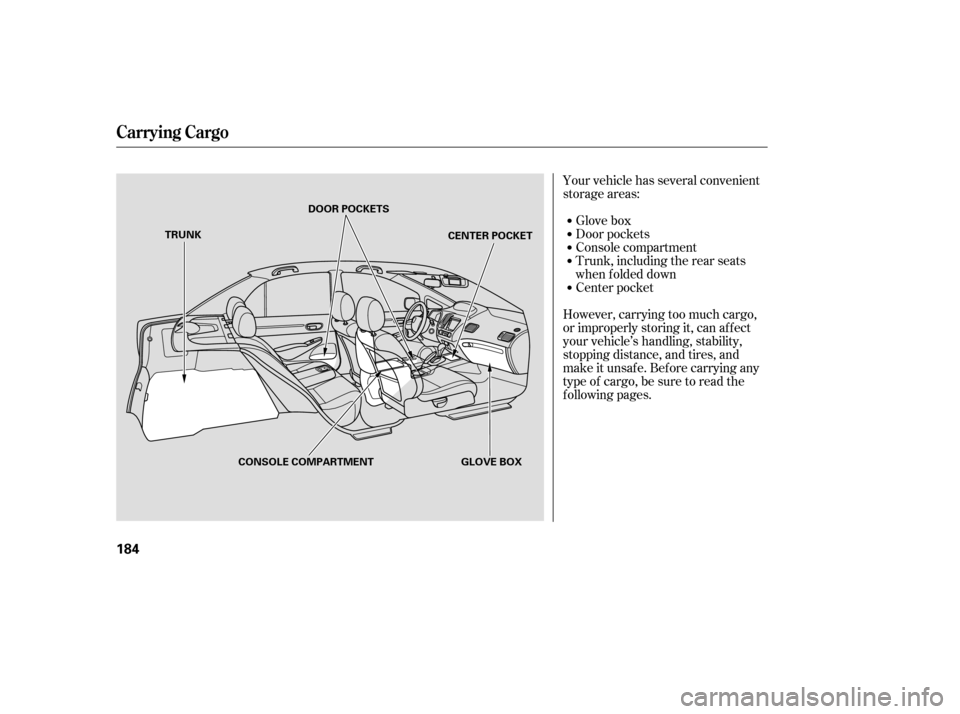
Your vehicle has several convenient
storage areas:Glove box
Console compartment
Door pockets
Trunk, including the rear seats
when f olded down
However, carrying too much cargo,
or improperly storing it, can af f ect
your vehicle’s handling, stability,
stopping distance, and tires, and
make it unsaf e. Bef ore carrying any
type of cargo, be sure to read the
f ollowing pages. Center pocket
Carrying Cargo
184
GLOVE BOX
CENTER POCKET
TRUNK DOOR POCKETS
CONSOLE COMPARTMENT
�����—�����—�����y�
����
������
�y���
�(�#�����
���y���
�����y
Page 186 of 304

�µ�·
Steps f or Determining Correct Load
Limit:
Locate the statement, ‘‘the
combined weight of occupants and
cargo should never exceed 850
lbs’’ on your vehicle’s placard.
[The placard is on the driver’s
doorjamb.]
Determine the combined weight
of the driver and passengers that
will be riding in your vehicle.
The resulting f igure equals the
available amount of cargo and
luggage load capacity.
For example, if the maximum load
is 850 lbs and there will be f ive 150
lb. passengers in your vehicle, the
amount of available cargo and
luggage load capacity is 100 lbs. (850 750 (5 150) = 100 lbs.)
The maximum load f or your vehicle
is 850 lbs (385 kg) f or U.S.A, 395 kg
f or Canada. This f igure includes the
total weight of all occupants, cargo,
and accessories, and the tongue load
if you are towing a trailer.
Subtract the combined weight of
the driver and passengers f rom
850 lbs.Determine the combined weight
of luggage and cargo being loaded
on the vehicle. That weight may
not saf ely exceed the available
cargo and luggage load capacity
calculated in step 4.
If your vehicle will be towing a
trailer, load f rom your trailer will
be transf erred to your vehicle.
Consult this manual to determine
how this reduces the available
cargo and luggage load capacity of
yourvehicle(seepage ).
In addition, the total weight of the
vehicle, all passengers, accessories,
and cargo must not exceed the Gross
Vehicle Weight Rating (GVWR) or
the Gross Axle Weight Rating
(GAWR). Both are on a label on the
driver’s doorjamb.
4. 5.
3.
1. 2.
6.
204
Load Limits
Carrying Cargo
Bef ore Driving
185
Overloading or improper
loading can affect handling and
stability and cause a crash in
which you can be hurt or killed.
Follow all load limits and other
loading guidelines in thismanual.
�����—�����—�����y�
����
��������y���
�(�#�����
���y���
�����y
Page 189 of 304
Make sure all windows, mirrors,
and outside lights are clean and
unobstructed. Remove f rost, snow,
or ice.
Check that the hood and trunk are
f ully closed.Check that any items you may be
carrying are stored properly or
f astened down securely.
Check the seat adjustment (see
page ).
Check the adjustment of the
inside and outside mirrors (see
page ).
Check the steering wheel
adjustment (see page ).
Make sure the doors are securely
closed and locked.Fasten your seat belt. Check that
your passengers have f astened
their seat belts (see page ).
Youshoulddothefollowingchecks
and adjustments every day bef ore
you drive your vehicle.
When you start the engine, check
the gauges and indicators in the
instrument panel (see page ).
Visually check the tires. If a tire
looks low, use a gauge to check its
pressure (see page ).
1. 2. 3. 4.
9.
8.
7.
6.
5.
10.
245 91
99 75 14
57
Preparing to Drive
Driving
189
�����—�����—�����y�
����
����
���y���
�(�#�����
���y���
�����y
Page 198 of 304

If your vehicle has an automatic
transmission, set the parking brake
bef ore you put the transmission in
Park. This keeps the vehicle f rom
moving and putting pressure on the
parking mechanism in the
transmission.Make sure the moonroof (if
equipped) and the windows are
closed.
Place any packages, valuables, etc.,
in the trunk or take them with you.
Turn of f the lights. If the vehicle is f acing uphill, turn
the f ront wheels away f rom the
curb. If you have a manual
transmission, put it in f irst gear.
If the vehicle is f acing downhill,
turn the front wheels toward the
curb. If you have a manual
transmission, put it in reverse gear.
Make sure the parking brake is
f ully released bef ore driving away.
Driving with the parking brake
partially set can overheat or
damage the rear brakes.
Lock the doors.
Always use the parking brake when
you park your vehicle. Make sure
the parking brake is set f irmly, or
your vehicle may roll if it is parked
on an incline.
Check the indicator on the
instrument panel to verif y that the
security system is set.
Never park over dry leaves, tall
grass, or other f lammable
materials. The hot three way
catalytic converter could cause
these materials to catch on fire.
On vehicles with security system
Parking T ips
Parking
198
Never install a sunshade between the
upper and lower meters on the
instrument panel. If you do, you could
cause heat damage to the upper meter
on a very hot day.
�����—�����—�����y�
����
��������y���
�(�#�����
���y���������y
Page 246 of 304
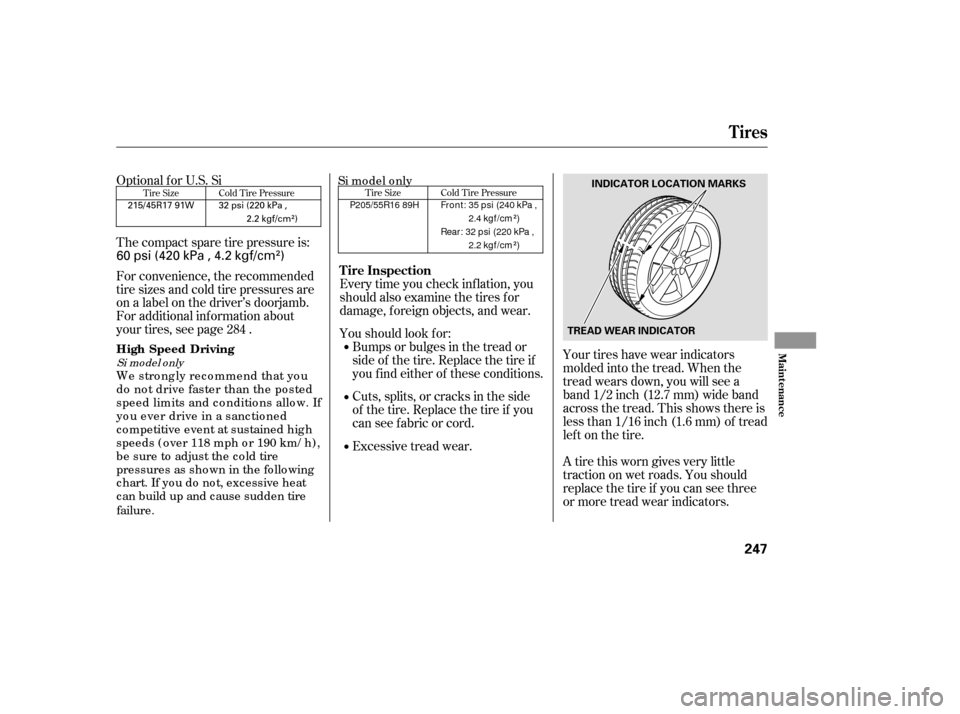
Your tires have wear indicators
molded into the tread. When the
tread wears down, you will see a
band 1/2 inch (12.7 mm) wide band
across the tread. This shows there is
less than 1/16 inch (1.6 mm) of tread
lef t on the tire.
A tire this worn gives very little
traction on wet roads. You should
replace the tire if you can see three
or more tread wear indicators.
Bumps or bulges in the tread or
side of the tire. Replace the tire if
youfindeitherof theseconditions.
Cuts, splits, or cracks in the side
of the tire. Replace the tire if you
can see f abric or cord.
Excessive tread wear.
Every time you check inf lation, you
should also examine the tires f or
damage, f oreign objects, and wear.
Youshouldlookfor:
Thecompactsparetirepressureis:
For convenience, the recommended
tire sizes and cold tire pressures are
on a label on the driver’s doorjamb.
For additional inf ormation about
your tires, see page .
Optional f or U.S. Si
284
Tire Size Cold Tire Pressure
Tires
Tire Inspection
Maint enance
247
TREAD WEAR INDICATORINDICATOR LOCATION MARKS
60 psi (420 kPa , 4.2 kgf/cm)
32 psi (220 kPa ,
2.2 kgf/cm
)
215/45R17 91W
�����—�����—�����y�
������
������y���
�(�#�����
���y���������y
c o mpetitive event at sustained hig h
speeds ( o ver 118 mph o r 190 km/ h) ,
be sure to adjust the c o ld tire
pressures as sho wn
in the fo llo wing
We stro ng ly rec o mmend that yo u
do no t drive faster than the po sted
speed limits and c o nditio ns
allo w. If
yo u ever drive in a sanc tio ned
Si mo del o nly
High Speed D riving
Tire Size Cold Tire Pressure Fr o n t : 35 p si (240 kPa ,
2.4 kg f /cm
)
P205/55R16 89H
Rear : 32 p si (220 kPa ,
2.2 kg f /cm
)
Si mo del o nly
c hart. If yo u do no t, exc essive heat
c an build up and c ause sudden tire
failure.
Page 253 of 304

Fill the f uel tank.
Change the engine oil and f ilter.Block the rear wheels.
If the vehicle is to be stored f or a
longer period, it should be
supported on jackstands so the
tires are of f the ground.
Wash and dry the exterior
completely.
Cleantheinterior.Makesurethe
carpeting, floor mats, etc., are
completely dry.
If you need to park your vehicle f or
an extended period (more than 1
month), there are several things you
should do to prepare it f or storage.
Proper preparation helps prevent
deterioration and makes it easier to
get your vehicle back on the road. If
possible, store your vehicle indoors. Leave one window open slightly (if
the vehicle is being stored
indoors).Cover the vehicle with a
‘‘breathable’’ cover, one made
f rom a porous material such as
cotton. Non-porous materials, such
as plastic sheeting, trap moisture,
which can damage the paint.
To minimize sticking, apply a
silicone spray lubricant to all door
and trunk seals. Also, apply a
vehiclebodywaxtothepainted
surfaces that mate with the door
and trunk seals.
Support the f ront wiper blade
arms with a f olded towel or rag so
they do not touch the windshield.
Disconnect the battery. If possible, periodically run the
engine until it reaches f ull
operating temperature (the
cooling f an cycles twice).
Pref erably, do this once a month.
Leave the parking brake off. Put
the transmission in reverse
(manual) or Park (automatic).
Vehicle Storage
254
�����—�����—�����y�
���������
���y���
�(�#�����
���y���������y
Page 273 of 304

�µ �µ�µ�µ �µ �µ �µ
�Î
�Î �Î
�Î
�Î
�Î
No. No.No.
Amps. Circuits Protected
Amps. Circuits Protected
Amps.
Circuits Protected :
1 23456789
10111213141516 17181920212223242526272829303132333435363738
7.5 A
7.5 A
10 A
10 A
10 A
7.5 A
7.5 A 10 A ODS
MET ER
SRS
Right Headlight High
Left Headlight High
Small (Interior)
Small (Exterior)
Right Headlight Low
7.5 A
15 A
10 A
7.5 A
(15 A) Left Headlight Low
Headlight High Main
Small (Main)
Not Used
Headlight Low Main
(HAC)
STS
Moonroof
Door Lock
Driver’s Power Window
Not Used
Rear ACC Socket
ACC
Passenger’s Power Window
Not Used
Right Rear Power Window
Left Rear Power Window
Not Used
ACC Radio
HAC
Daytime Running Light
Wiper
10 A
20 A
15 A
20 A
(7.5 A)
(7.5 A)
(20 A) 20 A
20 A
(15 A) 15 A
20 A
20 A
20 A
7.5 A 10 A
7.5 A 30 A
Power Window
Fuel Pump
Alternator
ABS/VSA
Heated Seat
Not Used
Not Used
Not Used
If equipped
Fuse Locations
T aking Care of t he Unexpect ed
275
INTERIOR FUSE BOX
�����—�����—�����y�
�������������y���
�(�#�����
���y���������y