Page 228 of 311
�µYou may use a synthetic motor oil if
it meets the same requirements
given f or a conventional motor oil: it
displays the API certif ication seal,
and it is the proper weight. You must
f ollow the oil and f ilter change
intervals shown on the information
display.
Your vehicle does not require any oil
additives. Additives may adversely
af f ect the engine or transmission
perf ormance and durability.
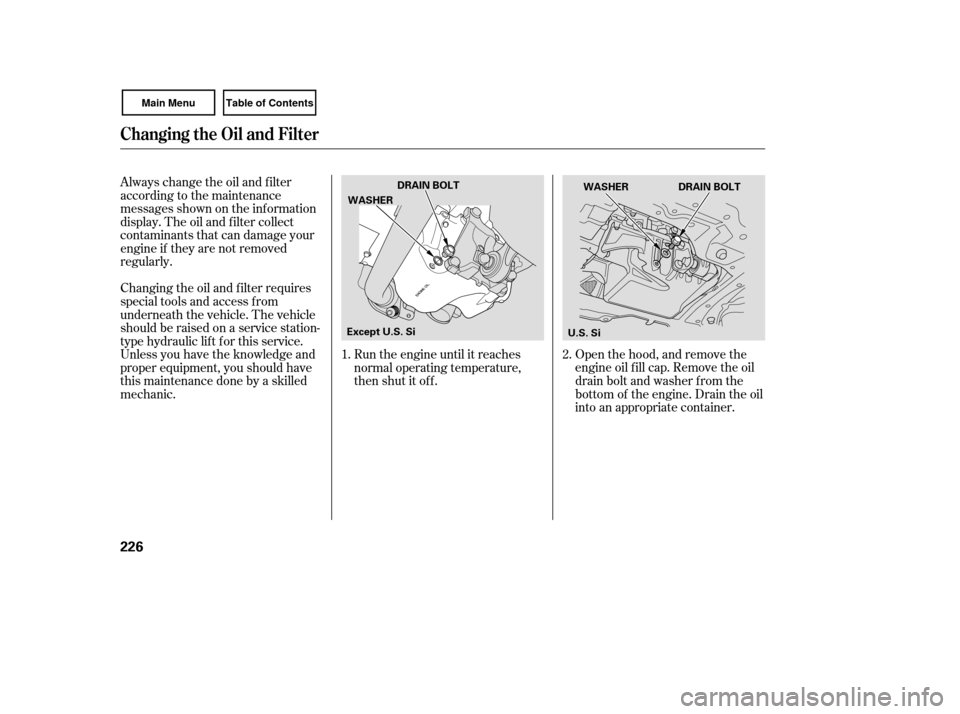
An oil with a viscosity of 5W-30 is
pref erred f or improved f uel economy
and year-round protection in your
vehicle. You may use a 10W-30 oil if
the temperature in your area never
goes below 20°F ( 7°C).
Make sure the API Certif ication Seal
says ‘‘For Gasoline Engines.’’
The oil viscosity or weight is
provided on the container’s label.
Honda Motor Oil is the pref erred
5W-20 lubricant f or your vehicle.
5W-20 oil is f ormulated f or year-
round protection of your vehicle, to
improve cold weather starting and
f uel economy.
Synthetic Oil
Engine Oil A dditives
A ll models except U.S. Si: U.S. Si model:
A dding Engine Oil
Maint enance
225
Ambient Temperature Ambient Temperature
Page 229 of 311
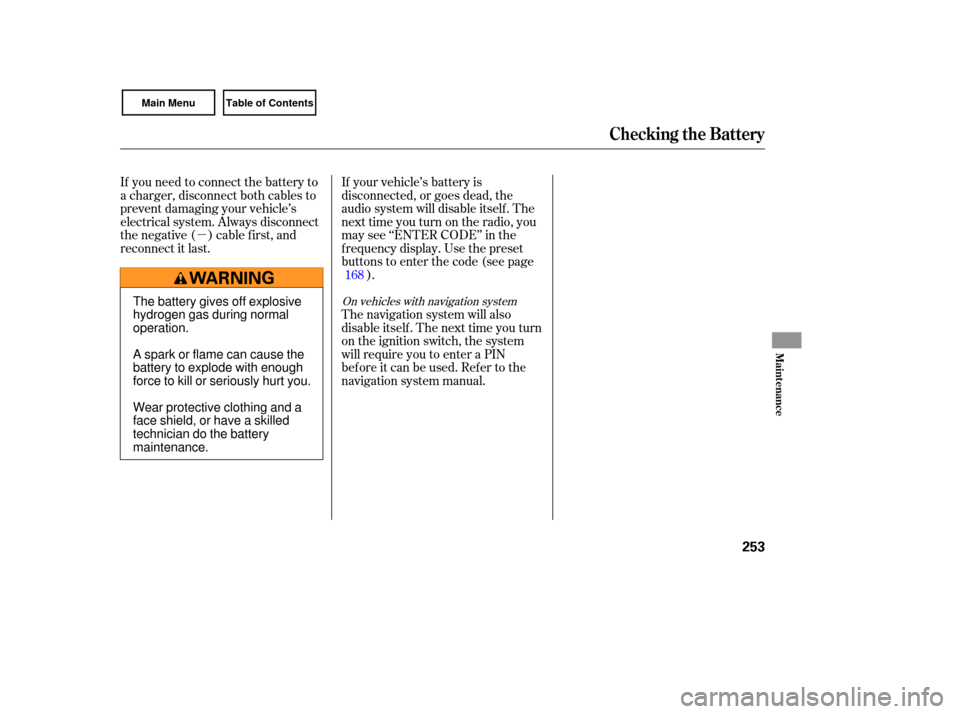
Open the hood, and remove the
engine oil f ill cap. Remove the oil
drain bolt and washer f rom the
bottom of the engine. Drain the oil
into an appropriate container.
Always change the oil and f ilter
according to the maintenance
messages shown on the inf ormation
display. The oil and f ilter collect
contaminants that can damage your
engine if they are not removed
regularly.
Changing the oil and f ilter requires
special tools and access f rom
underneath the vehicle. The vehicle
should be raised on a service station-
type hydraulic lif t f or this service.
Unless you have the knowledge and
proper equipment, you should have
this maintenance done by a skilled
mechanic.
Run the engine until it reaches
normal operating temperature,
then shut it off.
1. 2.
Changing the Oil and Filter
226
DRAIN BOLT
WASHER
DRAIN BOLT
WASHER
Except U.S. Si U.S. Si
Page 236 of 311
If Honda MTF is not available, you
may use an SAE 10W-30 or 10W-40
viscosity motor oil with the API
Certif ication seal that says ‘‘FOR
GASOLINE ENGINES’’ as a
temporary replacement. However,
motor oil does not contain the proper
additives, and continued use can
cause stif f er shif ting. Replace as
soon as it is convenient.
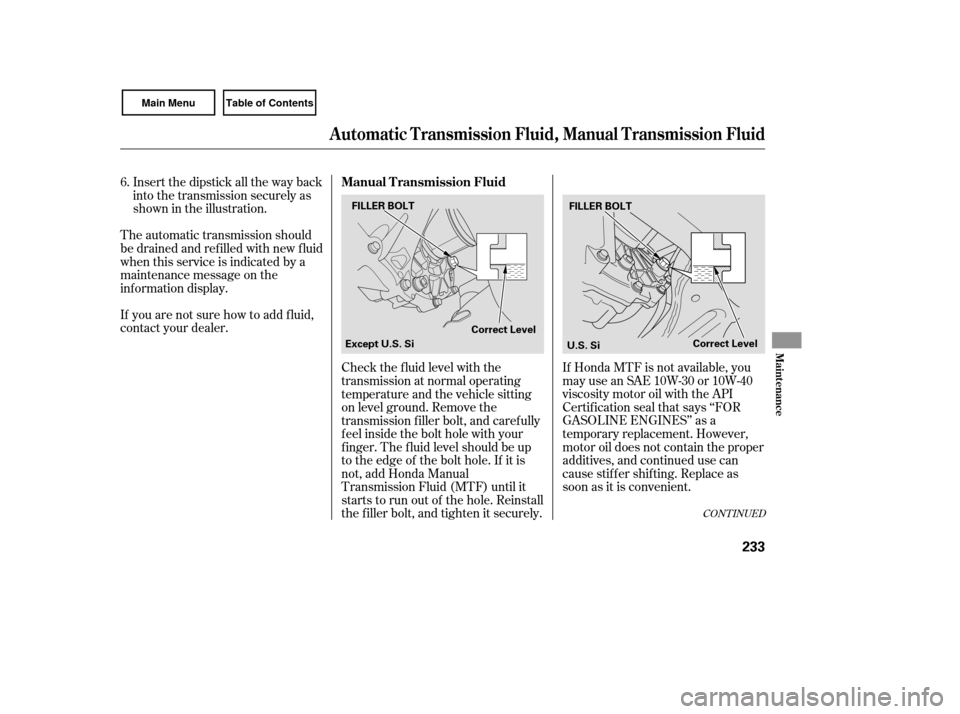
Check the f luid level with the
transmission at normal operating
temperature and the vehicle sitting
on level ground. Remove the
transmission f iller bolt, and caref ully
f eel inside the bolt hole with your
f inger. The f luid level should be up
to the edge of the bolt hole. If it is
not, add Honda Manual
Transmission Fluid (MTF) until it
starts to run out of the hole. Reinstall
the f iller bolt, and tighten it securely.
Insert the dipstick all the way back
into the transmission securely as
shown in the illustration.
The automatic transmission should
be drained and ref illed with new f luid
when this service is indicated by a
maintenance message on the
inf ormation display.
If you are not sure how to add f luid,
contact your dealer. 6.
CONT INUED
Manual Transmission Fluid
A utomatic T ransmission Fluid, Manual T ransmission Fluid
Maint enance
233
FILLER BOLT
Correct LevelFILLER BOLT
Correct Level
Except U.S. Si
U.S. Si
Page 237 of 311
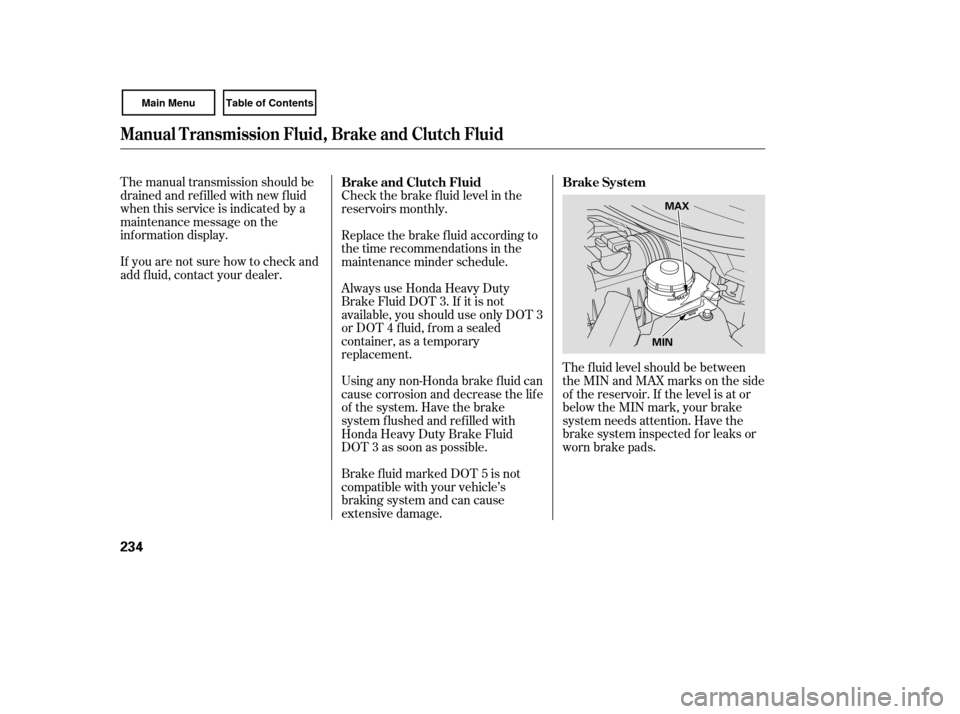
The f luid level should be between
theMINandMAXmarksontheside
of the reservoir. If the level is at or
below the MIN mark, your brake
system needs attention. Have the
brake system inspected f or leaks or
worn brake pads.
The manual transmission should be
drained and ref illed with new f luid
when this service is indicated by a
maintenance message on the
inf ormation display.
If you are not sure how to check and
add f luid, contact your dealer.
Brake f luid marked DOT 5 is not
compatible with your vehicle’s
braking system and can cause
extensive damage. Using any non-Honda brake f luid can
cause corrosion and decrease the lif e
of the system. Have the brake
system f lushed and ref illed with
Honda Heavy Duty Brake Fluid
DOT 3 as soon as possible. Always use Honda Heavy Duty
Brake Fluid DOT 3. If it is not
available, you should use only DOT 3
or DOT 4 f luid, f rom a sealed
container, as a temporary
replacement. Replace the brake f luid according to
thetimerecommendationsinthe
maintenance minder schedule. Check the brake f luid level in the
reservoirs monthly.Brake System
Brake and Clutch Fluid
Manual Transmission Fluid, Brake and Clutch Fluid
234
MAX
MIN
Page 245 of 311
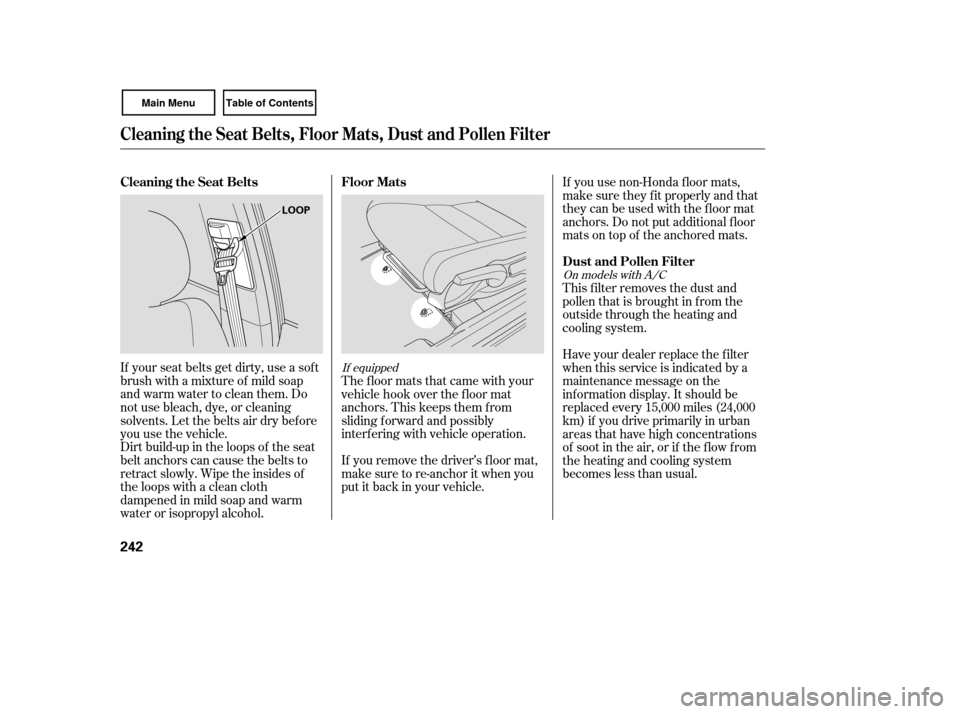
Dirt build-up in the loops of the seat
belt anchors can cause the belts to
retract slowly. Wipe the insides of
the loops with a clean cloth
dampened in mild soap and warm
water or isopropyl alcohol.This f ilter removes the dust and
pollenthatisbroughtinfromthe
outside through the heating and
cooling system.
If your seat belts get dirty, use a sof t
brush with a mixture of mild soap
and warm water to clean them. Do
not use bleach, dye, or cleaning
solvents. Let the belts air dry bef ore
you use the vehicle. The floor mats that came with your
vehicle hook over the f loor mat
anchors. This keeps them f rom
sliding f orward and possibly
interf ering with vehicle operation.
If you remove the driver’s f loor mat,
make sure to re-anchor it when you
putitbackinyourvehicle.If you use non-Honda f loor mats,
make sure they f it properly and that
theycanbeusedwiththefloormat
anchors. Do not put additional f loor
mats on top of the anchored mats.
Have your dealer replace the filter
when this service is indicated by a
maintenance message on the
inf ormation display. It should be
replaced every 15,000 miles (24,000
km) if you drive primarily in urban
areas that have high concentrations
of soot in the air, or if the f low f rom
the heating and cooling system
becomeslessthanusual.
If equipped
On models with A/C
Floor Mats
Dust and Pollen Filter
Cleaning the Seat Belts
Cleaning the Seat Belts, Floor Mats, Dust and Pollen Filter
242
LOOP
Page 251 of 311
In addition to proper inf lation,
correct wheel alignment helps to
decrease tire wear. If you f ind a tire
is worn unevenly, have your dealer
check the wheel alignment.
Have your dealer check the tires if
you f eel a consistent vibration while
driving. A tire should always be
rebalanced if it is removed f rom the
wheel. When you have new tires
installed, make sure they are
balanced. This increases riding
comf ort and tire lif e. For best results,
have the installer perform a dynamic
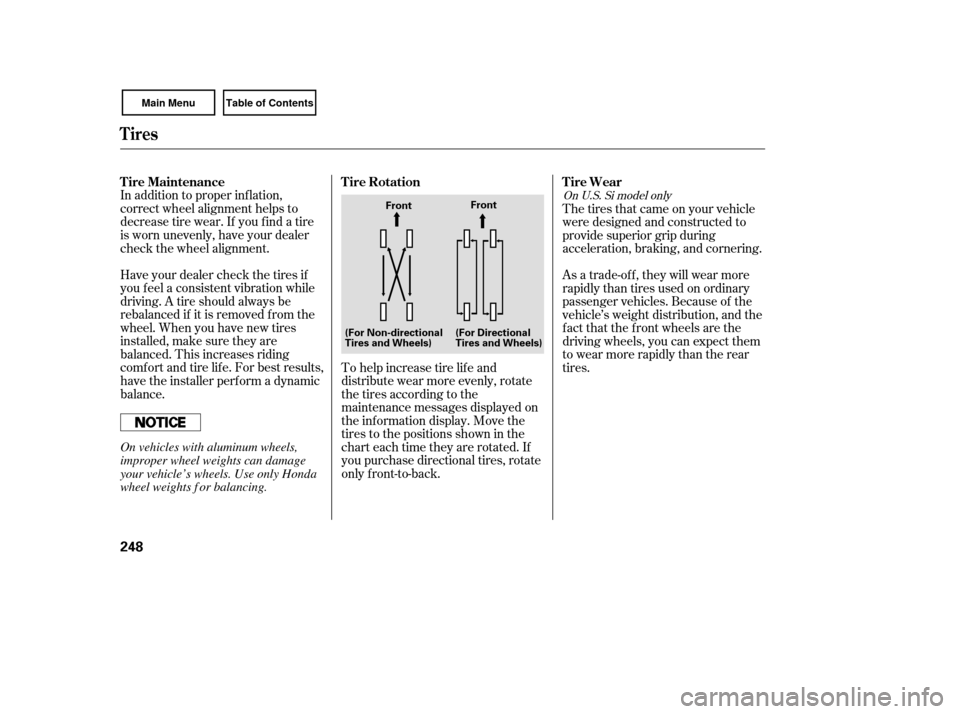
balance.To help increase tire lif e and
distribute wear more evenly, rotate
the tires according to the
maintenance messages displayed on
the information display. Move the
tires to the positions shown in the
chart each time they are rotated. If
you purchase directional tires, rotate
only f ront-to-back.As a trade-of f , they will wear more
rapidly than tires used on ordinary
passenger vehicles. Because of the
vehicle’s weight distribution, and the
fact that the front wheels are the
driving wheels, you can expect them
to wear more rapidly than the rear
tires. The tires that came on your vehicle
were designed and constructed to
provide superior grip during
acceleration, braking, and cornering.On U.S. Si model only
T ire Maintenance
T ire RotationT ire Wear
Tires
248
FrontFront
(For Non-directional
Tires and Wheels) (For Directional
Tires and Wheels)
On vehicles with aluminum wheels,
improper wheel weights can damage
your vehicle’s wheels. Use only Honda
wheel weights f or balancing.
Page 256 of 311
�µ
On vehicles with navigation system
The navigation system will also
disableitself.Thenexttimeyouturn
on the ignition switch, the system
will require you to enter a PIN
before it can be used. Refer to the
navigation system manual.
If
you need to connect the battery to
a charger, disconnect both cables to
prevent damaging your vehic le’s
electrical system. Always disconnect
the negative ( ) cable first, and
reconnect it last. If
your vehicle’s battery is
disconnected, or goes dead, the
audio system will disable itsel f. The
nexttimeyouturnontheradio,you
may see ‘‘ENTER CODE’’ in the
f requency display. Use the preset
buttons to enter the code (see page ).
168
Checking the Battery
Maint enance
253
The battery gives off explosive
hydrogen gas during normal
operation.
A spark or flame can cause the
battery to explode with enough
force to kill or seriously hurt you.
Wear protective clothing and a
face shield, or have a skilled
technician do the battery
maintenance.
Page 271 of 311
If the indicator comes on repeatedly,
even though it may turn off as you
continue driving, have the vehicle
checked by your dealer as soon as
possible.
Your vehicle has certain ‘‘readiness
codes’’ that are part of the on-board
diagnostics for the emissions
systems. In some states, part of the
emissions testing is to make sure
these codes are set. If they are not
set, the test cannot be completed.
If
this indicator comes on
while driving, it means one
of the engine’s emissions control
systems may have a problem. Even
though you may feel no difference in
your vehicle’s performance, it can
reduce your fuel economy and cause
increased emissions. Continued
operation may cause serious damag e. If
your vehicle’s battery has been
disconnected or gone dead, these
codes are erased. It can take several
days of driving under various
conditions to set the codes again.
To check if they are set, turn the
ignition switch to the ON (II)
position, without starting the engine.
The malfunction indicator lamp will
come on for 20 seconds. If it then
goes off, the readiness codes are set.
If it blinks five times, the readiness
codes are not set. If possible, do not
take your vehicle for a state
emissions test until the readiness
codes are set. Ref er to for more
inf ormation (see page ).
If you have recently ref ueled your
vehicle, the indicator coming on
could be due to a loose or missing
f uel f ill cap. You will also see a
‘‘CHECK FUEL CAP’’ message on
the inf ormation display. Tighten the
cap until it clicks at least once.
Tightening the cap will not turn the
indicator of f immediately; it can take
several days of normal driving.
290
Malf unction Indicator L amp
Readiness Codes
State
Emissions T esting
268
If you keep driving with the
malf unction indicator lamp on, you can
damage your vehicle’s emissions
controls and engine. Those repairs may
not be covered by your vehicle’s
warranties.