2007 GMC SIERRA CLASSIC steering
[x] Cancel search: steeringPage 383 of 674
Q:What should I do if my vehicle stalls,
or is about to stall, and I cannot make it
up the hill?
A:If this happens, there are some things you
should do, and there are some things you
must not do. First, here is what youshoulddo:
Push the brake pedal to stop the vehicle
and keep it from rolling backwards. Also, apply
the parking brake.
If the engine is still running, shift the
transmission to REVERSE (R), release the
parking brake, and slowly back down the
hill in REVERSE (R).
If the engine has stopped running, you will
need to restart it. With the brake pedal
pressed and the parking brake still applied,
shift the transmission to PARK (P), or shift to
NEUTRAL if your vehicle has a manual
transmission, and restart the engine. Then,
shift to REVERSE (R), release the parking
brake, and slowly back down the hill as
straight as possible in REVERSE (R).
As you are backing down the hill, put your left
hand on the steering wheel at the 12 o’clock
position. This way, you will be able to tell if the
wheels are straight and maneuver as you back
down. It is best that you back down the hill with
the wheels straight rather than in the left or right
direction. Turning the wheel too far to the left or
right will increase the possibility of a rollover.
Here are some things youmust notdo if you stall,
or are about to stall, when going up a hill.
Never attempt to prevent a stall by shifting into
NEUTRAL (N), or pressing the clutch if your
vehicle has a manual transmission, to rev-up
the engine and regain forward momentum. This
will not work. Your vehicle will roll backwards
very quickly and you could go out of control.
Instead, apply the regular brake to stop the
vehicle. Then apply the parking brake. Shift to
REVERSE (R), release the parking brake, and
slowly back straight down.
Never attempt to turn around if you are about to
stall when going up a hill. If the hill is steep
enough to stall your vehicle, it is steep enough
to cause you to roll over if you turn around.
If you cannot make it up the hill, you must back
straight down the hill.
383
Page 389 of 674
Driving in Mud, Sand, Snow, or Ice
When you drive in mud, snow, or sand, your wheels
will not get good traction. You cannot accelerate as
quickly, turning is more difficult, and you will need
longer braking distances. If your vehicle has
four-wheel drive, seeFour-Wheel Drive on
page 153for transfer case mode selection.
It is best to use a low gear when you are in
mud —the deeper the mud, the lower the gear.
In really deep mud, the idea is to keep your vehicle
moving so you do not get stuck.
When you drive on sand, you will sense a change
in wheel traction. But it will depend upon how
loosely packed the sand is. On loosely packed
sand, such as on beaches or sand dunes,
your tires will tend to sink into the sand. This has
an effect on steering, accelerating, and braking.
Drive at a reduced speed and avoid sharp turns
or abrupt maneuvers.Hard packed snow and ice offer the worst tire
traction. On these surfaces, it is very easy to lose
control. On wet ice, for example, the traction is so
poor that you will have difficulty accelerating. And if
you do get moving, poor steering and difficult
braking can cause you to slide out of control.
{CAUTION:
Driving on frozen lakes, ponds, or rivers
can be dangerous. Underwater springs,
currents under the ice, or sudden thaws
can weaken the ice. Your vehicle could
fall through the ice and you and your
passengers could drown. Drive your
vehicle on safe surfaces only.
389
Page 391 of 674
After Off-Road Driving
Remove any brush or debris that has collected
on the underbody, chassis, or under the hood.
These accumulations can be a re hazard.
After operation in mud or sand, have the brake
linings cleaned and checked. These substances
can cause glazing and uneven braking. Check the
body structure, steering, suspension, wheels,
tires, and exhaust system for damage. Also, check
the fuel lines and cooling system for any leakage.
Your vehicle will require more frequent service
due to off-road use. Refer to the Maintenance
Schedule for additional information.
Driving at Night
Night driving is more dangerous than day driving.
One reason is that some drivers are likely to
be impaired — by alcohol or drugs, with night
vision problems, or by fatigue.
Here are some tips on night driving.
Drive defensively.
Do not drink and drive.
Adjust the inside rearview mirror to reduce the
glare from headlamps behind you.
Since you cannot see as well, you may need
to slow down and keep more space between
you and other vehicles.
Slow down, especially on higher speed roads.
Your vehicle’s headlamps can light up only so
much road ahead.
In remote areas, watch for animals.
If you are tired, pull off the road in a safe
place and rest.
No one can see as well at night as in the daytime.
But as we get older these differences increase.
A 50-year-old driver may require at least twice as
much light to see the same thing at night as a
20-year-old.
What you do in the daytime can also affect your
night vision. For example, if you spend the
day in bright sunshine you are wise to wear
sunglasses. Your eyes will have less trouble
adjusting to night. But if you are driving, do not
wear sunglasses at night. They may cut down on
glare from headlamps, but they also make a
lot of things invisible.
391
Page 404 of 674
The Anti-Lock Brake System (ABS) improves your
vehicle’s stability when you make a hard stop
on a slippery road. Even though you have ABS,
you will want to begin stopping sooner than
you would on dry pavement. SeeAnti-Lock Brake
System (ABS) on page 361.
Allow greater following distance on any
slippery road.
Watch for slippery spots. The road might be
ne until you hit a spot that is covered with
ice. On an otherwise clear road, ice patches
may appear in shaded areas where the
sun cannot reach, such as around clumps of
trees, behind buildings, or under bridges.
Sometimes the surface of a curve or an
overpass may remain icy when the
surrounding roads are clear. If you see a
patch of ice ahead of you, brake before you
are on it. Try not to brake while you are
actually on the ice, and avoid sudden steering
maneuvers.
If You Are Caught in a Blizzard
If you are stopped by heavy snow, you could be in
a serious situation. You should probably stay
with your vehicle unless you know for sure that you
are near help and you can hike through the
snow. Here are some things to do to summon
help and keep yourself and your passengers safe:
Turn on your hazard ashers.
Tie a red cloth to your vehicle to alert police
that you have been stopped by the snow.
Put on extra clothing or wrap a blanket around
you. If you do not have blankets or extra
clothing, make body insulators from
newspapers, burlap bags, rags, oor
mats — anything you can wrap around yourself
or tuck under your clothing to keep warm.
404
Page 407 of 674
Notice:Spinning the wheels can destroy parts
of your vehicle as well as the tires. If you
spin the wheels too fast while shifting
the transmission back and forth, you can
destroy the transmission.
For information about using tire chains on your
vehicle, seeTire Chains on page 562.
Rocking Your Vehicle to Get It Out
First, turn the steering wheel left and right.
That will clear the area around the front wheels.
If you have a four-wheel-drive vehicle, shift
into Four-Wheel High. If your vehicle has the
Traction Assist System (TAS), you should
turn it off by pressing the TAS on/off button.Then shift back and forth between REVERSE (R)
and a forward gear, or with a manual transmission,
between FIRST (1) or SECOND (2) and
REVERSE (R), spinning the wheels as little as
possible. Release the accelerator pedal while you
shift, and press lightly on the accelerator pedal
when the transmission is in gear. By slowly
spinning the wheels in the forward and reverse
directions, you will cause a rocking motion
that may free your vehicle. If that does not get
your vehicle out after a few tries, it may need to be
towed out. Or, you can use the recovery hooks
if your vehicle has them. If your vehicle does need
to be towed out, seeTowing Your Vehicle on
page 423.
407
Page 425 of 674
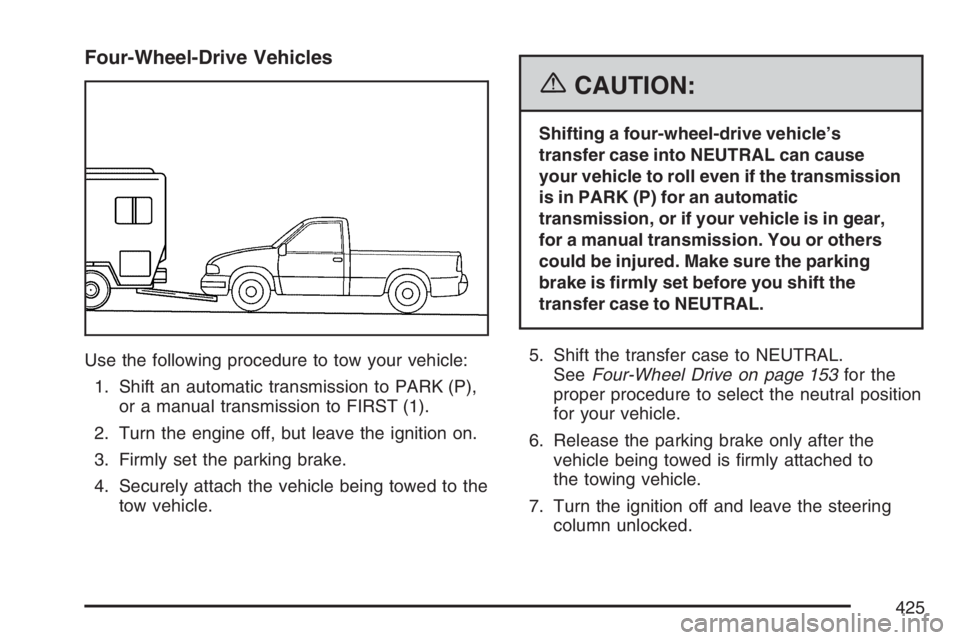
Four-Wheel-Drive Vehicles
Use the following procedure to tow your vehicle:
1. Shift an automatic transmission to PARK (P),
or a manual transmission to FIRST (1).
2. Turn the engine off, but leave the ignition on.
3. Firmly set the parking brake.
4. Securely attach the vehicle being towed to the
tow vehicle.
{CAUTION:
Shifting a four-wheel-drive vehicle’s
transfer case into NEUTRAL can cause
your vehicle to roll even if the transmission
is in PARK (P) for an automatic
transmission, or if your vehicle is in gear,
for a manual transmission. You or others
could be injured. Make sure the parking
brake is rmly set before you shift the
transfer case to NEUTRAL.
5. Shift the transfer case to NEUTRAL.
SeeFour-Wheel Drive on page 153for the
proper procedure to select the neutral position
for your vehicle.
6. Release the parking brake only after the
vehicle being towed is rmly attached to
the towing vehicle.
7. Turn the ignition off and leave the steering
column unlocked.
425
Page 427 of 674
{CAUTION:
Shifting a four-wheel-drive vehicle’s
transfer case into NEUTRAL can cause
your vehicle to roll even if the transmission
is in PARK (P) for an automatic
transmission, or if your vehicle is in gear,
for a manual transmission. You or others
could be injured. Make sure the parking
brake is rmly set before you shift the
transfer case to NEUTRAL.
6. Shift the transfer case to NEUTRAL.
SeeFour-Wheel Drive on page 153for the
proper procedure to select the neutral position
for your vehicle.
7. Release the parking brake only after the
vehicle being towed is rmly attached to
the towing vehicle.
8. Turn the ignition off and lock the steering
column.
Rear Towing
(Rear Wheels Off the Ground)
Two-Wheel-Drive Vehicles
Use the following procedure to tow your vehicle
from the rear:
1. Drive the vehicle onto the dolly.
2. Firmly set the parking brake. SeeParking
Brake on page 169
3. Put an automatic transmission in PARK (P) or
a manual transmission in FIRST (1).
4. Follow the dolly manufacturer’s instructions to
attach and secure the vehicle being towed to
the dolly and then the loaded dolly to the
tow vehicle. Make sure the wheels are straight
before towing.
For manual transmission vehicles, make sure
the wheels are straight before proceeding
to the next steps. On automatic transmission
vehicles, use an adequate clamping device
to ensure that the front wheels are locked into
the straight position.
5. Release the parking brake only after the
vehicle being towed is rmly attached to
the tow vehicle.
6. Turn the ignition to LOCK.
427
Page 452 of 674
Before you start, check all trailer hitch parts and
attachments, safety chains, electrical connector,
lamps, tires and mirror adjustment. If the trailer has
electric brakes, start your vehicle and trailer
moving and then apply the trailer brake controller
by hand to be sure the brakes are working.
This lets you check your electrical connection at
the same time.
During your trip, check occasionally to be sure
that the load is secure, and that the lamps and any
trailer brakes are still working.
While towing a trailer or when exposed to long
periods of sunshine, the oor of the truck bed may
become very warm. Avoid putting items in the
truck bed that might be affected by high ambient
temperatures.
Following Distance
Stay at least twice as far behind the vehicle ahead
as you would when driving your vehicle without
a trailer. This can help you avoid situations
that require heavy braking and sudden turns.
Passing
You’ll need more passing distance up ahead when
you’re towing a trailer. And, because you’re a
good deal longer, you’ll need to go much farther
beyond the passed vehicle before you can
return to your lane.
Backing Up
Hold the bottom of the steering wheel with
one hand. Then, to move the trailer to the left, just
move that hand to the left. To move the trailer to the
right, move your hand to the right. Always back up
slowly and, if possible, have someone guide you.
Making Turns
Notice:Making very sharp turns while
trailering could cause the trailer to come in
contact with the vehicle. Your vehicle could be
damaged. Avoid making very sharp turns
while trailering.
When you’re turning with a trailer, make wider
turns than normal. Do this so your trailer
won’t strike soft shoulders, curbs, road signs,
trees or other objects. Avoid jerky or sudden
maneuvers. Signal well in advance.
452