2007 GMC SIERRA CLASSIC warning light
[x] Cancel search: warning lightPage 274 of 674

FUEL LEVEL LOW
If the fuel level is low, this message will appear on
the DIC and you will hear a chime. Refuel as
soon as possible. Pressing any of the four DIC
buttons will acknowledge the message and clear it
from the DIC display. If your vehicle does not
have the four DIC buttons, pressing the trip
odometer reset stem will acknowledge the
message and clear it from the DIC display. See
Low Fuel Warning Light on page 265,Fuel
Gage on page 264, andFuel on page 470.
KEYFOB X BATTERY LOW
If a Remote Keyless Entry (RKE) transmitter
battery is low, this message will appear on the
DIC. The battery needs to be replaced in the
transmitter. See “Battery Replacement” under
Remote Keyless Entry System Operation on
page 117. Pressing any of the four DIC buttons
will acknowledge the message and clear it from the
DIC display. If your vehicle does not have the
four DIC buttons, pressing the trip odometer reset
stem will acknowledge the message and clear
it from the DIC display.
LEFT REAR DOOR AJAR (Crew Cab)
If the driver’s side rear door is not fully closed, this
message will appear on the display and you will
hear a chime. Stop and turn off the vehicle, check
the door for obstructions, and close the door
again. Check to see if the message still appears
on the DIC. Pressing any of the four DIC
buttons will acknowledge the message and clear it
from the DIC display. If your vehicle does not
have the four DIC buttons, pressing the trip
odometer reset stem will acknowledge the
message and clear it from the DIC display.
LOW COOLANT LEVEL
Notice:Engine damage from running your
engine without coolant is not covered by your
warranty. See “Overheated Engine Protection
Operating Mode” in the Index for information
on driving to a safe place in an emergency.
274
Page 278 of 674
SERVICE BRAKE BOOSTER
{CAUTION:
Your brake system may not be working
properly if the SERVICE BRAKE
BOOSTER message is displayed.
If the brake system warning light is also
on, you should have the vehicle towed for
service. SeeBrake System Warning Light
on page 254.
If the brake system warning light is not
on, you still have brakes, but the
supplemental brake assist system on
vehicles with rear disc brakes may not
operate properly. In the event of a vacuum
loss, you may not have vacuum power
assist for braking. The brake pedal will be
harder to push and it will take longer to
stop. If you continue to drive with this
message displayed it can lead to a crash.
Have the brake system serviced as soon
as possible.If your vehicle has vacuum assist power brakes,
this message will be displayed on the DIC
when there is a problem with the Supplemental
Brake Assist system. If the message is displayed
immediately after starting the vehicle or the
message appears while driving, the Supplemental
Brake Assist system needs service. See your
dealer. SeeBrake System Warning Light on
page 254for additional information.
SERVICE BRAKE SYSTEM
If there is a problem with the brake system, this
message will be displayed on the DIC. If this
message appears, stop as soon as possible and
turn off the vehicle. Restart the vehicle and
check for the message on the DIC display. If the
message is still displayed or appears again
when you begin driving, the brake system needs
service. See your dealer.
278
Page 279 of 674
SERVICE CHARGING SYSTEM
On some vehicles, if there is a problem with the
battery charging system, this message will appear
on the DIC. Under certain conditions, the battery
warning light may also turn on in the instrument
panel cluster. SeeBattery Warning Light on
page 253. The battery will not be charging at an
optimal rate and the vehicle will lose the ability
to enter the fuel economy mode. The vehicle
is safe to drive, however you should have
the electrical system checked by your dealer.
Pressing any of the four DIC buttons will
acknowledge the message and clear it from the
DIC display. If your vehicle does not have the four
DIC buttons, pressing the trip odometer reset
stem will acknowledge the message and clear it
from the DIC display.
TIGHTEN FUEL CAP
If the vehicle’s fuel cap is not tightened properly,
this message may appear along with the check
engine light on the instrument panel. See
Malfunction Indicator Lamp on page 258. Fully
reinstall the fuel cap. SeeFilling the Tank
on page 474. The diagnostic system can determine
if the fuel cap has been left off or improperly
installed. A loose or missing fuel cap will allow fuel
to evaporate into the atmosphere. A few driving
trips with the cap properly installed should turn the
light and message off.
TRACTION ACTIVE
When the traction control system had detected
that any of the vehicle’s wheels are slipping,
the traction control system will activate and this
message will appear on the DIC. For more
information, seeTraction Assist System (TAS) on
page 363.
279
Page 360 of 674
Control of a Vehicle
You have three systems that make your
vehicle go where you want it to go. They are
the brakes, the steering, and the accelerator.
All three systems have to do their work at
the places where the tires meet the road.
Sometimes, as when you are driving on snow or
ice, it is easy to ask more of those control systems
than the tires and road can provide. That means
you can lose control of your vehicle. SeeTraction
Assist System (TAS) on page 363.
Adding non-GM accessories can affect your
vehicle’s performance. SeeAccessories and
Modications on page 468.
Braking
SeeBrake System Warning Light on page 254.
Braking action involves perception time and
reaction time.
First, you have to decide to push on the brake
pedal. That is perception time. Then you have to
bring up your foot and do it. That is reaction time.
Average reaction time is about three-fourths of a
second. But that is only an average. It might be less
with one driver and as long as two or three seconds
or more with another. Age, physical condition,
alertness, coordination, and eyesight all play a part.
So do alcohol, drugs, and frustration. But even in
three-fourths of a second, a vehicle moving at
60 mph (100 km/h) travels 66 feet (20 m). That
could be a lot of distance in an emergency, so
keeping enough space between your vehicle and
others is important.
And, of course, actual stopping distances vary
greatly with the surface of the road, whether it is
pavement or gravel; the condition of the road,
whether it is wet, dry, or icy; tire tread; the
condition of the brakes; the weight of the vehicle;
and the amount of brake force applied.
360
Page 361 of 674
Avoid needless heavy braking. Some people drive
in spurts — heavy acceleration followed by
heavy braking — rather than keeping pace with
traffic. This is a mistake. The brakes may not have
time to cool between hard stops. The brakes
will wear out much faster if you do a lot of heavy
braking. If you keep pace with the traffic and
allow realistic following distances, you will
eliminate a lot of unnecessary braking. That means
better braking and longer brake life.
If your vehicle’s engine ever stops while you are
driving, brake normally but do not pump the
brakes. If you do, the pedal may get harder to
push down. If the engine stops, you will still have
some power brake assist. But you will use it
when you brake. Once the power assist is used
up, it may take longer to stop and the brake pedal
will be harder to push.
Adding non-GM accessories can affect your
vehicle’s performance. SeeAccessories and
Modications on page 468.Anti-Lock Brake System (ABS)
Your vehicle has the Anti-Lock Brake System
(ABS), an advanced electronic braking system
that will help prevent a braking skid.
When you start your engine and begin to drive
away, ABS will check itself. You may hear a
momentary motor or clicking noise while this test
is going on. This is normal.
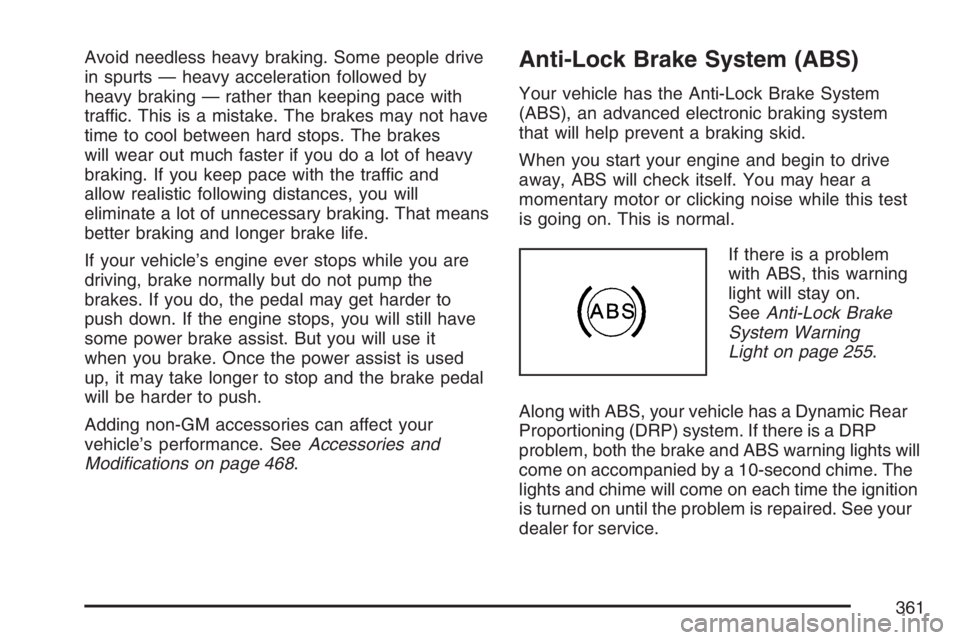
If there is a problem
with ABS, this warning
light will stay on.
SeeAnti-Lock Brake
System Warning
Light on page 255.
Along with ABS, your vehicle has a Dynamic Rear
Proportioning (DRP) system. If there is a DRP
problem, both the brake and ABS warning lights will
come on accompanied by a 10-second chime. The
lights and chime will come on each time the ignition
is turned on until the problem is repaired. See your
dealer for service.
361
Page 396 of 674
City Driving
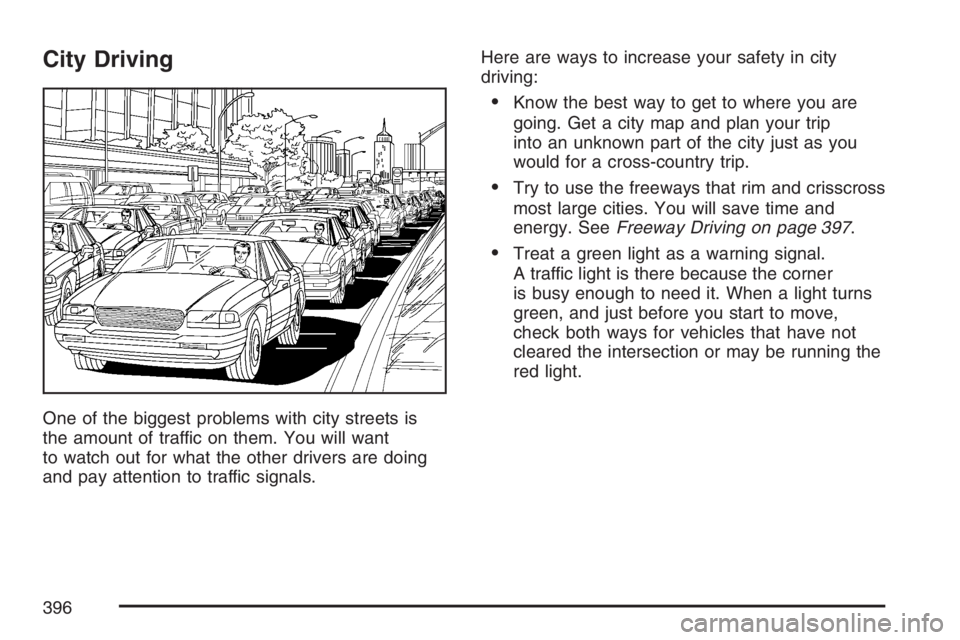
One of the biggest problems with city streets is
the amount of traffic on them. You will want
to watch out for what the other drivers are doing
and pay attention to traffic signals.Here are ways to increase your safety in city
driving:
Know the best way to get to where you are
going. Get a city map and plan your trip
into an unknown part of the city just as you
would for a cross-country trip.
Try to use the freeways that rim and crisscross
most large cities. You will save time and
energy. SeeFreeway Driving on page 397.
Treat a green light as a warning signal.
A traffic light is there because the corner
is busy enough to need it. When a light turns
green, and just before you start to move,
check both ways for vehicles that have not
cleared the intersection or may be running the
red light.
396
Page 402 of 674
Winter Driving
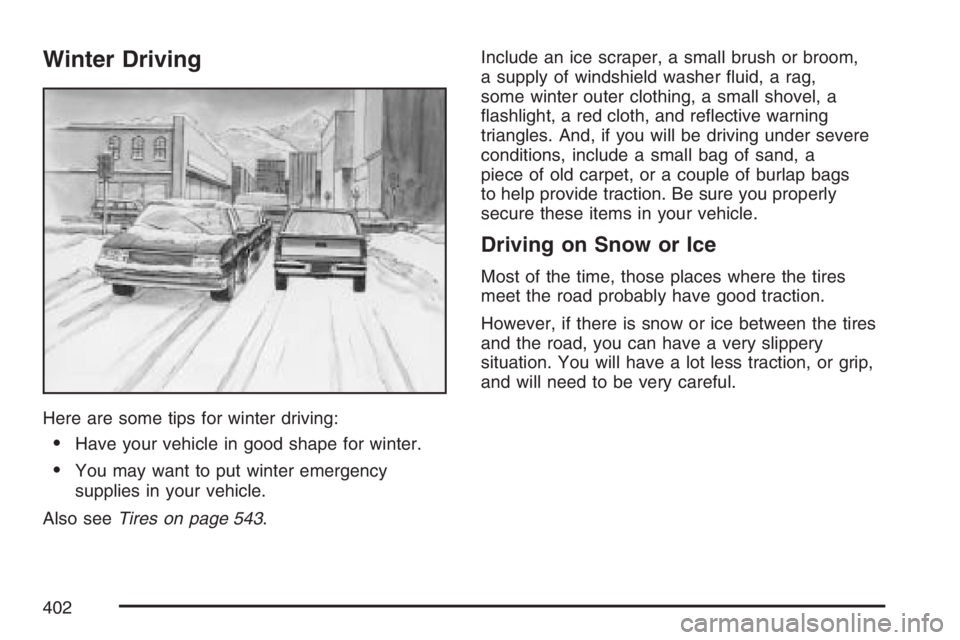
Here are some tips for winter driving:
Have your vehicle in good shape for winter.
You may want to put winter emergency
supplies in your vehicle.
Also seeTires on page 543.Include an ice scraper, a small brush or broom,
a supply of windshield washer uid, a rag,
some winter outer clothing, a small shovel, a
ashlight, a red cloth, and reective warning
triangles. And, if you will be driving under severe
conditions, include a small bag of sand, a
piece of old carpet, or a couple of burlap bags
to help provide traction. Be sure you properly
secure these items in your vehicle.
Driving on Snow or Ice
Most of the time, those places where the tires
meet the road probably have good traction.
However, if there is snow or ice between the tires
and the road, you can have a very slippery
situation. You will have a lot less traction, or grip,
and will need to be very careful.
402
Page 453 of 674
Turn Signals When Towing a Trailer
The arrows on your instrument panel will
ash whenever you signal a turn or lane change.
Properly hooked up, the trailer lamps will also
ash, telling other drivers you’re about to
turn, change lanes or stop.
When towing a trailer, the arrows on your
instrument panel will ash for turns even if the
bulbs on the trailer are burned out. Thus, you may
think drivers behind you are seeing your signal
when they are not. It’s important to check
occasionally to be sure the trailer bulbs are still
working.
Driving On Grades
Reduce speed and shift to a lower gearbefore
you start down a long or steep downgrade. If you
don’t shift down, you might have to use your
brakes so much that they would get hot and no
longer work well.
If you have an automatic transmission, you can
tow in DRIVE (D). You may want to shift the
transmission to lower gear selection if the
transmission shifts too often (e.g., under heavy
loads and/or hilly conditions).You may also want to activate the tow/haul mode
if the transmission shifts too often. SeeTow/Haul
Mode Light on page 264.
If you have a 5-speed manual transmission and
you are towing a trailer, it’s better not to use
FIFTH (5) gear. Just drive in FOURTH (4) gear
(or, as you need to, a lower gear).
When towing at high altitude on steep uphill
grades, consider the following: Engine coolant at
or near sea level will boil at a lower temperature
than at higher altitudes. If you turn your engine off
immediately after towing at high altitude on
steep uphill grades, your vehicle may show signs
similar to engine overheating. To avoid this, let
the engine run while parked, preferably on
level ground, with the automatic transmission in
PARK (P) for a few minutes before turning
the engine off. For manual transmissions, let the
engine run while parked, preferably on level
ground, with the transmission out of gear and the
parking brake applied, for a few minutes before
turning the engine off. If you do get the overheat
warning, seeEngine Overheating on page 505.
453