2007 GMC SIERRA CLASSIC engine
[x] Cancel search: enginePage 148 of 674
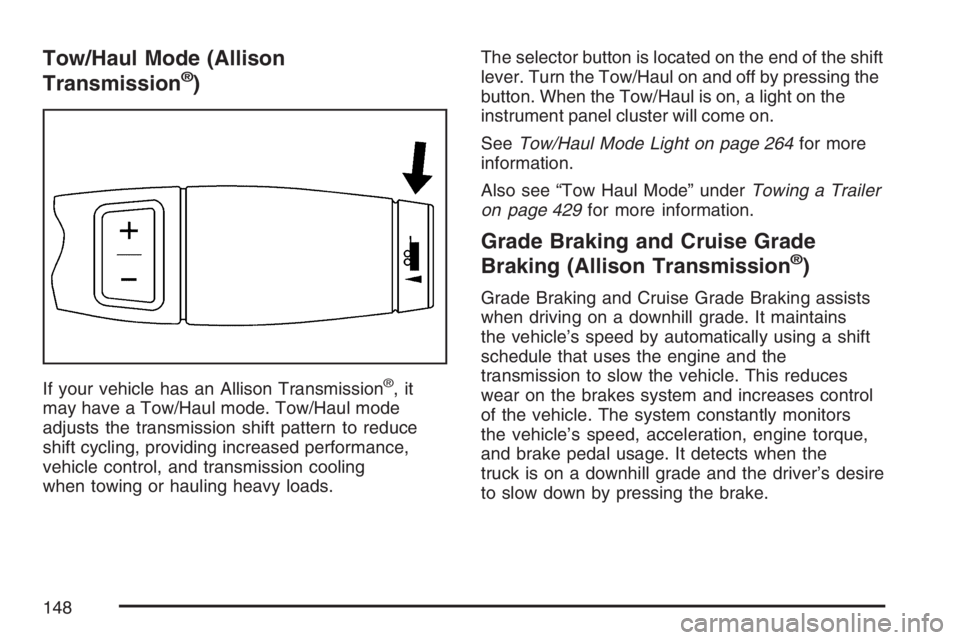
Tow/Haul Mode (Allison
Transmission®)
If your vehicle has an Allison Transmission®,it
may have a Tow/Haul mode. Tow/Haul mode
adjusts the transmission shift pattern to reduce
shift cycling, providing increased performance,
vehicle control, and transmission cooling
when towing or hauling heavy loads.The selector button is located on the end of the shift
lever. Turn the Tow/Haul on and off by pressing the
button. When the Tow/Haul is on, a light on the
instrument panel cluster will come on.
SeeTow/Haul Mode Light on page 264for more
information.
Also see “Tow Haul Mode” underTowing a Trailer
on page 429for more information.
Grade Braking and Cruise Grade
Braking (Allison Transmission®)
Grade Braking and Cruise Grade Braking assists
when driving on a downhill grade. It maintains
the vehicle’s speed by automatically using a shift
schedule that uses the engine and the
transmission to slow the vehicle. This reduces
wear on the brakes system and increases control
of the vehicle. The system constantly monitors
the vehicle’s speed, acceleration, engine torque,
and brake pedal usage. It detects when the
truck is on a downhill grade and the driver’s desire
to slow down by pressing the brake.
148
Page 149 of 674
Cruise Grade Braking is available on the 6.6L
DURAMAX®diesel engine. Cruise Grade Braking
monitors a vehicle’s cruise state, engine torque,
acceleration, vehicle speed, and the cruise set
speed. Using this information, it detects when the
truck is accelerating on a downhill grade and will
automatically downshift to slow the vehicle if it
exceeds the cruise set speed by a certain amount.
SeeCruise Control on page 217for more
information.
The Tow/Haul mode and Grade Braking shift
modes can be activated by pressing the button on
the end of the shift control stalk. If your vehicle
has the DURAMAX
®diesel Engine or the
8.1L VORTEC™ gasoline engine, Grade Braking
is only available while the Tow/Haul Mode is
selected. While in the Range Selection Mode,
Grade Braking is deactivated allowing the driver to
select a desired range of gears.
SeeAutomatic Transmission Operation on
page 140for more information.
Also seeTowing a Trailer on page 429for more
information.
Manual Transmission Operation
Five-Speed
(VORTEC™ 6.0L V8 Engine)
Here is how to operate
your transmission.
FIRST (1) is intended only for heavy loads or
trailer towing and is not recommended for normal
driving.
During the rst 500 miles (805 km) of vehicle use,
start your vehicle moving in FIRST (1). This
allows clutch components to break-in properly.
149
Page 150 of 674
FIRST (1):Press the clutch pedal and shift into
FIRST (1). Then, slowly let up on the clutch pedal
as you press the accelerator pedal. Shift into
FIRST (1) only when the vehicle is below
5 mph (8 km/h).
Notice:If you try to shift down into FIRST (1) at
excessive vehicle speeds, clutch or engine
damage could occur. Do not shift into FIRST (1)
unless you are going less than 5 mph (8km/h).
SECOND (2):Press the clutch pedal and shift into
SECOND (2). Then, slowly let up on the clutch
pedal as you press the accelerator pedal.
You can shift into SECOND (2) when you are going
less than 20 mph (32 km/h). If you have come to a
complete stop and it is hard to shift into
SECOND (2), put the shift lever into NEUTRAL and
let up on the clutch. Press the clutch pedal back
down. Then shift into SECOND (2).
Notice:If you try to shift down into
SECOND (2) at excessive vehicle speeds,
clutch or engine damage could occur. Do not
shift into SECOND (2) unless you are going
less than 20 mph (32km/h).THIRD (3):Press the clutch pedal and shift into
THIRD (3). Then, slowly let up on the clutch pedal
as you press the accelerator pedal.
FOURTH (4) and FIFTH (5):Shift into the higher
forward gears the same way you do for
THIRD (3). Slowly let up on the clutch pedal as
you press the accelerator pedal.
To stop, let up on the accelerator pedal and press
the brake pedal. Just before the vehicle stops,
press the clutch pedal and the brake pedal,
and shift to NEUTRAL.
NEUTRAL:Use this position when you start or
idle your engine.
REVERSE (R):To back up, rst press down the
clutch pedal. Wait for the vehicle to stop moving
and then, shift into REVERSE (R). Let up on
the clutch pedal slowly while pressing the
accelerator pedal.
Notice:Shifting to REVERSE (R) while your
vehicle is moving forward could damage the
transmission. The repairs would not be covered
by your warranty. Shift to REVERSE (R) only
after your vehicle is stopped.
150
Page 151 of 674
Also, use REVERSE (R), along with the parking
brake, when turning off your engine and parking
your vehicle.
Five-Speed (VORTEC™ 4.3L V6 and
4.8L V8 Engines)
Here is how to operate your transmission:
FIRST (1):Press the clutch pedal and shift into
FIRST (1). Then, slowly let up on the clutch pedal
as you press the accelerator pedal.
You can shift into FIRST (1) when you are going
less than 20 mph (32 km/h). If you have come to a
complete stop and it is hard to shift into FIRST (1),
put the shift lever into NEUTRAL and let up on
the clutch. Press the clutch pedal back down. Then
shift into FIRST (1).
Notice:If you try to shift down into FIRST (1)
at excessive vehicle speeds, clutch or
engine damage could occur. Do not shift into
FIRST (1) unless you are going less than
20 mph (32km/h).
SECOND (2):Press the clutch pedal as you let
up on the accelerator pedal and shift into
SECOND (2). Then, slowly let up on the clutch
pedal as you press the accelerator pedal.THIRD (3), FOURTH (4) and FIFTH (5):Shift into
THIRD (3), FOURTH (4) and FIFTH (5) the same
way you do for SECOND (2). Slowly let up on the
clutch pedal as you press the accelerator pedal.
To stop, let up on the accelerator pedal and press
the brake pedal. Just before the vehicle stops,
press the clutch pedal and the brake pedal, and
shift to NEUTRAL.
NEUTRAL:Use this position when you start or
idle your engine.
REVERSE (R):To back up, rst press down the
clutch pedal. Wait for the vehicle to stop moving
and then, shift into REVERSE (R). Let up on
the clutch pedal slowly while pressing the
accelerator pedal.
Notice:Shifting to REVERSE (R) while your
vehicle is moving forward could damage
the transmission. The repairs would not be
covered by your warranty. Shift to
REVERSE (R) only after your vehicle is
stopped.
Also, use REVERSE (R), along with the parking
brake, when turning off your engine and parking
your vehicle.
151
Page 152 of 674
Shift Speeds
{CAUTION:
If you skip a gear when you downshift,
you could lose control of your vehicle.
You could injure yourself or others. Do
not shift down more than one gear at a
time when you downshift.
Do not allow the engine Revolutions Per Minute
(RPM) to overspeed and enter the tachometer red
lines. Engine overspeed occurs when downshifting,
or descending a grade, at too high a vehicle
speed. When going down steep grades, always
select a gear at least one position lower than you
would use on climbing a grade. This will allow
the vehicle’s engine to provide some braking and
help to slow the vehicle as it goes down the
grade. Monitor your vehicle speed, acceleration
and engine RPM while applying the brakes as you
go down the grade to ensure you have complete
control over the vehicle.If your engine speed drops below 600 rpm, or if
the engine is not running smoothly, you should
downshift to the next lower gear. When operating
on slippery surfaces, downshift at lower than
normal vehicle speeds to prevent the tires from
slipping.
In vehicles that have a bench seat, move the
tallest beverage containers to the right cupholder
to provide additional clearance for the shift
lever.
For vehicles that have a center console, the front
cup holder pulls out and turns 180° to provide
additional clearance between tall beverage
containers and the shift lever.
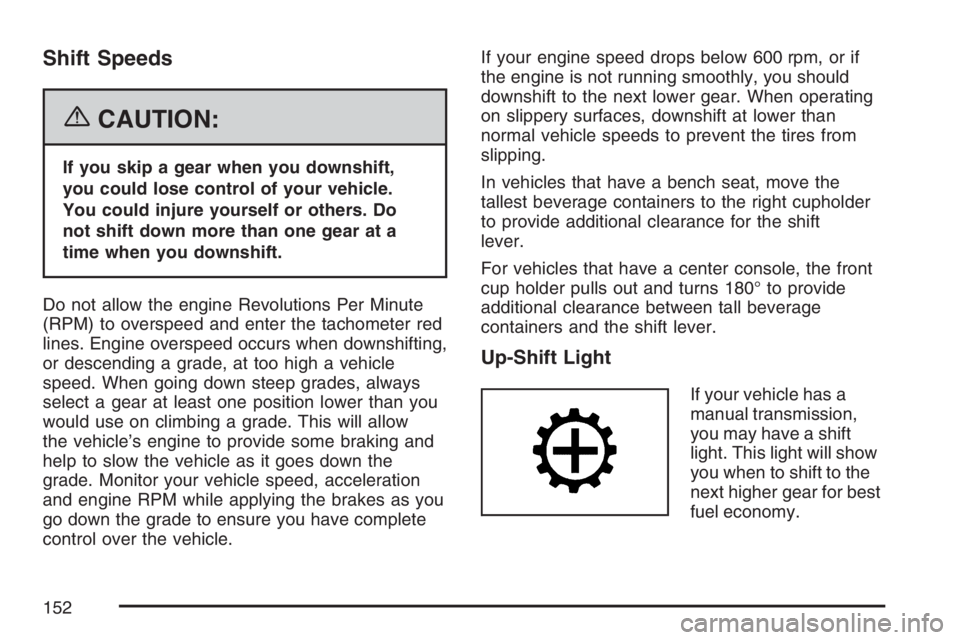
Up-Shift Light
If your vehicle has a
manual transmission,
you may have a shift
light. This light will show
you when to shift to the
next higher gear for best
fuel economy.
152
Page 153 of 674

When this light comes on, you can shift to the next
higher gear if weather, road and traffic conditions
allow. For the best fuel economy, accelerate slowly
and shift when the light comes on.
While you accelerate, it is normal for the light to
go on and off if you quickly change the position of
the accelerator.
If your vehicle has four-wheel drive and has a
manual transmission, disregard the shift light when
the transfer case is in Four-Wheel Low.
Ignore the shift light when you downshift.
Four-Wheel Drive
If your vehicle has four-wheel drive, you can send
your engine’s driving power to all four wheels
for extra traction. To get the most satisfaction out
of four-wheel drive, you must be familiar with
its operation. Read the part that follows before
using four-wheel drive. See the appropriate text for
the transfer case in your vehicle.
While driving on clean dry pavement and during
tight turns, you may experience a vibration in
the steering system.
Front Axle Locking Feature
The front axle locks and unlocks automatically
when you shift the transfer case. Some delay for
the axle to lock or unlock is normal.
Manual Transfer Case
The transfer case shift lever is located on the oor
to the right of the driver. Use this lever to shift
into and out of four-wheel drive.
153
Page 157 of 674

Shifting In or Out of 4L (Four-Wheel
Drive Low)
Notice:Shifting the transfer case into 4L
while moving at speeds faster than 3 mph
(5 km/h) may cause premature wear to
the transfer case, and may cause the gears to
grind. To avoid causing premature wear,
and grinding the gears, do not shift the transfer
case into 4L while the vehicle is moving
faster than 3 mph (5 km/h).
Shifts into 4L can be made with the vehicle at a
stop, or while slowly rolling about 1 to 3 mph
(2 to 5 km/h).
Shift the automatic transmission into
NEUTRAL (N), or with a manual transmission,
press the clutch pedal, or shift into NEUTRAL.
Shift the transfer case shift lever in one
continuous motion into the 4L position.
When in 4L do not drive faster than 45 mph.
This will reduce wear and extend the life of
the transfer case.
Shifting In or Out of NEUTRAL
1. With the vehicle running and the engine at an
idle set the parking brake and apply the
regular brake.
2. Place the transmission into NEUTRAL (N).
Shift the transfer case in one continuous motion
into or out of the NEUTRAL position.
Automatic Transfer Case
The transfer case
buttons are located to
the left of the instrument
panel cluster.
Use these switches to shift into and out of
four-wheel drive.
157
Page 160 of 674
Shifting into Four-Wheel Drive High or
AUTO 4WD (Automatic Four-Wheel Drive)
Press and release the Four-Wheel Drive High
or AUTO 4WD switch. This can be done at any
speed, except when shifting from Four-Wheel
Drive Low. The indicator light will ash while
shifting. It will remain on when the shift is
completed.
Shifting into Two-Wheel Drive High
Press and release the Two-Wheel Drive High
switch. This can be done at any speed, except
when shifting from Four-Wheel Drive Low.
See shifting out of Four-Wheel Drive Low later in
this section for more information.
Shifting into Four-Wheel Drive Low
Notice:Shifting the transfer case into
Four-Wheel Drive Low while moving at speeds
faster than 3 mph (5 km/h) may cause
premature wear to the transfer case, and may
cause the gears to grind. To avoid causing
premature wear, and grinding the gears, do not
shift the transfer case into Four-Wheel Drive
Low while the vehicle is moving faster
than 3 mph (5 km/h).To shift to Four-Wheel Drive Low, the ignition
must be in RUN and the vehicle must be stopped
or moving less than 3 mph (5 km/h) with the
transmission in NEUTRAL (N). The preferred
method for shifting into Four-Wheel Drive Low
is to have your vehicle moving 1 to 2 mph
(1.6 to 3.2 km/h). Press and release the
Four-Wheel Drive Low switch. You must wait for
the Four-Wheel Drive Low indicator light to
stop ashing and remain on before shifting the
transmission into gear.
Notice:Shifting the transmission into gear
before the Four-Wheel Drive Low indicator light
has stopped ashing could damage the
transfer case. To help avoid damaging your
vehicle, always wait for the Four-Wheel
Drive Low indicator light to stop ashing
before shifting the transmission into gear.
It is typical for your vehicle to exhibit signicant
engagement noise and bump when shifting
between Four-Wheel Drive Low and Four-Wheel
Drive High ranges or from NEUTRAL (N) with
the engine running.
160