2007 GMC CANYON ABS
[x] Cancel search: ABSPage 281 of 492
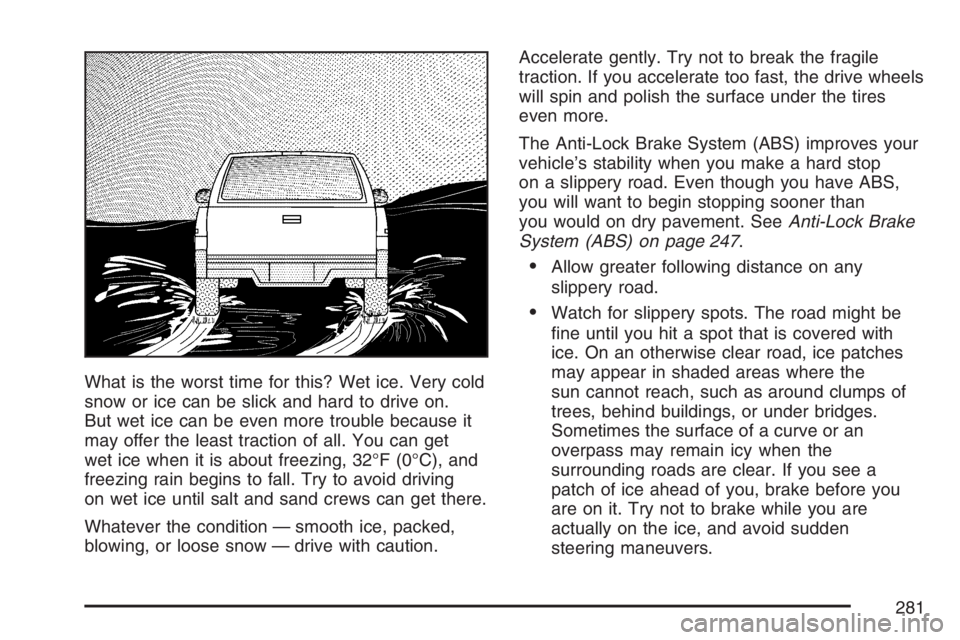
What is the worst time for this? Wet ice. Very cold
snow or ice can be slick and hard to drive on.
But wet ice can be even more trouble because it
may offer the least traction of all. You can get
wet ice when it is about freezing, 32°F (0°C), and
freezing rain begins to fall. Try to avoid driving
on wet ice until salt and sand crews can get there.
Whatever the condition — smooth ice, packed,
blowing, or loose snow — drive with caution.Accelerate gently. Try not to break the fragile
traction. If you accelerate too fast, the drive wheels
will spin and polish the surface under the tires
even more.
The Anti-Lock Brake System (ABS) improves your
vehicle’s stability when you make a hard stop
on a slippery road. Even though you have ABS,
you will want to begin stopping sooner than
you would on dry pavement. SeeAnti-Lock Brake
System (ABS) on page 247.
Allow greater following distance on any
slippery road.
Watch for slippery spots. The road might be
ne until you hit a spot that is covered with
ice. On an otherwise clear road, ice patches
may appear in shaded areas where the
sun cannot reach, such as around clumps of
trees, behind buildings, or under bridges.
Sometimes the surface of a curve or an
overpass may remain icy when the
surrounding roads are clear. If you see a
patch of ice ahead of you, brake before you
are on it. Try not to brake while you are
actually on the ice, and avoid sudden
steering maneuvers.
281
Page 310 of 492

Parking on Hills
{CAUTION:
You really should not park your
vehicle, with a trailer attached, on a hill.
If something goes wrong, your rig could
start to move. People can be injured,
and both your vehicle and the trailer can
be damaged.
But if you ever have to park your rig on a hill,
here’s how to do it:
1. Apply your regular brakes, but don’t shift into
PARK (P) yet, or into gear for a manual
transmission. When parking uphill, turn your
wheels away from the curb. When parking
downhill, turn your wheels into the curb.
2. Have someone place chocks under the trailer
wheels.
3. When the wheel chocks are in place, release
the regular brakes until the chocks absorb
the load.4. Reapply the regular brakes. Then apply your
parking brake, and then shift into PARK (P),
or REVERSE (R) for a manual transmission.
SeeParking Brake on page 130for more
information.
5. If you have a four-wheel-drive vehicle, be sure
the transfer case is in a drive gear and not in
NEUTRAL. SeeFour-Wheel Drive on page 126
for more information.
6. Release the regular brakes.
When You Are Ready to Leave After
Parking on a Hill
1. Apply your regular brakes and hold the pedal
down while you:
start your engine,
shift into a gear, and
release the parking brake.
2. Let up on the brake pedal.
3. Drive slowly until the trailer is clear of the
chocks.
4. Stop and have someone pick up and store
the chocks.
310
Page 396 of 492
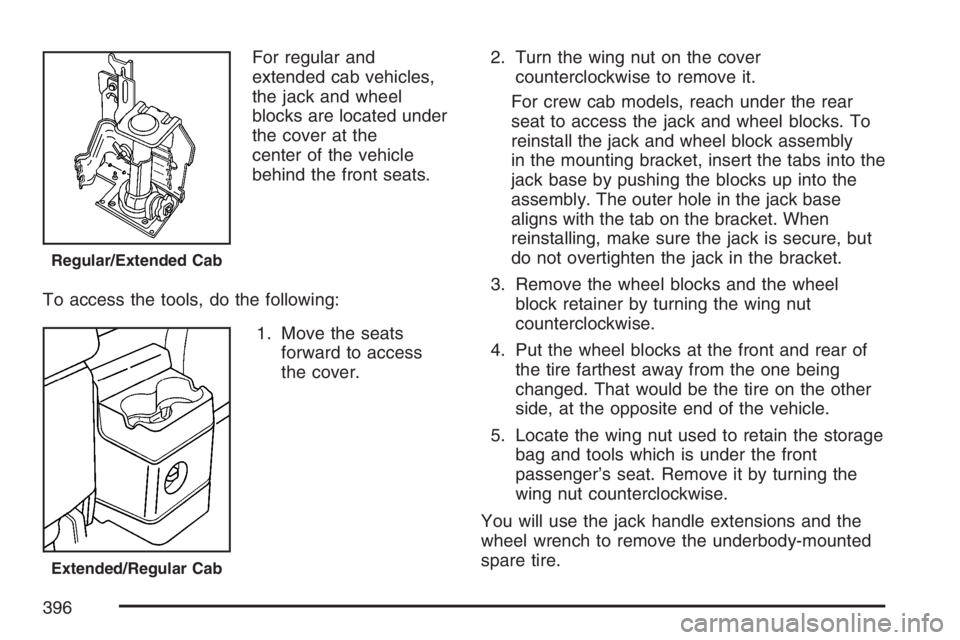
For regular and
extended cab vehicles,
the jack and wheel
blocks are located under
the cover at the
center of the vehicle
behind the front seats.
To access the tools, do the following:
1. Move the seats
forward to access
the cover.2. Turn the wing nut on the cover
counterclockwise to remove it.
For crew cab models, reach under the rear
seat to access the jack and wheel blocks. To
reinstall the jack and wheel block assembly
in the mounting bracket, insert the tabs into the
jack base by pushing the blocks up into the
assembly. The outer hole in the jack base
aligns with the tab on the bracket. When
reinstalling, make sure the jack is secure, but
do not overtighten the jack in the bracket.
3. Remove the wheel blocks and the wheel
block retainer by turning the wing nut
counterclockwise.
4. Put the wheel blocks at the front and rear of
the tire farthest away from the one being
changed. That would be the tire on the other
side, at the opposite end of the vehicle.
5. Locate the wing nut used to retain the storage
bag and tools which is under the front
passenger’s seat. Remove it by turning the
wing nut counterclockwise.
You will use the jack handle extensions and the
wheel wrench to remove the underbody-mounted
spare tire.
Regular/Extended Cab
Extended/Regular Cab
396
Page 401 of 492
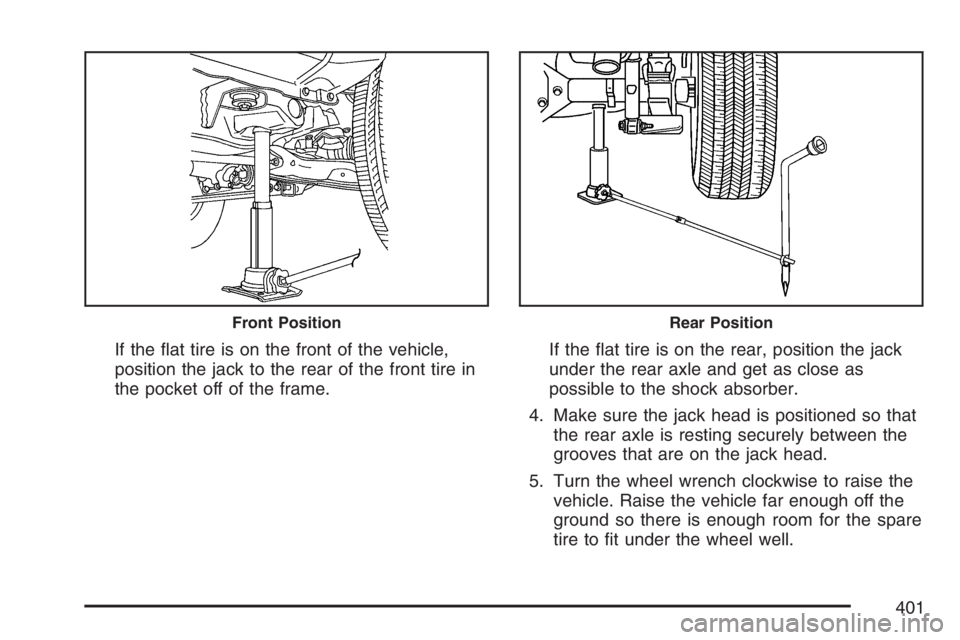
If the at tire is on the front of the vehicle,
position the jack to the rear of the front tire in
the pocket off of the frame.If the at tire is on the rear, position the jack
under the rear axle and get as close as
possible to the shock absorber.
4. Make sure the jack head is positioned so that
the rear axle is resting securely between the
grooves that are on the jack head.
5. Turn the wheel wrench clockwise to raise the
vehicle. Raise the vehicle far enough off the
ground so there is enough room for the spare
tire to t under the wheel well.
Front PositionRear Position
401
Page 416 of 492

Dust may be removed from small buttons and
knobs using a small brush with soft bristles.
Your GM dealer has a product for cleaning your
vehicle’s glass. Should it become necessary,
you can also obtain a product from your GM dealer
to remove odors from your vehicle’s upholstery.
Do not clean your vehicle using the following
cleaners or techniques:
Never use a knife or any other sharp object to
remove a soil from any interior surface.
Never use a stiff brush. It can cause damage
to your vehicle’s interior surfaces.
Never apply heavy pressure or rub
aggressively with a cleaning cloth. Use of
heavy pressure can damage your interior and
does not improve the effectiveness of soil
removal.
Use only mild, neutral-pH soaps. Avoid
laundry detergents or dishwashing soaps with
degreasers. Using too much soap will leave
a residue that leaves streaks and attracts dirt.
For liquid cleaners, about 20 drops per
gallon (3.78 L) of water is a good guide.
Do not heavily saturate your upholstery while
cleaning.
Damage to your vehicle’s interior may result
from the use of many organic solvents such
as naptha, alcohol, etc.
Fabric/Carpet
Use a vacuum cleaner with a soft brush
attachment frequently to remove dust and loose
dirt. A canister vacuum with a beater bar in
the nozzle may only be used on oor carpet and
carpeted oor mats. For soils, always try to remove
them rst with plain water or club soda. Before
cleaning, gently remove as much of the soil
as possible using one of the following techniques:
For liquids: gently blot the remaining soil
with a paper towel. Allow the soil to absorb into
the paper towel until no more can be
removed.
For solid dry soils: remove as much as
possible and then vacuum.
416
Page 428 of 492

Fuses Usage
RT HDLP Passenger’s Side Headlamp
LT HDLP Driver’s Side Headlamp
AUX PWR 2 Accessory Power 2
FOG/LAMP Fog Lamps (If Equipped)
A/C CMPRSR Air Conditioning Compressor
WSW Wiper/Washer Switch
RVC Regulated Voltage Control
PWR/WNDW Power Windows (If Equipped)
FUEL/PUMP Fuel Pump
STRTR Starter Solenoid Relay
WPR Wiper
ABS 2Anti-lock Brake System 2
(ABS Pump)
DR/LCK Power Door Locks (If Equipped)
ETC Electronic Throttle Control (ETC)
02 SNSROxygen Sensors, Air Injection
Reactor (AIR) Relay
CRUISECruise Control Switch, Inside
Rearview Mirror, Transfer Case
Control Module, Brake Switch,
Clutch Disable
HTD/SEAT Heated Seat (If Equipped)
AIRBAGSupplemental Inatable Restraint
System, Sensing and Diagnostic
ModuleFuses Usage
ABSAnti-lock Brake System (ABS),
ABS module, Four-Wheel Drive,
Gravity Sensor
BCK/UP Back-up Lights
FRT/AXLE Front Axle Actuator
TRN/HAZRD
REARRear Turn/Hazard Lights
ERLSMass Air Flow (MAF) Sensor, Can
Purge Solenoid, Air Injection
Reactor (AIR) Relay
PCMI Powertrain Control Module (PCM)
TRANS Transmission Solenoid
IGNIgnition, Clutch Starter Switch,
Neutral Safety Back-Up
Switch, Ignition Coils 1-5, Air
Conditioning Relay
INJ Injectors
ABS 1Anti-lock Brake System 1
(ABS Logic)
FRT PRK
LAMPFront Park/Turn Lamps, Driver
and Passenger’s Side Power
Window Switches Lighting
REAR PRK
LAMPRear Parking Lamp 1,
Passenger’s Side Taillamp,
License Plate Lamps
428
Page 429 of 492

Fuses Usage
REAR PRK
LAMP2Driver’s Side Rear Taillamp,
Passenger Side Airbag Indicator
Lighting, Instrument Panel Dimming
Power (2WD/4WD switch lighting)
CLSTR Cluster
TRN/HAZRD
FRTTurn/Hazard/Courtesy/Cargo
Lamps/Mirrors
TCCM Transfer Case Control Module
HORN Horn
TBC Truck Body Controller
IGN TRNSD Ignition Transducers
RDO Radio
ONSTAR OnStar
®
CNSTR VENT Fuel Canister Vent Solenoid
PCM B Powertrain Control Module (PCM) B
Relays Usage
DRL Daylight Running Lamps
BEAM SEL Beam Selection
IGN 3 HVACIgnition 3, Climate Control, Climate
Control Head Fuse, Power Seat
Fuse
RAPRetained Accessory Power (Power
Window Fuse, Wiper/Washer Switch
Fuse), Sunroof Fuse
Relays Usage
PRK/LAMPFront Parking Lamp Fuse, Rear
Parking Lamps
HDLP Headlamps
FOG/LAMP Fog Lamps (If Equipped)
FUEL/PUMP Fuel Pump, Fuel Pump Fuse
A/C CMPRSR Air Conditioning Compressor
RUN/CRNKRun/Crank, Airbag System Fuse,
Cruise Control Fuse, Ignition Fuse,
Back-Up Lamps, ABS Fuse, Front
Axle, PCM-1, Injectors Fuse,
Transmission Fuse, ERLS
PWR/TRNPowertrain, Electronic Throttle
Control Fuse, Oxygen Sensor Fuse
HORN Horn
WPR 2 Wiper 2 (High/Low)
WPR Wipers (On/Off)
STRTR Starter Relay (PCM Relay)
Miscellaneous Usage
WPR Diode — Wiper
A/C CLTCH Diode — Air Conditioning, Clutch
MEGA FUSE Mega Fuse
429
Page 468 of 492
Vehicle Data Collection and Event
Data Recorders
Your vehicle, like other modern motor vehicles,
has a number of sophisticated computer systems
that monitor and control several aspects of the
vehicle’s performance. Your vehicle uses on-board
vehicle computers to monitor emission control
components to optimize fuel economy, to monitor
conditions for airbag deployment and, if the vehicle
has the Anti-lock Brake System (ABS), to provide
anti-lock braking and to help the driver control the
vehicle in difficult driving situations. Some
information may be stored during regular operations
to facilitate repair of detected malfunctions; other
information is stored only in a crash event by
computer systems, such as those commonly called
Event Data Recorders (EDR).
In a crash event, computer systems, such as the
airbag Sensing and Diagnostic Module (SDM)
in your vehicle may record information about the
condition of the vehicle and how it was operated,
such as data related to engine speed, brake
application, throttle position, vehicle speed, safety
belt usage, airbag readiness, airbag performance,
and the severity of a collision.This information has been used to improve vehicle
crash performance and may be used to improve
crash performance of future vehicles and
driving safety. Unlike the data recorders on many
airplanes, these on-board systems do not
record sounds, such as conversation of vehicle
occupants.
To read this information, special equipment is
needed and access to the vehicle or the device
that stores the data is required. GM will not access
information about a crash event or share it with
others other than:
with the consent of the vehicle owner or, if the
vehicle is leased, with the consent of the
lessee,
in response to an official request of police or
similar government office,
as part of GM’s defense of litigation through
the discovery process, or
as required by law.
468