Page 369 of 554
6. Shift your transmission to NEUTRAL (N).
7. Release the parking brake.
Notice:If you tow your vehicle without
performing each of the steps listed under
“Dinghy Towing,” you could damage the
automatic transmission. Be sure to follow all
steps of the dinghy towing procedure prior
to and after towing your vehicle.
Notice:If you exceed 65 mph (105 km/h) while
towing your vehicle, it could be damaged.
Never exceed 65 mph (105 km/h) while towing
your vehicle.
Once you have reached your destination, do the
following:
1. Set the parking brake.
2. Turn the ignition key to OFF and remove the
key from the ignition.
3. Reinstall the IGN (Ignition) fuse.
Notice:Don’t tow a vehicle with the front
drive wheels on the ground if one of the front
tires is a compact spare tire. Towing with
two different tire sizes on the front of the
vehicle can cause severe damage to the
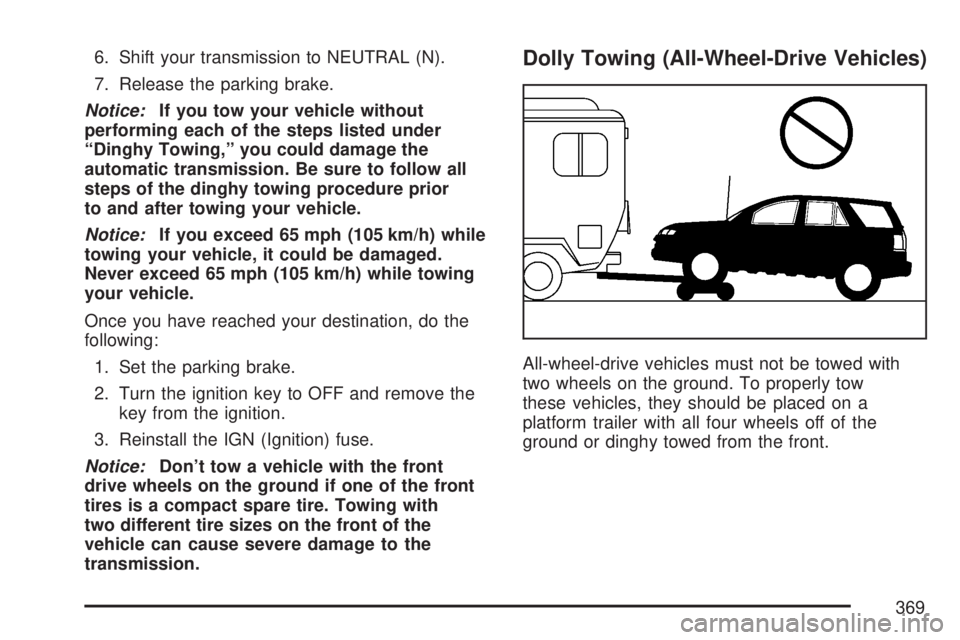
transmission.Dolly Towing (All-Wheel-Drive Vehicles)
All-wheel-drive vehicles must not be towed with
two wheels on the ground. To properly tow
these vehicles, they should be placed on a
platform trailer with all four wheels off of the
ground or dinghy towed from the front.
369
Page 382 of 554

Trailer Wiring Harness
Your vehicle is equipped with the following wiring
harness for towing a trailer.
Basic Trailer Wiring
The trailer wiring harness, with a seven-pin
connector, is located at the rear of the vehicle
and is tied to the vehicle’s frame. The harness
connector can be plugged into a seven-pin
universal heavy-duty trailer connector available
through your dealer/retailer.
The seven-wire harness contains the following
trailer circuits:
Yellow: Left Stop/Turn Signal
Dark Green: Right Stop/Turn Signal
Brown: Taillamps
White: Ground
Light Green: Back-up Lamps
Red: Battery Feed*
Dark Blue: Trailer Brake*
*The fuses for these two circuits are installed in
the underhood electrical center, but the wires
are not connected. They should be connected by
your dealer/retailer or a qualied service center.
If you are charging a remote (non-vehicle) battery,
press the tow/haul mode button located at the
end of the shift lever. This will boost the vehicle
system voltage and properly charge the battery.
If the trailer is too light for tow/haul mode, you can
turn on the headlamps (Non-HID only) as a
second way to boost the vehicle system and
charge the battery.
Engine Cooling When Trailer Towing
Your cooling system may temporarily overheat
during severe operating conditions. SeeEngine
Overheating on page 410.
382
Page 384 of 554

Buying New Tires...................................... 450
Different Size Tires and Wheels................ 452
Uniform Tire Quality Grading..................... 453
Wheel Alignment and Tire Balance............ 454
Wheel Replacement.................................. 454
Tire Chains............................................... 456
If a Tire Goes Flat.................................... 457
Changing a Flat Tire................................. 458
Removing the Spare Tire and Tools.......... 459
Removing the Flat Tire and Installing
the Spare Tire....................................... 463
Secondary Latch System........................... 468
Storing a Flat or Spare Tire and Tools...... 472
Compact Spare Tire.................................. 477
Appearance Care........................................ 478
Cleaning the Inside of Your Vehicle.......... 478
Fabric/Carpet............................................. 480
Leather...................................................... 481
Instrument Panel, Vinyl, and Other
Plastic Surfaces..................................... 481
Care of Safety Belts.................................. 482
Weatherstrips............................................ 482
Washing Your Vehicle............................... 482
Cleaning Exterior Lamps/Lenses................ 483Finish Care............................................... 483
Windshield, Backglass, and
Wiper Blades......................................... 484
Aluminum or Chrome-Plated Wheels
and Trim................................................ 484
Tires......................................................... 485
Sheet Metal Damage................................. 486
Finish Damage.......................................... 486
Underbody Maintenance............................ 486
Chemical Paint Spotting............................ 486
Vehicle Care/Appearance Materials............ 487
Vehicle Identication.................................. 488
Vehicle Identication Number (VIN)........... 488
Service Parts Identication Label............... 488
Electrical System........................................ 489
High Voltage Devices and Wiring.............. 489
Add-On Electrical Equipment..................... 489
Windshield Wiper Fuses............................ 490
Power Windows and Other
Power Options....................................... 490
Fuses and Circuit Breakers....................... 490
Instrument Panel Fuse Block..................... 490
Underhood Fuse Block.............................. 493
Capacities and Specications.................... 497
Section 5 Service and Appearance Care
384
Page 386 of 554
California Proposition 65 Warning
Most motor vehicles, including this one, contain
and/or emit chemicals known to the State of
California to cause cancer and birth defects or
other reproductive harm. Engine exhaust,
many parts and systems (including some inside
the vehicle), many uids, and some component
wear by-products contain and/or emit these
chemicals.
Doing Your Own Service Work
{CAUTION:
You can be injured and your vehicle could
be damaged if you try to do service work
on a vehicle without knowing enough
about it.
Be sure you have sufficient
knowledge, experience, the proper
replacement parts, and tools
before you attempt any vehicle
maintenance task.
Be sure to use the proper nuts, bolts,
and other fasteners. English and
metric fasteners can be easily
confused. If you use the wrong
fasteners, parts can later break or
fall off. You could be hurt.
386
Page 397 of 554

A. Radiator Pressure Cap (Out of View).
SeeRadiator Pressure Cap on page 410.
B. Engine Coolant Recovery Cap. SeeCooling
System on page 413.
C. Underhood Fuse Block. SeeUnderhood Fuse
Block on page 493.
D. Remote Positive (+) Terminal. SeeJump
Starting on page 425.
E. Power Steering Fluid Reservoir. SeePower
Steering Fluid on page 419.
F. Engine Oil Fill Cap. See “When to Add Engine
Oil” underEngine Oil on page 397.
G. Engine Oil Dipstick. See “Checking Engine Oil”
underEngine Oil on page 397.
H. Automatic Transmission Fluid Dipstick.
See “Checking the Fluid Level” under
Automatic Transmission Fluid on page 404.
I. Brake Master Cylinder Reservoir. See “Brake
Fluid” underBrakes on page 421.
J. Engine Air Cleaner/Filter. SeeEngine Air
Cleaner/Filter on page 402.
K. Windshield Washer Fluid Reservoir.
See “Adding Washer Fluid” under
Windshield Washer Fluid on page 420.Engine Oil
Checking Engine Oil
It is a good idea to check the engine oil every time
you get fuel. In order to get an accurate reading,
the oil must be warm and the vehicle must be
on level ground.
The engine oil dipstick handle is a yellow loop.
SeeEngine Compartment Overview on page 396
for the location of the engine oil dipstick.
1. Turn off the engine and give the oil
several minutes to drain back into the oil
pan. If you do not do this, the oil dipstick might
not show the actual level.
2. Pull out the dipstick and clean it with a paper
towel or cloth, then push it back in all the
way. Remove it again, keeping the tip down,
and check the level.
397
Page 490 of 554
Windshield Wiper Fuses
The windshield wiper motor is protected by a
circuit breaker and a fuse. If the motor overheats
due to heavy snow or ice, the wiper will stop
until the motor cools. If the overload is caused by
some electrical problem, have it xed.
Power Windows and Other Power
Options
Circuit breakers in the fuse panel protect the
power windows and other power accessories.
When the current load is too heavy, the circuit
breaker opens and closes, protecting the circuit
until the problem is xed.
Fuses and Circuit Breakers
The wiring circuits in your vehicle are protected
from short circuits by a combination of fuses,
circuit breakers and fusible thermal links.
This greatly reduces the chance of res caused by
electrical problems.Look at the silver-colored band inside the fuse.
If the band is broken or melted, replace the fuse.
Be sure you replace a bad fuse with a new
one of the identical size and rating.
If you ever have a problem on the road and do not
have a spare fuse, you can borrow one that has
the same amperage. Just pick some feature
of your vehicle that you can get along without, like
the radio or cigarette lighter, and use its fuse if
it is the correct amperage. Replace it as soon as
you can.
Instrument Panel Fuse Block
The instrument panel fuse block is located under
the instrument panel on the passenger side of
the vehicle. Pull down on the cover to access the
fuse block.
490
Page 491 of 554
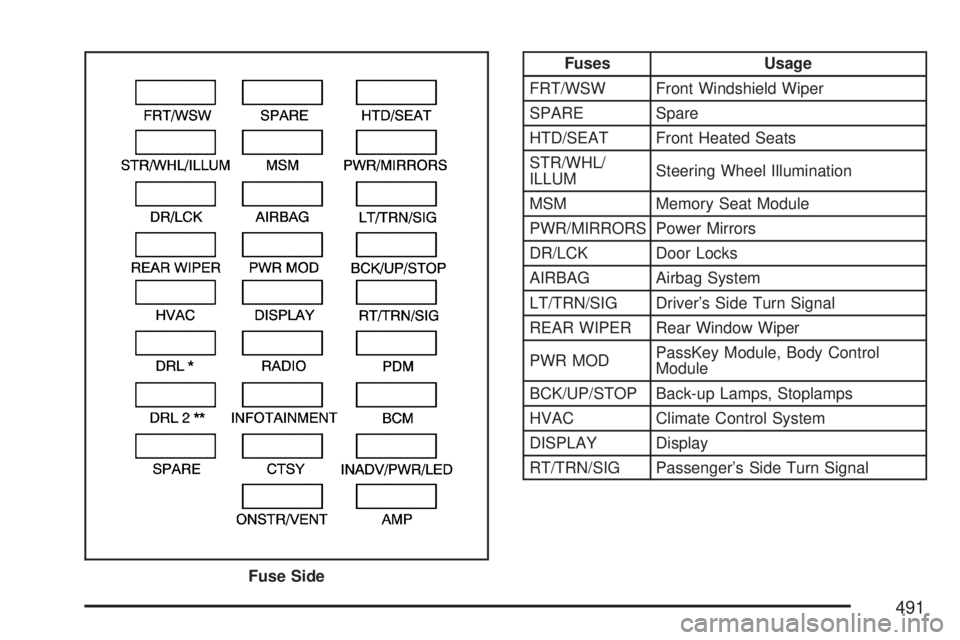
Fuses Usage
FRT/WSW Front Windshield Wiper
SPARE Spare
HTD/SEAT Front Heated Seats
STR/WHL/
ILLUMSteering Wheel Illumination
MSM Memory Seat Module
PWR/MIRRORS Power Mirrors
DR/LCK Door Locks
AIRBAG Airbag System
LT/TRN/SIG Driver’s Side Turn Signal
REAR WIPER Rear Window Wiper
PWR MODPassKey Module, Body Control
Module
BCK/UP/STOP Back-up Lamps, Stoplamps
HVAC Climate Control System
DISPLAY Display
RT/TRN/SIG Passenger’s Side Turn Signal
Fuse Side
491
Page 492 of 554
Fuses Usage
DRL* Daytime Running Lamps
RADIO Radio
PDM Power Mirrors, Liftgate Release
DRL 2** Daytime Running Lamps 2
INFOTAINMENT Infotainment System
BCM Body Control Module
SPARE Spare
CTSY Dome Lamps
INADV/
PWR/LEDInterior Lamps
ONSTR/VENT Emissions
AMP Audio Amplier
Harness
ConnectorUsage
BODY Harness Connector
Relay Side
492