Page 397 of 554

A. Radiator Pressure Cap (Out of View).
SeeRadiator Pressure Cap on page 410.
B. Engine Coolant Recovery Cap. SeeCooling
System on page 413.
C. Underhood Fuse Block. SeeUnderhood Fuse
Block on page 493.
D. Remote Positive (+) Terminal. SeeJump
Starting on page 425.
E. Power Steering Fluid Reservoir. SeePower
Steering Fluid on page 419.
F. Engine Oil Fill Cap. See “When to Add Engine
Oil” underEngine Oil on page 397.
G. Engine Oil Dipstick. See “Checking Engine Oil”
underEngine Oil on page 397.
H. Automatic Transmission Fluid Dipstick.
See “Checking the Fluid Level” under
Automatic Transmission Fluid on page 404.
I. Brake Master Cylinder Reservoir. See “Brake
Fluid” underBrakes on page 421.
J. Engine Air Cleaner/Filter. SeeEngine Air
Cleaner/Filter on page 402.
K. Windshield Washer Fluid Reservoir.
See “Adding Washer Fluid” under
Windshield Washer Fluid on page 420.Engine Oil
Checking Engine Oil
It is a good idea to check the engine oil every time
you get fuel. In order to get an accurate reading,
the oil must be warm and the vehicle must be
on level ground.
The engine oil dipstick handle is a yellow loop.
SeeEngine Compartment Overview on page 396
for the location of the engine oil dipstick.
1. Turn off the engine and give the oil
several minutes to drain back into the oil
pan. If you do not do this, the oil dipstick might
not show the actual level.
2. Pull out the dipstick and clean it with a paper
towel or cloth, then push it back in all the
way. Remove it again, keeping the tip down,
and check the level.
397
Page 440 of 554
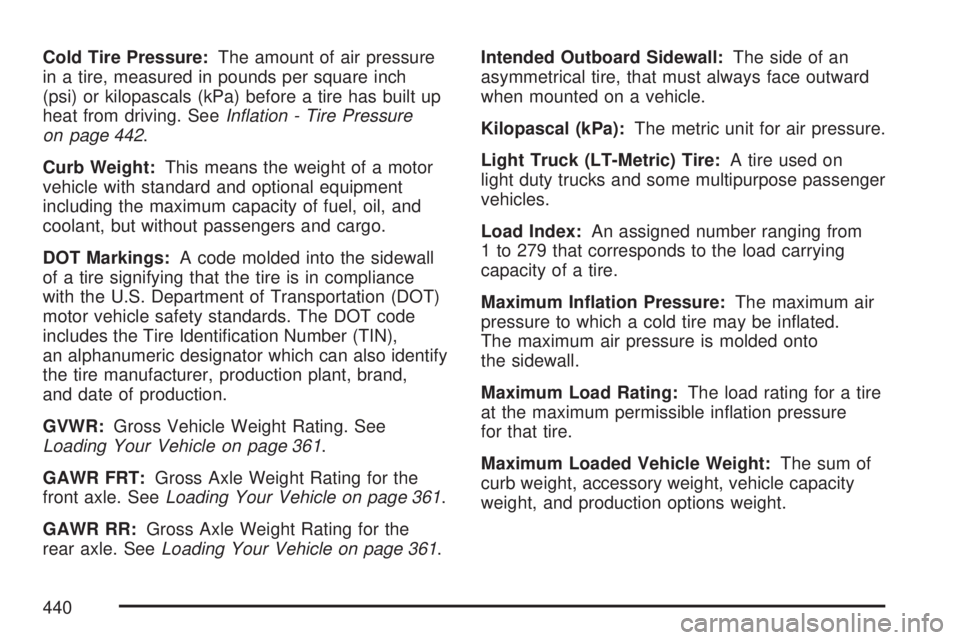
Cold Tire Pressure:The amount of air pressure
in a tire, measured in pounds per square inch
(psi) or kilopascals (kPa) before a tire has built up
heat from driving. SeeInflation - Tire Pressure
on page 442.
Curb Weight:This means the weight of a motor
vehicle with standard and optional equipment
including the maximum capacity of fuel, oil, and
coolant, but without passengers and cargo.
DOT Markings:A code molded into the sidewall
of a tire signifying that the tire is in compliance
with the U.S. Department of Transportation (DOT)
motor vehicle safety standards. The DOT code
includes the Tire Identication Number (TIN),
an alphanumeric designator which can also identify
the tire manufacturer, production plant, brand,
and date of production.
GVWR:Gross Vehicle Weight Rating. See
Loading Your Vehicle on page 361.
GAWR FRT:Gross Axle Weight Rating for the
front axle. SeeLoading Your Vehicle on page 361.
GAWR RR:Gross Axle Weight Rating for the
rear axle. SeeLoading Your Vehicle on page 361.Intended Outboard Sidewall:The side of an
asymmetrical tire, that must always face outward
when mounted on a vehicle.
Kilopascal (kPa):The metric unit for air pressure.
Light Truck (LT-Metric) Tire:A tire used on
light duty trucks and some multipurpose passenger
vehicles.
Load Index:An assigned number ranging from
1 to 279 that corresponds to the load carrying
capacity of a tire.
Maximum Ination Pressure:The maximum air
pressure to which a cold tire may be inated.
The maximum air pressure is molded onto
the sidewall.
Maximum Load Rating:The load rating for a tire
at the maximum permissible ination pressure
for that tire.
Maximum Loaded Vehicle Weight:The sum of
curb weight, accessory weight, vehicle capacity
weight, and production options weight.
440
Page 442 of 554
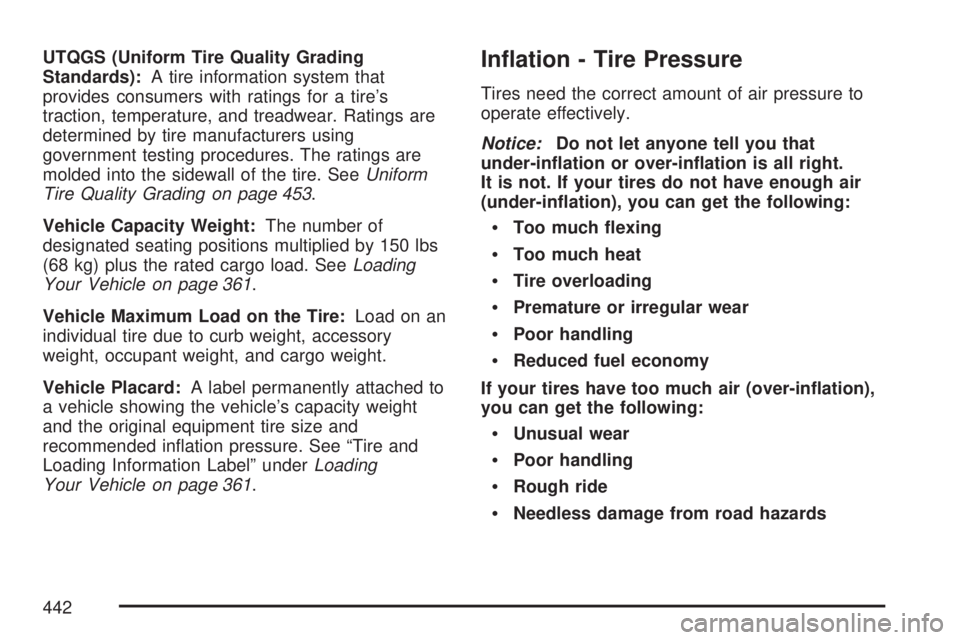
UTQGS (Uniform Tire Quality Grading
Standards):A tire information system that
provides consumers with ratings for a tire’s
traction, temperature, and treadwear. Ratings are
determined by tire manufacturers using
government testing procedures. The ratings are
molded into the sidewall of the tire. SeeUniform
Tire Quality Grading on page 453.
Vehicle Capacity Weight:The number of
designated seating positions multiplied by 150 lbs
(68 kg) plus the rated cargo load. SeeLoading
Your Vehicle on page 361.
Vehicle Maximum Load on the Tire:Load on an
individual tire due to curb weight, accessory
weight, occupant weight, and cargo weight.
Vehicle Placard:A label permanently attached to
a vehicle showing the vehicle’s capacity weight
and the original equipment tire size and
recommended ination pressure. See “Tire and
Loading Information Label” underLoading
Your Vehicle on page 361.Ination - Tire Pressure
Tires need the correct amount of air pressure to
operate effectively.
Notice:Do not let anyone tell you that
under-ination or over-ination is all right.
It is not. If your tires do not have enough air
(under-ination), you can get the following:
Too much exing
Too much heat
Tire overloading
Premature or irregular wear
Poor handling
Reduced fuel economy
If your tires have too much air (over-ination),
you can get the following:
Unusual wear
Poor handling
Rough ride
Needless damage from road hazards
442
Page 497 of 554
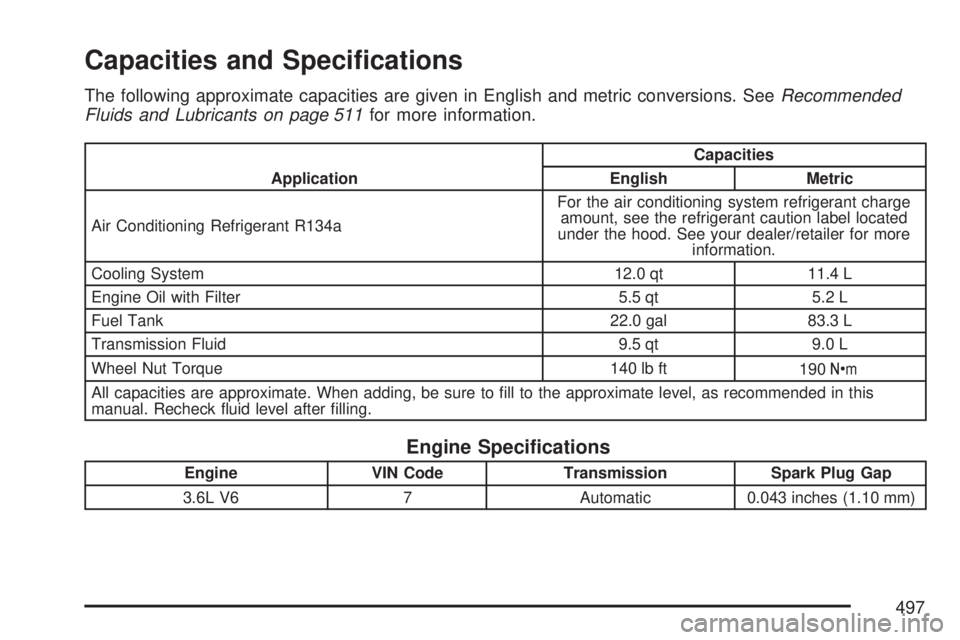
Capacities and Specications
The following approximate capacities are given in English and metric conversions. SeeRecommended
Fluids and Lubricants on page 511for more information.
ApplicationCapacities
English Metric
Air Conditioning Refrigerant R134aFor the air conditioning system refrigerant charge
amount, see the refrigerant caution label located
under the hood. See your dealer/retailer for more
information.
Cooling System 12.0 qt 11.4 L
Engine Oil with Filter 5.5 qt 5.2 L
Fuel Tank 22.0 gal 83.3 L
Transmission Fluid 9.5 qt 9.0 L
Wheel Nut Torque 140 lb ft
190Y
All capacities are approximate. When adding, be sure to ll to the approximate level, as recommended in this
manual. Recheck uid level after lling.
Engine Specications
Engine VIN Code Transmission Spark Plug Gap
3.6L V6 7 Automatic 0.043 inches (1.10 mm)
497
Page 541 of 554

C
Calibration................................................... 140
California Fuel............................................. 388
California Proposition 65 Warning................ 386
Canadian Owners........................................... 3
Capacities and Specications...................... 497
Carbon Monoxide..............110, 138, 356, 371
Care of
Safety Belts............................................. 482
Your CD and DVD Player........................ 328
Your CDs and DVDs................................ 328
Cargo Cover............................................... 163
Cargo Management System........................ 164
Cargo Tie Downs........................................ 163
CD, MP3 ............................................295, 301
Center Console Storage Area...................... 161
Chains, Tire................................................. 456
Charging System Light................................ 220
Check
Engine Light............................................ 226
Checking Things Under the Hood................ 394
Chemical Paint Spotting.............................. 486Child Restraints
Child Restraint Systems............................. 55
Infants and Young Children........................ 51
Lower Anchors and Tethers for Children..... 61
Older Children........................................... 48
Securing a Child Restraint in a
Rear Seat Position ................................. 69
Securing a Child Restraint in the
Right Front Seat Position........................ 72
Where to Put the Restraint........................ 60
Cleaning
Aluminum or Chrome-Plated Wheels........ 484
Exterior Lamps/Lenses............................. 483
Fabric/Carpet........................................... 480
Finish Care.............................................. 483
Inside of Your Vehicle.............................. 478
Instrument Panel, Vinyl,
and Other Plastic Surfaces................... 481
Leather.................................................... 481
Tires........................................................ 485
Underbody Maintenance........................... 486
Washing Your Vehicle.............................. 482
Weatherstrips........................................... 482
Windshield, Backglass,
and Wiper Blades................................. 484
541