2007 GMC ACADIA coolant temperature
[x] Cancel search: coolant temperaturePage 247 of 554
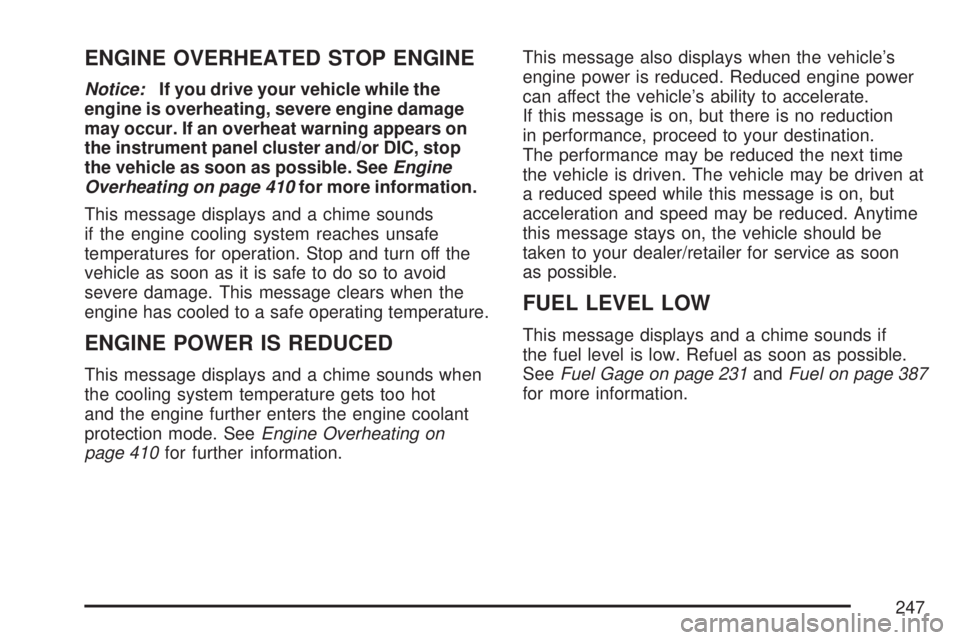
ENGINE OVERHEATED STOP ENGINE
Notice:If you drive your vehicle while the
engine is overheating, severe engine damage
may occur. If an overheat warning appears on
the instrument panel cluster and/or DIC, stop
the vehicle as soon as possible. SeeEngine
Overheating on page 410for more information.
This message displays and a chime sounds
if the engine cooling system reaches unsafe
temperatures for operation. Stop and turn off the
vehicle as soon as it is safe to do so to avoid
severe damage. This message clears when the
engine has cooled to a safe operating temperature.
ENGINE POWER IS REDUCED
This message displays and a chime sounds when
the cooling system temperature gets too hot
and the engine further enters the engine coolant
protection mode. SeeEngine Overheating on
page 410for further information.This message also displays when the vehicle’s
engine power is reduced. Reduced engine power
can affect the vehicle’s ability to accelerate.
If this message is on, but there is no reduction
in performance, proceed to your destination.
The performance may be reduced the next time
the vehicle is driven. The vehicle may be driven at
a reduced speed while this message is on, but
acceleration and speed may be reduced. Anytime
this message stays on, the vehicle should be
taken to your dealer/retailer for service as soon
as possible.
FUEL LEVEL LOW
This message displays and a chime sounds if
the fuel level is low. Refuel as soon as possible.
SeeFuel Gage on page 231andFuel on page 387
for more information.
247
Page 380 of 554

Driving on Grades
Your vehicle is designed primarily as a passenger
and load carrying vehicle. If you tow a trailer,
your vehicle will require more frequent
maintenance due to the additional load. Because
of the added load of the trailer, your vehicle’s
engine may overheat on hot days, when going up
a long or steep grade with a trailer. If the engine
coolant temperature gage indicates overheating,
turn off the air conditioning to reduce engine load,
pull off the road and stop in a safe spot.
Reduce speed and shift to a lower gear before
you start down a long or steep downgrade. If you
don’t shift down, you might have to use your
brakes so much that they would get hot and no
longer work well.
On a long uphill grade, shift down and reduce
your speed to around 55 mph (88 km/h) to reduce
the possibility of the engine and the transmission
overheating.
Parking on Hills
{CAUTION:
You really should not park your vehicle,
with a trailer attached, on a hill.
If something goes wrong, your rig could
start to move. People can be injured, and
both your vehicle and the trailer can be
damaged.
But if you ever have to park your rig on a hill,
here’s how to do it:
1. Apply your regular brakes, but don’t shift
into PARK (P).
When parking uphill, turn your wheels away
from the curb. When parking downhill,
turn your wheels into the curb.
2. Have someone place chocks behind the
trailer wheels.
380
Page 406 of 554

How to Add Automatic Transmission
Fluid
Refer to the Maintenance Schedule to determine
what kind of transmission uid to use. See
Recommended Fluids and Lubricants on page 511.
If the uid level is low, add only enough of the
proper uid to bring the level into the crosshatched
area on the dipstick.
1. Remove the dipstick.
2. Using a long-neck funnel, add enough uid at
the dipstick hole to bring it to the proper level.
It does not take much uid, generally
less than one half of a pint (0.25 L).
Do not overll.
Notice:Use of the incorrect automatic
transmission uid may damage your vehicle,
and the damages may not be covered by
your warranty. Always use the automatic
transmission uid listed inRecommended
Fluids and Lubricants on page 511.
3. After adding uid, recheck the uid level as
described under “How to Check Automatic
Transmission Fluid,” earlier in this section.
4. When the correct uid level is obtained,
twist & lock dipstick cap in place.
Engine Coolant
The cooling system in your vehicle is lled with
DEX-COOL®engine coolant. This coolant is
designed to remain in your vehicle for ve years or
150,000 miles (240 000 km), whichever occurs
rst, if you add only DEX-COOL
®extended
life coolant.
The following explains your cooling system and
how to add coolant when it is low. If you have
a problem with engine overheating or if you need
to add coolant to the radiator, seeEngine
Overheating on page 410.
A 50/50 mixture of clean, drinkable water and
DEX-COOL
®coolant will:
Give freezing protection down to
−34°F (−37°C).
Give boiling protection up to 265°F (129°C).
Protect against rust and corrosion.
Help keep the proper engine temperature.
Let the warning lights and gages work as
they should.
406
Page 410 of 554

Radiator Pressure Cap
Notice:If the pressure cap is not tightly
installed, coolant loss and possible engine
damage may occur. Be sure the cap is properly
and tightly secured.
SeeEngine Compartment Overview on page 396
for more information on location.
Engine Overheating
There is an engine coolant temperature gage on
your vehicle’s instrument panel. SeeEngine
Coolant Temperature Gage on page 225.
Your vehicle may also have an ENGINE
OVERHEATED IDLE ENGINE and ENGINE
OVERHEATED STOP ENGINE message
displayed in the Driver Information Center (DIC).
SeeDIC Warnings and Messages on page 244.
If Steam Is Coming From Your Engine
{CAUTION:
Steam from an overheated engine can
burn you badly, even if you just open the
hood. Stay away from the engine if you
see or hear steam coming from it. Turn it
off and get everyone away from the
vehicle until it cools down. Wait until
there is no sign of steam or coolant
before you open the hood.
CAUTION: (Continued)
410
Page 412 of 554
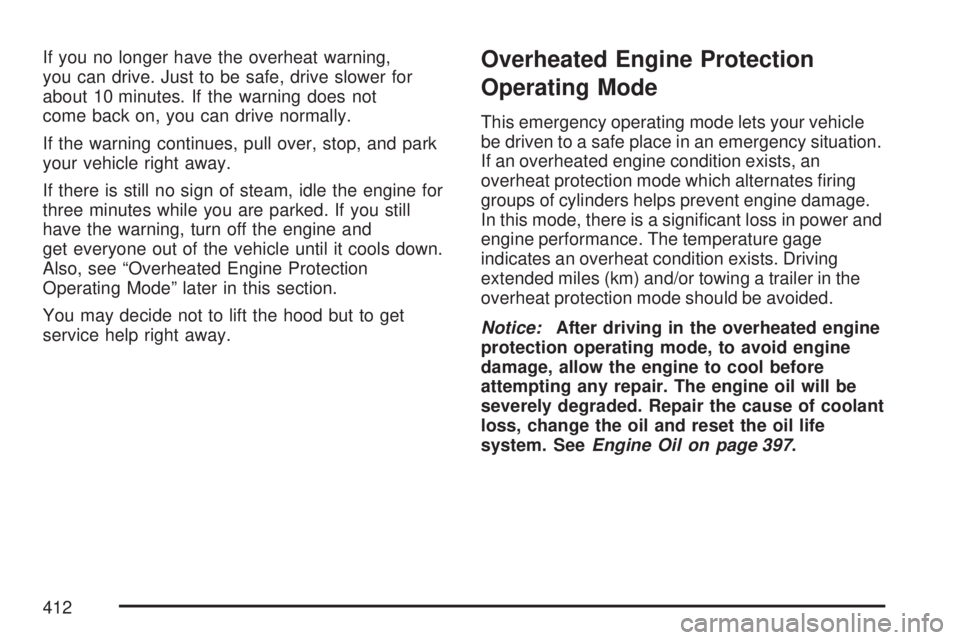
If you no longer have the overheat warning,
you can drive. Just to be safe, drive slower for
about 10 minutes. If the warning does not
come back on, you can drive normally.
If the warning continues, pull over, stop, and park
your vehicle right away.
If there is still no sign of steam, idle the engine for
three minutes while you are parked. If you still
have the warning, turn off the engine and
get everyone out of the vehicle until it cools down.
Also, see “Overheated Engine Protection
Operating Mode” later in this section.
You may decide not to lift the hood but to get
service help right away.Overheated Engine Protection
Operating Mode
This emergency operating mode lets your vehicle
be driven to a safe place in an emergency situation.
If an overheated engine condition exists, an
overheat protection mode which alternates ring
groups of cylinders helps prevent engine damage.
In this mode, there is a signicant loss in power and
engine performance. The temperature gage
indicates an overheat condition exists. Driving
extended miles (km) and/or towing a trailer in the
overheat protection mode should be avoided.
Notice:After driving in the overheated engine
protection operating mode, to avoid engine
damage, allow the engine to cool before
attempting any repair. The engine oil will be
severely degraded. Repair the cause of coolant
loss, change the oil and reset the oil life
system. SeeEngine Oil on page 397.
412
Page 420 of 554

Windshield Washer Fluid
What to Use
When adding windshield washer uid, be sure to
read the manufacturer’s instructions before
use. If operating your vehicle in an area where the
temperature may fall below freezing, use a uid
that has sufficient protection against freezing.
Adding Washer Fluid
When the windshield washer uid reservoir is low,
a WASHER FLUID LOW ADD FLUID message
will be displayed on the Driver Information Center
(DIC). SeeDIC Warnings and Messages on
page 244for more information.
Open the cap with the
washer symbol on it.
Add washer uid
until the tank is full. See
Engine Compartment
Overview on page 396
for reservoir location.Notice:
When using concentrated washer uid,
follow the manufacturer’s instructions
for adding water.
Do not mix water with ready-to-use washer
uid. Water can cause the solution to
freeze and damage your washer uid tank
and other parts of the washer system.
Also, water does not clean as well
as washer uid.
Fill the washer uid tank only
three-quarters full when it is very cold.
This allows for uid expansion if freezing
occurs, which could damage the tank if it is
completely full.
Do not use engine coolant (antifreeze) in
your windshield washer. It can damage
the vehicle’s windshield washer system
and paint.
420
Page 507 of 554
(g)A fluid loss in any vehicle system could
indicate a problem. Have the system inspected
and repaired and the fluid level checked. Add fluid
if needed.
(h)Change automatic transmission fluid if the
vehicle is mainly driven under one or more
of these conditions:
In heavy city traffic where the outside
temperature regularly reaches 90°F
(32°C) or higher.
In hilly or mountainous terrain.
When doing frequent trailer towing.
Uses such as found in taxi, police, or
delivery service.
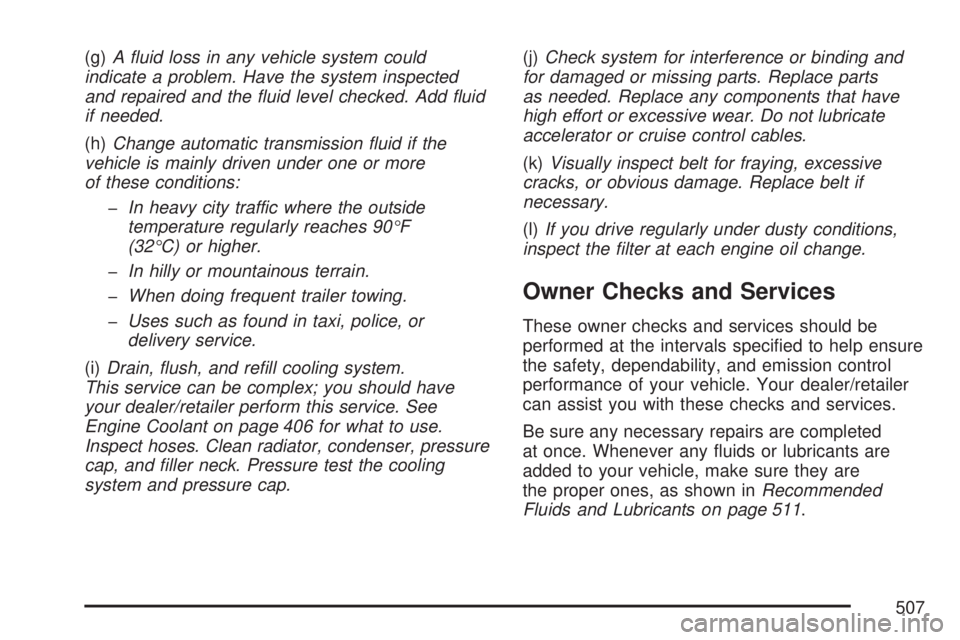
(i)Drain, flush, and refill cooling system.
This service can be complex; you should have
your dealer/retailer perform this service. See
Engine Coolant on page 406 for what to use.
Inspect hoses. Clean radiator, condenser, pressure
cap, and filler neck. Pressure test the cooling
system and pressure cap.(j)Check system for interference or binding and
for damaged or missing parts. Replace parts
as needed. Replace any components that have
high effort or excessive wear. Do not lubricate
accelerator or cruise control cables.
(k)Visually inspect belt for fraying, excessive
cracks, or obvious damage. Replace belt if
necessary.
(l)If you drive regularly under dusty conditions,
inspect the filter at each engine oil change.
Owner Checks and Services
These owner checks and services should be
performed at the intervals specied to help ensure
the safety, dependability, and emission control
performance of your vehicle. Your dealer/retailer
can assist you with these checks and services.
Be sure any necessary repairs are completed
at once. Whenever any uids or lubricants are
added to your vehicle, make sure they are
the proper ones, as shown inRecommended
Fluids and Lubricants on page 511.
507
Page 542 of 554
Climate Control System............................... 199
Dual Automatic......................................... 203
Outlet Adjustment..................................... 210
Rear Air Conditioning and
Heating System.................................... 211
Rear Air Conditioning and
Heating System, Electronic................... 212
Clock.......................................................... 266
Collision Damage Repair............................. 530
Comfort Guides, Rear Safety Belt................. 43
Compact Spare Tire.................................... 477
Compass..................................................... 140
Content Theft-Deterrent............................... 118
Control of a Vehicle..................................... 334
Convenience Net......................................... 163
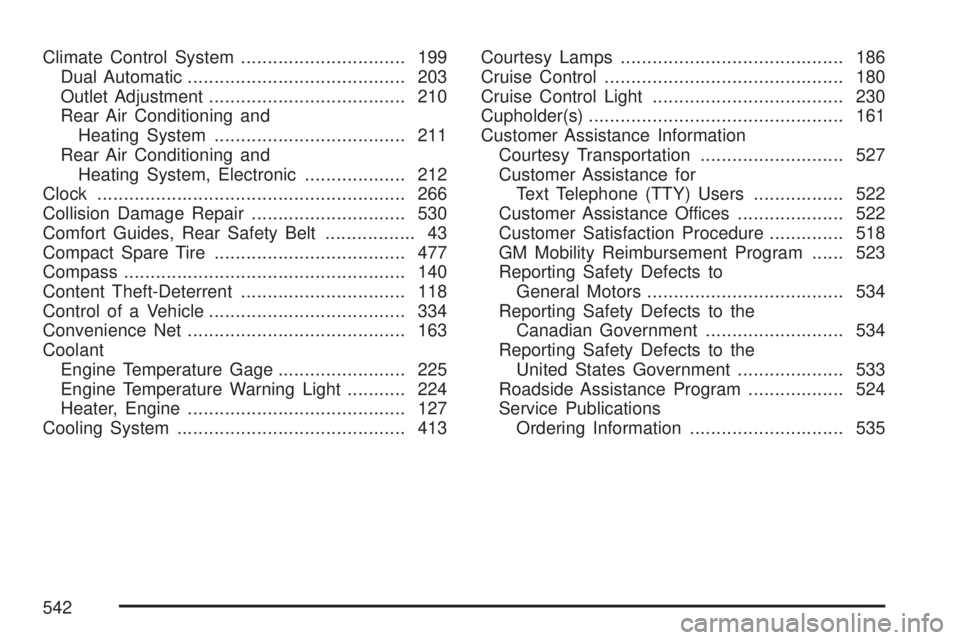
Coolant
Engine Temperature Gage........................ 225
Engine Temperature Warning Light........... 224
Heater, Engine......................................... 127
Cooling System........................................... 413Courtesy Lamps.......................................... 186
Cruise Control............................................. 180
Cruise Control Light.................................... 230
Cupholder(s)................................................ 161
Customer Assistance Information
Courtesy Transportation........................... 527
Customer Assistance for
Text Telephone (TTY) Users................. 522
Customer Assistance Offices.................... 522
Customer Satisfaction Procedure.............. 518
GM Mobility Reimbursement Program...... 523
Reporting Safety Defects to
General Motors..................................... 534
Reporting Safety Defects to the
Canadian Government.......................... 534
Reporting Safety Defects to the
United States Government.................... 533
Roadside Assistance Program.................. 524
Service Publications
Ordering Information............................. 535
542