2007 FORD SUPER DUTY ABS
[x] Cancel search: ABSPage 30 of 72
Do not use home heating oil or any diesel fuel not intended for
highway use. Red dye is used to identify fuels intended for
agricultural and non-highway use. Damage to the fuel injection
system, engine and exhaust catalyst can occur if an improper fuel
is used. Do not add gasoline, gasohol or alcohol to diesel fuel.
This practice creates a serious fire hazard and engine
performance problems.
Fuel Filler Cap
When fueling your vehicle:
1. Turn the engine off.
2. Carefully turn the filler cap counterclockwise until it stops.
3. Pull to remove the cap from the fuel filler pipe.
4. To install the cap, align the tabs on the cap with the notches on the
filler pipe.
5. Turn the filler cap clockwise until a few clicks are heard.
If the “Check Fuel Cap” message comes on and stays on after you start
the engine, the fuel filler cap may not be properly installed. Turn off the
engine, remove the fuel filler cap, align the cap properly and reinstall it.
If you must replace the fuel filler cap, replace it with a fuel filler
cap that is designed for your vehicle. The customer warranty may
be void for any damage to the fuel tank or fuel system if the
correct genuine Ford or Motorcraft fuel filler cap is not used.
The fuel system may be under pressure. If the fuel filler cap is
venting vapor or if you hear a hissing sound, wait until it stops
before completely removing the fuel filler cap. Otherwise, fuel may
spray out and injure you or others.
If you do not use the proper fuel filler cap, excessive pressure or
vacuum in the fuel tank may damage the fuel system or cause
the fuel cap to disengage in a collision, which may result in possible
personal injury.
Fuel quality
It should not be necessary to add any aftermarket additives to your fuel
tank if you use a properly formulated diesel fuel that meets the ASTM D
975 industry specification. Aftermarket additives can damage the injector
system or engine. Repairs to correct the effects of using an aftermarket
product in your fuel may not be covered by your warranty.
2007 Econoline (eco)
Supplement
USA (fus)
Maintenance and Specifications
30
Page 42 of 72
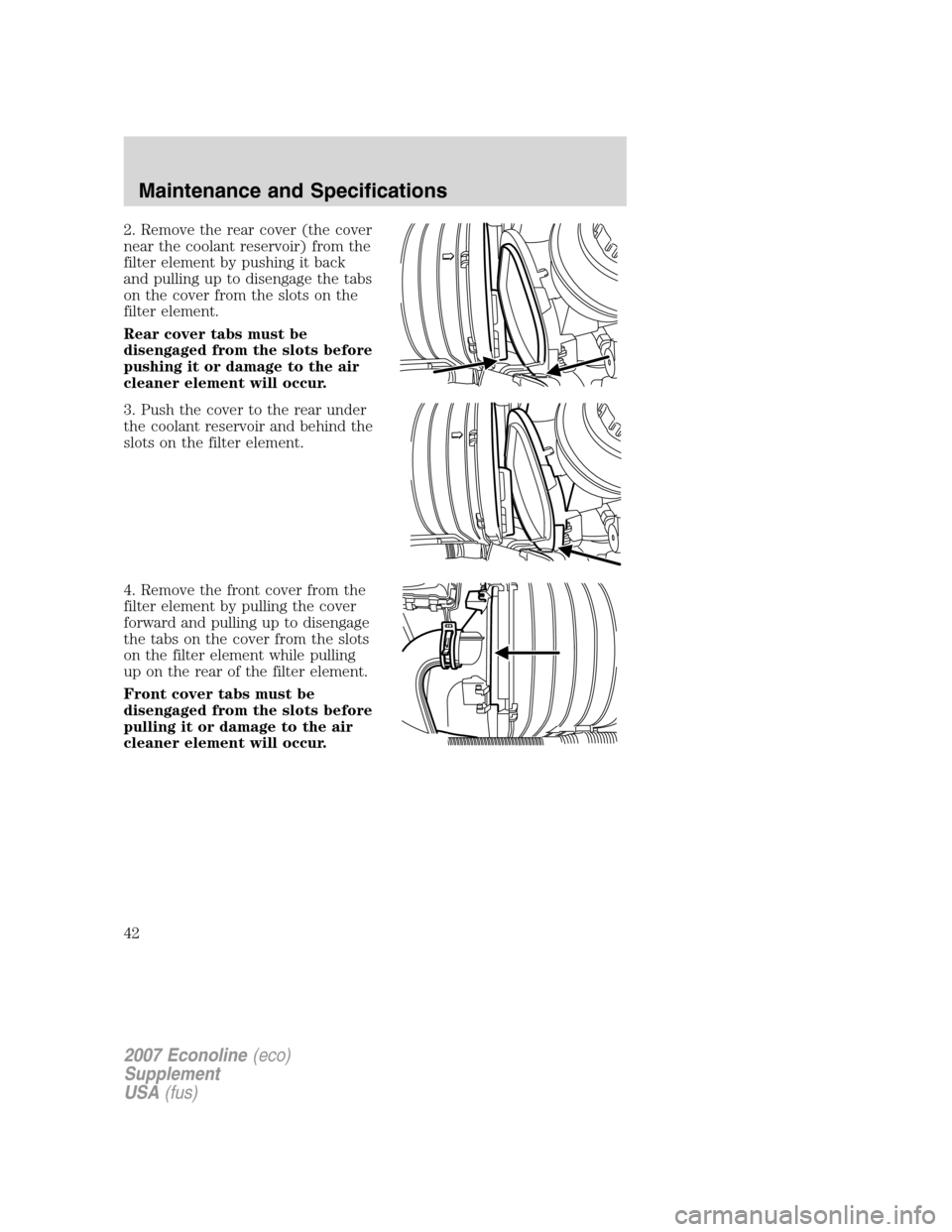
2. Remove the rear cover (the cover
near the coolant reservoir) from the
filter element by pushing it back
and pulling up to disengage the tabs
on the cover from the slots on the
filter element.
Rear cover tabs must be
disengaged from the slots before
pushing it or damage to the air
cleaner element will occur.
3. Push the cover to the rear under
the coolant reservoir and behind the
slots on the filter element.
4. Remove the front cover from the
filter element by pulling the cover
forward and pulling up to disengage
the tabs on the cover from the slots
on the filter element while pulling
up on the rear of the filter element.
Front cover tabs must be
disengaged from the slots before
pulling it or damage to the air
cleaner element will occur.
2007 Econoline(eco)
Supplement
USA(fus)
Maintenance and Specifications
42
Page 43 of 72
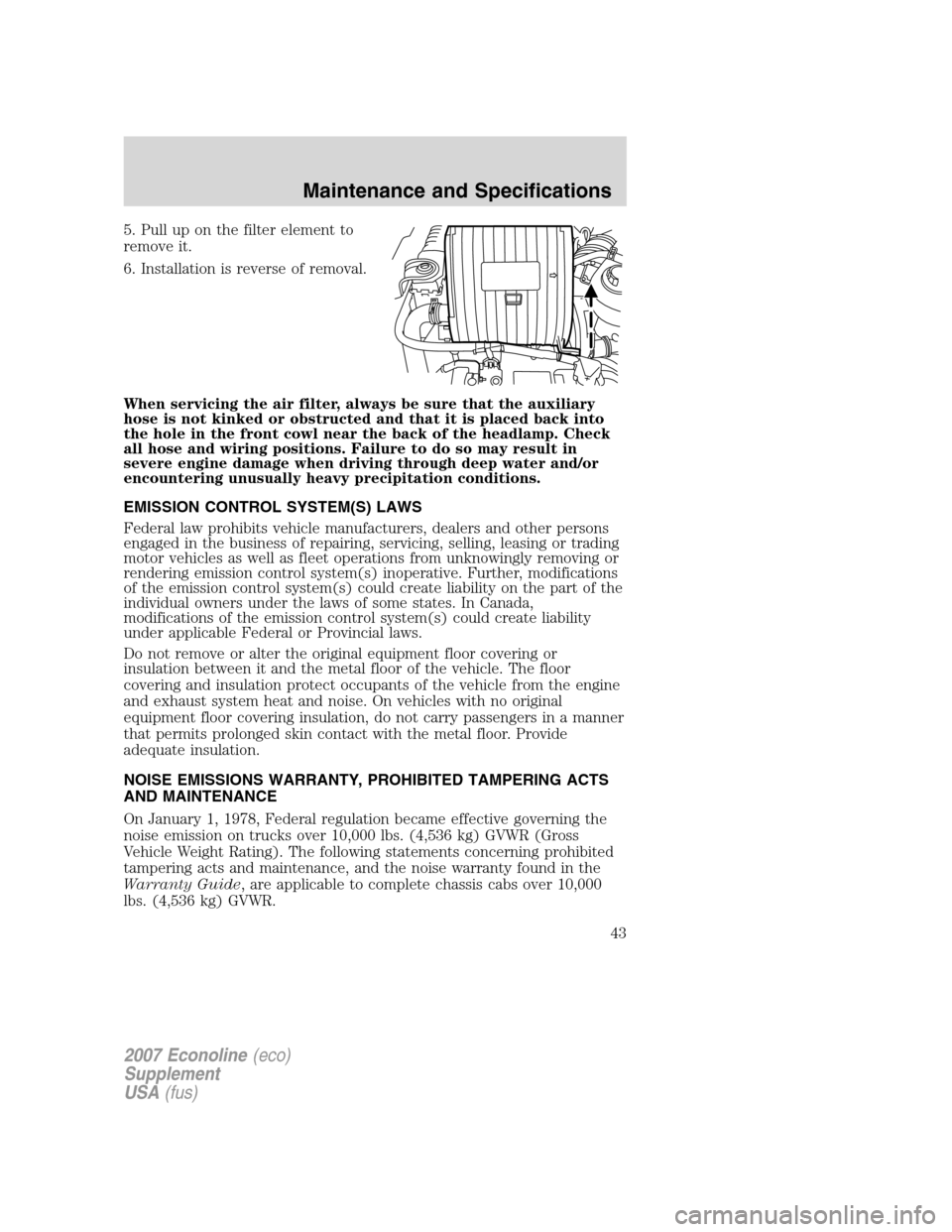
5. Pull up on the filter element to
remove it.
6. Installation is reverse of removal.
When servicing the air filter, always be sure that the auxiliary
hose is not kinked or obstructed and that it is placed back into
the hole in the front cowl near the back of the headlamp. Check
all hose and wiring positions. Failure to do so may result in
severe engine damage when driving through deep water and/or
encountering unusually heavy precipitation conditions.
EMISSION CONTROL SYSTEM(S) LAWS
Federal law prohibits vehicle manufacturers, dealers and other persons
engaged in the business of repairing, servicing, selling, leasing or trading
motor vehicles as well as fleet operations from unknowingly removing or
rendering emission control system(s) inoperative. Further, modifications
of the emission control system(s) could create liability on the part of the
individual owners under the laws of some states. In Canada,
modifications of the emission control system(s) could create liability
under applicable Federal or Provincial laws.
Do not remove or alter the original equipment floor covering or
insulation between it and the metal floor of the vehicle. The floor
covering and insulation protect occupants of the vehicle from the engine
and exhaust system heat and noise. On vehicles with no original
equipment floor covering insulation, do not carry passengers in a manner
that permits prolonged skin contact with the metal floor. Provide
adequate insulation.
NOISE EMISSIONS WARRANTY, PROHIBITED TAMPERING ACTS
AND MAINTENANCE
On January 1, 1978, Federal regulation became effective governing the
noise emission on trucks over 10,000 lbs. (4,536 kg) GVWR (Gross
Vehicle Weight Rating). The following statements concerning prohibited
tampering acts and maintenance, and the noise warranty found in the
Warranty Guide, are applicable to complete chassis cabs over 10,000
lbs. (4,536 kg) GVWR.
2007 Econoline(eco)
Supplement
USA(fus)
Maintenance and Specifications
43
Page 44 of 72
Tampering with noise control system prohibited
Federal law prohibits the following acts or the causing thereof: (1) The
removal or rendering inoperative by any person other than for purposes
of maintenance, repair or replacement of any device or element of design
incorporated into any new vehicle for the purpose of noise control prior
to its sale or delivery to the ultimate purchaser or while it is in use, or
(2) the use of the vehicle after such device or element of design has
been removed or rendered inoperative by any person.
Among those acts which the U.S. Environmental Protection Agency may
presume to constitute tampering are the acts listed below:
•Removal of hood blanket, fender apron absorbers, fender apron
barriers, underbody noise shields or acoustically absorptive material.
•Tampering or rendering inoperative the engine speed governor, so as
to allow engine speed to exceed manufacturer’s specifications.
The complexity of the diesel engine makes it so the owner is discouraged
from attempting to perform maintenance other than the services
described in this supplement.
If you experience difficult starting, rough idling, excessive exhaust
smoke, a decrease in engine performance or excess fuel consumption,
perform the following checks:
•a plugged air inlet system or engine air filter element.
•water in the fuel filter/water separator.
•a clogged fuel filter.
•contaminated fuel.
•air in the fuel system, due to loose connections.
•an open or pinched sensor hose.
•low engine oil level.
•wrong fuel or oil viscosity for climactic conditions.
If these checks do not help you correct the engine performance problem
you are experiencing, consult an authorized dealer.
FUELING
Do not use starting fluid such as ether or gasoline in the diesel
air intake system. Such fluids can cause immediate explosive
damage to the engine and possible personal injury.
2007 Econoline(eco)
Supplement
USA(fus)
Maintenance and Specifications
44
Page 53 of 72
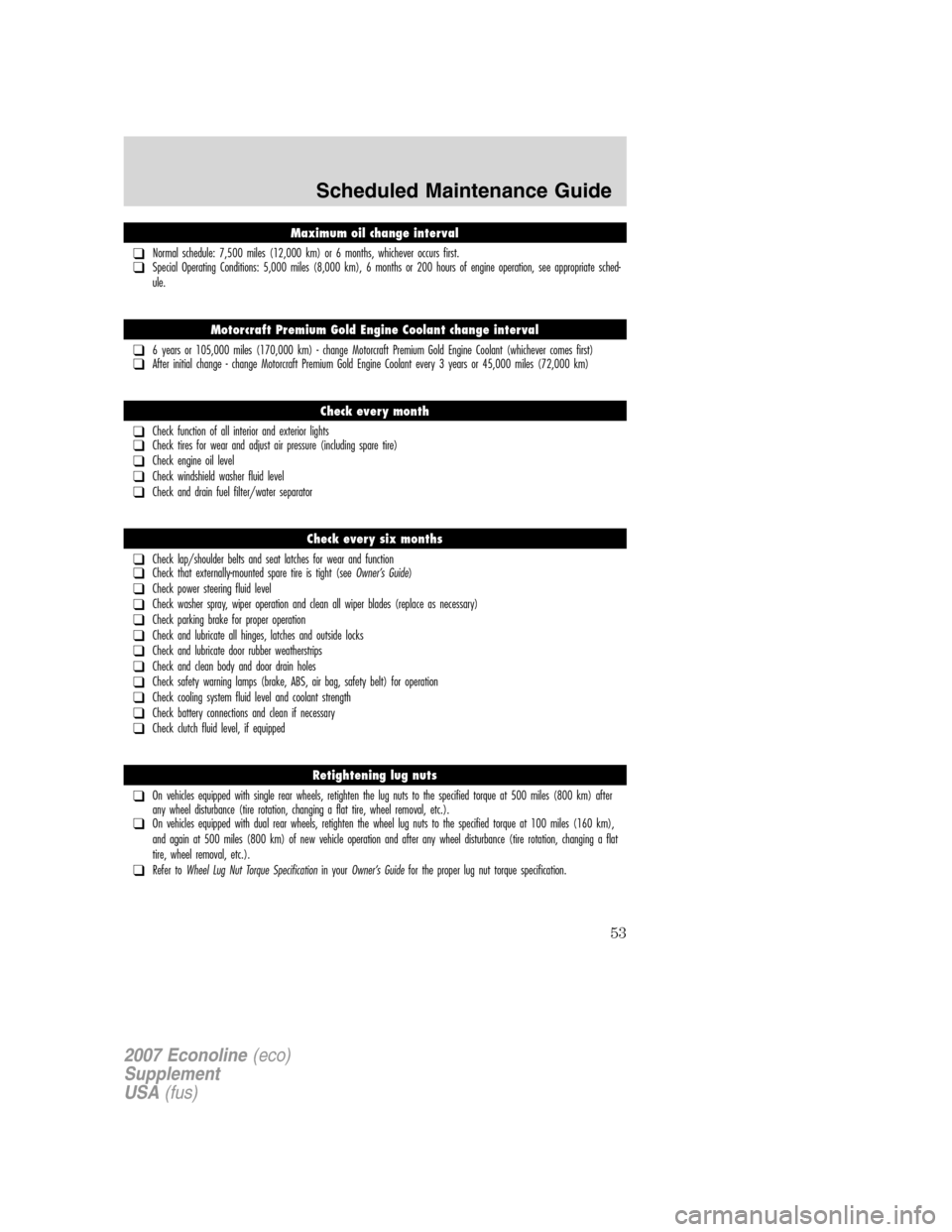
Maximum oil change interval
❑Normal schedule: 7,500 miles (12,000 km) or 6 months, whichever occurs first.❑Special Operating Conditions: 5,000 miles (8,000 km), 6 months or 200 hours of engine operation, see appropriate sched-
ule.
Motorcraft Premium Gold Engine Coolant change interval
❑6 years or 105,000 miles (170,000 km) - change Motorcraft Premium Gold Engine Coolant (whichever comes first)❑After initial change - change Motorcraft Premium Gold Engine Coolant every 3 years or 45,000 miles (72,000 km)
Check every month
❑Check function of all interior and exterior lights❑Check tires for wear and adjust air pressure (including spare tire)
❑Check engine oil level
❑Check windshield washer fluid level
❑Check and drain fuel filter/water separator
Check every six months
❑Check lap/shoulder belts and seat latches for wear and function❑Check that externally-mounted spare tire is tight (seeOwner’s Guide)
❑Check power steering fluid level
❑Check washer spray, wiper operation and clean all wiper blades (replace as necessary)
❑Check parking brake for proper operation
❑Check and lubricate all hinges, latches and outside locks
❑Check and lubricate door rubber weatherstrips
❑Check and clean body and door drain holes
❑Check safety warning lamps (brake, ABS, air bag, safety belt) for operation
❑Check cooling system fluid level and coolant strength
❑Check battery connections and clean if necessary
❑Check clutch fluid level, if equipped
Retightening lug nuts
❑On vehicles equipped with single rear wheels, retighten the lug nuts to the specified torque at 500 miles (800 km) after
any wheel disturbance (tire rotation, changing a flat tire, wheel removal, etc.).
❑On vehicles equipped with dual rear wheels, retighten the wheel lug nuts to the specified torque at 100 miles (160 km),
and again at 500 miles (800 km) of new vehicle operation and after any wheel disturbance (tire rotation, changing a flat
tire, wheel removal, etc.).
❑Refer toWheel Lug Nut Torque Specificationin yourOwner’s Guidefor the proper lug nut torque specification.
2007 Econoline(eco)
Supplement
USA(fus)
Scheduled Maintenance Guide
53