Page 268 of 288
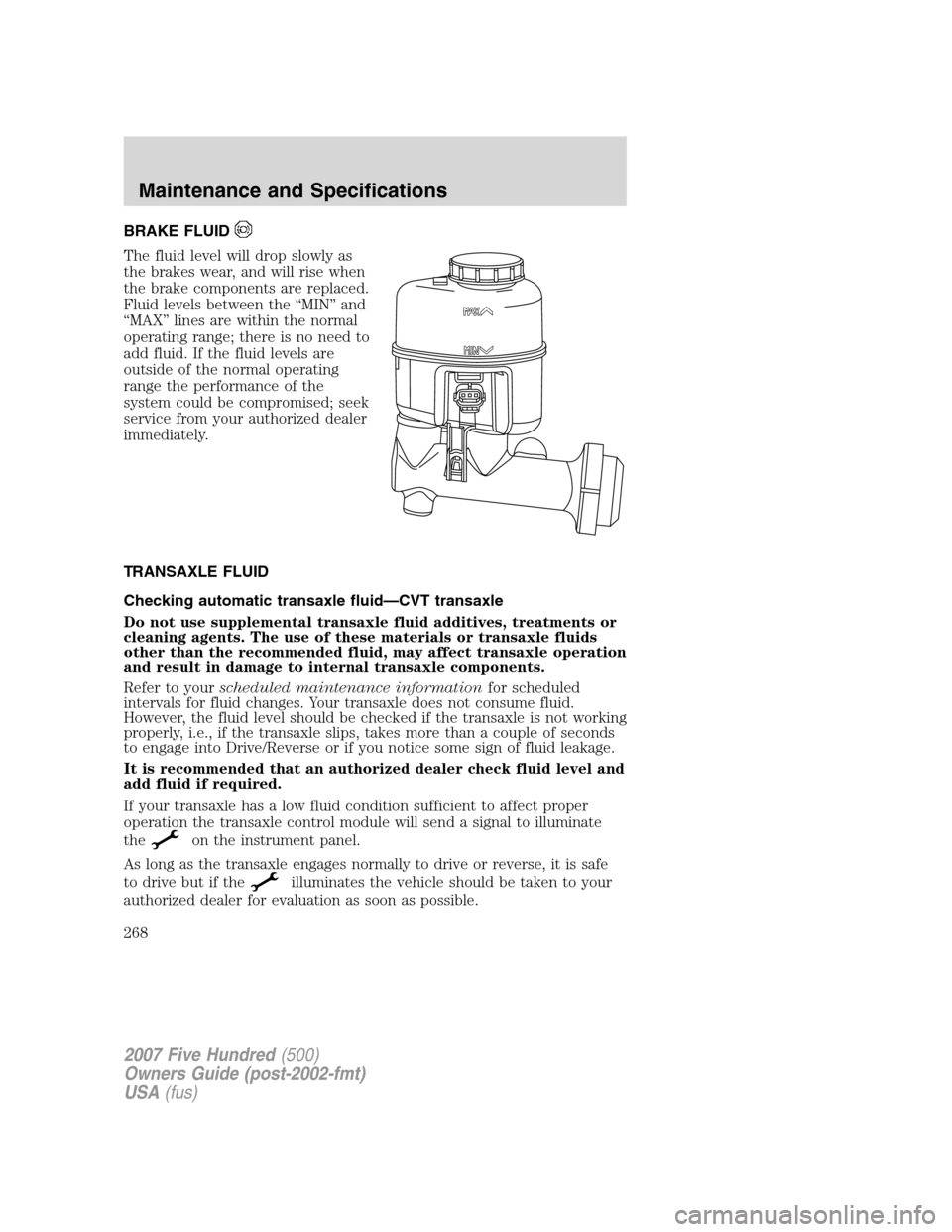
BRAKE FLUID
The fluid level will drop slowly as
the brakes wear, and will rise when
the brake components are replaced.
Fluid levels between the “MIN” and
“MAX” lines are within the normal
operating range; there is no need to
add fluid. If the fluid levels are
outside of the normal operating
range the performance of the
system could be compromised; seek
service from your authorized dealer
immediately.
TRANSAXLE FLUID
Checking automatic transaxle fluid—CVT transaxle
Do not use supplemental transaxle fluid additives, treatments or
cleaning agents. The use of these materials or transaxle fluids
other than the recommended fluid, may affect transaxle operation
and result in damage to internal transaxle components.
Refer to yourscheduled maintenance informationfor scheduled
intervals for fluid changes. Your transaxle does not consume fluid.
However, the fluid level should be checked if the transaxle is not working
properly, i.e., if the transaxle slips, takes more than a couple of seconds
to engage into Drive/Reverse or if you notice some sign of fluid leakage.
It is recommended that an authorized dealer check fluid level and
add fluid if required.
If your transaxle has a low fluid condition sufficient to affect proper
operation the transaxle control module will send a signal to illuminate
the
on the instrument panel.
As long as the transaxle engages normally to drive or reverse, it is safe
to drive but if the
illuminates the vehicle should be taken to your
authorized dealer for evaluation as soon as possible.
2007 Five Hundred(500)
Owners Guide (post-2002-fmt)
USA(fus)
Maintenance and Specifications
268
Page 269 of 288

If your transaxle does not engage normally, do not attempt to
drive. The vehicle should be towed to your authorized dealer for
evaluation.
Checking 6–speed automatic transmission fluid (if equipped)
Refer to yourscheduled maintenance informationfor scheduled
intervals for fluid checks and changes. Your transaxle does not consume
fluid. However, the fluid level should be checked if the transaxle is not
working properly, i.e., if the transaxle slips or shifts slowly or if you
notice some sign of fluid leakage.
Checking automatic transmission fluid at operating temperature
(158°F-176°F [70°C-80°C])
Automatic transmission fluid expands when warmed. To obtain an
accurate fluid check, drive the vehicle until it is warmed up
(approximately 20 miles [30 km]). If your vehicle has been
operated for an extended period at high speeds, in city traffic
during hot weather or pulling a trailer, the vehicle should be
turned off for about 30 minutes to allow fluid to cool before
checking.
1. Drive the vehicle 20 miles (30 km) or until it reaches normal operating
temperature.
2. Park the vehicle on a level surface and engage the parking brake.
3. With the parking brake engaged and your foot on the brake pedal,
start the engine and move the gearshift lever through all of the gear
ranges. Allow sufficient time for each gear to engage.
4. Latch the gearshift lever in P (Park) and leave the engine running.
5. Remove the dipstick, wiping it clean with a clean, dry, lint-free rag. If
necessary, refer toIdentifying components in the engine compartment
in this chapter for the location of the dipstick.
6. Install the dipstick making sure it is fully seated in the filler tube.
7. Remove the dipstick and inspect
the fluid level. The fluid should read
within the hot range on the dipstick
if at normal operating temperature
(158°F-176°F [70°C-80°C]).
2007 Five Hundred(500)
Owners Guide (post-2002-fmt)
USA(fus)
Maintenance and Specifications
269
Page 270 of 288
![FORD FIVE HUNDRED 2007 D258 / 1.G Owners Manual Checking automatic transmission fluid at cool temperature
(32°F-81°F [17°C-27°C])
If a fluid check is necessary at a low
fluid temperature (32°F-81°F
[17°C-27°C]), perform the check
using the](/manual-img/11/5101/w960_5101-269.png "FORD FIVE HUNDRED 2007 D258 / 1.G Owners Manual Checking automatic transmission fluid at cool temperature
(32°F-81°F [17°C-27°C])
If a fluid check is necessary at a low
fluid temperature (32°F-81°F
[17°C-27°C]), perform the check
using the")
Checking automatic transmission fluid at cool temperature
(32°F-81°F [17°C-27°C])
If a fluid check is necessary at a low
fluid temperature (32°F-81°F
[17°C-27°C]), perform the check
using the cold range on the dipstick.
However, the fluid must be
re-checked at the proper fluid
temperature.
Low fluid level
Do not drive the vehicle if the fluid
level does not show at all on the
dipstick.
High fluid level
Fluid levels above the safe range
may result in transaxle failure. An
overfill condition of transmission
fluid may cause shift and/or
engagement concerns and/or
possible damage.
High fluid levels can be caused by an overheating condition.
Adjusting automatic transmission fluid levels
Before adding any fluid, make sure the correct type is used. The type of
fluid used is normally indicated on the dipstick and also in the
Maintenance product specifications and capacitiessection in this
chapter.
Note:Only one ATF fluid specification has been tested and approved for
use with 6-speed—Premium Automatic Transmission fluid. Mercon fluids
can not be used in a automatic 6-speed without damage or voiding
warranty.
Use of a non-approved automatic transmission fluid may cause
internal transaxle component damage.
If necessary, add fluid in 1/2 pint (250 mL) increments through the filler
tube until the level is correct.
2007 Five Hundred(500)
Owners Guide (post-2002-fmt)
USA(fus)
Maintenance and Specifications
270
Page 271 of 288
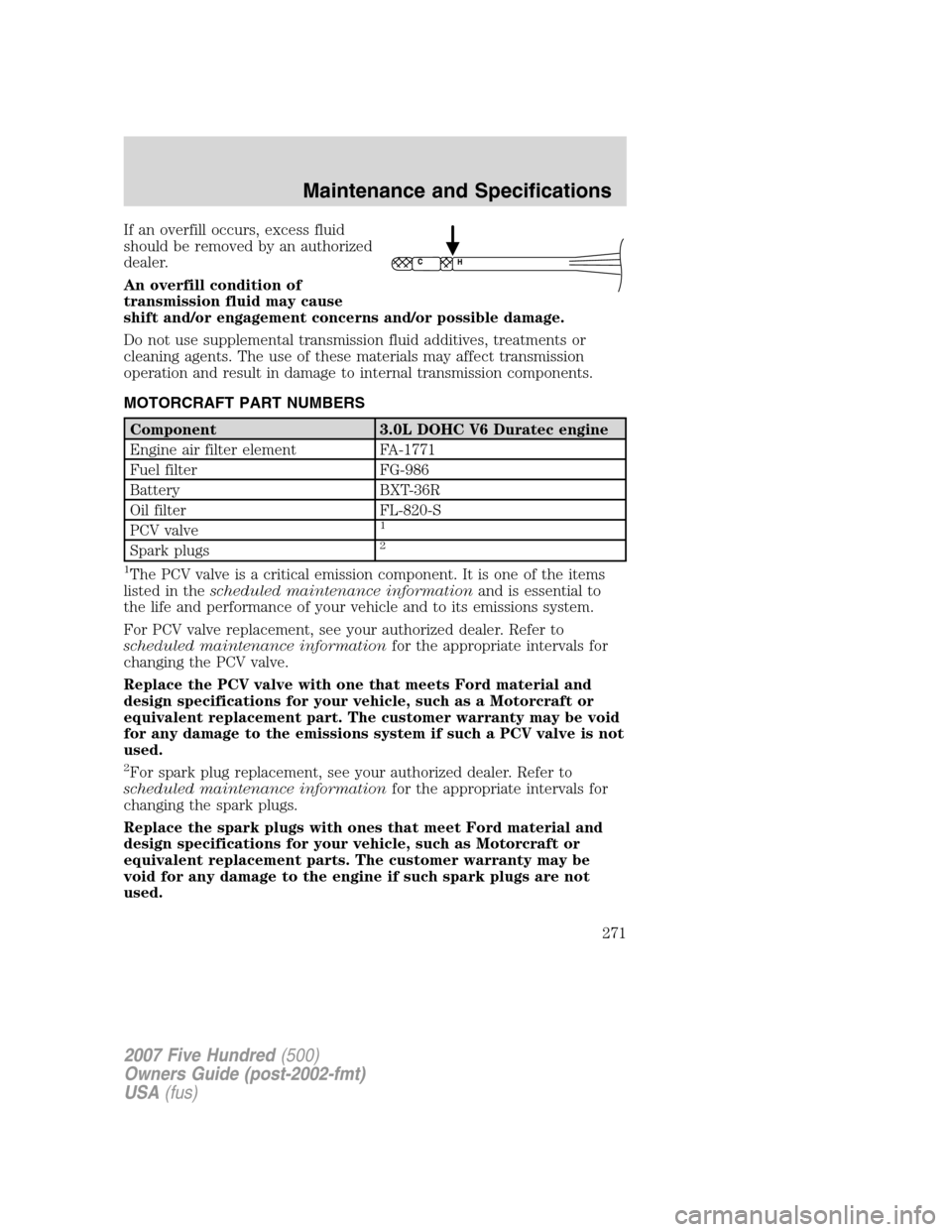
If an overfill occurs, excess fluid
should be removed by an authorized
dealer.
An overfill condition of
transmission fluid may cause
shift and/or engagement concerns and/or possible damage.
Do not use supplemental transmission fluid additives, treatments or
cleaning agents. The use of these materials may affect transmission
operation and result in damage to internal transmission components.
MOTORCRAFT PART NUMBERS
Component 3.0L DOHC V6 Duratec engine
Engine air filter element FA-1771
Fuel filter FG-986
Battery BXT-36R
Oil filter FL-820-S
PCV valve
1
Spark plugs2
1
The PCV valve is a critical emission component. It is one of the items
listed in thescheduled maintenance informationand is essential to
the life and performance of your vehicle and to its emissions system.
For PCV valve replacement, see your authorized dealer. Refer to
scheduled maintenance informationfor the appropriate intervals for
changing the PCV valve.
Replace the PCV valve with one that meets Ford material and
design specifications for your vehicle, such as a Motorcraft or
equivalent replacement part. The customer warranty may be void
for any damage to the emissions system if such a PCV valve is not
used.
2For spark plug replacement, see your authorized dealer. Refer to
scheduled maintenance informationfor the appropriate intervals for
changing the spark plugs.
Replace the spark plugs with ones that meet Ford material and
design specifications for your vehicle, such as Motorcraft or
equivalent replacement parts. The customer warranty may be
void for any damage to the engine if such spark plugs are not
used.
2007 Five Hundred(500)
Owners Guide (post-2002-fmt)
USA(fus)
Maintenance and Specifications
271
Page 272 of 288
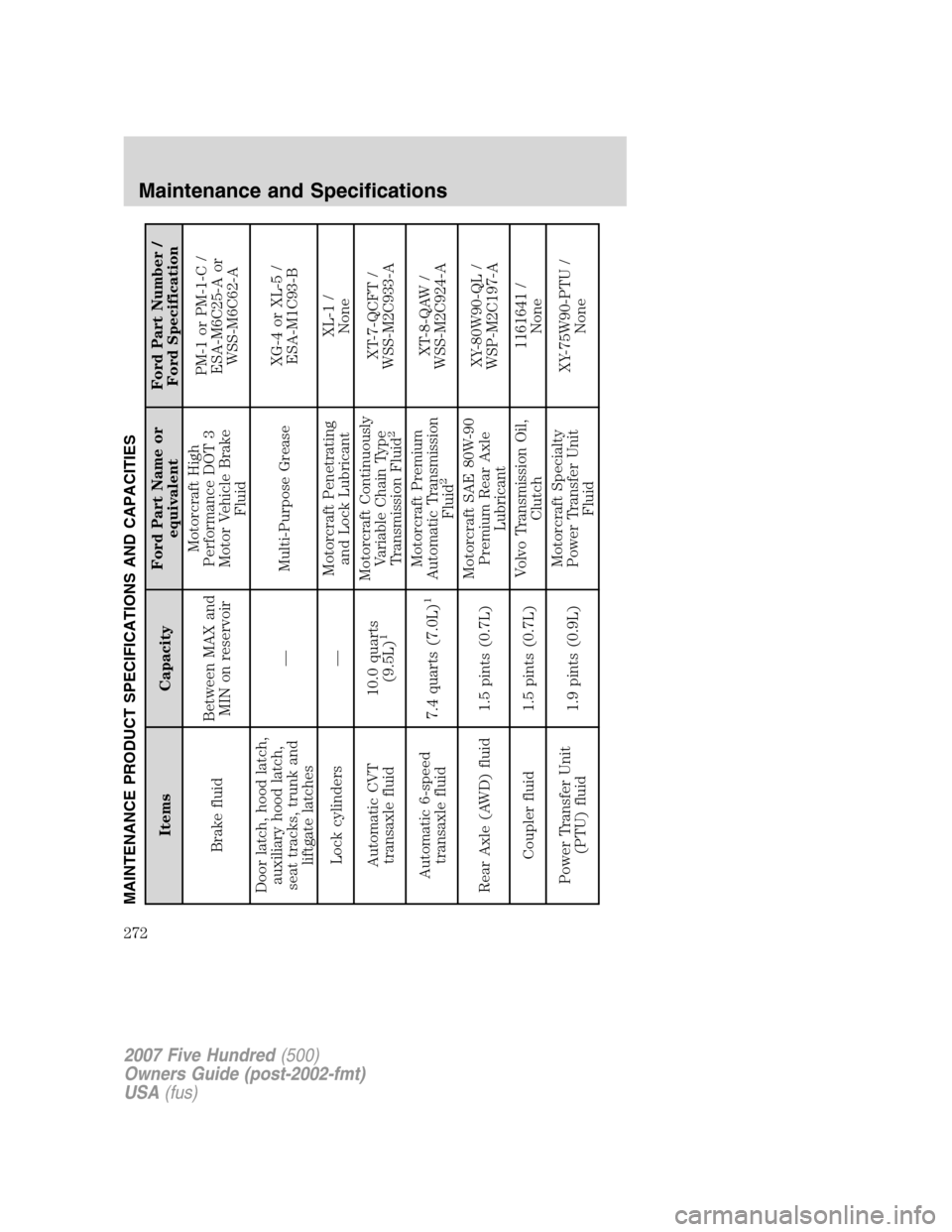
MAINTENANCE PRODUCT SPECIFICATIONS AND CAPACITIES
Items CapacityFord Part Name or
equivalentFord Part Number /
Ford Specification
Brake fluidBetween MAX and
MIN on reservoirMotorcraft High
Performance DOT 3
Motor Vehicle Brake
FluidPM-1 or PM-1-C /
ESA-M6C25-A or
WSS-M6C62-A
Door latch, hood latch,
auxiliary hood latch,
seat tracks, trunk and
liftgate latches— Multi-Purpose GreaseXG-4 or XL-5 /
ESA-M1C93-B
Lock cylinders —Motorcraft Penetrating
and Lock LubricantXL-1 /
None
Automatic CVT
transaxle fluid10.0 quarts
(9.5L)
1
Motorcraft Continuously
Variable Chain Type
Transmission Fluid
2
XT-7-QCFT /
WSS-M2C933-A
Automatic 6-speed
transaxle fluid7.4 quarts (7.0L)
1
Motorcraft Premium
Automatic Transmission
Fluid
2
XT-8-QAW /
WSS-M2C924-A
Rear Axle (AWD) fluid 1.5 pints (0.7L)Motorcraft SAE 80W-90
Premium Rear Axle
LubricantXY-80W90-QL /
WSP-M2C197-A
Coupler fluid 1.5 pints (0.7L)Volvo Transmission Oil,
Clutch1161641 /
None
Power Transfer Unit
(PTU) fluid1.9 pints (0.9L)Motorcraft Specialty
Power Transfer Unit
FluidXY-75W90-PTU /
None
2007 Five Hundred(500)
Owners Guide (post-2002-fmt)
USA(fus)
Maintenance and Specifications
272
Page 273 of 288
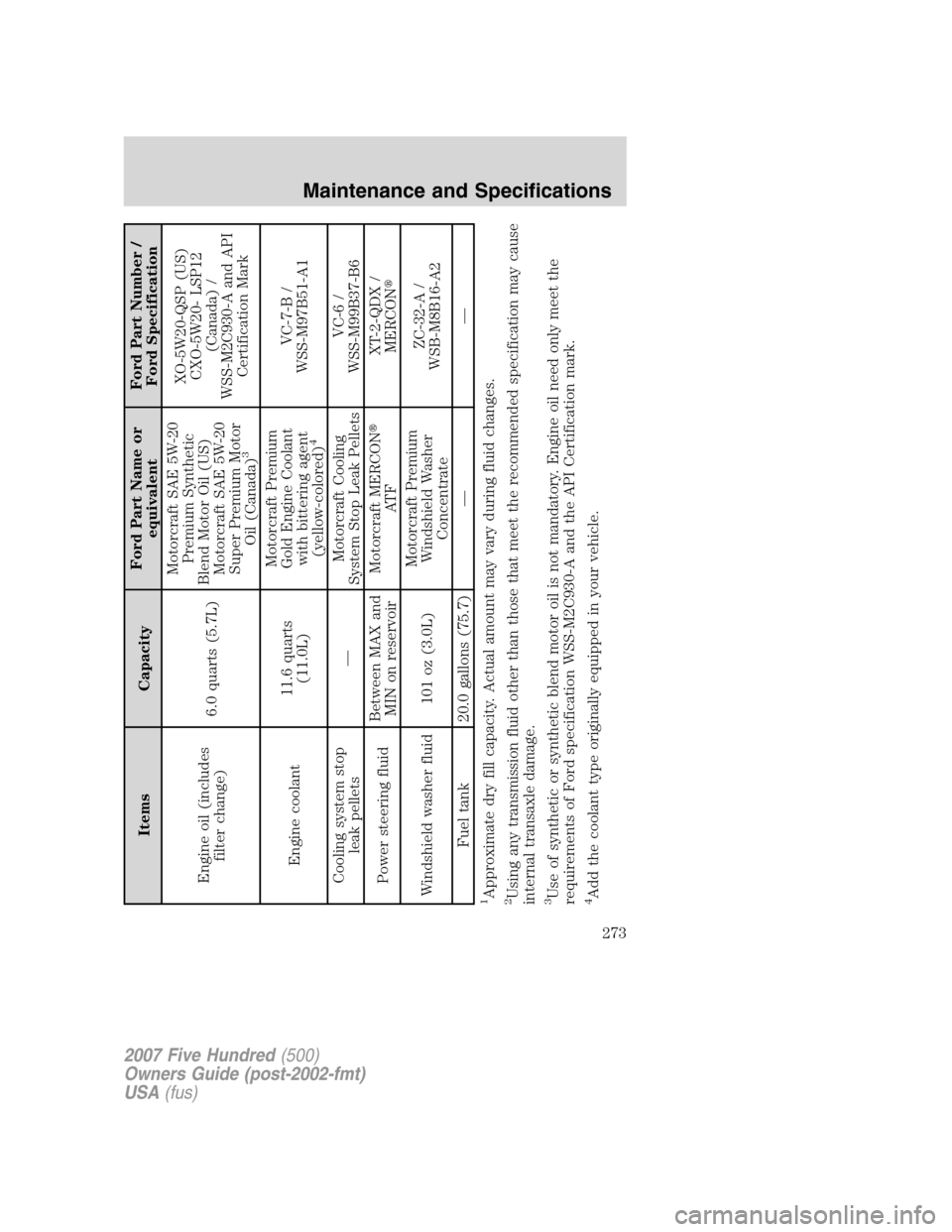
Items CapacityFord Part Name or
equivalentFord Part Number /
Ford Specification
Engine oil (includes
filter change)6.0 quarts (5.7L)Motorcraft SAE 5W-20
Premium Synthetic
Blend Motor Oil (US)
Motorcraft SAE 5W-20
Super Premium Motor
Oil (Canada)
3
XO-5W20-QSP (US)
CXO-5W20- LSP12
(Canada) /
WSS-M2C930-A and API
Certification Mark
Engine coolant11.6 quarts
(11.0L)Motorcraft Premium
Gold Engine Coolant
with bittering agent
(yellow-colored)
4
VC-7-B /
WSS-M97B51-A1
Cooling system stop
leak pellets—Motorcraft Cooling
System Stop Leak PelletsVC-6 /
WSS-M99B37-B6
Power steering fluidBetween MAX and
MIN on reservoirMotorcraft MERCON�
AT FXT-2-QDX /
MERCON�
Windshield washer fluid 101 oz (3.0L)Motorcraft Premium
Windshield Washer
ConcentrateZC-32-A /
WSB-M8B16-A2
Fuel tank 20.0 gallons (75.7) — —
1Approximate dry fill capacity. Actual amount may vary during fluid changes.2Using any transmission fluid other than those that meet the recommended specification may cause
internal transaxle damage.3Use of synthetic or synthetic blend motor oil is not mandatory. Engine oil need only meet the
requirements of Ford specification WSS-M2C930-A and the API Certification mark.4Add the coolant type originally equipped in your vehicle.
2007 Five Hundred(500)
Owners Guide (post-2002-fmt)
USA(fus)
Maintenance and Specifications
273
Page 274 of 288
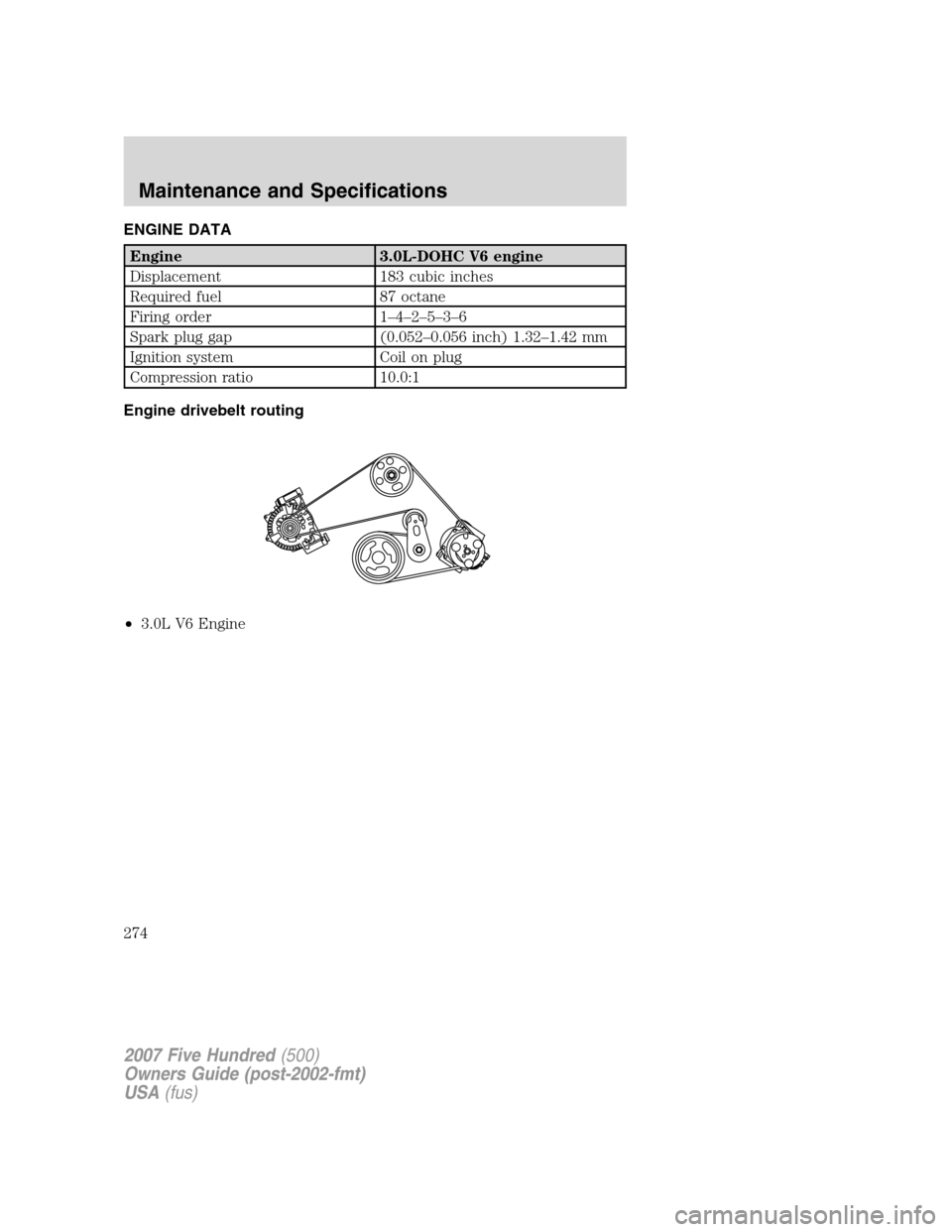
ENGINE DATA
Engine 3.0L-DOHC V6 engine
Displacement 183 cubic inches
Required fuel 87 octane
Firing order 1–4–2–5–3–6
Spark plug gap (0.052–0.056 inch) 1.32–1.42 mm
Ignition system Coil on plug
Compression ratio 10.0:1
Engine drivebelt routing
•3.0L V6 Engine
2007 Five Hundred(500)
Owners Guide (post-2002-fmt)
USA(fus)
Maintenance and Specifications
274
Page 275 of 288
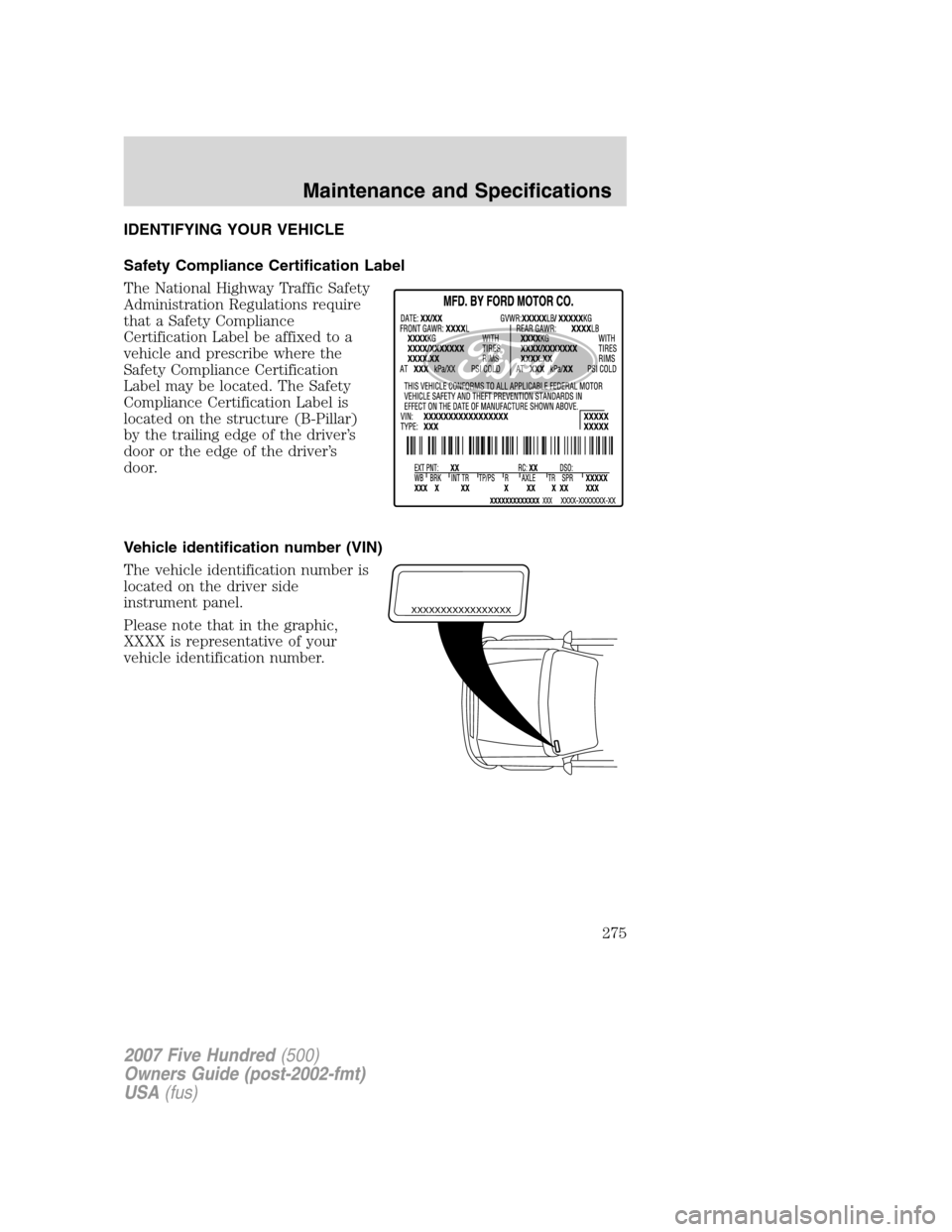
IDENTIFYING YOUR VEHICLE
Safety Compliance Certification Label
The National Highway Traffic Safety
Administration Regulations require
that a Safety Compliance
Certification Label be affixed to a
vehicle and prescribe where the
Safety Compliance Certification
Label may be located. The Safety
Compliance Certification Label is
located on the structure (B-Pillar)
by the trailing edge of the driver’s
door or the edge of the driver’s
door.
Vehicle identification number (VIN)
The vehicle identification number is
located on the driver side
instrument panel.
Please note that in the graphic,
XXXX is representative of your
vehicle identification number.
XXXXXXXXXXXXXXXXX
2007 Five Hundred(500)
Owners Guide (post-2002-fmt)
USA(fus)
Maintenance and Specifications
275