2007 FORD FIESTA Tank
[x] Cancel search: TankPage 4 of 1226

Intake Air Distribution and
- Filtering
303-1 2
Evaporative Emissions 303-1 3
Electronic Engine Controls 303-14
Automatic Transmission/Transaxle
Automatic TransmissionlTransaxle -
Vehicles With: 4-Speed Automatic
Transmission
(AW81-40) 307-01
TransmissionlTransaxle Cooling -
Vehicles With: 4-Speed Automatic
Transmission
(AW81-40) 307-02
Automatic
TransmissionlTransaxle
External Controls - Vehicles With:
4-Speed Automatic Transmission
(AW8 1 -40) 307-05
Manual Transmissionrrransaxle, Clutch and
Transfer Case
Manual TransmissionlTransaxle and
Clutch
- General Information 308-00
Clutch 308-0 1
Clutch Controls 308-02
Manual
Transmission/Transaxle 308-03
Manual TransmissionlTransaxle
External Controls 308-06
Exhaust System
Exhaust System 309-00
Fuel System
Fuel System - General
Information 31 0-00
Fuel Tank and Lines
31 0-01
Acceleration Control - I .3L Duratec-8V
(Rocam)ll.25L Duratec-I 6V
Instrumentation and Warning Systems
lnstrument Cluster and Panel
(
Illumination 41 3-00
Instrument Cluster
413-01
Horn 41 3-06
lnformation and Message
Center 41 3-08
Warning Devices
4 1 3-09
Parking Aid 41 3-1 3
Battery and Charging System
Charging System - General
Information 4 14-00
Battery, Mounting and Cables 414-01
Generator and Regulator 41 4-02
lnformation and Entertainment Systems
lnformation and Entertainment System
- General Information 41 5-00
Audio Unit 41 5-01
Antenna 41 5-02
Lighting
Exterior Lighting 41 7-01
Interior Lighting 4 1 7-02
Electrical Distribution
Module Communications ( 'j
Network 41 8-00
Module Configuration 41 8-01
Electronic Feature Group
Anti-Theft - Active 419-01A
Anti-Theft
- Passive 41 9-01 B
Cellular Phone 41 9-08
Multifunction Electronic
Modules 41 9-1 0
Climate Control System
Climate Control System - General
Information
Air Distribution and Filtering
Heating and Ventilation
Air Conditioning
Control Components
(Sigma)ll.4L Duratec-I 6V
lnterior Trim and
Ornamentation
Exterior Trim and
Ornamentation
Rear View Mirrors
Seating
Glass, Frames and
Mechanisms
(Sigma)/l .6L Duratec-1 6V
Instrument Panel and Console 501 -1 2
0512005 2006.0 Fiesta
GROUP 5 Body and Paint
(Sigma) 3 1 0-02A
Acceleration Control
- 2.OL Duratec-HE Body and Paint
(M14) 31 0-028 Body System - General
Information 501 -00
GROUP 4 Electrical Front End Body Panels 50 1 -02
Body Closures 50 1 -03
procarmanuals.com
Page 12 of 1226

Exhaust System (I
Exhaust System ........................................................................\
..................................... 309-00
Fuel System
Fuel System
- General Information ........................................................................\
.... 310-00
Fuel Tank and Lines..
........................................................................\
............................ .310-01
Acceleration Controll.3L Duratec-8V (Rocam)ll.25L Duratec-1 6V (Sigma)ll.4L
Duratec-1 6V (Sigma)ll .6L Duratec-1 6V (Sigma) ....................................................... 310-02A
Acceleration
Control2.0L Duratec-HE (M14) .............................................................. 30-02B
0512005 2006.0 Fiesta
procarmanuals.com
Page 27 of 1226

100-00-1 1 General Information 100-00-1 1
DESCRIPTION AND OPERATION
First Aid
Apart from meeting any legal requirements it is
desirable for someone in the workshop to be
trained in First Aid procedures.
Splashes in the eye should be flushed carefully
with clean water for at least ten minutes.
Soiled skin should be washed with soap and water.
In case of cold burns, from alternative fuels, place
affected area in cool to cold water.
Individuals affected by inhalation of gases and
fumes should be removed to fresh air immediately.
If effects persist, consult a doctor.
If liquids are swallowed inadvertently, consult a
doctor giving him the information on the container
or label. Do not induce vomiting unless this action
is indicated on the label.
Fluoroelastomer
See Viton.
Foams - Polyurethane
See also Fire.
Used in sound and noise insulation. Cured foams
used in seat and trim cushioning.
Follow manufacturers instructions.
Unreacted components are irritating and may be
harmful to the skin and eyes. Wear gloves and
goggles.
Individuals with chronic respiratory diseases,
asthma, bronchial medical problems, or histories
of allergic diseases should not work in or near
uncured materials.
The components, vapors or spray mists can cause
direct irritation, sensitivity reactions and may be
toxic or harmful.
Vapors and spray mists must not be inhaled. These
materials must be applied with adequate ventilation
and respiratory protection. Do not remove the
respirator immediately after spraying; wait until the
vapors/mists have cleared.
Burning of the uncured components and the cured
foams can generate toxic and harmful fumes.
Smoking, naked flames or the use of electrical
equipment during foaming operations and until
vapors/mists have cleared should not be allowed.
Any heat cutting of cured foams or partially cured foams
should be conducted with extraction
ventilation. See also the vehicle Body Repair
Manual.
Freon
See Air Conditioning Refrigerant.
Fuels
See also, Fire, Legal Aspects, Chemicals and
Solvents.
Avoid skin contact with fuel where possible. Should
contact occur, wash the affected skin with soap
and water.
Gasoline (Petrol)
Highly flammable - observe No Smoking policy.
Swallowing can result in mouth and throat irritation
and absorption from the stomach can result in
drowsiness and unconsciousness. Small amounts
can be fatal to children. Aspiration of liquid into the
lungs, through vomiting, is a very serious hazard.
Gasoline dries the skin and can cause irritation
and dermatitis on prolonged or repeated contact.
Liquid in the eye causes severe smarting.
Motor gasoline may contain appreciable quantities
of benzene, which is toxic upon inhalation, and the
concentration of gasoline vapors must be kept very
low. High concentrations will cause eye, nose and
throat irritation, nausea, headache, depression and
symptoms of drunkenness. Very high
concentrations will result in rapid loss of
CO~SC~OUS~~SS.
Make sure there is adequate ventilation when
handling and using gasoline. Great care must be
taken to avoid the serious consequences of
inhalation in the event of vapor build up arising
from spillages in confined spaces.
Special precautions apply to cleaning and
maintenance operations on gasoline storage tanks.
Gasoline should not be used as a cleaning agent.
It must not be siphoned by mouth. See First Aid.
Gasoil (Diesel Fuel)
Com busti ble.
2006.0 Fiesta 1212006 GI 7372en
procarmanuals.com
Page 28 of 1226

100-00-12 General Information 100-00-12
DESCRIPTION AND OPERATION
Gross or prolonged skin contact with high boiling
point gas oils may also cause serious skin
disorders including skin cancer.
Kerosene (Paraffin)
Used also as heating fuel, solvent and cleaning
agent.
Flammable
- observe No Smoking policy.
Irritation of the mouth and throat may result from
swallowing. The main hazard from swallowing
arises if liquid aspiration into the lungs occurs.
Liquid contact dries the skin and can cause
irritation or dermatitis. Splashes in the eye may be
slightly irritating.
In normal circumstances the low volatility does not
give rise to harmful vapors. Exposure to mists and
vapors from kerosene at elevated temperature
should be avoided (mists may arise in dewaxing).
Avoid skin and eye contact and make sure there
is adequate ventilation.
Alternative Fuel
Highly flammable. Observe "NO SMOKING" signs.
Make sure there is adequate ventilation when
working on alternative fuelled vehicles. Great care
must be taken to avoid the serious consequences
of inhalation in the event of vapor build up in
confined spaces.
Inhalation in high concentrations may cause
dizziness, headache, nausea and loss of
co-ordination. Very high concentrations may result
in loss of consciousness.
Contact with liquefied petroleum gas (LPG) or
compressed natural gas (CNG) to the skin may
cause cold burns and frost bite.
Long sleeved cotton overalls, steel toe capped
safety boots and rubber neoprene gloves should
be worn during removal and installation of
LPGICNG fuel system components.
LPGICNG fuel leaks could cause a fire and be a
hazard to health that can lead to personal injury,
illness or even death.
If a leak is detected, under no circumstances
attempt to seal the leak by tightening the
unionlconnection until the fuel in the system or
component is depressurized. Once tightened the
system should be checked for integrity following
the specified procedures. If
the fuel tank is to be removed for service or repair
the fuel must be evacuated using dedicated
equipment and following the specified
procedures. (
Gas Cylinders
See also Fire.
Gases such as oxygen, acetylene, argon and
propane are normally stored in cylinders at
pressures of up to
138 bar (2000 psi) and great
care should be taken in handling these cylinders
to avoid mechanical damage to them or to the valve
gear attached. The contents of each cylinder
should be clearly identified by appropriate
markings.
Cylinders should be stored in well-ventilated
enclosures, and protected from ice and snow, or
direct sunlight. Fuel gases, for example acetylene
and propane, should not be stored in close
proximity to oxygen cylinders.
Care should be exercised to prevent leaks from
gas cylinders and lines, and to avoid sources of
ignition.
Only trained personnel should undertake work
involving gas cylinders.
Gases
See Gas Cylinders.
Gaskets (Fluoroelastomer)
See Viton.
General Workshop Tools and
Equipment
It is essential that all tools and equipment are
maintained in good condition and that the correct
safety equipment is used where required.
Never use tools or equipment for any purpose other
than that for which they were designed. Never
overload equipment such as hoists, jacks, axle and
chassis stands or
lifting slings. Damage caused by
overloading is not always immediately apparent
and may result in a fatal failure the next time that
the equipment is used.
2006.0 Fiesta 1212006 GI 7372en
procarmanuals.com
Page 33 of 1226
100-00-1 7 General Information 100-00-1 7
DESCRIPTION AND OPERATION
The flame is bright, and eye protection should be - used, but the ultra-violet emission is much less
than that from arc welding, and lighter filters may
be used.
The process itself produces few toxic fumes, but
such fumes and gases may be produced from
coatings on the work, particularly during cutting
away of damaged body parts, and inhalation of the
fumes should be avoided.
In brazing, toxic fumes may be produced from the
metals in the brazing rod, and a severe hazard
may arise if brazing rods containing cadmium are
used. In this event particular care must be taken
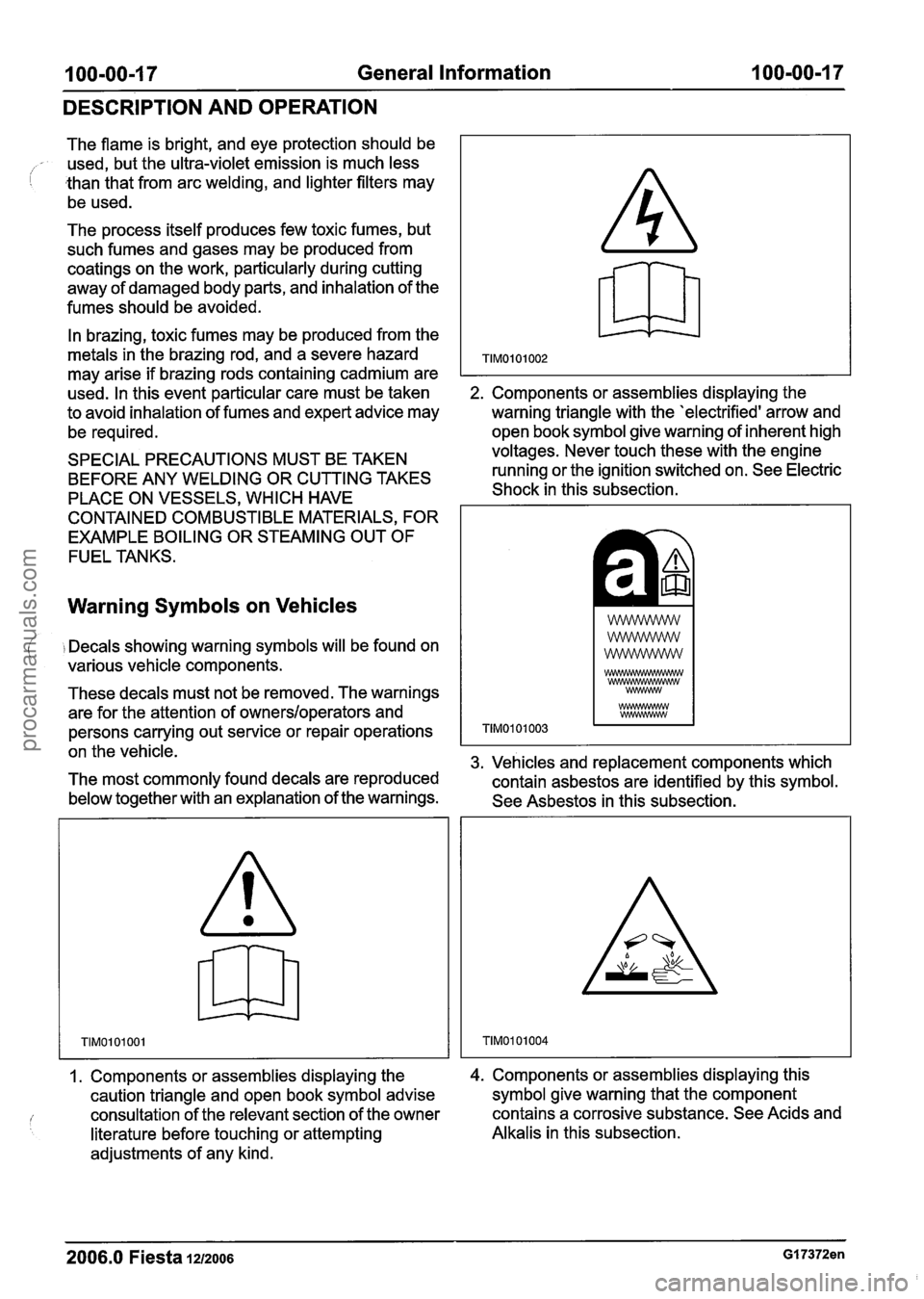
2. Components or assemblies displaying the
to avoid inhalation of fumes and expert advice may
warning triangle with the 'electrified' arrow and
be required. open book symbol
give warning of inherent high
SPECIAL PRECAUTIONS MUST BE TAKEN voltages.
Never touch these with the engine
BEFORE ANY WELDING OR CUTTING TAKES running
or the ignition switched on. See Electric
PLACE ON VESSELS, WHICH HAVE Shock
in this subsection.
CONTAINED COMBUSTIBLE MATERIALS, FOR
EXAMPLE BOILING OR STEAMING OUT OF
FUEL TANKS.
Warning Symbols on Vehicles
( i Decals showing warning symbols will be found on
various vehicle components.
These decals must not be removed. The warnings
are for the attention of
owners/operators and
persons carrying out service or repair operations
on the vehicle.
3. Vehicles and replacement components which
The most commonly found decals are reproduced
contain asbestos are identified by this symbol.
below together with an explanation of the warnings.
See Asbestos in this subsection.
1. Components or assemblies displaying the
caution triangle and open book symbol advise
consultation of the relevant section of the owner
literature before touching or attempting
adjustments of any kind. 4. Components or assemblies displaying this
symbol give warning that the component
contains a corrosive substance. See Acids and
Alkalis in this subsection.
2006.0 Fiesta 1212006 GI 7372en
procarmanuals.com
Page 35 of 1226

100-00-1 9 General Information 100-00-1 9
DESCRIPTION AND OPERATION
Standard Workshop Practices
Vehicle in Workshop
When working on a vehicle in the workshop always
make sure that:
- the parking brake is applied or the wheels are
securely chocked to prevent the vehicle moving
forwards or backwards.
- the key is removed from key operated hood
locks before any work is carried out around the
front of the vehicle.
- if the engine is to be run, there is adequate
ventilation, or an extraction hose to remove
exhaust fumes.
- there is adequate room to raise the vehicle and
remove the wheels, if necessary.
- fender covers are always fitted if any work is to
be carried out in the engine compartment.
- the battery is disconnected if working on the
engine, underneath the vehicle, or if the vehicle
is raised.
Alternative Fuel - Dons
- Do work on the vehicle in a designated area,
that is well ventilated and with access restricted
to qualified personnel only.
- Install new warning labels to their original
locations.
- If possible always isolate the alternative fuel
tank, and run the vehicle on the alternative fuel
until it automatically switches to its normal fuel
prior to taking the vehicle into the workshop
service area.
- Only use tested and approved components and
pipes when repairing or servicing
LPG and CNG
systems.
Alternative Fuel - Do Nots
- Do not vent off LPG fuel.
- Do not use shop air pressure to force LPG fuel
from the fuel tank.
( A CAUTION:When electric arc welding on a - Do not use paint drying ovens above 40°C for vehicle, always disconnect the generator any alternative fuel vehicle. LPG and CNG fuel wiring to prevent the possibility of a surge tanks must be removed from the vehicle prior of current causing damage to the internal to being put into paint drying ovens above 40°C. components of the generator. - Do not modify the system or install new - if using welding equipment on the vehicle, a
components that are not designed for gas
suitable fire extinguisher is readily available.
vehicles.
Alternative Fuel
A WARNING:When servicing the fuel system
always follow the recommended
procedures. Failure to follow these
instructions may result in personal injury.
If the odor of liquefied petroleum gas (LPG) or
compressed natural gas
(CNG) is present in the
air in the workshop, warn all persons in the area
to:
- extinguish all flames and lighted tobacco.
- shut off electrical and air powered equipment.
- evacuate the area.
- ventilate the area.
- contact the fire control authorities.
- remove the vehicle to a dedicated, ventilated
area.
- Do not evacuate fuel tanks unless there is repair
that requires the removal of the fuel tank.
- Do not work on the fuel lines or system
components unless the alternative fuel has been
evacuated and the pressure in the system
reduced to atmospheric or less.
- Do not use anything other than the specified
leak detector fluid to trace fuel leaks.
Be aware of situations that may cause the
LPG or I
CNG fuel system to vent off fuel, such as: I
- extremely hot days.
- parking by a space heater.
- hoisting a vehicle up near a ceiling heater.
Only fully trained personnel, who are conversant
with local standards, are to work on alternative fuel
vehicles.
2006.0 Fiesta 1212006 GI 7373en
procarmanuals.com
Page 39 of 1226

100-00-23 General Information 100-00-23
DESCRIPTION AND OPERATION
RoadIRoller Testing
I Road or roller testing may be carried out for various
reasons and a procedure detailing pre-test checks,
engine starting and stopping, pre-driving checks,
on-test checks and final checks to be completed
on completion of the test is given below.
Unless complete vehicle performance is being
checked, the full road test procedure need not be
carried out. Instead, those items particularly
relevant to the
system(s) being checked can be
extracted.
Pre-Test Checks
A WARNING:lf the brake system hydraulic
fluid level is low, pedal travel is excessive
or a hydraulic leak is found, do not attempt
to road test the vehicle until the reason for
the low fluid level, excessive pedal travel
or hydraulic leak is found and rectified.
It is suggested that pre-test checks and functional
tests of those systems and circuits which affect the
safe and legal operations of the vehicle, such as
( , brakes, lights and steering, should always be
carried out before the road or roller test.
With the ignition switched off, check:
- the engine oil level.
- the engine coolant level.
- the tires, for correct pressure, compatible types
and tread patterns, and wear within limits.
- that there is sufficient fuel in the tank to
complete the test.
- all around the engine, transmission and under
the vehicle for oil, coolant, hydraulic and fuel
leaks. Make a note of any apparent leaks and
wipe off the surrounding areas to make it easier
to identify the extent of the leak on completion
of the test.
Starting the Engine
N0TE:On initial drive away from cold and within
the first 1.5 km (1 mile), do not depress the
accelerator pedal beyond half travel until the
vehicle has attained a minimum speed of
25 kmlh
(15 mileslh). Never operate at high engine speed
or with the accelerator pedal at full travel whilst the
engine is cold.
With the ignition switched off, check:
- that the parking brake is applied.
- that the gear lever is in the neutral position.
- that all instrument gauges (except fuel gauge)
read zero.
With the ignition switched on, check:
- that the ignition controlled warning lamps are
illuminated.
- that the engine temperature gauge registers a reading compatible with the engine temperature.
- that the fuel gauge registers a reading
appropriate to the fuel level in the tank.
- the operation of the parking brake warning lamp
and fluid level warning indicator.
Road or Roller Testing
A CAUTI0N:lf road testing, check the brake
operation while still traveling at low speed
before continuing with the test. If the
brakes pull to one side, or appear to be
otherwise faulty, do not continue with the
road test until the fault has been found and
rectified.
During the road or roller test, check:
- that the clutch pedal operation is not stiff or
heavy.
- that the initial gear engagement is smooth and
there is no evidence of clutch drag.
- that the parking brake control operates smoothly
and releases quickly and completely.
- that the clutch takes up the drive smoothly,
without slip or judder.
- that gear changing is smooth with no abnormal
noises or vibrations from the transmission.
- the engine power output is satisfactory, full
power is achieved, acceleration is smooth and
pedal operation is not stiff or heavy, and engine
speed returns to idle correctly.
- there is no excessive or abnormally colored
smoke from the engine under normal driving,
heavy load or overrun conditions.
- that steering operation, including power steering
(if equipped), is smooth, accurate, not
excessively heavy or with excessive free play
or vibration.
- that the steering does not pull to one side and
self centers smoothly after cornering.
2006.0 Fiesta 1212006 GI 7375en
procarmanuals.com
Page 353 of 1226

21 1-02-5 Power Steering 21 1-02-5
REMOVAL AND INSTALLATION
Power Steering Pump - 1.25L Duratec-I 6V (Sigma)/l.4L
I Duratec-1 6V (Sigma)/l .6L Duratec-1 6V (Sigma), Vehicles
With: Air
Conditioning(l3 434 0)
7 I Removerllnstaller, Hose
632
Clamp
303-397 (24-003)
Wrench, Hydraulic Line Union
"-269 (13-027)
Removal
2. Detach the power steering line from the
power steering pump mounting bracket.
3. Detach the power steering line bracket from
the cylinder head.
1. Detach the coolant expansion tank from the
wheelhouse assembly and position
it to one
side.
1. Remove the retaining bolt. 4. Remove the accessory drive belt.
2. Release the retaining clip. For additional information, refer to: Power
Steering Pump Belt
- 1.4L Duratec-1 6V
(Sigma)ll .6L Duratec-1 6V (Sigma), Vehicles
With: Air Conditioning
(303-05 Accessory
Drive, Removal and Installation).
5. Disconnect the power steering fluid reservoir
return hose quick release coupling, from
either the power steering fluid cooler or the
power steering reservoir return hose.
1. Press the power steering fluid reservoir return
hose quick release coupling locking tangs.
2. Disconnect the power steering fluid reservoir
return hose quick release coupling.
2006.0 Fiesta 1212006 G91963en
procarmanuals.com