Page 131 of 1226
204-02-9 Rear Suspension 204-02-9
REMOVAL AND INSTALLATION
Tighten the shock absorber lower mounting
bolt.
2006.0 Fiesta 1212006 G89135en
procarmanuals.com
Page 133 of 1226

204-02-1 1 Rear Suspension 204-02-1 1
REMOVAL AND INSTALLATION
Using a suitable electric hand drill, remove
the rivets.
Vehicles with rear disc brakes
8. Remove the brake disc shield.
For additional information, refer to: Brake
Disc Shield
(206-04 Rear Disc Brake,
Removal and Installation).
9. Detach the parking brake cable from the
beam axle bracket on both sides.
All vehicles
10. Detach the parking brake cable from the
beam axle on both sides.
11. Remove the rear wheel speed sensor.
For additional information, refer to: Rear
Wheel Speed Sensor
(206-09 Anti-Lock
Control, Removal and Installation).
I*' AWARNING:M~~~ sure that the beam axle
is secured to the transmission jack. Failure
to follow this instruction may result in
personal injury.
Using a suitable securing strap, secure the
beam axle to a transmission jack.
13. Detach the shock absorber from the beam
axle on both sides.
14. Detach the spring from the lower spring
seat on both sides.
15. Remove the beam axle.
2006.0 Fiesta 1212006 GI 83767en
procarmanuals.com
Page 134 of 1226
204-02-1 2 Rear Suspension 204-02-1 2
REMOVAL AND INSTALLATION
Remove the beam axle retaining bolts on 3. Attach the spring to the lower spring seat on
both sides. both sides. /'
installation 4. N0TE:Do not fully tighten the shock
absorber retaining bolts at this stage.
All vehicles Attach the shock absorber to the beam axle
N0TE:Final tightening of the beam axle on both sides.
components should be carried out when the vehicle I I
weight is on the road wheels.
1. Using a suitable transmission jack, locate
the beam axle.
2. N0TE:Do not fully tighten the beam axle
retaining bolts at this stage.
Install the beam axle.
Install the beam axle retaining bolts on both
sides.
5. Remove the securing strap.
6. Lower and remove the transmission jack.
7. Install the rear wheel speed sensor.
For additional information, refer to: Rear
Wheel Speed Sensor
(206-09 Anti-Lock
Control, Removal and Installation).
2006.0 Fiesta 1212006 Gl83767en
procarmanuals.com
Page 136 of 1226
204-02-1 4 Rear Suspension 204102-14
REMOVAL AND INSTALLATION
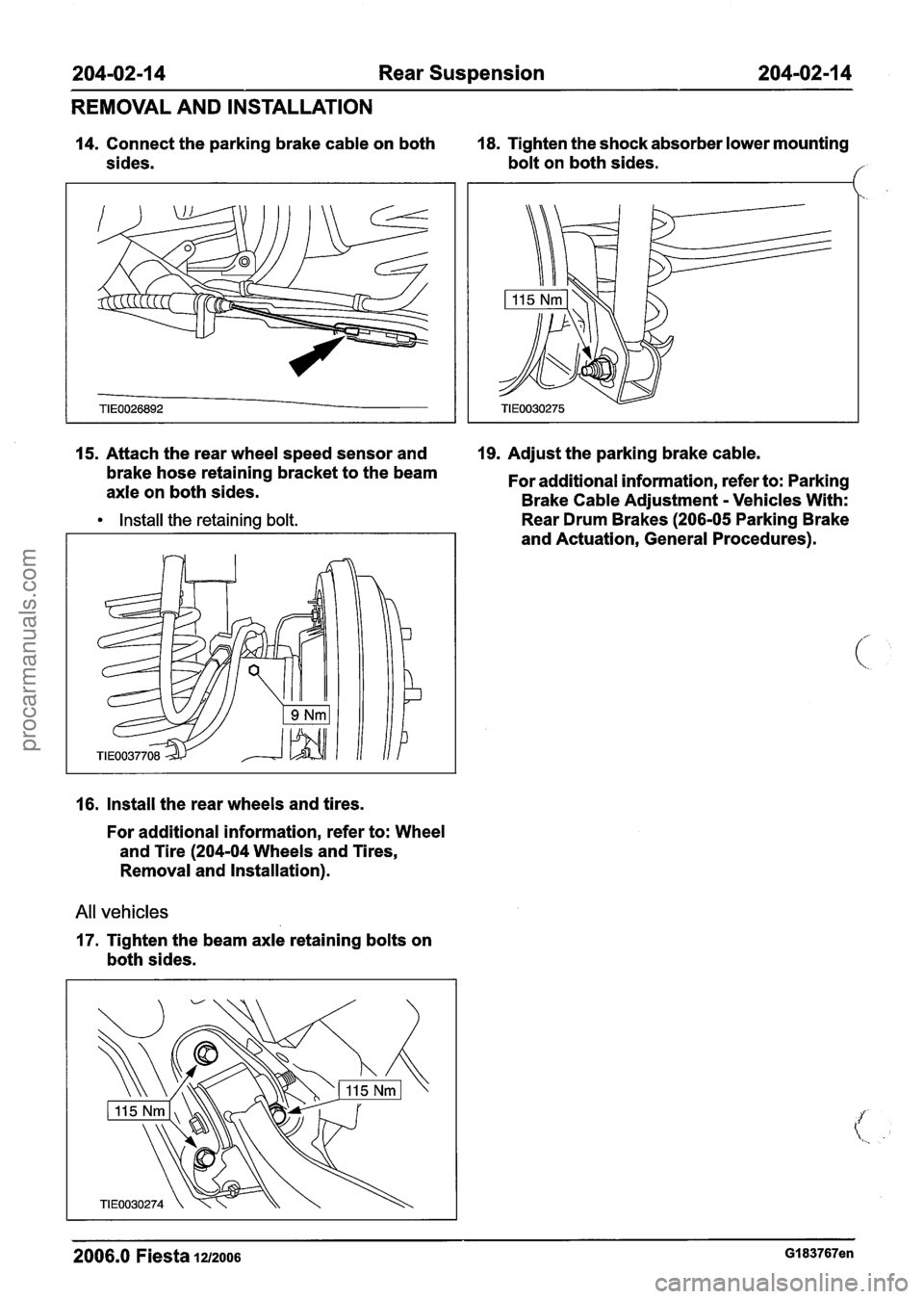
14. Connect the parking brake cable on both 18. Tighten the shock absorber lower mounting
sides. bolt on both sides.
f
15. Attach the rear wheel speed sensor and 19. Adjust the parking brake cable.
brake hose retaining bracket to the beam
For additional information, refer to: Parking
axle on both sides.
Brake Cable Adjustment
- Vehicles With:
Install the retaining bolt. Rear Drum Brakes (206-05 Parking Brake
and Actuation, General Procedures).
16. Install the rear wheels and tires.
For additional information, refer to: Wheel
and Tire
(204-04 Wheels and Tires,
Removal and Installation).
All vehicles
17. Tighten the beam axle retaining bolts on
both sides.
2006.0 Fiesta 1212006 GI 83767en
procarmanuals.com
Page 148 of 1226

204-0414 Wheels and Tires 204-04-4
DIAGNOSIS AND TESTING
Engine Speed Sensitive A thumping noise usually means that the tire is flat
or has soft spots making a noise as they slap the
This means that the vibration occurs at varying
roadway. Tire whine can be distinguished from axle
vehicle speeds when a different transmission gear
noise. Tire whine remains the same over a range
is selected. It can sometimes be isolated by
of speeds.
increasing Or decreasing engine with the A complete road test procedure is described in transmission in NEUTRAL or by stall testing with Section the transmission in gear. If the condition is engine
speed sensitive, the-cause is probably not related
REFER to: Noise, Vibration and Harshness (NVH)
to the tires. (1
00-04 Noise, Vibration and Harshness,
If the road test indicates that there is tire whine, Diagnosis and
Testing).
but no shake or vibration, the noise originates with
the contact between the tire and the road surface.
Symptom Chart
Symptom Possible Sources Action
Tire(s) show excess wear on
edge of tread
I Vehicle overloaded. I CORRECT as necessary. I
Tire(s) under-inflated.
lncorrect wheel alignment. ADJUST the tire pressure(s).
ADJUST the wheel alignment.
REFER to: (204-00 Suspension
System
- General Information)
Specifications (Specifications), Front Toe Adjustment (General
Procedures).
Tire(s) show excess wear in Tire(s) over-inflated.
I I
ADJUST the tire pressure(s).
I center of tread
Other excessive tire wear Incorrect tire pressure(s).
concerns
need rotating.
ADJUST the tire pressure(s).
ROTATE the wheel and tire
assemblies.
lncorrect wheel alignment. ADJUST the wheel alignment.
REFER to: (204-00 Suspension
System
- General Information)
Specifications (Specifications), Front Toe Adjustment (General
Procedures).
I Vehicle overloaded.
Loose or leaking front strut and
spring assembly. CORRECT as necessary.
I
2006.0 Fiesta 1212006 G25362en
TIGHTEN
or INSTALL new
suspension components as
necessary.
REFER to: Shock Absorber
and Spring Assembly (204-01
,
Front Suspension, Removal
and Installation).
procarmanuals.com
Page 174 of 1226

206-00-2 Brake System - General Information 206-00-2
DESCRIPTION AND OPERATION
Brake System
Overview
A Brake system without Anti-lock
Brake
I I system (ABS)
I B I Brake system with ABS I
I 1 I Brake master cylinder I -
1 2 1 Reservoir I
1 4 1 Brake pedal I
1 5 1 Brake pressure reduction valve I
1 6 1 Rear drum brake I
171t disk brake I
8 ABS hydraulic unit with integrated control
1 1 unit
1 9 I Wheel speed sensors I
Vehicles without ABS are equipped with brake
pressure reduction valves for the rear wheel
brakes. They are located in the corresponding
brake circuits at the brake master cylinder.
Vehicles with ABS do not need brake pressure
reduction valves because they are equipped with
electronic brake distribution (EBD).
The handbrake is cable operated on the rear
brakes.
On vehicles with a petrol engine the necessary
vacuum for the brake booster is generated by the
intake manifold.
On vehicles with a diesel engine, a vacuum pump
driven by the engine provides the necessary
vacuum for the brake booster.
2006.0 Fiesta lu2006 G281357en
procarmanuals.com
Page 267 of 1226

206-0713 Power Brake Actuation 206-0713
DESCRIPTION AND OPERATION
Brake Booster
Emergency brake assistant (EBA) EBA operates purely mechanically, and is
completely integral with the brakeservo.
As ABS braking systems have become widespread,
it has emerged that because of incorrect use of the
Brake servo units with and without EBA are
brakes, many drivers are losing the safety benefit externally identical. For identification purposes,
which ABS
~rovides. brake servo units with EBA carry a white sticker I showing a large letter "A. Drivers are applying the brakes too timidly.
Because of this, the Anti-lock Braking System The tandem master cylinder
is the same for
(ABS) does not engage, and the maximum braking
vehicles with or without
effect is not achieved.
The EBA recognises from the driver's manner of
braking that an emergency situation is occurring,
and automatically applies full braking power.
This occurs in a matter of milliseconds, which is
faster than the driver could do it.
Furthermore, it was observed that after the first
heavy application of the brake pedal, the driver
releases the pressure on the pedal too early.
The EBA ensures that the ABS effect still continues
when the pedal pressure would normally lie below
the ABS range of control. The system is available
j as an option depending on market and vehicle
variant.
Function
In normal braking situations, the brake servo with
EBA operates in the same way as a conventional
brake servo unit. This means that the driver can
always modulate the brakes.
If an activation threshold defined by a characteristic
curve is exceeded during braking, the EBA
operates.
Determination of the activation threshold is based
on the pedal movement parameters, which are a
function of the pressure on the brake pedal and
the speed of movement of the pedal.
Depending on driving manner, EBA results in a The characteristic curve
is separately defined for
reduction in braking distance of 15% for each vehicle model.
experienced drivers, to over
40% for average The mechanical EBA uses the fact that in a brake
drivers. servo unit, the valve piston moves ahead of the
Because EBA decelerates the vehicle up to the control housing
when a braking operation starts.
wheel locking limit, emergency brake assist is only Because of this, there is a relative travel distance used in vehicles with ABS.
between the control housing and the valve piston
which can vary depending on the force applied to
Components the brake pedal and the pedal speed.
The relative travel distance is small when the pedal
moves slowly with low force applied to it. The
relative travel distance is larger when the pedal
moves faster with higher force applied to it.
Item Description
-
2006.0 Fiesta 1212006 GI 63289en
procarmanuals.com
Page 269 of 1226

206-07-5 Power Brake Actuation 206-07-5
DESCRIPTION AND OPERATION
Item Description
1 3 I Valve piston I
i '
1 4 1 Ball I
1 5 1 ~ock sleeve I
I
2
1 6 1 Ball cage I
Ball sleeve
Control housing
Active brake assistant
In a normal braking operation, pedal operation
causes the relative travel distance to remain so
small that the distance required for engagement is
not exceeded.
The lock sleeve is held in its rest position by the
force applied by the spring, the ball cage remains
free to move axially and the balls remain free to
move radially.
Item Description
I 1 I Relative travel distance I
1 2 1 Disc valve I -
1 3 1 Key I
If the activation threshold level is.exceeded
because of an emergency braking situation, i.e.
the relative travel distance of the valve piston is so
great that the balls are moved in over the slope of
the ball sleeve, then the lock sleeve can move
completely to its end position.
I
--
The balls are now locked, and the ball sleeve can
no longer be moved in the closing direction of the
disc valve.
The EBA is now active, the brake pressure is
increased up to the wheel locking limit, and the
brake pedal can be moved to its maximum
pressure point without effort.
The brake pressure remains at the ABS control
limit until the EBA is completely released again.
2006.0 Fiesta 1212006 GI 63289en
procarmanuals.com