2007 FORD F150 check engine
[x] Cancel search: check enginePage 295 of 344

•Always dispose of automotive
batteries in a responsible manner.
Follow your local authorized
standards for disposal. Call your
local authorized recycling center
to find out more about recycling
automotive batteries.
ENGINE COOLANT
Checking engine coolant
The concentration and level of engine coolant should be checked at the
intervals listed inscheduled maintenance information.The coolant
concentration should be maintained at 50/50 coolant and distilled water,
which equates to a freeze point of -34°F (-36°C). Coolant concentration
testing is possible with a hydrometer or antifreeze tester (such as the
Rotunda Battery and Antifreeze Tester, 014–R1060). The level of coolant
should be maintained at the “FULL COLD” level or within the “COLD
FILL RANGE” in the coolant reservoir. If the level falls below, add
coolant per the instructions in theAdding engine coolantsection.
Your vehicle was factory-filled with a 50/50 engine coolant and water
concentration. If the concentration of coolant falls below 40% or above
60%, the engine parts could become damaged or not work properly.A
50–50 mixture of coolant and water provides the following:
•Freeze protection down to -34°F (-36°C).
•Boiling protection up to 265°F (129°C).
•Protection against rust and other forms of corrosion.
•Enables calibrated gauges to work properly.
L
E
A
D
RETURN
RECYCLE
2007 F-150(f12)
Owners Guide (post-2002-fmt)
USA(fus)
Maintenance and Specifications
295
Page 296 of 344

When the engine is cold, check the
level of the engine coolant in the
reservoir.
•The engine coolant should be at the “FULL COLD” level or within the
“COLD FILL RANGE” as listed on the engine coolant reservoir
(depending upon application).
•Refer toscheduled maintenance informationfor service interval
schedules.
•Be sure to read and understandPrecautions when servicing your
vehiclein this chapter.
If the engine coolant has not been checked at the recommended interval,
the engine coolant reservoir may become low or empty. If the reservoir is
low or empty, add engine coolant to the reservoir. Refer toAdding
engine coolantin this chapter.
Note:Automotive fluids are not interchangeable; do not use engine
coolant, antifreeze or windshield washer fluid outside of its specified
function and vehicle location.
Adding engine coolant
When adding coolant, make sure it is a 50/50 mixture of engine coolant
and distilled water. Add the mixture to the coolant reservoir,when the
engine is cool, until the appropriate fill level is obtained.
Do not add engine coolant when the engine is hot. Steam and
scalding liquids released from a hot cooling system can burn you
badly. Also, you can be burned if you spill coolant on hot engine parts.
2007 F-150(f12)
Owners Guide (post-2002-fmt)
USA(fus)
Maintenance and Specifications
296
Page 298 of 344
2. When the engine is cool, wrap a thick cloth around the coolant
pressure relief cap on the coolant reservoir (an opaque plastic bottle).
Slowly turn cap counterclockwise (left) until pressure begins to release.
3. Step back while the pressure releases.
4. When you are sure that all the pressure has been released, use the
cloth to turn it counterclockwise and remove the cap.
5. Fill the coolant reservoir slowly with the proper coolant mixture (see
above), to within the “COLD FILL RANGE” or “FULL COLD” level on the
reservoir.
6. Replace the cap. Turn until tightly installed. Turn cap until click is
heard/felt to ensure it is tightly installed.
After any coolant has been added, check the coolant concentration, refer
to theChecking engine coolantsection. If the concentration is not
50/50 (protection to –34° F/–36° C), drain some coolant and adjust the
concentration. It may take several drains and additions to obtain a 50/50
coolant concentration.
Whenever coolant has been added, the coolant level in the coolant
reservoir should be checked the next few times you drive the vehicle. If
necessary, add enough 50/50 concentration of engine coolant and
distilled water to bring the liquid level to the proper level.
If you have to add more than 1.0 quart (1.0 liter) of engine coolant per
month, have your authorized dealer check the engine cooling system.
Your cooling system may have a leak. Operating an engine with a low
level of coolant can result in engine overheating and possible engine
damage.
Recycled engine coolant
Ford Motor Company does NOT recommend the use of recycled engine
coolant in vehicles originally equipped with Motorcraft Premium Gold
Engine Coolant since a Ford-approved recycling process is not yet
available.
Used engine coolant should be disposed of in an appropriate
manner. Follow your community’s regulations and standards for recycling
and disposing of automotive fluids.
Coolant refill capacity
To find out how much fluid your vehicle’s cooling system can hold, refer
toMaintenance product specifications and capacitiesin this chapter.
2007 F-150(f12)
Owners Guide (post-2002-fmt)
USA(fus)
Maintenance and Specifications
298
Page 300 of 344
How fail-safe cooling works
If the engine begins to overheat:
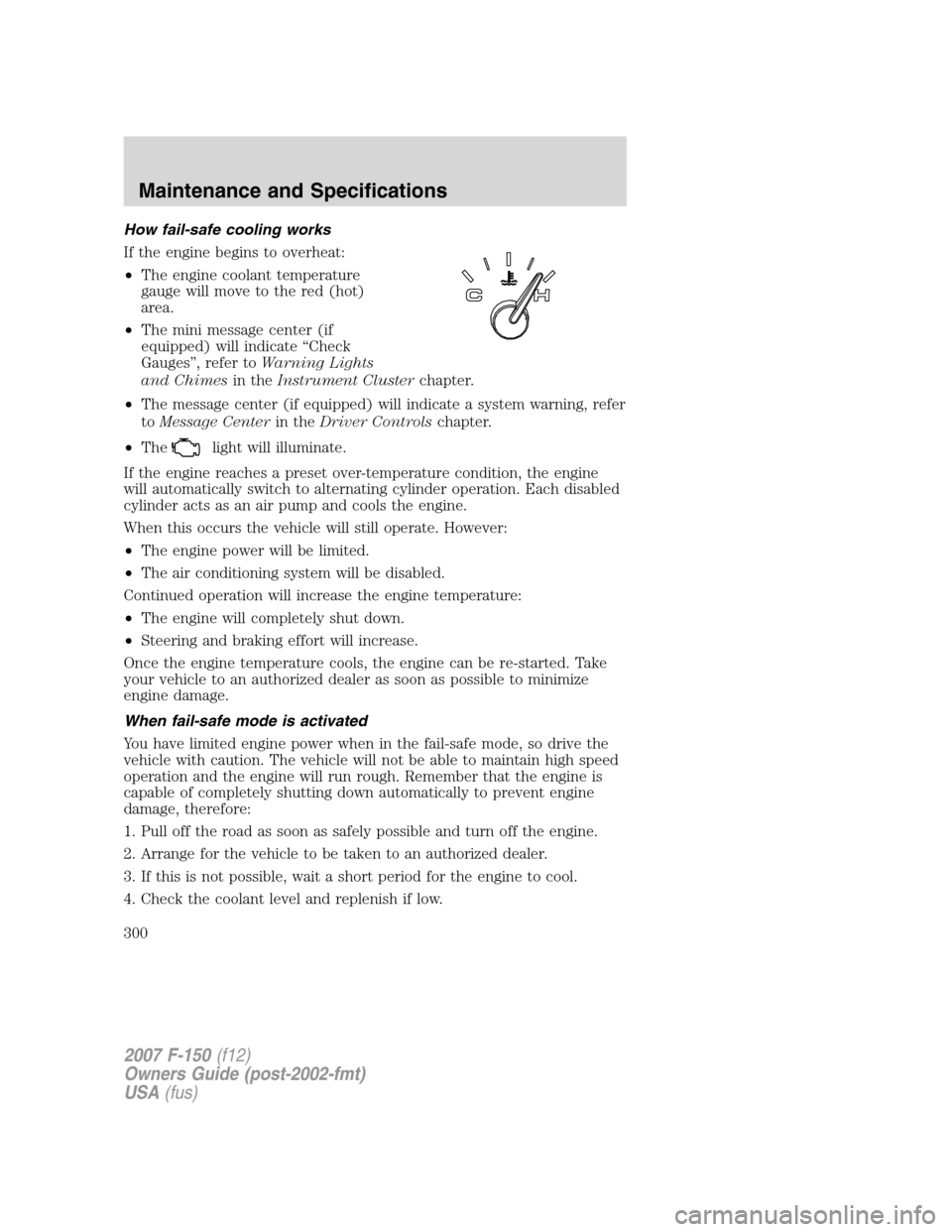
•The engine coolant temperature
gauge will move to the red (hot)
area.
•The mini message center (if
equipped) will indicate “Check
Gauges”, refer toWarning Lights
and Chimesin theInstrument Clusterchapter.
•The message center (if equipped) will indicate a system warning, refer
toMessage Centerin theDriver Controlschapter.
•The
light will illuminate.
If the engine reaches a preset over-temperature condition, the engine
will automatically switch to alternating cylinder operation. Each disabled
cylinder acts as an air pump and cools the engine.
When this occurs the vehicle will still operate. However:
•The engine power will be limited.
•The air conditioning system will be disabled.
Continued operation will increase the engine temperature:
•The engine will completely shut down.
•Steering and braking effort will increase.
Once the engine temperature cools, the engine can be re-started. Take
your vehicle to an authorized dealer as soon as possible to minimize
engine damage.
When fail-safe mode is activated
You have limited engine power when in the fail-safe mode, so drive the
vehicle with caution. The vehicle will not be able to maintain high speed
operation and the engine will run rough. Remember that the engine is
capable of completely shutting down automatically to prevent engine
damage, therefore:
1. Pull off the road as soon as safely possible and turn off the engine.
2. Arrange for the vehicle to be taken to an authorized dealer.
3. If this is not possible, wait a short period for the engine to cool.
4. Check the coolant level and replenish if low.
2007 F-150(f12)
Owners Guide (post-2002-fmt)
USA(fus)
Maintenance and Specifications
300
Page 302 of 344
Observe the following guidelines when handling automotive fuel:
•Extinguish all smoking materials
and any open flames before
fueling your vehicle.
•Always turn off the vehicle before
fueling.
•Automotive fuels can be harmful
or fatal if swallowed. Fuels such as gasoline and ethanol are highly
toxic and if swallowed can cause death or permanent injury. If fuel is
swallowed, call a physician immediately, even if no symptoms are
immediately apparent. The toxic effects of fuel may not be visible for
hours.
•Avoid inhaling fuel vapors. Inhaling too much fuel vapor of any kind
can lead to eye and respiratory tract irritation. In severe cases,
excessive or prolonged breathing of fuel vapor can cause serious
illness and permanent injury.
•Avoid getting fuel liquid in your eyes. If fuel is splashed in the eyes,
remove contact lenses (if worn), flush with water for 15 minutes and
seek medical attention. Failure to seek proper medical attention could
lead to permanent injury.
•Fuels can also be harmful if absorbed through the skin. If fuel is
splashed on the skin and/or clothing, promptly remove contaminated
clothing and wash skin thoroughly with soap and water. Repeated or
prolonged skin contact with fuel liquid or vapor causes skin irritation.
•Be particularly careful if you are taking “Antabuse” or other forms of
disulfiram for the treatment of alcoholism. Breathing gasoline and/or
ethanol vapors, or skin contact could cause an adverse reaction. In
sensitive individuals, serious personal injury or sickness may result. If
fuel is splashed on the skin, promptly wash skin thoroughly with soap
and water. Consult a physician immediately if you experience an
adverse reaction.
•FFV fuel tanks may contain zero to 85 percent ethanol. Any fuel
blends containing gasoline and ethanol should be treated the same as
“Fuel Ethanol ”. To identify if your vehicle is an FFV, check your VIN
or the label on the inside of your fuel filler door. When checking the
VIN look for the engine type identifier (8th character). If your vehicle
is an FFV, then the character will be labeled as a “V”.
2007 F-150(f12)
Owners Guide (post-2002-fmt)
USA(fus)
Maintenance and Specifications
302
Page 305 of 344
If the digital display reads “CHECK
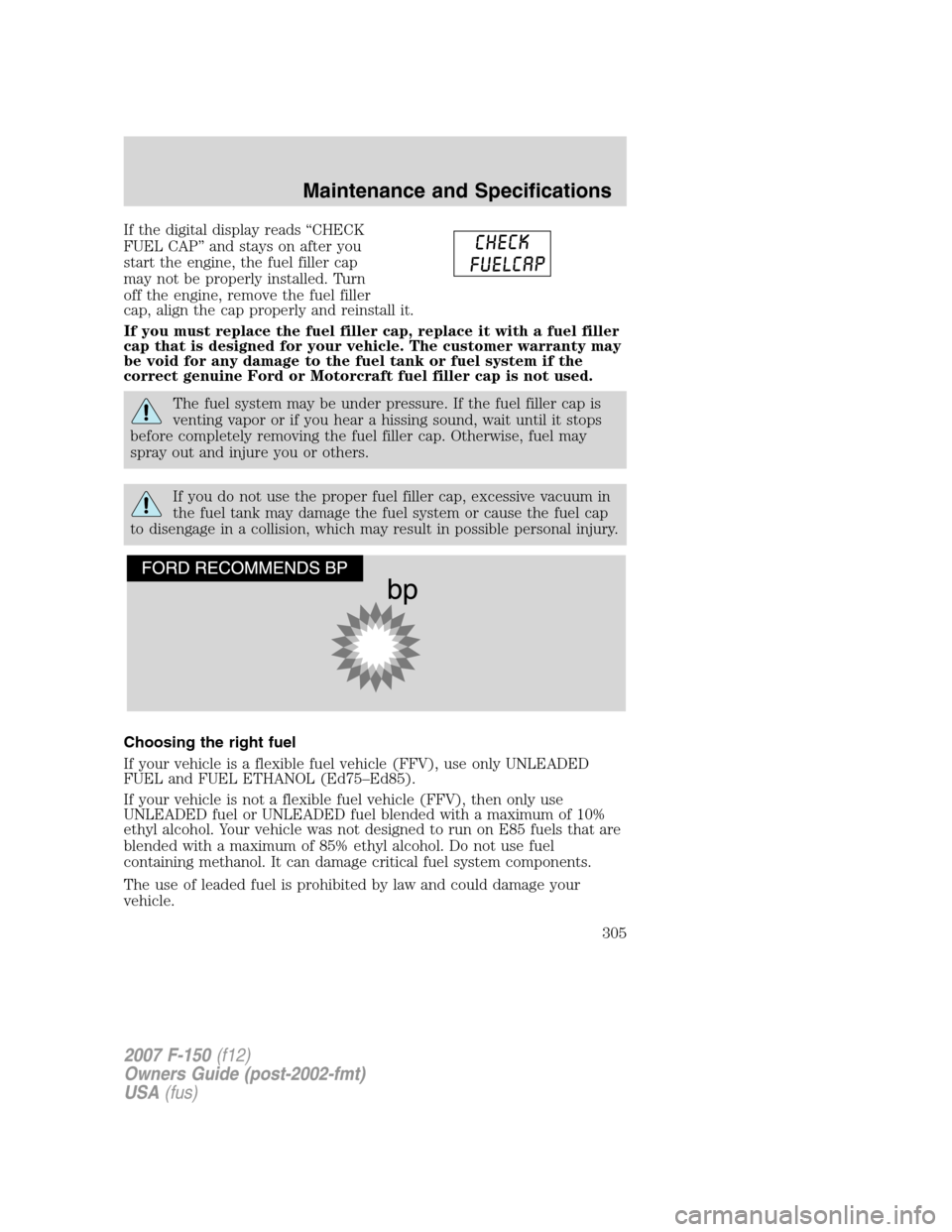
FUEL CAP” and stays on after you
start the engine, the fuel filler cap
may not be properly installed. Turn
off the engine, remove the fuel filler
cap, align the cap properly and reinstall it.
If you must replace the fuel filler cap, replace it with a fuel filler
cap that is designed for your vehicle. The customer warranty may
be void for any damage to the fuel tank or fuel system if the
correct genuine Ford or Motorcraft fuel filler cap is not used.
The fuel system may be under pressure. If the fuel filler cap is
venting vapor or if you hear a hissing sound, wait until it stops
before completely removing the fuel filler cap. Otherwise, fuel may
spray out and injure you or others.
If you do not use the proper fuel filler cap, excessive vacuum in
the fuel tank may damage the fuel system or cause the fuel cap
to disengage in a collision, which may result in possible personal injury.
Choosing the right fuel
If your vehicle is a flexible fuel vehicle (FFV), use only UNLEADED
FUEL and FUEL ETHANOL (Ed75–Ed85).
If your vehicle is not a flexible fuel vehicle (FFV), then only use
UNLEADED fuel or UNLEADED fuel blended with a maximum of 10%
ethyl alcohol. Your vehicle was not designed to run on E85 fuels that are
blended with a maximum of 85% ethyl alcohol. Do not use fuel
containing methanol. It can damage critical fuel system components.
The use of leaded fuel is prohibited by law and could damage your
vehicle.
2007 F-150(f12)
Owners Guide (post-2002-fmt)
USA(fus)
Maintenance and Specifications
305
Page 306 of 344

Your vehicle was not designed to use fuel or fuel additives with metallic
compounds, including manganese-based additives. Studies indicate that
these additives can cause your vehicle’s emission control system to
deteriorate more rapidly. In Canada, premium grade fuel generally
contains more metallic additives than regular grade fuel. We recommend
using regular grade fuel. In Canada, many fuels contain metallic
additives, but fuels free of such additives may be available; check with
your local fuel dealer.
Repairs to correct the effects of using a fuel for which your vehicle was
not designed may not be covered by your warranty.
Cleaner air
Ford endorses the use of reformulated “cleaner-burning” gasolines to
improve air quality.
Octane recommendations
Do not be concerned if your engine
sometimes knocks lightly. However,
if it knocks heavily under most
driving conditions while you are
using fuel with the recommended
octane rating, see your authorized dealer to prevent any engine damage.
Unleaded Gasoline engines
Your vehicle is designed to use “Regular” unleaded gasoline with an
(R+M)/2 octane rating of 87. We do not recommend the use of gasolines
labeled as “Regular” that are sold with octane ratings of 86 or lower in
high altitude areas.
FFV engine (if equipped)
Your vehicle is designed to use Fuel Ethanol (Ed75–Ed85),“Regular”
unleaded gasoline or any mixture of the two fuels.
U.S. government regulations require fuel ethanol dispensing
pumps to have a small, square, orange and black label with the
common abbreviation or the appropriate percentage for that
region. Use of other fuels such as Fuel Methanol may cause
powertrain damage, a loss of vehicle performance, and your
warranty may be invalidated.
87(R+M)/2 METHOD
2007 F-150(f12)
Owners Guide (post-2002-fmt)
USA(fus)
Maintenance and Specifications
306
Page 307 of 344

Fuel quality
Many of the world’s automakers approved the World-wide Fuel Charter
that recommends gasoline specifications to provide improved
performance and emission control system protection for your vehicle.
Gasolines that meet the World-wide Fuel Charter should be used when
available. Ask your fuel supplier about gasolines that meet the
World-wide Fuel Charter.
Do not add aftermarket fuel additive products to your fuel tank. It
should not be necessary to add any aftermarket products to your fuel
tank if you continue to use high quality fuel of the recommended octane
rating. These products have not been approved for your engine and
could cause damage to the fuel system. Repairs to correct the effects of
using an aftermarket product in your fuel may not be covered by your
warranty.
Unleaded Gasoline engines
If you are experiencing starting, rough idle or hesitation driveability
problems during a cold start, try a different brand of “Regular” unleaded
gasoline. “Premium” unleaded gasoline is not recommended (particularly
in the United States) because it may cause these problems to become
more pronounced. If the problems persist, see your authorized dealer.
FFV engine (if equipped)
Your FFV will operate well on ordinary “Regular” unleaded gasoline, but
only the highest quality fuel ethanol will provide the same level of
protection and performance. To identify if your vehicle is an FFV, check
your VIN or the label on the inside of your fuel filler door. When
checking the VIN, look for the engine type identifier (8th character). If
your vehicle is an FFV, then the character will be labeled as a “V”.
If you operate your vehicle 50% or more of the time on ethanol, you
should follow a different maintenance schedule. See theScheduled
Maintenance Guidefor more information.
If you are experiencing a rough or rolling idle after start-up with the
outside temperature above 80° F (27° C), the idle should improve within
10 to 30 seconds. If the problems persist below this temperature, see
your authorized dealer.
Running out of fuel
Avoid running out of fuel because this situation may have an adverse
effect on powertrain components.
2007 F-150(f12)
Owners Guide (post-2002-fmt)
USA(fus)
Maintenance and Specifications
307