2007 FORD EXPLORER four wheel drive
[x] Cancel search: four wheel drivePage 245 of 344
4WD Systems
4WD uses all four wheels to power the vehicle. This increases traction,
enabling you to drive over terrain and road conditions that a
conventional two-wheel drive vehicle cannot.
Power is supplied to all four wheels through a transfer case. On 4WD
vehicles, the transfer case allows you to select 4WD when necessary.
Information on transfer case operation and shifting procedures can be
found in theDrivingchapter. Information on transfer case maintenance
can be found in theMaintenance and Specificationschapter. You
should become thoroughly familiar with this information before you
operate your vehicle.
Normal characteristics
On some 4WD models, the initial shift from two-wheel drive to 4x4 while
the vehicle is moving can cause some momentary clunk and ratcheting
sounds. This is the front drivetrain coming up to speed and the
automatic locking hubs engaging and is not cause for concern.
Sand
When driving over sand, try to keep all four wheels on the most solid
area of the trail. Avoid reducing the tire pressures but shift to a lower
gear and drive steadily through the terrain. Apply the accelerator slowly
and avoid spinning the wheels.
Note:If your vehicle is equipped with the Tire Pressure Monitoring
System (TPMS), the system indicator light may illuminate depending on
how much air is released from your tires and/or how long you drive the
vehicle under these conditions.
Avoid excessive speed because vehicle momentum can work against you
and cause the vehicle to become stuck to the point that assistance may
be required from another vehicle. Remember, you may be able to back
out the way you came if you proceed with caution.
Mud and water
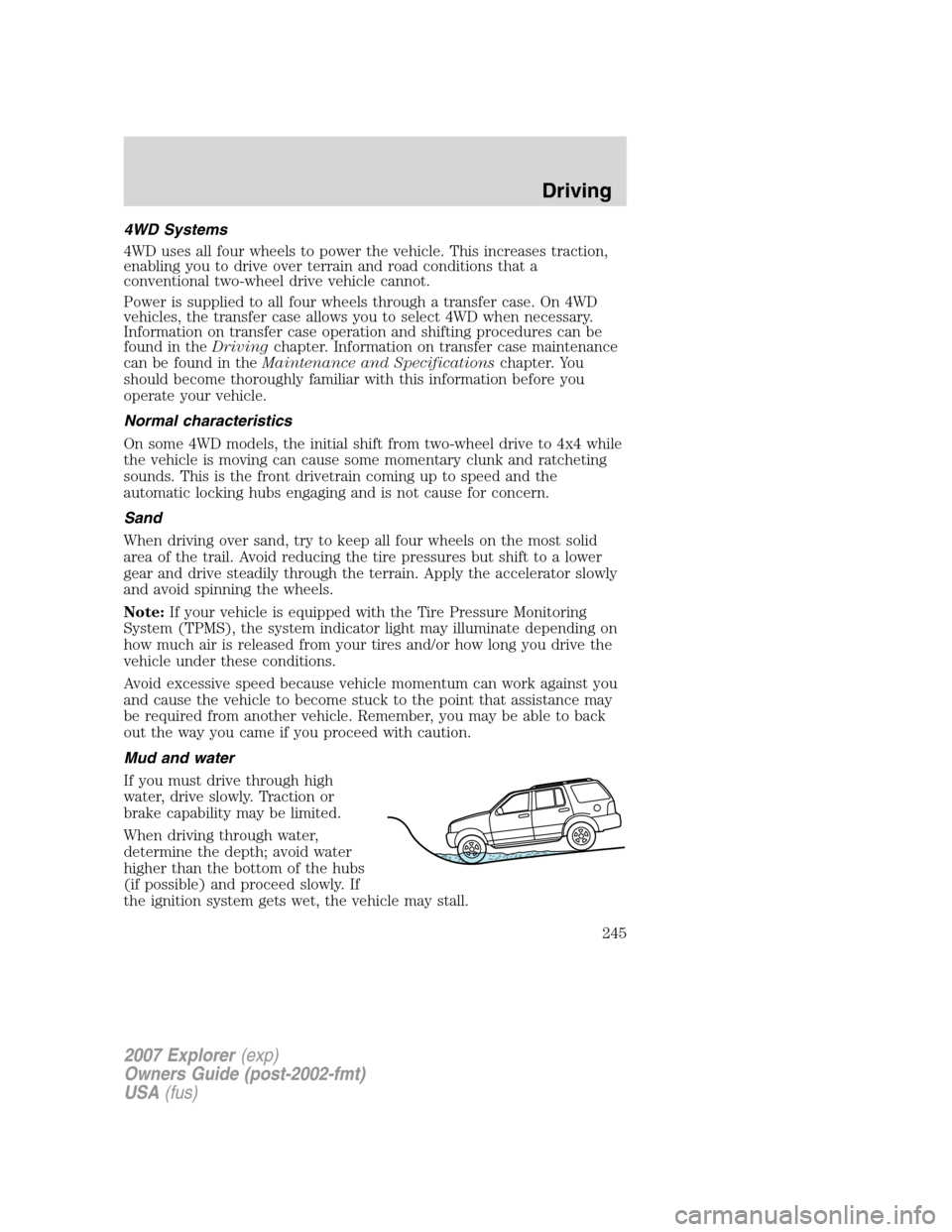
If you must drive through high
water, drive slowly. Traction or
brake capability may be limited.
When driving through water,
determine the depth; avoid water
higher than the bottom of the hubs
(if possible) and proceed slowly. If
the ignition system gets wet, the vehicle may stall.
2007 Explorer(exp)
Owners Guide (post-2002-fmt)
USA(fus)
Driving
245
Page 248 of 344
faster, because as in other vehicles, braking occurs at all four wheels. Do
not become overconfident as to road conditions.
Make sure you allow sufficient distance between you and other vehicles
for stopping. Drive slower than usual and consider using one of the lower
gears. In emergency stopping situations, avoid locking of the wheels. Use
a “squeeze” technique, push on the brake pedal with a steadily increasing
force which allows the wheels to brake yet continue to roll so that you
may steer in the direction you want to travel. If you lock the wheels,
release the brake pedal and repeat the squeeze technique. If your vehicle
is equipped with a Four Wheel Anti-Lock Brake System (ABS), apply the
brake steadily. Do not “pump” the brakes. Refer to theBrakessection of
this chapter for additional information on the operation of the anti-lock
brake system.
Never drive with chains on the front tires of 4WD vehicles without also
putting them on the rear tires. This could cause the rear to slide and
swing around during braking.
Maintenance and Modifications
The suspension and steering systems on your vehicle have been designed
and tested to provide predictable performance whether loaded or empty
and durable load carrying capability. For this reason, Ford Motor
Company strongly recommends that you do not make modifications such
as adding or removing parts (such as lift kits or stabilizer bars) or by
using replacement parts not equivalent to the original factory equipment.
Any modifications to a vehicle that raise the center of gravity can make
it more likely the vehicle will roll over as a result of a loss of control.
Ford Motor Company recommends that caution be used with any vehicle
equipped with a high load or device (such as ladder racks or pickup box
cover).
Failure to maintain your vehicle properly may void the warranty, increase
your repair cost, reduce vehicle performance and operational capabilities
and adversely affect driver and passenger safety. Frequent inspection of
vehicle chassis components is recommended if the vehicle is subjected to
heavy off-road usage.
2007 Explorer(exp)
Owners Guide (post-2002-fmt)
USA(fus)
Driving
248
Page 321 of 344
•Revving the engine before turning it off may reduce fuel economy.
•Using the air conditioner or defroster may reduce fuel economy.
•You may want to turn off the speed control in hilly terrain if
unnecessary shifting between the top gears occurs. Unnecessary
shifting of this type could result in reduced fuel economy.
•Warming up a vehicle on cold mornings is not required and may
reduce fuel economy.
•Resting your foot on the brake pedal while driving may reduce fuel
economy.
•Combine errands and minimize stop-and-go driving.
Maintenance
•Keep tires properly inflated and use only recommended size.
•Operating a vehicle with the wheels out of alignment will reduce fuel
economy.
•Use recommended engine oil. Refer toMaintenance product
specifications and capacitiesin this chapter.
•Perform all regularly scheduled maintenance items. Follow the
recommended maintenance schedule and owner maintenance checks
found inscheduled maintenance information.
Conditions
•Heavily loading a vehicle or towing a trailer may reduce fuel economy
at any speed.
•Carrying unnecessary weight may reduce fuel economy (approximately
1 mpg [0.4 km/L] is lost for every 400 lb [180 kg] of weight carried).
•Adding certain accessories to your vehicle (for example bug
deflectors, rollbars/light bars, running boards, ski/luggage racks) may
reduce fuel economy.
•Fuel economy may decrease with lower temperatures during the first
8–10 miles (12–16 km) of driving.
•Driving on flat terrain offers improved fuel economy as compared to
driving on hilly terrain.
•Transmissions give their best fuel economy when operated in the top
cruise gear and with steady pressure on the gas pedal.
•Four-wheel-drive operation (if equipped) is less fuel efficient than
two-wheel-drive operation.
•Close windows for high speed driving.
2007 Explorer(exp)
Owners Guide (post-2002-fmt)
USA(fus)
Maintenance and Specifications
321
Page 340 of 344

Engine oil ..................................300
checking and adding ..............300
dipstick ....................................300
filter, specifications ........303, 328
recommendations ...................303
refill capacities ........................329
specifications ..........................329
Exhaust fumes ..........................222
F
Fail safe cooling ........................312
Floor mats .................................107
Fluid capacities .........................329
Foglamps .....................................53
Four-Wheel Drive vehicles .......240
driving off road .......................242
indicator light .........................241
preparing to drive your
vehicle .....................................230
Fuel ............................................313
calculating fuel
economy ......................82, 94, 319
cap ...........................................316
capacity ...................................329
choosing the right fuel ...........317
comparisons with EPA fuel
economy estimates .................322
detergent in fuel .....................318
filling your vehicle
with fuel ..................313, 316, 319
filter, specifications ........313, 328
fuel pump shut-off switch .....252
improving fuel economy ........319
octane rating ...................317, 333
quality ......................................318
running out of fuel .................318
safety information relating
to automotive fuels ................313
Fuses ..................................253, 255G
Garage door opener ....................65
Gas cap (see Fuel cap) ............316
Gas mileage
(see Fuel economy) .................319
Gauges .........................................18
GAWR
(Gross Axle Weight Rating)
calculating ...............................211
GVWR
(Gross Vehicle Weight Rating)
calculating ...............................211
H
Hazard flashers .........................252
Head restraints .........................127
Headlamps ...................................53
aiming ........................................55
bulb specifications ....................58
daytime running lights .............54
flash to pass ..............................54
high beam .................................54
turning on and off ....................53
Heating
heating and air
conditioning system ...........45, 47
Homelink wireless control
system ..........................................77
Hood ..........................................296
How to get going ........................21
I
Ignition ...............................219, 333
Illuminated visor mirror .............64
2007 Explorer(exp)
Owners Guide (post-2002-fmt)
USA(fus)
Index
340