Page 262 of 344

Have a flat serviced by an authorized dealer in order to prevent damage
to the TPMS sensor, refer toChanging tires with TPMSin theTires,
Wheels and Loadingchapter. Replace the spare tire with a road tire as
soon as possible.
The use of tire sealants may damage your tires. The use of tire
sealants may also damage your Tire Pressure Monitoring System
and should not be used.
Refer toTire Pressure Monitoring System (TPMS)in the
Tires, Wheels and Loadingchapter for important information. If
the tire pressure monitor sensor becomes damaged, it will no longer
function.
Dissimilar spare tire/wheel information
Failure to follow these guidelines could result in an increased
risk of loss of vehicle control, injury or death.
Note:Turn off the power running boards (if equipped) before driving
with a dissimilar spare tire/wheel. Refer toRunning boardsin the
Driver Controlschapter.
If you have a dissimilar spare tire/wheel, then it is intended for
temporary use only. This means that if you need to use it, you should
replace it as soon as possible with a road tire/wheel that is the same size
and type as the road tires and wheels that were originally provided by
Ford. If the dissimilar spare tire or wheel is damaged, it should be
replaced rather than repaired.
A dissimilar spare tire/wheel is defined as a spare tire and/or wheel that
is different in brand, size or appearance from the road tires and wheels
and can be one of three types:
1.T-type mini-spare:This spare tire begins with the letter “T” for tire
size and may have “Temporary Use Only” molded in the sidewall
2.Full-size dissimilar spare with label on wheel:This spare tire has
a label on the wheel that states: “THIS TIRE AND WHEEL FOR
TEMPORARY USE ONLY”
When driving with one of the dissimilar spare tires listed above,do not:
•Exceed 50 mph (80 km/h)
•Load the vehicle beyond maximum vehicle load rating listed on the
Safety Compliance Label
2007 Explorer(exp)
Owners Guide (post-2002-fmt)
USA(fus)
Roadside Emergencies
262
Page 264 of 344

When driving with the full-size dissimilar spare tire/wheel additional
caution should be given to:
•Towing a trailer
•Driving vehicles equipped with a camper body
•Driving vehicles with a load on the cargo rack
Drive cautiously when using a full-size dissimilar spare tire/wheel and
seek service as soon as possible.
Stopping and securing the vehicle
1. If you get a flat tire while driving,
do not apply the brake heavily;
instead, gradually decrease your
speed. Hold the steering wheel
firmly and slowly move to a safe
place on the side of the road.
2. Park on a level surface, activate
the hazard flashers and set the
parking brake.
3. Place gearshift lever in P (Park)
and turn engine OFF.
When one of the rear wheels is off the ground, the transmission
alone will not prevent the vehicle from moving or slipping off the
jack, even if the transmission is in P (Park).
4. Turn off the power running boards (if equipped). Refer toRunning
boardsin theDriver Controlschapter.
Note:Passengers should not remain
in the vehicle when the vehicle is
being jacked.
5. Block the wheel that is diagonally
opposite of the flat tire using the
wheel chock provided with your
vehicle.
Location of the spare tire and tools
Have a flat tire serviced by an authorized dealer in order to prevent
damage to the TPMS sensor, refer toChanging tires with TPMSin the
Tires, Wheels and Loadingchapter. Replace the spare tire with a road
tire as soon as possible.
2007 Explorer(exp)
Owners Guide (post-2002-fmt)
USA(fus)
Roadside Emergencies
264
Page 343 of 344
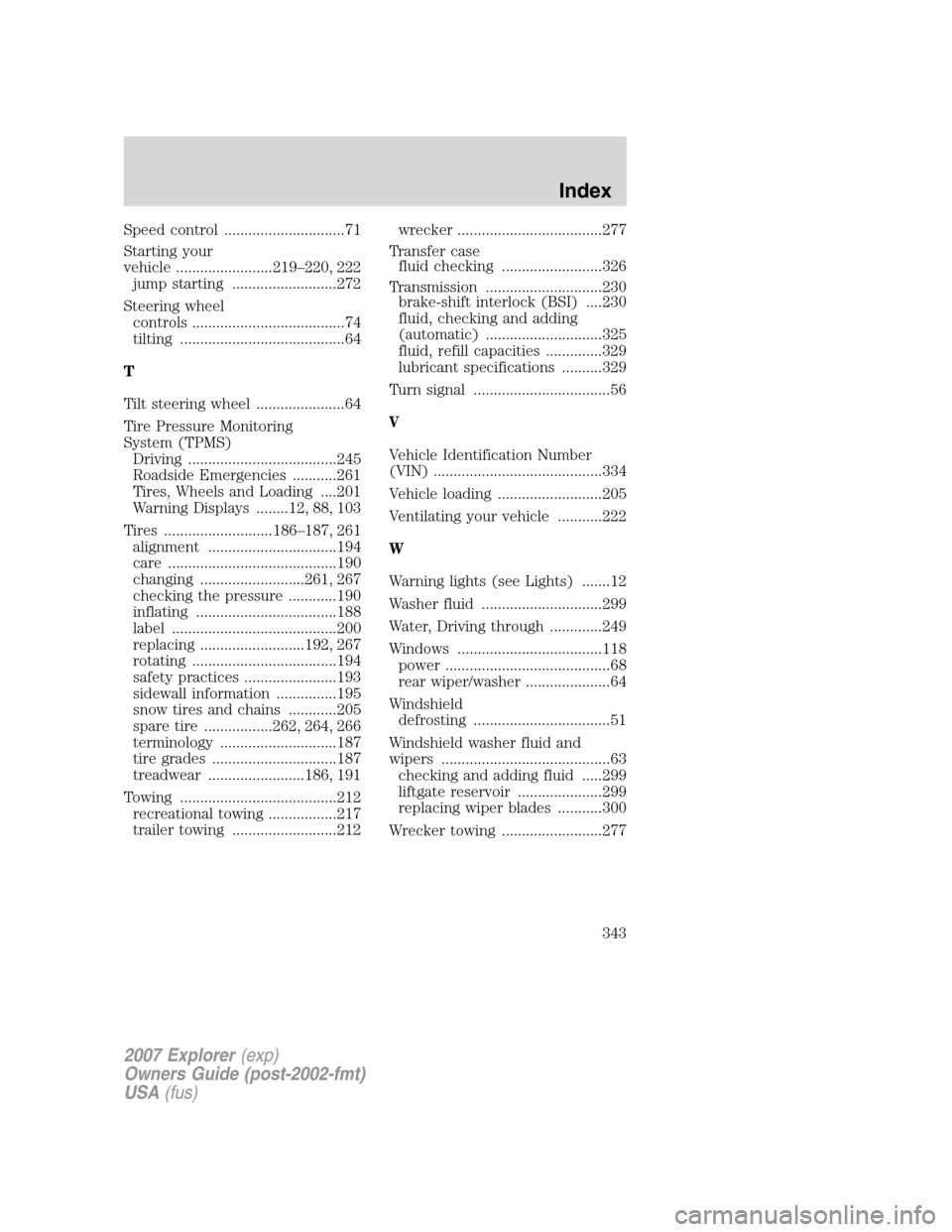
Speed control ..............................71
Starting your
vehicle ........................219–220, 222
jump starting ..........................272
Steering wheel
controls ......................................74
tilting .........................................64
T
Tilt steering wheel ......................64
Tire Pressure Monitoring
System (TPMS)
Driving .....................................245
Roadside Emergencies ...........261
Tires, Wheels and Loading ....201
Warning Displays ........12, 88, 103
Tires ...........................186–187, 261
alignment ................................194
care ..........................................190
changing ..........................261, 267
checking the pressure ............190
inflating ...................................188
label .........................................200
replacing ..........................192, 267
rotating ....................................194
safety practices .......................193
sidewall information ...............195
snow tires and chains ............205
spare tire .................262, 264, 266
terminology .............................187
tire grades ...............................187
treadwear ........................186, 191
Towing .......................................212
recreational towing .................217
trailer towing ..........................212wrecker ....................................277
Transfer case
fluid checking .........................326
Transmission .............................230
brake-shift interlock (BSI) ....230
fluid, checking and adding
(automatic) .............................325
fluid, refill capacities ..............329
lubricant specifications ..........329
Turn signal ..................................56
V
Vehicle Identification Number
(VIN) ..........................................334
Vehicle loading ..........................205
Ventilating your vehicle ...........222
W
Warning lights (see Lights) .......12
Washer fluid ..............................299
Water, Driving through .............249
Windows ....................................118
power .........................................68
rear wiper/washer .....................64
Windshield
defrosting ..................................51
Windshield washer fluid and
wipers ..........................................63
checking and adding fluid .....299
liftgate reservoir .....................299
replacing wiper blades ...........300
Wrecker towing .........................277
2007 Explorer(exp)
Owners Guide (post-2002-fmt)
USA(fus)
Index
343