2007 DODGE SPRINTER oil
[x] Cancel search: oilPage 195 of 393

194 OperationEngine
4
Check assemblies regularly for leaks. In
the event of fluid loss (e.g. spots of oil un-
der the vehicle when it has been parked),
have the cause traced and rectified imme-
diately at an authorized Sprinter Dealer
which has the necessary specialist knowl-
edge and tools to carry out the work re-
quired.
The manufacturer recommends that you
use an authorized Sprinter Dealer for this
purpose. All work relevant to safety or on
safety-related systems must be carried out
at an authorized Sprinter Dealer.Vehicle assemblies
Page 203 of 393

202 OperationTires and wheels
4
\4When replacing individual tires, you
should mount new tires on the front
wheels first.
The tire inflation pressure should be
checked regularly, i.e. at least each time
you refuel the vehicle. The preferred inter-
val for checking the tire inflation pressure,
however, is before each trip.
For more information on checking tire in-
flation pressure, refer to "Recommended
tire inflation pressure" (\2page 210).Tire inspection
Every time when checking the tire inflation
pressure, the tires should also be inspect-
ed for the following:
\4excessive treadwear, refer to "Tread
depth". the condition of the tread
depths, i.e. uneven tread wear or ex-
cessive treadwear on one side. Turn
the front wheels to full lock if neces-
sary to enable you to check the inner
edge of the front tires more easily. You
must also always check the inside of
the tire tread on the rear wheels.
\4cord or fabric showing through the
tire’s rubber
\4bumps, bulges, cuts, cracks or splits in
the tread or side of the tire
\4foreign objects between the tires
(on vehicles with twin tires)
Replace the tire if any of the above condi-
tions is found.
Also inspect the spare tire periodically for
condition and inflation. Spare tires will age
and become worn over time even if never
used, and thus should be inspected and re-
placed when necessary.Tire damage
Tire damage can be caused
by:
\4the vehicle’s operating conditions
\4tire aging
\4curbs
\4foreign objects
\4insufficient or excessive tire pressures
\4weather and environmental influences
\4contact with oil, grease, fuel, etc.
Tire care and maintenanceWarning
G
Regularly check the tires for damage. Dam-
aged tires can cause tire inflation pressure
loss. As a result, you could lose control of
your vehicle.
Worn, old tires can cause accidents. If the
tire tread is badly worn, or if the tires have
sustained damage, replace them.
Warning
G
Driving over curbs or sharp-edged objects
can cause damage to the tire substructure
which is not visible from the outside.
Damage to the tire substructure cannot be
detected until later and can cause the tire to
burst.
\2\2
Page 205 of 393
204 OperationTires and wheels
4
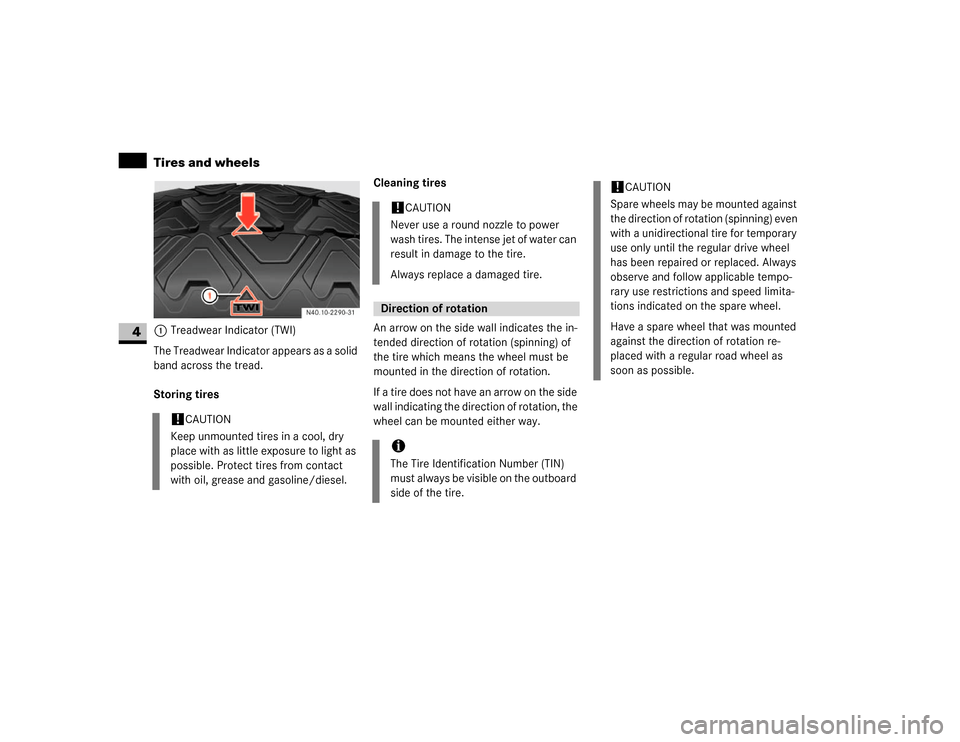
1Treadwear Indicator (TWI)
The Treadwear Indicator appears as a solid
band across the tread.
Storing tiresCleaning tires
An arrow on the side wall indicates the in-
tended direction of rotation (spinning) of
the tire which means the wheel must be
mounted in the direction of rotation.
If a tire does not have an arrow on the side
wall indicating the direction of rotation, the
wheel can be mounted either way.
!
CAUTION
Keep unmounted tires in a cool, dry
place with as little exposure to light as
possible. Protect tires from contact
with oil, grease and gasoline/diesel.
!
CAUTION
Never use a round nozzle to power
wash tires. The intense jet of water can
result in damage to the tire.
Always replace a damaged tire.
Direction of rotationiThe Tire Identification Number (TIN)
must always be visible on the outboard
side of the tire.
!
CAUTION
Spare wheels may be mounted against
the direction of rotation (spinning) even
with a unidirectional tire for temporary
use only until the regular drive wheel
has been repaired or replaced. Always
observe and follow applicable tempo-
rary use restrictions and speed limita-
tions indicated on the spare wheel.
Have a spare wheel that was mounted
against the direction of rotation re-
placed with a regular road wheel as
soon as possible.
Page 229 of 393

228 OperationTires and wheels
4
1Plies in side wall
2Plies under tread
This marking tells you about the type of
cord and number of plies in the side wall
and under the tread.Accessory weight
The combined weight (in excess of those
standard items which may be replaced) of
automatic transmission, power steering,
power brakes, power windows, power
seats, radio, and heater, to the extent that
these items are available as factory-in-
stalled equipment (whether installed or
not).
Air pressure
The amount of air inside the tire pressing
outward on each square inch of the tire.
Air pressure is expressed in pounds per
square inch (psi), or kilopascal (kPa) or
bars.
Aspect ratio
Dimensional relationship between the tire
section height and the section width ex-
pressed in percentage.Bar
Another metric unit for air pressure. There
are 14.5038 pounds per square inch (psi)
to 1 bar; there are 100 kilopascals (kPa)
to 1 bar.
Bead
The tire bead contains steel wires wrapped
by steel cords that hold the tire onto the
rim.
Cold tire inflation pressure
Tire inflation pressure when your vehicle
has been sitting for at least 3 hours or driv-
en no more than 1 mile (1.6 km).
Curb weight
The weight of a motor vehicle with stan-
dard equipment including the maximum
capacity of fuel, oil, and coolant, and, if so
equipped, air conditioning and additional
optional equipment, but without passen-
gers and cargo.Tire ply materialiFor illustrative purposes only. The actu-
al data on tires is specific to each vehi-
cle and may vary from the data shown
in the above illustration.
Tire and loading terminology
Page 233 of 393

232 OperationTires and wheels
4
The reasons for any rapid or unusual wear
should be corrected prior to rotation being
performed.
Thoroughly clean the mounting face of
wheels and brake disks, i.e. the inner side
of the wheels/tires, during each rotation.
Check for and ensure proper tire inflation
pressure, refer to "Recommended tire in-
flation pressure" (\2page 210).
Rotation pattern for single and dual rear
wheelsSingle rear wheels:
\1Rotate the tires by axle. Never change
the direction of rotation of your tires.
\1Make sure that on one axle just one
type of tire (same size, type construc-
tion, load and speed rating) is used.
!
CAUTION
If your vehicle is equipped with the tire
pressure monitor*, each wheel has an
electronic component.
Tire mounting tools should not be ap-
plied in the area of the valve, as this
could damage the electronic compo-
nents.
Have the tires changed only at an
authorized Sprinter Dealer.
Warning
G
In order to avoid loosing a wheel and in or-
der to reduce the risk of fatal or serious in-
juries or vehicle damage, please follow
these safety instructions:
\4Always replace wheel bolts that are
damaged or rusted.
\4Never apply oil or grease to wheel bolts.
\4If a wheel hub thread is damaged, you
must not drive the vehicle. Consult an
authorized Sprinter Dealer.
Only use genuine wheel bolts approved
by the vehicle manufacturer and speci-
fied for your vehicle’s rims. Check tight-
ness of wheel bolts or nuts regularly and
retighten with a torque wrench, if neces-
sary. Tighten wheel bolts or nuts in a
crisscross pattern. For information on
mounting bolts and tightening torques,
refer to "Installing a wheel"
(\2page 320).
\4After changing a wheel, the wheel bolts
or nuts must be retightened after the ve-
hicle has been driven for about 30 miles
(50 km).
\4If new or repainted rims are fitted, the
wheel bolts or nuts must be retightened
again after about 600 to 3000 miles
(about 1000 to 5000 km).
Page 235 of 393

234 OperationWinter driving
4
\3 Winter drivingHave your vehicle winterproofed at the
onset of winter at an authorized Sprinter
Dealer. This service includes the following:
\4Oil change, if the current engine oil
used has not been approved for winter
use
\4The antifreeze / anti-corrosion concen-
tration in the coolant is checked
\4The addition of a concentrated clean-
ing agent to the water in the windshield
washer system
\4Battery check
\4A tire change
You will find information about diesel fuel
for use at low outside temperatures in the
“Technical data” section (\2page 360).
Please also observe the information about
winter driving (\2page 235).Always use winter tires at temperatures
below 45°F (7°C) and whenever wintry
road conditions prevail. Winter tires should
be of the same size and type construction
as the summer tires.
Winter tires should also be operated as
printed on the tire and loading information
placard, refer to "Tires and wheels"
(\2page 199). Not all M+S rated radial-ply
tires provide special winter performance.
Make sure the tires you use show M+S and
the mountain/snowflake marking.on
the tire side wall. These tires meet specific
snow traction performance requirements
of the Rubber Manufacturers Association
(RMA) and the Rubber Association of Can-
ada (RAC) and have been designed specif-
ically for use in snow conditions. Use of
winter tires is the only way to achieve the
maximum effectiveness of the ABS, BAS,
ASR and ESP
® in winter operation.
For safe handling, make sure all winter
tires mounted are of the same make and
have the same tread design.Always observe the speed rating of the
winter tires installed on your vehicle. If the
maximum speed for which your tires are
rated is below the speed rating of your ve-
hicle, you must place a notice to this effect
where it will be seen by the driver. Such no-
tices are available at your tire dealer or any
authorized Sprinter Dealer.
\1Reactivate the tire pressure monitor.
While studded tires improve performance
on ice, skid and traction capability on wet
or dry surfaces may be poorer than that of
non-studded tires. Some states prohibit
studded tires; therefore, local laws should
be checked before using these tire types.
Winter tires
Warning
G
Winter tires with a tread depth under 1/6 in
(4 mm) must be replaced. They are no long-
er suitable for winter operation.
Page 236 of 393

235 Operation
Winter driving
4
Drive with particular care on icy roads.
Avoid sudden acceleration, steering move-
ments and braking.If it seems likely that the vehicle is about to
enter a skid or cannot be stopped at a low
speed:
\4Move the selector lever to position N.
\4Try to maintain control of the vehicle
using light corrective steering.
Road salt may adversely affect braking ef-
ficiency. It may therefore be necessary to
apply the brakes more forcefully in order to
achieve the same braking force as normal.
Apply the brakes regularly when making
longer journeys on gritted or salted roads.
This will have the effect of restoring the
brakes to their normal level of perfor-
mance.
When stopping the vehicle after traveling
on roads that have been salted, check that
the brakes are fully functional before pro-
ceeding further.
Warning
G
If you use your spare tire when winter tires
are fitted on the other wheels, be aware that
the difference in tire characteristics may im-
pair turning stability and overall driving sta-
bility may be reduced. Adapt your driving
style accordingly.
Have the spare tire replaced with a winter
tire at the nearest authorized Sprinter Deal-
er.iWhen they have been removed, store
wheels and tires in a cool, dry, and if
possible dark place. Protect the tires
from oil, grease, and gasoline / diesel.
Driving in winterWarning
G
Downshifting to brake could cause the drive
wheels to lose grip on a slippery surface due
to the increased difference in speed be-
tween the engine and the drive wheels at
this time.
Do not downshift for additional engine brak-
ing on a slippery surface. Use the service
brake in accordance with road conditions.
Only downshift to a lower gear when travel-
ing at a low engine speed.
Page 238 of 393

237 Operation
Maintenance and servicing
4
\3 Maintenance and servicing
Mechanical elements and the lubricants
used for them must be carefully matched.
For this reason, only brands tested and ap-
proved by the manufacturer should be
used. Please contact your Sprinter Dealer
to obtain the necessary information. No lu-
bricant additives should be used.
The use of such additives could affect your
warranty rights. Information is available
from any authorized Sprinter Dealer.
For specifications of engine oils, coolant
and brake fluid, see "Service products and
capacities" (\2page 355) and contact your
authorized Sprinter Dealer.
Observe the information on spare parts in
the “Technical data” section
(\2page 352).
Warning
G
Before carrying out maintenance operations
and repairs, please make sure that you read
the relevant sections of the technical docu-
mentation, such as:
\4Operating instructions and workshop in-
formation
Familiarize yourself in advance in particular
with legal requirements, such as:
\4Safety at work and accident prevention
regulations.
You may otherwise fail to recognize dangers
and could injure yourself or others.
When working underneath the vehicle, you
must place the vehicle on stands with suffi-
cient load-bearing capacity.
Never use the vehicle jack instead. There is
a risk that the vehicle jack could give way
and the vehicle could drop, seriously injuring
yourself or others, or causing damage to
property.
The jack is only designed to raise the vehicle
for a short time.
Always have the maintenance work carried
out and checked at an authorized Sprinter
Dealer which has the necessary specialist
knowledge and tools to carry out the work
required.
The manufacturer recommends that you use
an authorized Sprinter Dealer for this pur-
pose. In particular, work relevant to safety
or on safety-related systems must be car-
ried out at an authorized Sprinter Dealer.
Service products